Decoding the Hidden Heart of Illumination: The Ultimate Guide to Sourcing a True led flashlight manufacturer
Greetings. Operating as a Senior Electronics Engineer and Supply Chain Risk Expert, I continuously dissect the catastrophic field failures that plague the global illumination market. When overseas procurement directors evaluate an illumination instrument, they frequently fall victim to superficial analysis. They aggressively inspect the aerospace aluminum knurling, verify the brand of the semiconductor diode, and immediately authorize a mass-production contract. This acute lack of electronic due diligence is precisely why thousands of seemingly robust tactical lights fail catastrophically in the field.
The aluminum chassis is merely the skeletal structure; the Light Emitting Diode (LED) is merely the engine. The true operational heart—the component that absolutely dictates the lifespan, thermal stability, and reliability of the device—is the internal Printed Circuit Board (PCB). If you procure from an assembly house that compromises on the substrate of this invisible heart, your product is biologically engineered to fail. This technical whitepaper dismantles the "black box" of micro-electronics, providing B2B buyers with the empirical thresholds required to vet an authentic manufacturing partner.
I. The Invisible Heart: Why PCB Substrates Dictate Flashlight Lifespan
To understand structural failure, we must analyze the physics of thermal generation. Modern high-output semiconductors convert a massive percentage of their electrical input into raw thermal energy. In budget manufacturing, unverified assembly houses typically mount these powerful diodes onto standard FR-4 (fiberglass epoxy) circuit boards to maliciously suppress the Bill of Materials (BOM) cost. This is a fatal engineering error. Because FR-4 possesses an abysmal thermal conductivity coefficient (approximately 0.25 W/m·K), it acts as a profound thermal insulator. It traps the immense heat directly beneath the LED junction. Within minutes of activation, the trapped thermal energy degrades the phosphor coating, causes severe chromatic tint-shifting, and ultimately incinerates the semiconductor die.
A genuine led flashlight manufacturer resolves this thermodynamic bottleneck through advanced substrate metallurgy. For standard high-lumen deployments, engineers mandate the use of Metal Core PCBs (MCPCB), specifically aluminum substrates, which drastically accelerate heat dissipation. The aluminum core pulls the thermal load away from the diode and transfers it into the external housing for atmospheric convection.
However, for extreme tactical and industrial instruments drawing massive multi-ampere currents, an elite facility will deploy Copper-base PCBs featuring Direct Thermal Path (DTP) technology. Thermo-electric separation physically eliminates the dielectric insulating layer directly beneath the LED’s thermal pad. By soldering the semiconductor directly to the raw copper core, the heat is evacuated near-instantaneously. This micro-electronic architecture prevents thermal throttling, sustains maximum luminous flux, and guarantees the longevity of the instrument under severe duress.
II. Constant Current vs. Direct Drive: The Truth Behind "Lumen Drops"
The Direct Drive Vulnerability
One of the most persistent and dangerous complaints from end-users in law enforcement is the phenomenon of the "cliff-like power drop." An operator activates their fully charged flashlight, experiencing a blinding tactical beam. Yet, merely twenty minutes later, the output decays into a dim, useless glow. This occurs because cheap trading companies utilize primitive Direct Drive or Resistor-Limited circuits. The LED is directly tethered to the battery's raw voltage. As the lithium-ion cell naturally depletes from its 4.2V peak down to 3.2V, the electrical current drops exponentially, leaving the operator visually impaired during critical missions.
Constant Current Intelligence
Eliminating this fatal flaw requires the integration of sophisticated Constant Current (CC) Drivers. Utilizing advanced Buck (step-down) or Boost (step-up) switching topologies, the driver actively negotiates with the battery. As the voltage sags, the Microcontroller Unit (MCU) triggers ultra-low resistance MOSFETs to switch at high frequencies. This mathematical manipulation ensures the LED receives a perfectly flat, unwavering supply of current, guaranteeing 100% peak brightness even when the battery capacity drops to 20%. Furthermore, integrated NTC thermistors allow the MCU to execute Advanced Temperature Regulation (ATR), autonomously stepping down amperage to prevent catastrophic internal melting.
III. The SMT Revolution: Precision Assembly in Modern Manufacturing
A brilliantly designed schematic is functionally worthless if it cannot be physically manufactured with absolute consistency. The B2B market is heavily fragmented with small assembly workshops that still rely on manual, hand-soldering techniques to populate their driver boards. This archaic method guarantees a high yield of cold solder joints, microscopic voids, and heat-damaged silicon chips. When a tactical flashlight assembled under these conditions experiences the violent kinetic shock of a firearm recoil or a simple drop onto concrete, the weak solder joints instantly shear. The device loses power immediately, creating an unacceptable field liability.
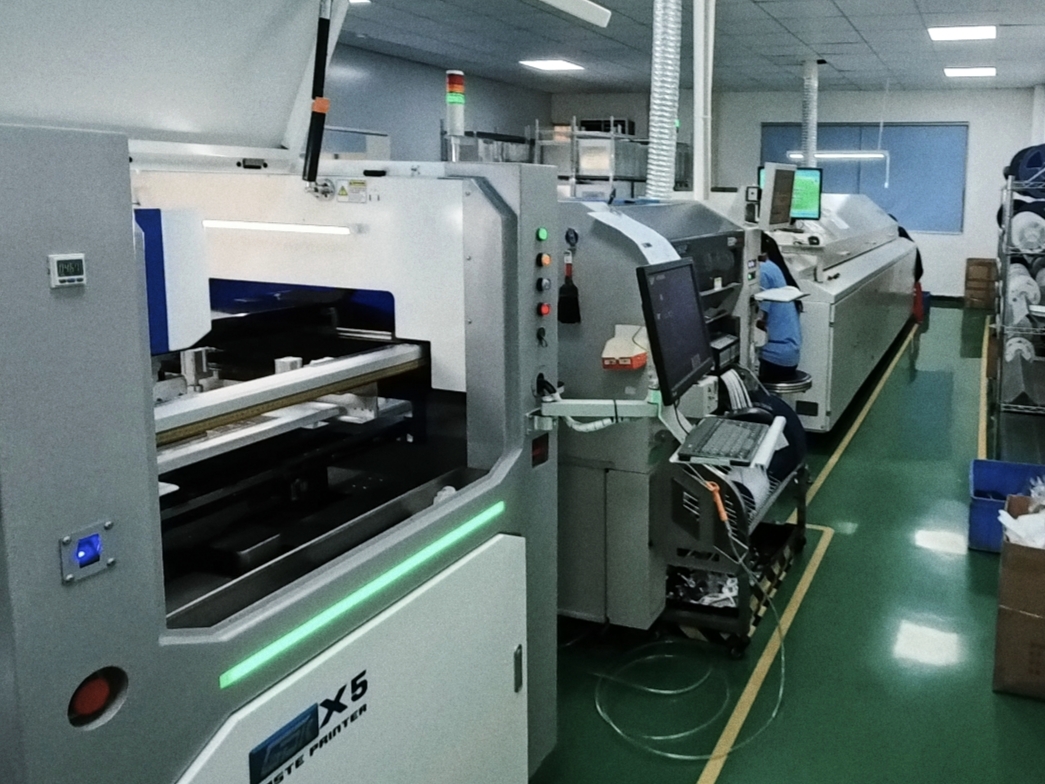
To eradicate assembly inconsistency, a professional flashlight supplier must completely transition to fully automated Surface Mount Technology (SMT). In our advanced production environment, bare circuit boards are fed into enclosed, high-speed robotic pick-and-place machines. Utilizing integrated machine vision cameras, these robotic nozzles extract microscopic 01005-sized resistors and complex MCU chips, firing them onto precisely printed solder paste with micron-level accuracy. Following nitrogen-shielded reflow soldering, every single PCB enters an Automated Optical Inspection (AOI) machine. High-definition 3D cameras and AI algorithms instantly flag any microscopic solder bridges, ensuring zero-defect reliability across mass production.
IV. Battery Management Systems (BMS): Defending Against Extremes
Driving thousands of lumens requires power sources with immense volumetric energy density. The integration of 18650 and 21700 lithium-ion cells has revolutionized portable illumination. However, these electrochemical powerhouses are incredibly volatile. If a lithium-ion cell is subjected to a dead short, overcharged by a faulty power adapter, or drained past its critical minimum voltage, the internal liquid electrolyte may boil. This can trigger a catastrophic thermal runaway event, resulting in toxic venting or a violent explosion.
You cannot entrust the safety of your end-users to unverified trading companies who source naked, unprotected battery cells to widen their margins. An authoritative engineering facility actively defends against these extremes by implementing a rigid Battery Management System (BMS). The BMS utilizes a dedicated DW01 control IC paired with dual MOSFETs acting as fail-safe electrical gates. It executes strict Over-Charge Voltage Protection (OCVP) and Over-Discharge Voltage Protection (ODVP). Furthermore, if a panicked operator inserts the battery backward in the dark, Reverse Polarity Protection shuts down the electrical flow entirely to avert a fire.
V. Optimizing Your Supply Chain with Reliable Flashlight Suppliers in China
Inexperienced procurement managers consistently fixate on securing the lowest initial unit cost. This miscalculation fatally ignores the Total Cost of Ownership (TCO). A marginally cheaper device procured from an unverified broker ultimately generates astronomical hidden expenses. Because high electronic defect rates precipitate expensive cross-border shipping for Return Merchandise Authorizations (RMAs), overwhelm customer service infrastructure, and permanently destroy your brand's digital reputation, sourcing poorly engineered circuitry effectively becomes a massive operational hemorrhage.
Strategic resilience requires forging direct alliances with elite Flashlight OEM ODM Manufacturers. By integrating with a facility that controls the entire electronic lifecycle—from custom PCB layout and thermal simulation to fully automated SMT assembly and rigorous pre-shipment aging tests—you establish an impenetrable market moat. Partnering with Reliable Flashlight Suppliers in China like Shengqi Lighting allows your enterprise to bypass intermediary markups to secure genuine factory-direct pricing, fundamentally minimizing your TCO and empowering your brand to scale its distribution network with absolute financial certainty.
Secure Your Micro-Electronic Supply Chain
Do not allow unverified assembly houses to compromise your brand equity with hazardous electrical designs. Sourcing professional illumination tools requires an uncompromising partnership with a true engineering facility capable of delivering flawless SMT precision and DTP thermal routing.
[ Initiate Custom R&D Consultation ]
SHENGQI LIGHTING operates as a globally recognized manufacturing authority. We formally invite global procurement directors to consult with our microelectronics division. Request our empirical SMT quality reports, explore custom constant-current driver solutions, and schedule your comprehensive virtual factory audit today.