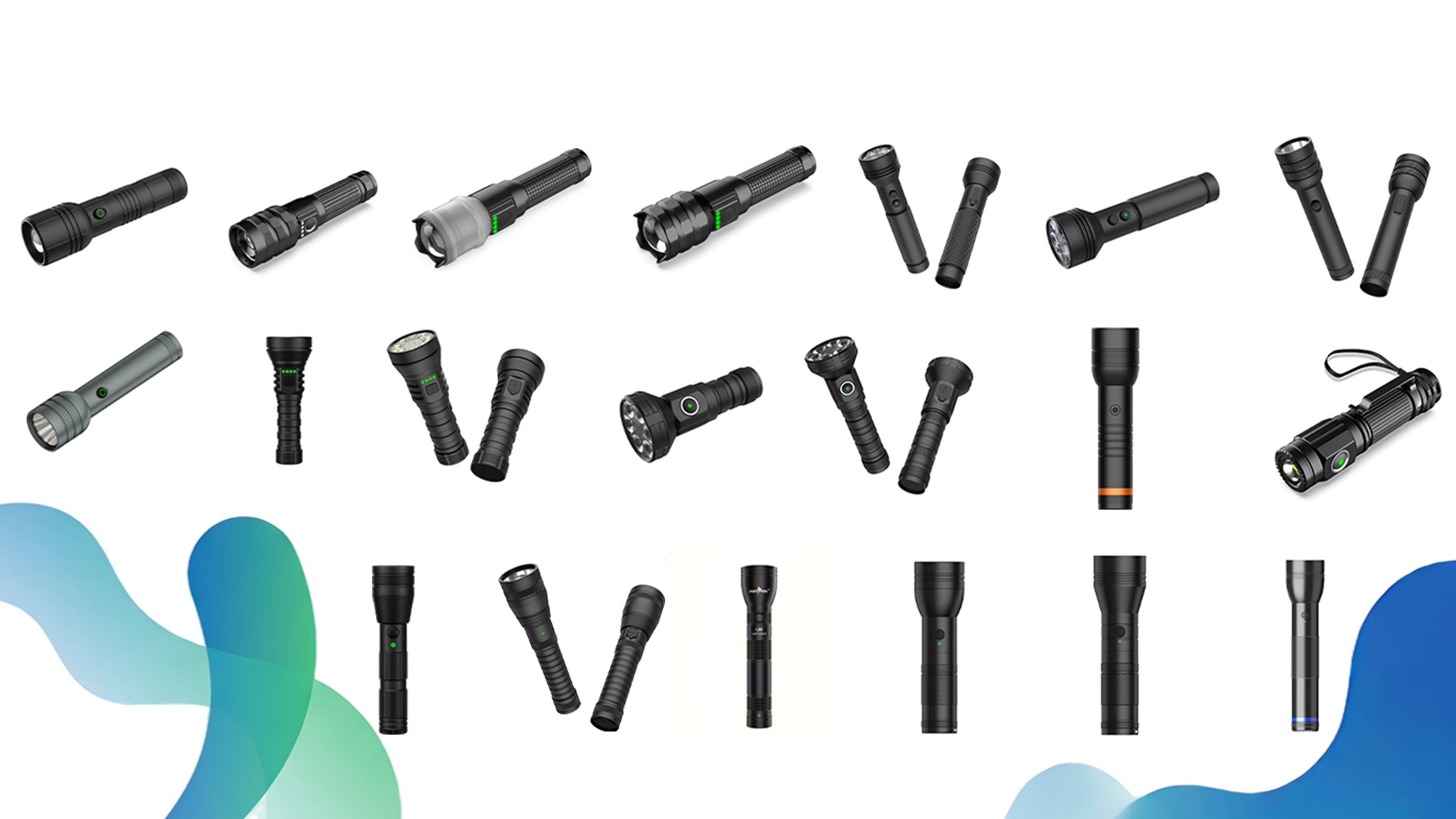

What type of flashlight should I choose?
The right flashlight depends on the task, required beam pattern, working distance, runtime, carrying method, environment, and whether hands-free operation is needed. Choose an EDC flashlight for compact daily carry, a pen light or tooling light for detailed inspection, and a headlamp when both hands must remain free. A camping light is better for wide-area illumination, while tactical, outdoor, or hunting lights may suit longer-distance observation. Underwater work requires a purpose-built diving light, not simply a water-resistant flashlight. UV inspection lights are designed for fluorescence-based checking. The main types of flashlights are therefore application tools rather than interchangeable brightness products.
How Should You Choose a Flashlight?
The most reliable way to compare the different types of flashlights is to begin with the operating task and then work through beam, distance, power, carrying method, and environmental protection. A specification is only useful when it supports the real application.
Define the Task
Decide whether the light is for daily carry, inspection, camping, long-range observation, underwater use, emergency preparation, or another specific activity.
Choose the Beam Pattern
A flood beam lights a broad nearby area, a focused beam supports distance, and a balanced beam combines a central hotspot with useful spill.
Estimate the Working Distance
Close-range repair, room lighting, trail use, and perimeter observation require different hotspot intensity and beam distance.
Select the Power System
Consider battery availability, rechargeable or replaceable formats, charging access, expected runtime, storage, and maintenance.
Consider Carrying and Operation
Pocket clips, head straps, magnetic bases, gloves, switch placement, accidental activation, and weight all affect usability.
Match Protection to the Environment
Waterproof rating, impact resistance, corrosion exposure, temperature, dust, and underwater pressure must match actual conditions.
Quick Selection Guide
| User Need | Recommended Flashlight Type | Main Reason | Key Feature to Check | Main Limitation |
|---|---|---|---|---|
| Daily carry | EDC flashlight | Compact and immediately available | Size, clip, switch, low mode | Limited heat and battery volume |
| Close-range inspection | Pen or tooling light | Controlled task lighting | Uniformity and glare control | Not designed for long throw |
| General household use | General-purpose flashlight | Simple, versatile backup lighting | Battery availability and controls | May lack specialized protection |
| Outdoor travel | Outdoor flashlight | Balanced beam and environmental durability | Runtime, grip, waterproof rating | Often larger than EDC models |
| Professional long-distance inspection | Tactical or focused outdoor light | Higher directional intensity | Candela, hotspot, switch logic | Narrower close-range coverage |
| Hands-free work | Headlamp | Keeps both hands available | Weight, balance, beam width | Wear comfort can limit duration |
| Campsite area lighting | Camping light | Wide, comfortable area illumination | Low mode, color temperature, stability | Limited directional reach |
| Hunting and field observation | Hunting or field light | Stable long-range observation | Beam width, runtime, color option | Less suitable for broad nearby work |
| Underwater use | Diving light | Pressure-rated sealing and corrosion control | Depth rating and pressure testing | Requires careful seal maintenance |
| Fluorescence detection | UV inspection light | Reveals suitable fluorescent materials | Wavelength and filter design | Not all materials fluoresce |
Who Should Choose an EDC Flashlight?
An EDC flashlight is designed for Everyday Carry, with portability, immediate access, and daily usefulness as its main priorities. Among the common types of flashlights, EDC models usually require the most careful balance between size, output, runtime, heat, and pocket comfort.
Who is it for? Commuters, technicians, repair workers, outdoor users, drivers, and anyone who wants dependable backup lighting in a pocket, bag, or vehicle. Brands may also use EDC products as the entry point for a broader portable lighting range.
Typical applications: Finding objects, checking a vehicle, navigating a short dark path, working during a power outage, and supporting routine maintenance. A balanced beam with a defined hotspot and usable spill is often more practical than an extremely narrow or extremely wide beam.
What to check before buying: Body size, weight, pocket clip, switch protection, low-mode usefulness, battery format, charging system, runtime, and thermal behavior. The main limitation is that a small body has limited space for heat dissipation and battery capacity, so an EDC light may not be ideal for sustained long-distance use or large-area lighting.
Which Users Benefit from a Pen Light?
A pen light uses a narrow, elongated body for quick access and precise close-range illumination. Its design priority is controlled task lighting rather than maximum output or long beam distance.
Who is it for? Maintenance technicians, electrical inspectors, mechanical inspectors, security inspection personnel, professional tool users, and workers in care or medical environments who require a compact light for observation. The product should not be presented as a diagnostic device.
Typical applications: Looking inside equipment, reading instruments, checking narrow spaces, examining surfaces, and carrying a small backup light in a shirt or tool pocket. A smooth, uniform beam can be more useful than a very intense hotspot at short distance.
What to check before buying: Barrel diameter, weight, clip strength, switch operation, beam uniformity, replaceable or rechargeable battery format, and whether a UV function is actually required. Pen lights are generally not intended for extreme brightness, broad area lighting, or distant target identification.
What Is the Difference Between General-Purpose and Outdoor Flashlights?
General-purpose flashlights prioritize simple, versatile use, while outdoor flashlights usually place more emphasis on environmental durability, runtime, grip, and a beam that supports both near- and mid-range visibility. These two types of flashlights can look similar but serve different expectations.
A general-purpose model suits households, vehicles, warehouses, property staff, emergency kits, and routine checks. An outdoor model is more appropriate for hiking, camping, travel, wet conditions, and longer periods away from charging access.
What to check before buying: Battery availability, mode simplicity, waterproof rating, impact resistance, grip, low-temperature behavior, runtime, and whether the beam combines a visible hotspot with useful spill. Outdoor users may value a lower sustained mode more than a brief maximum output.
The main limitation is specialization. A household flashlight may not provide the sealing or structural protection expected in difficult outdoor conditions. An outdoor flashlight may be larger, heavier, or more complex than necessary for a drawer or vehicle kit. A splash-resistant flashlight must never be treated as a professional diving light.
Who Should Choose a Tactical Flashlight?
A tactical flashlight is a professional portable light emphasizing rapid operation, concentrated beam performance, structural strength, clear switch logic, sealing, and dependable use during inspection, search, security, or emergency work.
Security personnel, perimeter inspectors, search teams, emergency workers, and professionals who need distant recognition may benefit from this category. The main optical priority is often center-beam intensity, measured in candela, rather than lumens alone. A high-lumen floodlight can illuminate more nearby area while producing less throw than a lower-lumen, higher-candela design.
What to check before buying: Hotspot size, spill, peak intensity, switch response, mode sequence, accidental activation, thermal regulation, impact resistance, sealing, and glove-friendly operation. Optical alignment and assembly tolerances also influence whether production units maintain the intended beam.
The limitation is application range. A tight, intense beam can create glare at close distance and may not provide enough area illumination for repair, camping, or indoor work. Tactical is a product category, not a universal quality level.
When Is a Headlamp Better Than a Handheld Flashlight?
A headlamp is better when the user must keep both hands available. Its value is not simply attaching a light to the head; the optical design, weight distribution, strap system, battery position, and controls must support comfortable hands-free lighting.
Headlamps suit hikers, campers, repair workers, electricians, night runners, warehouse staff, cave workers, and anyone performing extended two-handed tasks. Beam patterns vary: some provide broad flood light, some add a focused hotspot, and others combine separate near- and far-field sources.
What to check before buying: Front weight, rear battery balance, strap comfort, beam width, close-range glare, sensor controls, mode operation, runtime, waterproof capability, and whether the light can be tilted accurately.
The limitation is wearing comfort. A high-output headlamp can become uncomfortable when the lamp body is heavy, the strap does not distribute load, or heat remains close to the forehead. A handheld light may still be preferable when the beam must be directed independently of head movement.
What Makes a Camping Light Different from a Handheld Flashlight?
A camping light is designed to illuminate an area rather than project a narrow beam in one direction. It commonly uses diffused, 360-degree, or directional area lighting to make tents, tables, cooking areas, and shared spaces easier to use.
Family campers, recreational vehicle users, outdoor event organizers, campsite operators, emergency-preparedness users, and outdoor lifestyle brands are typical users. Unlike many handheld types of flashlights, a camping light is judged heavily by comfort, stability, hanging options, and low-output usability.
What to check before buying: 360-degree versus directional output, color temperature, low mode, hanging hooks, magnetic mounting, battery capacity, charging method, base stability, and splash resistance. A warm or neutral light may feel more comfortable during long evening use than a very cool, high-intensity source.
The main limitation is directional reach. A lantern can brighten a campsite but may not identify a distant object. Maximum lumens should not be the only comparison because an overly bright area light can create glare and reduce visual comfort.
How Should a Hunting or Field Observation Light Be Selected?
A hunting or field observation light usually emphasizes distant target recognition, beam stability, runtime, environmental durability, and practical operation outdoors. It can also serve farm inspection, ranch patrol, wildlife observation, outdoor tracking, and nighttime perimeter checks.
The appropriate beam depends on distance and field of view. A narrow hotspot can reach farther, but a slightly wider focused beam may make moving subjects or irregular terrain easier to follow. Red or green light may be useful in some projects, but these colors are not required for every field light.
What to check before buying: Beam distance, candela, hotspot width, spill, color temperature, optional colored-light requirements, runtime, waterproofing, grip, and switch operation while wearing gloves.
The limitation is close-range versatility. A field light optimized for distance may provide less comfortable illumination for campsite tasks, equipment repair, or indoor use. Product selection should focus on observation and environmental needs rather than treating every long-range light as the same category.
What Makes a Diving Flashlight Different?
A diving flashlight is engineered for underwater pressure, sealing, corrosion exposure, switch operation, and the way water absorbs and scatters light. A standard waterproof flashlight is not automatically suitable for diving.
Recreational divers, professional divers, underwater inspectors, water-sports brands, and diving-equipment distributors require products matched to a stated operating depth and verified pressure conditions. O-rings, threads, front lens structure, switch design, charging access, and battery compartments all affect sealing.
What to check before buying: Rated working depth, pressure testing, seal design, corrosion-resistant materials, switch accessibility, beam angle, color temperature, attachment method, runtime, and battery maintenance. Water changes the apparent beam, so an optic that performs well in air may behave differently underwater.
The main limitation is maintenance and specialization. Seals must remain clean and correctly installed, while charging structures and threads require care. Different diving lights may be rated for different depths; no single depth should be assumed across the category.
Which Flashlight Is Suitable for Professional Inspection?
Tooling and inspection lights are suitable when the goal is stable, uniform illumination of machinery, vehicles, cabinets, wiring, work surfaces, and narrow spaces. Their main priority is usable task lighting rather than maximum throw.
Automotive technicians, industrial maintenance teams, electricians, mechanics, HVAC workers, warehouse inspectors, and quality-control personnel may use magnetic bases, pocket clips, side lights, rotating heads, wide flood beams, or narrow bodies to position light where it is needed.
What to check before buying: Beam uniformity, color-rendering needs, close-range glare, magnetic stability, resistance to oil and impact, charging interface, mounting flexibility, and practical work runtime.
The limitation is distance. Tooling lights are designed to illuminate a work area efficiently, so they may not provide the focused hotspot needed for long-range observation. Among the professional types of flashlights, inspection lights often deliver more value through positioning and beam comfort than peak output.
Who Should Use a UV Inspection Light?
A UV inspection light uses ultraviolet output to make suitable materials fluoresce, helping users observe features that may be difficult to see under normal visible light. It is an inspection aid, not a medical, laboratory, bacterial, or authenticity diagnosis by itself.
Industrial leak inspectors, anti-counterfeit inspection teams, pet-environment cleaning users, mineral collectors, repair technicians, and brands developing fluorescence tools may consider UV products. Leak detection often requires a compatible fluorescent tracer, and not every stain, fluid, coating, mineral, or document will fluoresce.
What to check before buying: Wavelength, optical filter, beam uniformity, visible-light leakage, application material, safety instructions, and operating distance. A 365 nm light and a 395–400 nm light may produce different results depending on the target and ambient lighting.
The main limitation is interpretation. Fluorescence shows a reaction, not a complete explanation. Users should avoid looking directly at the UV source, and UV flashlights cannot replace medical or laboratory diagnostic equipment.
How Do Accessories and Custom OEM Products Affect Selection?
Accessories and custom OEM products extend the usability of different types of flashlights. Possible project elements include battery solutions, chargers, clips, lanyards, diffusers, filters, packaging, and product-specific mounting or carrying solutions.
B2B buyers should confirm compatibility with the exact flashlight rather than assuming an accessory fits an entire category. Battery chemistry, charger output, contact design, cable requirements, mechanical fit, package dimensions, and replacement-part planning can affect both safety and customer experience.
What to check before buying: Product compatibility, battery and charging safety, package completeness, destination-market requirements, carrying method, application conditions, and after-sales spare-parts needs.
The limitation is complexity. Adding accessories can improve product value, but it can also increase packaging size, inventory needs, documentation, testing, and support requirements. A useful kit should solve a defined user problem rather than add components without a clear purpose.
How Should Buyers Compare the Main Types of Flashlights?
The table compares the design priorities of the main types of flashlights without assigning fixed lumen, runtime, or beam-distance ranges. Those specifications vary by model, battery, optical system, driver, and product size.
| Flashlight Type | Primary Purpose | Typical Beam | Carrying Method | Recommended Users | Key Buying Factors | Not Ideal For |
|---|---|---|---|---|---|---|
| EDC | Daily portable lighting | Balanced hotspot and spill | Pocket or bag | Commuters, technicians, drivers | Size, clip, switch, battery | Extended area or long-range lighting |
| Pen Light | Precision inspection | Controlled close-range beam | Pocket clip | Inspectors and technical users | Diameter, uniformity, battery | High-output or long-distance work |
| General-Purpose | Household and emergency use | Versatile general beam | Drawer, vehicle, emergency kit | Households and property staff | Simple controls and battery access | Specialized environmental use |
| Outdoor | Travel, hiking, and emergency use | Balanced near- and mid-range beam | Pack, belt, or hand | Campers, hikers, drivers | Runtime, grip, sealing, impact | Underwater diving |
| Tactical | Rapid professional illumination | Focused hotspot with controlled spill | Hand, belt, or equipment pouch | Security and inspection professionals | Candela, switch logic, durability | Comfortable wide-area lighting |
| Headlamp | Hands-free work and movement | Flood, focused, or mixed | Head strap | Workers, runners, hikers | Weight, comfort, beam, runtime | Independent hand-directed aiming |
| Camping Light | Area illumination | Wide or 360-degree output | Table, hook, or magnetic mount | Campers and emergency users | Low mode, color temperature, stability | Long-distance target identification |
| Hunting Light | Field observation | Focused long-range beam | Hand or carrying system | Outdoor observers and ranch staff | Beam width, candela, runtime | Broad close-range work |
| Diving Light | Underwater illumination | Beam matched to underwater visibility | Hand, wrist, or tether | Divers and underwater inspectors | Depth, pressure, seals, corrosion | Use beyond rated depth |
| Tooling Light | Close-range work illumination | Wide, uniform task beam | Magnet, clip, stand, or hand | Mechanics and technicians | Mounting, uniformity, glare, runtime | Long-distance observation |
| UV Inspection Light | Fluorescence inspection | UV beam matched to the target | Hand or pocket | Inspectors and specialist users | Wavelength, filter, safety, target response | Medical or laboratory diagnosis |
Common Mistakes When Choosing a Flashlight
How Should B2B Buyers Plan a Flashlight Product Category?
Brand owners and procurement teams should plan a category around a clearly defined user group rather than asking one product to satisfy every application. The first decision is who will use the product and what problem the light must solve.
Working distance and beam pattern should be defined before selecting the LED or headline output. Product size, weight, battery format, charging system, environmental rating, switch logic, packaging, and target-market position then shape the engineering brief.
A clear product line may include compact EDC, balanced outdoor, long-range professional, hands-free, area-lighting, inspection, and specialty products. Separating these roles helps buyers communicate value and prevents overlapping products with unclear differences.
B2B Product Planning Checklist
- Define the target user and primary application.
- Set the working distance, hotspot, spill, and area-lighting needs.
- Confirm size, weight, carrying method, and switch operation.
- Choose the battery format, runtime objective, and charging system.
- Match waterproofing, impact resistance, temperature, and corrosion requirements to the environment.
- Define packaging, accessories, destination market, and product positioning.
- Identify the tests needed to support product claims and production consistency.
- Avoid designing one flashlight to cover incompatible use cases.
- Build a clear product hierarchy so buyers understand the role of each category.
How SHENGQI LIGHTING Supports Different Flashlight Categories
SHENGQI LIGHTING is the brand of Dongguan Shengqi Lighting Technology Co., Ltd., a flashlight and portable lighting manufacturer with manufacturing roots dating back to 1981. The current company was formally established in 2008.
The product scope includes EDC flashlights, pen lights, outdoor flashlights, tactical flashlights, headlamps, camping lights, hunting lights, diving lights, tooling lights, accessories, and OEM products. These types of flashlights require different optical, structural, battery, interface, and testing decisions; changing only the exterior does not turn one design into a suitable product for every application.
Development support includes Industrial Design, Optical Engineering Design, Electronic Design, Packaging Design, Manufacturing, and Testing. The factory covers approximately 130,000 square feet and operates 75 CNC machines, one fully automated SMT production line, two welding lines, and eleven dust-free assembly lines. Annual production capacity is approximately 2.2 million flashlights.
Testing capabilities include switch-life, vibration, drop, luminous-performance, high- and low-temperature, waterproof, and battery evaluations. The company operates under an ISO9001 quality management system.
For OEM and ODM projects, the design process must balance output, candela, beam distance, runtime, product size, weight, thermal behavior, carrying method, and environmental protection. SHENGQI LIGHTING can support category development according to the intended users and market position rather than applying one optical or structural solution to every portable lighting product.
Frequently Asked Questions About Types of Flashlights
1. What is the best flashlight type for everyday use?
An EDC flashlight is usually the most practical choice for everyday use because it balances portability, access, beam versatility, and battery convenience. The right model should fit the intended pocket or bag, resist accidental activation, provide a useful low mode, and offer enough runtime for routine tasks. A general-purpose flashlight may be better for a household drawer or vehicle kit when pocket carry is not important. The best choice depends on how often the light will be carried and used.
2. What is the difference between an EDC flashlight and a tactical flashlight?
An EDC flashlight prioritizes convenient daily carry, balanced illumination, manageable size, and routine usefulness. A tactical flashlight usually places more emphasis on rapid switch access, focused beam intensity, structural strength, sealing, and professional inspection or security applications. Either category can have high output, so lumens alone do not define the difference. Buyers should compare switch logic, candela, hotspot size, spill, product size, thermal behavior, and expected working distance.
3. Is a headlamp better than a handheld flashlight?
A headlamp is better when both hands must remain free for walking, repair, climbing, sorting, or equipment work. A handheld flashlight is better when the user needs to aim the beam independently, inspect around obstacles, or change direction without moving the head. Many users benefit from carrying both. Headlamp selection should consider weight, balance, strap comfort, beam width, runtime, and close-range glare rather than assuming every headlamp provides the same type of illumination.
4. Can a waterproof flashlight be used for diving?
Not necessarily. A waterproof rating may cover rain, splashing, or temporary immersion, but diving involves sustained water pressure at a defined depth. A diving light should have a suitable depth rating, pressure verification, corrosion-resistant materials, dependable seals, and controls that operate underwater. O-rings, threads, lenses, switches, charging structures, and battery compartments all influence performance. Buyers should never assume that a general waterproof flashlight is safe for diving without product-specific depth and pressure information.
5. What type of flashlight is suitable for close-range inspection?
Pen lights and tooling lights are usually suitable for close-range inspection. A pen light works well in pockets and narrow spaces, while a tooling light may add a side light, magnetic base, rotating head, or broader flood beam. Important factors include beam uniformity, glare control, color-rendering needs, mounting stability, resistance to oil or impact, charging access, and runtime. The longest beam distance is rarely the main priority when inspecting machinery, vehicles, wiring, or surfaces at close range.
6. Are more lumens always better?
No. Lumens describe total visible light output, but they do not explain how the light is distributed. A high-lumen floodlight can illuminate a large nearby area, while a lower-lumen light with higher candela may reach farther. Buyers should also review beam shape, hotspot, spill, sustained output, runtime, heat, color temperature, and application distance. Different types of flashlights use light differently, so the most useful output is the output that fits the task.
7. How should a brand choose flashlight categories for an OEM product line?
A brand should begin with distinct target users and applications, then assign each product a clear role. Define working distance, beam pattern, size, weight, battery, charging, controls, environmental protection, packaging, and testing needs before selecting components. Avoid creating several models with only cosmetic differences and no meaningful application distinction. A structured line might include EDC, outdoor, professional long-range, headlamp, area-lighting, inspection, and specialty products, depending on the market and distribution channel.
Choose the Application Before the Specification
No single flashlight type is right for every user. A successful choice begins with the intended task and then considers beam pattern, working distance, runtime, battery format, carrying method, controls, and environmental protection.
The main types of flashlights solve different problems. EDC models support daily carry, headlamps keep hands free, camping lights illuminate an area, tooling lights support close work, focused lights support distance, and diving or UV products require application-specific design and verification.
Professional categories need structures, seals, optics, batteries, and tests matched to the use case. B2B product lines should therefore be organized around clear user groups and distinct application value rather than repeated specifications or appearance changes.
Plan a Portable Lighting Range Around Real Users
Lighting brands, outdoor brands, importers, distributors, product managers, and OEM/ODM sourcing teams can discuss target users, product categories, beam requirements, battery systems, structural design, product testing, packaging, and manufacturing with SHENGQI LIGHTING.