The Physics of Flashlight Lenses: TIR Optics, AR Glass & Reflectors
[ Failure Analysis: The Art of Controlling Light ]
Hello, this is your Senior Optical Engineer from SHENGQI LIGHTING. Many brand procurement managers fixate entirely on the semiconductor. They source the most powerful, high-bin LED available and assume superior performance will follow. This is a fundamental engineering fallacy.
The physical reality is that a raw LED emits photons in a highly divergent, chaotic 120-degree Lambertian distribution. If you do not collect, focus, and direct this photonic energy through precision optical devices, the light scatters uselessly into the atmosphere. A 3000-lumen LED without proper optical routing might fail to illuminate a target just 50 meters away, while producing severe artifact rings and dark spots in the beam pattern.
The design of the optical system directly dictates the effective range and beam distribution of the flashlight. In this masterclass, we will deconstruct the physics of parabolic reflectors, the solid-state revolution of TIR lenses, and the thin-film interference of AR-coated glass to help you engineer the perfect beam.
I. Reflectors: SMO vs. OP
Reflectors manipulate light using a parabolic curve. When the LED is placed at the exact focal point, the metallic walls bounce the photons forward. The internal surface texture completely alters the operational result.
Smooth Reflectors (SMO)
An SMO reflector features a mirror-like, highly polished finish. This geometry relies on specular reflection to maximize light-gathering efficiency. It forcefully collimates the photons, directing them parallel to the central axis.
The Result: It creates a highly concentrated center hotspot with sharp, distinct edges. This generates extreme peak beam intensity (candela). An SMO setup is the absolute mandatory choice for long-range search-and-rescue (SAR) tools and hunting flashlights where maximum throw distance is required.
Orange Peel Reflectors (OP)
An OP reflector features a micro-textured surface visually resembling the skin of an orange. Instead of acting as a single continuous mirror, this texture induces diffuse reflection, intentionally scattering a calculated percentage of the light rays.
The Result: This scattering thoroughly eliminates dark spots, chromatic aberrations (tint shifts), and ugly artifact rings generated by multi-die LEDs. It creates a buttery smooth transition from the hotspot into the wide spill. The OP reflector is the perfect choice for Everyday Carry (EDC) and outdoor hiking, where a clean, wide field of view is critical.
II. The TIR Revolution: Total Internal Reflection
While parabolic reflectors bounce light, they inherently suffer from inefficiency. The photons emitted directly sideways from the LED frequently escape the front of the flashlight without ever touching the reflective walls. This "spill" is wasted energy.
Combining Refraction and Reflection
TIR (Total Internal Reflection) optics solve this inefficiency completely. A TIR lens is a solid polymeric structure (typically PMMA or Polycarbonate). The center of the optic functions as a refractive convex lens, collimating the direct forward light. Concurrently, the outer conical body of the lens captures the side-emitted light and reflects it totally internally, pushing nearly 100% of the LED's output forward.
This architecture provides an incredibly high light-utilization efficiency. It produces a stunningly natural beam transition with virtually no hard edges. Because TIR optics rely on solid geometry, they eliminate the need for deep, hollow reflector cups, making them the mainstream, space-saving solution for premium headlamps and compact EDC lights.
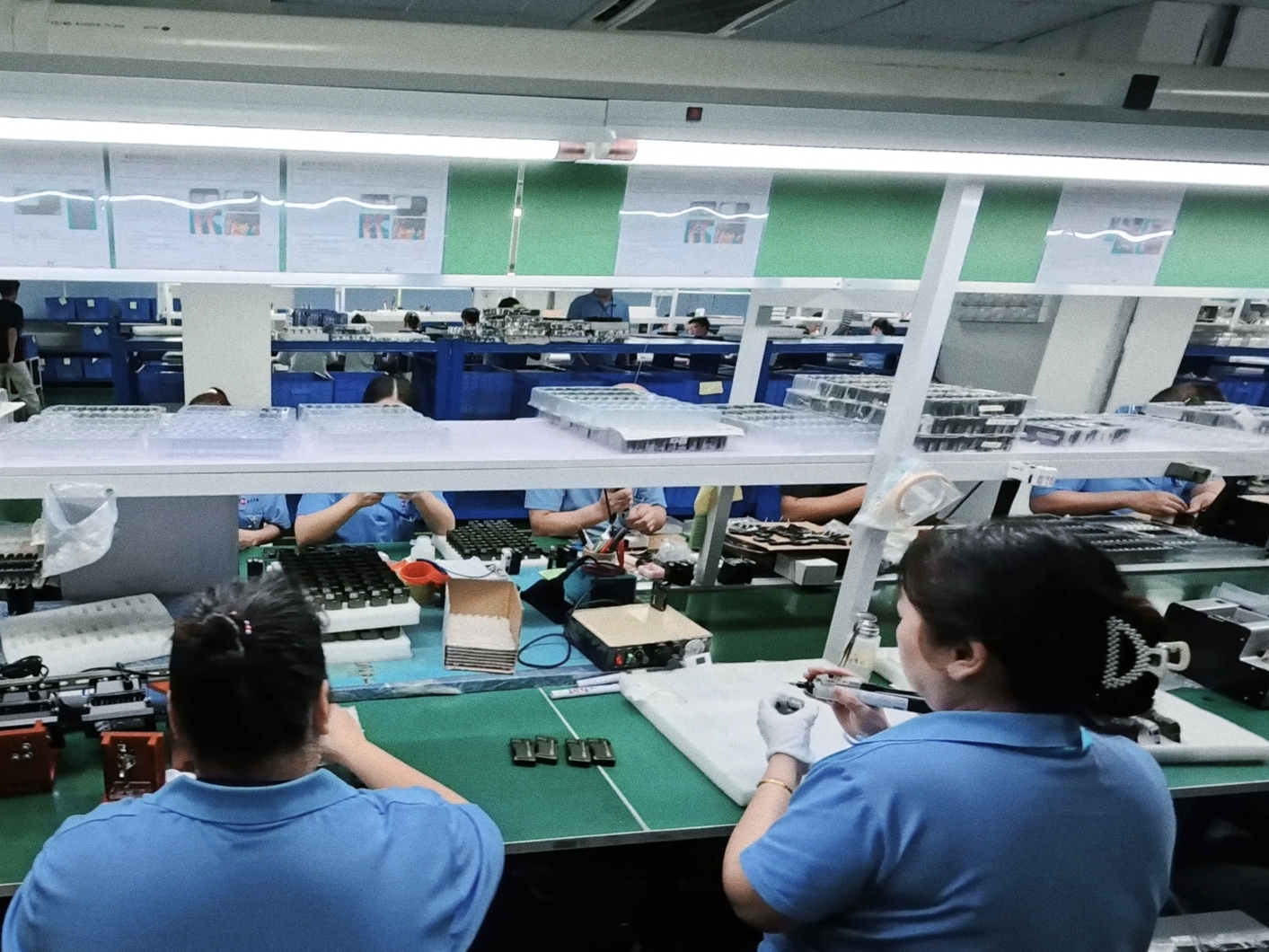
However, a TIR lens requires absolute microscopic alignment with the semiconductor. A fractional offset ruins the beam. As a premier OEM CNC machined aluminum flashlight factory, our 5-axis turning centers guarantee that the internal chassis dimensions are cut to ±0.01mm tolerances. This ensures the LED rests at the exact geometric epicenter of the TIR optic every single time.
III. Physical Barrier: AR Coated Glass
The final element in the optical pathway is the outermost protective lens. Standard uncoated mineral glass naturally reflects roughly 4% to 8% of the light back into the reflector, severely reducing the Out-The-Front (OTF) lumen output.
Thin-Film Interference
High-end optoelectronics utilize AR (Anti-Reflective) Coated Glass. Engineers apply microscopic dielectric layers to the glass via vapor deposition. This creates destructive thin-film interference, canceling out the reflected light waves. Visually, you might recognize an AR coating by a faint purple or blue tint when viewing the lens at an angle. This technology significantly increases light transmittance (up to 99%) and maximizes the actual lumen output striking the target.
Cheap commercial flashlights often rely on untreated, easily scratched plastic lenses. As a trusted Heavy duty tactical flashlight supplier and an authoritative Industrial grade flashlight manufacturer China depends upon, SHENGQI LIGHTING insists on utilizing AR-coated tempered mineral glass. This guarantees maximum optical clarity while offering superior scratch and impact resistance against operational hazards.
IV. Expert FAQ: Flashlight Optics Sourcing
Q1: As a procurement manager, should I specify SMO or OP reflectors for my brand's new product line?
It depends entirely on your target demographic. If your end-users are law enforcement, hunters, or Search and Rescue (SAR) teams who demand maximum beam distance to identify targets hundreds of meters away, you must specify an SMO (Smooth) reflector. If your product is an Everyday Carry (EDC) light, a mechanic's tool, or a camping lantern where a wide, uniform, glare-free light is preferred, an OP (Orange Peel) reflector is the superior choice.
Q2: What makes a TIR lens optically superior to a traditional metallic reflector?
Traditional reflectors allow a significant amount of light to "spill" out of the front without being focused. A TIR (Total Internal Reflection) lens physically encapsulates the LED, combining both convex refraction and internal reflection to capture and direct almost 100% of the photonic output. This yields a higher overall optical efficiency, a softer beam transition without ugly artifact rings, and allows the flashlight head to be engineered much shorter.
Q3: How does SHENGQI ensure the optical components match the external housing perfectly?
Optical alignment requires severe mechanical precision. As a premier Aerospace aluminum flashlight wholesale provider, we do not use die-casting. We carve our housings from solid aluminum billets using 5-axis CNC turning centers. This guarantees a dimensional tolerance of ±0.01mm. This structural perfection ensures the LED die rests at the exact mathematical focal point of the reflector or TIR lens, ensuring zero beam distortion.
Secure Your Optical Architecture
Do not allow poor optical geometry to throttle your brand's performance. Designing a precise, artifact-free beam profile requires profound computational physics and micron-level manufacturing integration.
[ Initiation of R&D Partnership ]
SHENGQI LIGHTING operates a dedicated optical engineering division. We invite B2B procurement managers to collaborate with our R&D team to engineer bespoke TIR lenses, specific AR-coated profiles, and exact reflector geometries tailored for your next tactical or industrial deployment.