The Ultimate Sourcing Guide for a Professional Diving Flashlight Manufacturer: Decoupling Hydraulic Pressure and Saltwater Corrosion
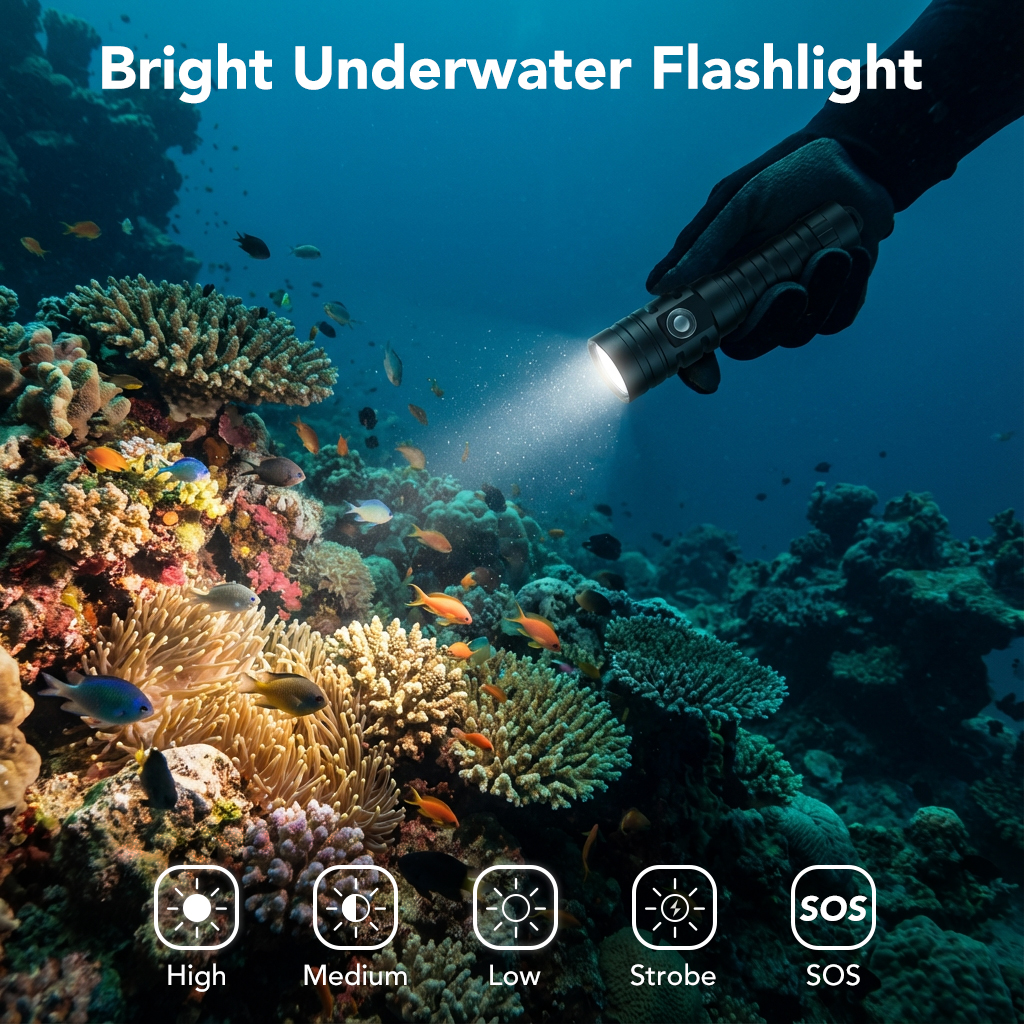
The IPX8 Lie: Why "Water-Resistant" is a Death Sentence in Scuba Diving
In the global marine gear and subsea equipment procurement markets, relying on standard consumer grading scales is a critical error. The most common pitfall for hardware sourcing agents is the generic "IPX8 waterproof" designation. In land-based testing, IPX8 typically implies that a device can withstand static immersion in fresh water, usually up to 1.5 or 2 meters, for roughly thirty minutes. Many low-end suppliers assemble basic tactical flashlights, add a single cheap silicone gasket, and claim to be a qualified diving flashlight manufacturer. In the real world, placing this consumer-grade hardware into active marine environments invites immediate failure.
The physics of scuba diving completely changes the demands on an optical housing. As a diver descends, hydrostatic pressure increases rapidly at a rate of approximately 1 atmosphere (14.7 PSI) for every 10 meters of depth. At a standard recreational depth of 20 meters, the housing must withstand a constant external pressure of approximately 44 PSI. Under this load, any minor structural deformities, microscopic gaps in the thread engagement, or slight imperfections in the gasket seating will be exploited. Once the high-pressure water breaches the outer seal, it immediately floods the battery compartment, triggering rapid electrochemical electrolysis, short-circuiting the driver, and leaving the diver in pitch darkness.
Furthermore, dynamic movement underwater significantly increases local pressure on the seals. A diver moving their arm rapidly or dropping their gear generates a transient pressure spike that can easily bypass a simple static rubber gasket. When a low-grade flashlight fails under these conditions, it is not merely an operational inconvenience—it is a life-threatening emergency. In deep, low-visibility waters, the sudden loss of a primary light source can cause disorientation, panic, and rapid ascent mistakes. Therefore, marine distributors must look past generic waterproofing claims and focus on suppliers that design products to withstand extreme hydrostatic stress.
When selecting a manufacturing partner, sourcing professionals must prioritize suppliers that understand deep-sea survival baselines. A qualified manufacturer will design their optical hosts using finite element analysis (FEA) to ensure that the glass lens, aluminum bezel, and rear tailcap do not compress or deform under high pressure. This structural rigidity is essential for maintaining a secure seal, as any deformation at depth will warp the gasket channels and allow water ingress. Sourcing departments must demand detailed engineering documentation showing how a supplier's designs perform under simulated deep-water stress before committing to a partnership.
Engineering the Abyss: The Triple-Seal System
To prevent water ingress at depth, a high-quality underwater light must utilize a robust, redundant sealing system. Relying on a single O-ring is a critical vulnerability; if that single barrier becomes twisted, collects a grain of sand, or degrades over time, the seal will fail completely. To solve this issue, a professional scuba diving light supplier must design a comprehensive "Triple-Seal System." This engineering approach uses multiple protective barriers, including dual or triple professional O-rings, silicone precision holes for dynamic interfaces, and high-precision CNC-machined waterproof threads to block high-pressure water from reaching the interior.
At the center of this sealing strategy are the professional O-rings, which are typically made from high-durability synthetic rubbers like Nitrile (NBR) or Viton (fluorocarbon elastomer). These gaskets must be selected with the correct shore hardness—usually between 70A and 90A—to ensure they can compress sufficiently to seal micro-gaps without tearing or flattening permanently under load. These O-rings are seated in precision-engineered grooves that are machined to exact depths, maintaining the ideal compression ratio when the tailcap or bezel is fully tightened. This precise geometry prevents the gaskets from extruding or pinching under pressure, ensuring a secure seal across the entire operating range.
Dynamic interfaces, such as mechanical push buttons or rotary control switches, present the greatest risk of leakage in deep-water designs. Traditional spring-loaded push buttons will easily compress and lock up under the weight of deep water, rendering the switch useless or causing water to leak past the shaft. To overcome this, advanced manufacturers use non-penetrating switching mechanisms, such as magnetic induction slide switches or piezoelectric buttons. These switches operate through a solid aluminum wall, utilizing silicone precision holes to mount external magnetic sliders. This design completely eliminates physical penetrations through the housing, removing a primary path for water ingress.
The final line of defense is the mechanical thread interface, which must be machined using advanced CNC threading centers. These machines cut precise, square or trapezoidal waterproof threads that provide a high degree of physical engagement and resistance to shear forces. Unlike cheap triangular threads, which can slip or strip under pressure, square-cut threads distribute mechanical loads evenly across the joint. This precise thread profile, when paired with high-viscosity, hydrophobic fluorosilicone grease, forms a highly redundant seal that blocks capillary moisture from reaching the primary O-rings, ensuring long-term watertight integrity under extreme hydrostatic loads.
Surviving Saltwater: Aerospace Aluminum and Hard Anodizing
Ocean water is a highly corrosive electrolyte containing high concentrations of sodium chloride, magnesium chloride, and dissolved oxygen. This chemical makeup makes saltwater incredibly aggressive toward metals, particularly aluminum, copper, and low-grade steels. When standard metals are submerged, they undergo rapid galvanic and pitting corrosion, especially where different metals meet (such as steel screws in contact with an aluminum body). Sourcing a diving light built with cheap, untreated alloy or low-grade plastics will quickly lead to structural failure, as the housing can corrode, seize up, or crack after only a few exposures to marine environments.
To resist this chemical attack, a premier underwater led torch factory must build its housings from high-purity 6063 aerospace aluminum. This specific alloy offers an exceptional balance of mechanical strength, thermal conductivity, and natural resistance to corrosion. However, the raw metal alone is not enough to survive long-term exposure to saltwater. The machined housing must undergo military-grade Type III hard-anodizing (conforming to MIL-A-8625 standards). This process uses an electrochemical bath to convert the outer surface of the aluminum into a dense, protective layer of aluminum oxide ($ ext{Al}_2 ext{O}_3$) with a thickness exceeding 50 microns.
This hard-anodized finish acts as a durable, non-conductive barrier that stops the flow of galvanic currents and prevents salt ions from reaching the raw aluminum beneath. The resulting surface has a hardness close to sapphire, providing excellent protection against both saltwater corrosion and physical impacts from underwater rocks or heavy diving gear. Sourcing agents must check that the hard anodizing is applied uniformly, including inside the threads and seal grooves, as any unprotected spots will quickly become targets for localized pitting corrosion.
Additionally, a professional manufacturer will carefully manage galvanic compatibility across all metallic connections. Any external fasteners, lanyard rings, or switch bezels must be made from marine-grade 316 stainless steel or titanium, and isolated from the aluminum housing using non-conductive polymer washers or specialized thread compounds. This attention to detail prevents galvanic cell formation, ensuring the threads remain easy to unscrew and the seals remain watertight throughout years of active service in harsh saltwater conditions.
The Pressure Test Black Box: Validating the 20-Meter Depth Rating
In the diving equipment industry, theoretical calculations and computer-aided design are not sufficient to guarantee field safety. A design that looks perfect in CAD or shows excellent safety margins in finite element analysis can still fail due to minor variations in raw material density, microscopic molding flaws in the silicone gaskets, or subtle tooling wear during CNC threading. Sourcing professionals must avoid manufacturers that rely solely on "design validation" or batch-level sampling. To ensure consistent quality and safety, a high-tier diving flashlight manufacturer must conduct 100% hydrostatic pressure testing on every single unit that leaves the assembly line.
A professional factory must invest in extensive high-pressure simulation labs to run these rigorous testing protocols. The testing process typically begins with a dry vacuum leak test, which pulls a negative pressure inside the assembled housing to check if the gaskets are seated correctly. This is followed by a wet hydrostatic test, where the fully assembled light is placed inside a pressurized water chamber. To validate a standard 20-meter depth rating, the chamber must be pressurized to at least 3 bar (approximately 44 PSI) and held at this level for a specified dwell time to simulate the continuous stress of a deep dive.
During this hydrostatic test, the pressure chamber should be equipped with automated sensors to monitor the interior of the light for any drop in pressure or increase in humidity, which would indicate a micro-leak. Additionally, the test protocols must verify the operation of the switch under full pressure. In poorly designed lights, the external water pressure can compress the switch housing and lock the light in the "on" or "off" position. Testing the switch under pressure ensures the magnetic or piezoelectric controls remain fully functional and easy to operate at maximum depth.
After depressurization, each light must undergo a thermal condensation test. The device is heated internally by running the LED, and then cold water is applied to the front glass. If any moisture had penetrated the housing during the pressure test, it will immediately condense on the inside of the cold lens, revealing even the smallest micro-leak. Partnering with a manufacturer that conducts this level of rigorous, documented testing is the only way to safeguard your inventory from field failures, protect your brand's reputation, and ensure the safety of divers in the field.
Protecting Your Marine Brand with a Reliable Professional Flashlight Supplier
For global marine equipment distributors, commercial dive operations, and high-end outdoor brands, selecting a manufacturing partner is a critical decision that directly affects customer trust and overall brand value. The marine industry requires equipment that is reliable, durable, and built to high standards. Supplying poorly engineered dive lights that fail under pressure can lead to negative user reviews, high return rates, and potential safety liabilities, highlighting the importance of partnering with a reliable, quality-focused manufacturer.
A true manufacturing partner must provide robust technical support, including comprehensive verification against recognized standards like ANSI/PLATO FL1 and ASTM B117 salt spray metrics. These standards cover critical metrics such as luminous flux, peak beam intensity, beam distance, impact resistance, and corrosion resistance. A high-tier professional flashlight supplier should operate fully equipped in-house testing facilities to generate precise, unbiased data sheets, giving sourcing professionals the verified metrics they need to confidently market their products to government agencies, search-and-rescue organizations, and high-end consumers.
Additionally, consistent quality control across large-scale production runs is essential for maintaining brand reputation and minimizing returns. A premier manufacturer must maintain full control over the entire production workflow, from initial CNC machining and anodizing to cleanroom optical assembly and final waterproof testing. Managing these critical processes in-house allows the engineering team to monitor tolerances at every stage, keeping product return rates (RMA) low and ensuring that every batch of dive lights delivers consistent, reliable performance in the field.
At Shengqi Lighting, we combine decades of comprehensive engineering heritage with advanced, automated assembly and strict quality control. Our in-house R&D, machining, and testing capabilities enable us to develop customized, high-performance illumination tools that meet the toughest field requirements. Whether you are looking to expand your existing tool catalog or develop a new line of high-durability dive lights, our engineering team is ready to deliver tailored solutions that help your business succeed.
Ready to Develop a High-Performance, Watertight Dive Light?
Stop risking your brand's reputation on low-quality seals and generic ratings. Partner with Shengqi's engineering team to build custom, CNC-machined, triple-sealed dive lights engineered for absolute safety and reliability at depth.
Consult Our Watertight Engineering Experts