What Defines a True industrial flashlight manufacturer in High-Risk Environments?
Greetings. As a Senior Supply Chain Auditor, I evaluate the structural integrity and manufacturing origins of equipment deployed in the world's most hazardous sectors. In subterranean mining, high-voltage electrical grid maintenance, and deep-water salvage, an illumination device is never merely a convenience—it is categorized as critical life-safety equipment.
When procurement directors mistakenly source commercial-grade consumer lights for these environments, the operational consequences are disastrous. Instruments shatter, batteries overheat, and poor optics lead to catastrophic diagnostic errors. This whitepaper abandons the marketing rhetoric prevalent in the hardware industry. By executing a rigorous Q&A format, we dissect the absolute engineering thresholds that a genuine industrial flashlight manufacturer must maintain, demonstrating how Shengqi Lighting secures global supply chains through empirical science.
Q1: Why do commercial-grade flashlights constantly fail in heavy-duty industrial settings?
The primary failure vector is metallurgical inadequacy. Commercial-grade flashlights are typically manufactured using injection-molded polymers or thin-walled, extruded aluminum tubing. In a heavy-duty industrial setting, equipment routinely suffers high-velocity kinetic impacts—such as being dropped from scaffolding onto steel grating—and is frequently exposed to caustic chemical solvents, cutting fluids, and abrasive metallic dust. A plastic chassis will instantly fracture under these parameters, while inferior aluminum will quickly succumb to galvanic corrosion.
To survive this environment, a premier industrial flashlight manufacturer must employ subtractive metallurgy. The chassis must be carved entirely from solid aerospace-grade aluminum billets utilizing advanced multi-axis machining facilities. This process ensures the continuous crystalline grain structure of the metal remains undisturbed, providing immense shear strength. Furthermore, the exterior must undergo military-grade anodic oxidation. This electrochemical process grows a dense, ceramic-like aluminum oxide shield that actively repels corrosive industrial chemicals and prevents abrasive wear, guaranteeing long-term structural survivability.
Q2: How does thermal management affect the lifespan and safety of an inspection light?
Modern LED semiconductors are incredibly powerful, yet they convert a significant percentage of their electrical input into raw thermal energy. If an inspection light lacks calculated thermodynamic routing, the internal heat will rapidly exceed the semiconductor's degradation threshold. This triggers an aggressive "lumen drop," where the light imperceptibly dims, compromising the technician's visibility. More critically, unmitigated heat transferring into the lithium-ion battery cavity could induce a severe thermal runaway event, posing a catastrophic fire hazard to the operator.
An authoritative heavy-duty tooling light supplier engineers the entire aluminum chassis to function as a unified, geometric heatsink. By minimizing internal threaded seams and utilizing Direct Thermal Path (DTP) copper circuit boards, heat is evacuated from the diode instantaneously. Additionally, intelligent temperature control microprocessors constantly monitor internal thermistors; should ambient temperatures spike, the circuit automatically and safely steps down the current, effectively protecting both the operator and the lifespan of the tool.
Q3: Why is optical consistency a non-negotiable factor for industrial engineers?
When an aviation mechanic is inspecting a turbine blade for micro-fractures, or an electrician is identifying color-coded wiring inside a dark utility panel, optical distortions are intolerable. Flashlights assembled in substandard facilities frequently exhibit "black holes" in the center of the beam, severe chromatic tint-shifts, or high-frequency PWM (Pulse Width Modulation) flickering. These optical defects rapidly induce ocular fatigue, directly leading to diagnostic misjudgments that might cost millions in downtime.
Optical consistency cannot be achieved manually. It requires the manufacturer to operate optically pure assembly zones, strictly maintaining a positive-pressure, dust-free atmospheric environment. Inside these zones, robotic machine vision systems calculate the precise geometric center of the semiconductor die, aligning it with the parabolic reflector or TIR lens with micron-level accuracy. This flawless coaxial alignment guarantees that every unit in a bulk deployment produces an identical, artifact-free beam profile.
Q4: What testing standards separate a true OEM work light factory from a simple trading company?
The B2B sourcing landscape is fraught with intermediaries. A trading company might present a beautifully machined "golden sample," but they lack the infrastructure to enforce quality across a mass-production run. When a bulk order arrives, the waterproof seals may fail, and the internal components may shear under vibration. The absolute differentiator is empirical, in-house destruction testing.
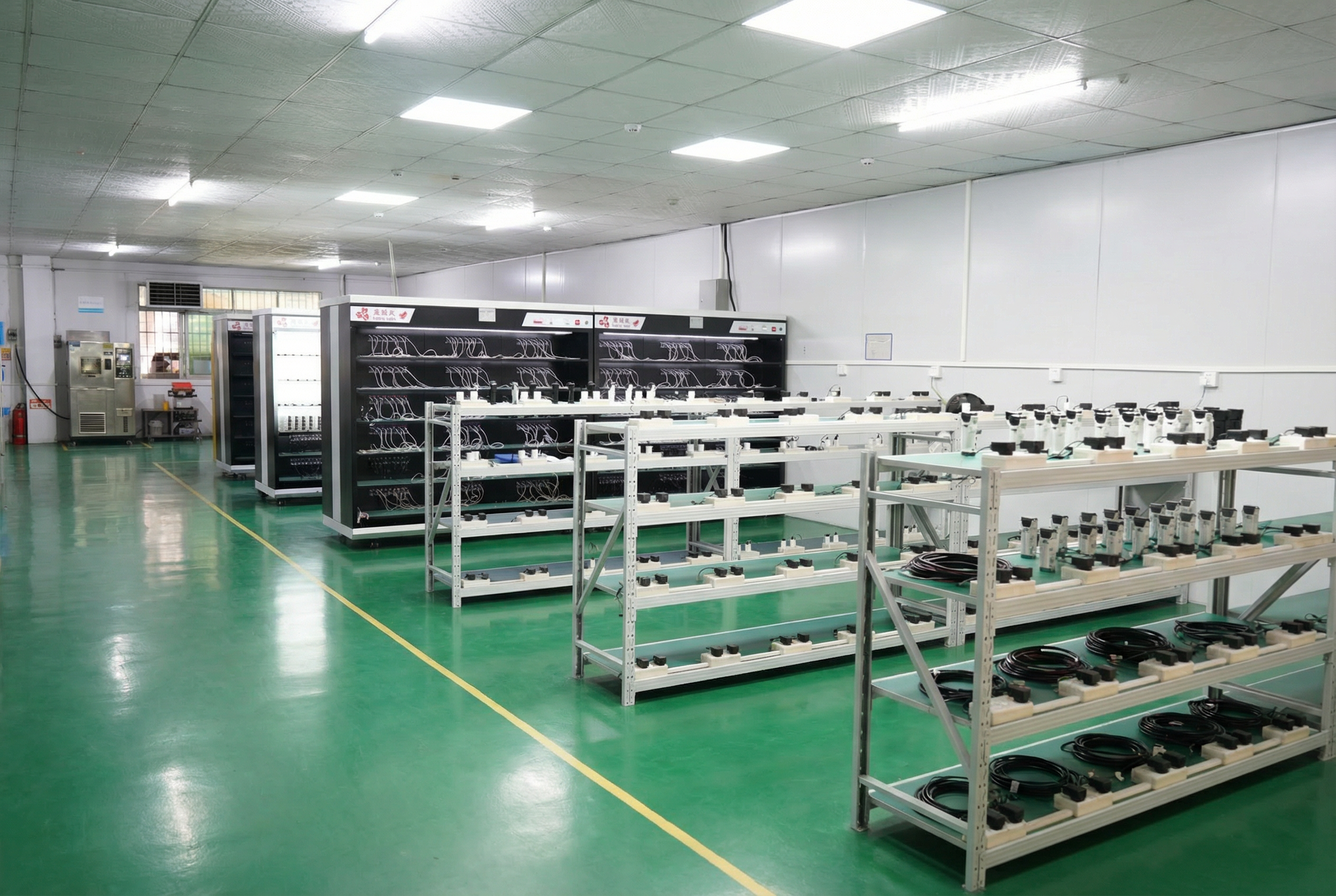
An authentic OEM work light factory governs its production through internationally recognized metrology, such as the rigorous ANSI/NEMA FL1 protocols. Instead of relying on random spot checks, a genuine facility integrates automated negative-pressure vacuum chambers directly onto the assembly line to instantly detect microscopic leaks in the O-ring seals. Furthermore, continuous samples are subjected to automated kinetic drop testing onto concrete. If a factory cannot immediately produce integrating sphere data and physical laboratory testing reports, they are a liability to your supply chain.
Q5: How does partnering with reliable flashlight suppliers in China reduce the Total Cost of Ownership (TCO)?
Procurement managers frequently fixate on the lowest initial per-unit cost, fundamentally misunderstanding the Total Cost of Ownership (TCO). A marginally cheaper flashlight sourced from an unverified vendor carries massive hidden liabilities. High defect rates precipitate expensive international RMA (Return Merchandise Authorization) logistics, damage the operational efficiency of your industrial workforce, and critically erode your brand's reputation in the marketplace.
By consolidating your procurement strategy and partnering directly with reliable flashlight suppliers in China, you eliminate the volatile margins of middlemen brokers. More importantly, aligning with a manufacturer backed by decades of deep-rooted engineering heritage guarantees an exceptionally high, consistent yield rate. This transforms your lighting procurement into a "maintenance-free" channel, allowing your enterprise to scale operations with absolute confidence and maximize long-term profitability.