Why We Store Flashlight Batteries Separately at SHENGQI LIGHTING

A battery installed in a flashlight is not inherently unsafe. However, long-term unattended storage can introduce avoidable risk depending on battery condition, product design, storage environment, operating state, and the possibility of accidental activation. Separating batteries from internally stored employee-use lights is one conservative control measure—not a universal rule for every flashlight owner or every commercial product configuration.
1. Why Employees Can Request Products for Hands-On Learning
At SHENGQI LIGHTING, employees may apply to handle and operate company products for product familiarization. This is not simply about trying a flashlight for entertainment. Hands-on use can help employees become more familiar with controls, body shape, beam behavior, ergonomics, operating logic, and the practical details that users may notice in daily handling.
Product knowledge is stronger when it is connected to real interaction. A person who has held a light, used its controls, considered how it is carried, and understood how it should be powered can communicate more clearly about practical user needs. This is relevant to product development, customer communication, application discussion, and internal collaboration.
However, responsible product familiarization needs a handling framework. Portable lighting is not only about brightness, modes, or appearance. It also involves batteries, charging, heat, storage, and correct operation. For that reason, internal product learning should include safety awareness as well as product understanding.
Product Familiarity
Employees can better understand controls, grip, carry behavior, beam use, and general operating logic.
Safety Awareness
Battery compatibility, intentional operation, storage context, and abnormal-condition awareness are part of product knowledge.
Better Internal Communication
Hands-on experience helps teams discuss portable-lighting requirements in a more practical and user-focused way.
2. Why Employee-Use Flashlights Are Stored Without Batteries
“When I received my first internally requested flashlight, my first question was simple: why was there no battery inside?”
It would be easy to assume that the employee needed to buy a battery personally. The reason was different: for employee-use lights stored internally, SHENGQI LIGHTING does not keep batteries installed in the flashlight for long-term storage.
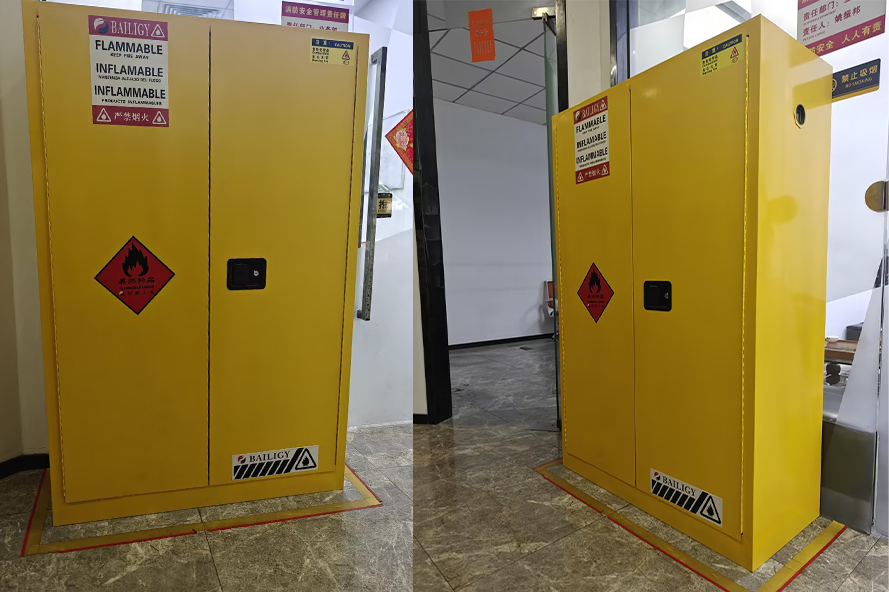
Instead, batteries are centrally stored in a clearly designated battery safety cabinet intended for controlled fire and explosion-risk management. When a battery is needed for product familiarization, it is taken out under the internal sign-out requirement. After the product-use activity is complete, the battery is returned to the designated storage location.
This approach is not meant to suggest that every flashlight with a battery installed is dangerous. It is an internal risk-control practice for a specific shared-use environment. It helps avoid unattended powered storage and makes battery handling deliberate, visible, and accountable.
3. Battery Storage, Sign-Out and Return Logic
The internal process is intentionally simple. It is not presented as an international safety standard, a product certification, or a substitute for application-specific procedures. It is a practical operating logic for employee product use.
| Stage | Internal Product-Use Logic | Why It Matters |
|---|---|---|
| Product Request | An employee requests a product for hands-on familiarization. | Keeps product use intentional rather than casual. |
| Flashlight Issued | The employee-use flashlight is stored without a battery installed. | Avoids unnecessary unattended powered storage. |
| Battery Sign-Out | A compatible battery is taken from the designated safety cabinet according to the internal requirement. | Makes battery access visible and accountable. |
| Product Use | The employee operates the flashlight and learns its controls and handling characteristics. | Connects product learning with responsible operation. |
| Power-Off and Return | The light is switched off, the battery is removed for internal storage, and the battery is returned. | Reduces avoidable storage risk and helps maintain control of battery use. |
The purpose of the sign-out process is not bureaucracy. It helps make battery use intentional, visible, and accountable. It also helps ensure that employees do not simply select an unknown cell that happens to look physically similar to the battery required by a product.
4. Battery Risk Is Not the Same as Accidental Activation Risk
Battery-related risk and flashlight-operation risk are connected, but they are not the same issue. Treating them as one problem can lead to unclear safety decisions.
Battery-Related Considerations
Battery condition, age, physical damage, unsuitable storage, wrong chemistry, and incompatible use can affect safe handling. Different battery types can also have different failure modes.
Flashlight-Operation Considerations
Accidental switch-on, continuous higher-output use, enclosed-space heating, and unnoticed discharge are operating and storage concerns.
Some primary batteries can leak electrolyte as they age or become damaged. Rechargeable lithium-ion cells have different potential failure modes, such as internal damage, overheating, or thermal events under abnormal conditions. Neither statement means that normal use automatically leads to failure.
For internally stored employee-use lights, battery separation is one way to reduce the chance that a flashlight remains powered or capable of accidental activation while it is unattended. It is a conservative internal control, not a claim that batteries should never be installed in a flashlight.
5. A Personal Reminder About Pocket Heat
A personal experience made the importance of accidental-activation awareness very clear. A flashlight was once left on inside a trouser pocket. The enclosed pocket trapped heat, and the fabric was eventually damaged badly enough to leave a hole.
This was one personal safety lesson. It was not a product-defect record, a recall, an injury statistic, or evidence that every flashlight will create the same result. It simply showed why high-output portable lights should be handled deliberately.
Some high-output flashlights can generate enough heat during continuous operation to damage heat-sensitive materials, particularly if they are accidentally activated in an enclosed space with limited airflow. A pocket or bag can be a special risk environment because the product is close to fabric or other items, heat may disperse more slowly, and the user may not notice that the light remains on.
High output means heat must be managed. Portable lights convert electrical energy into both light and heat. The level of thermal regulation, step-down behavior, switch protection, or lockout varies by product design and should never be assumed to be identical across all lights.
6. Product Design and Handling Discipline Work Together
Internal safety is not only a product-feature discussion. Some portable-light designs may include product-side measures such as thermal regulation, switch protection, lockout functions, or battery-protection features where applicable. These are engineering controls.
Company-side practices such as separate battery storage, sign-out, clear storage designation, return after use, and handling instructions are administrative controls. They do not replace product engineering, and product features do not remove the need for correct handling.
Engineering Controls
Product-side measures may include thermal management, switch design, lockout functions, or battery-protection design depending on the individual product.
Handling Controls
Internal storage, sign-out, return procedures, condition checks, and employee awareness help manage how a product is used.
Safety depends on both product design and operating discipline. This distinction is useful because it prevents a company from relying only on product features while overlooking how lights and batteries are actually handled.
7. Battery Compatibility and Condition Checks
Employees and users should not select a battery only because it appears to fit the flashlight body. Battery type, voltage, size, polarity, and product compatibility all matter. Physical fit does not automatically mean electrical compatibility.
Centralized internal battery handling helps reduce the possibility of an unknown battery source, unsuitable chemistry, incorrect voltage, damaged cell, or inconsistent storage practice. It does not mean every SHENGQI LIGHTING product uses the same battery brand, battery chemistry, or power platform.
Example Internal Handling Logic
- Before use: check visible product condition and confirm a compatible battery.
- During use: operate the light deliberately and pay attention to unusual heat or behavior.
- After use: power off, confirm the light is off, remove the battery for internal storage, and return it.
- For abnormal conditions: stop use and report unusual heat, odor, swelling, leakage, or physical damage to responsible staff.
Do not use visibly damaged, swollen, leaking, or otherwise questionable batteries. Do not attempt battery repair, modification, short-circuit testing, or disassembly. Internal product learning should never become uncontrolled battery handling.
8. What This Internal Practice Means for B2B Buyers
B2B buyers should not treat an internal battery-handling practice as a certification or as proof of every product-quality claim. It is one piece of operational evidence. It can show how a manufacturer thinks about product handling, employee awareness, battery risk, and real-world user experience.
That distinction matters. Internal safety practice does not replace product-specific validation. Buyers should still assess the relevant specifications, target application, battery requirement, charging method, thermal expectations, sample evaluation, testing needs, compliance requirements, and project documentation for their own market.
Internal practice is evidence, not certification. It demonstrates how a company manages a specific handling risk. It should not be presented as proof of every product’s safety performance, regulatory compliance, or market approval.
For portable-lighting sourcing discussions, buyers may explore product application, compatible battery requirements, charging preferences, heat-management expectations, lockout needs, accidental-activation concerns, storage context, testing requirements, and OEM/ODM development needs. Explore the SHENGQI LIGHTING product range, review our quality approach and manufacturing capabilities, or discuss an OEM/ODM project through our services.
Today is the final day of the 140th Canton Fair. Buyers visiting Guangzhou can still meet SHENGQI LIGHTING at Booth 16.4F25 to discuss portable-lighting products, OEM/ODM development, and product safety requirements.
Looking for a Portable-Lighting Partner That Takes Product Handling Seriously?
Tell us about your application, battery requirement, charging preference, thermal expectation, storage context, accidental-activation concern, testing requirement, OEM/ODM needs, and estimated quantity. We can help you discuss an appropriate product-development path.
Explore Flashlights Contact Our Team