How to Choose the Right Flashlight Beam for Different Applications

FLASHLIGHT BEAM SELECTION
The best flashlight beam is the one that matches the viewing distance, target size, surrounding area and user task.
A spot beam, flood beam and balanced beam are not competing “quality levels.” They distribute light differently, so each can be useful in the right application.
What Is a Flashlight Beam Pattern?
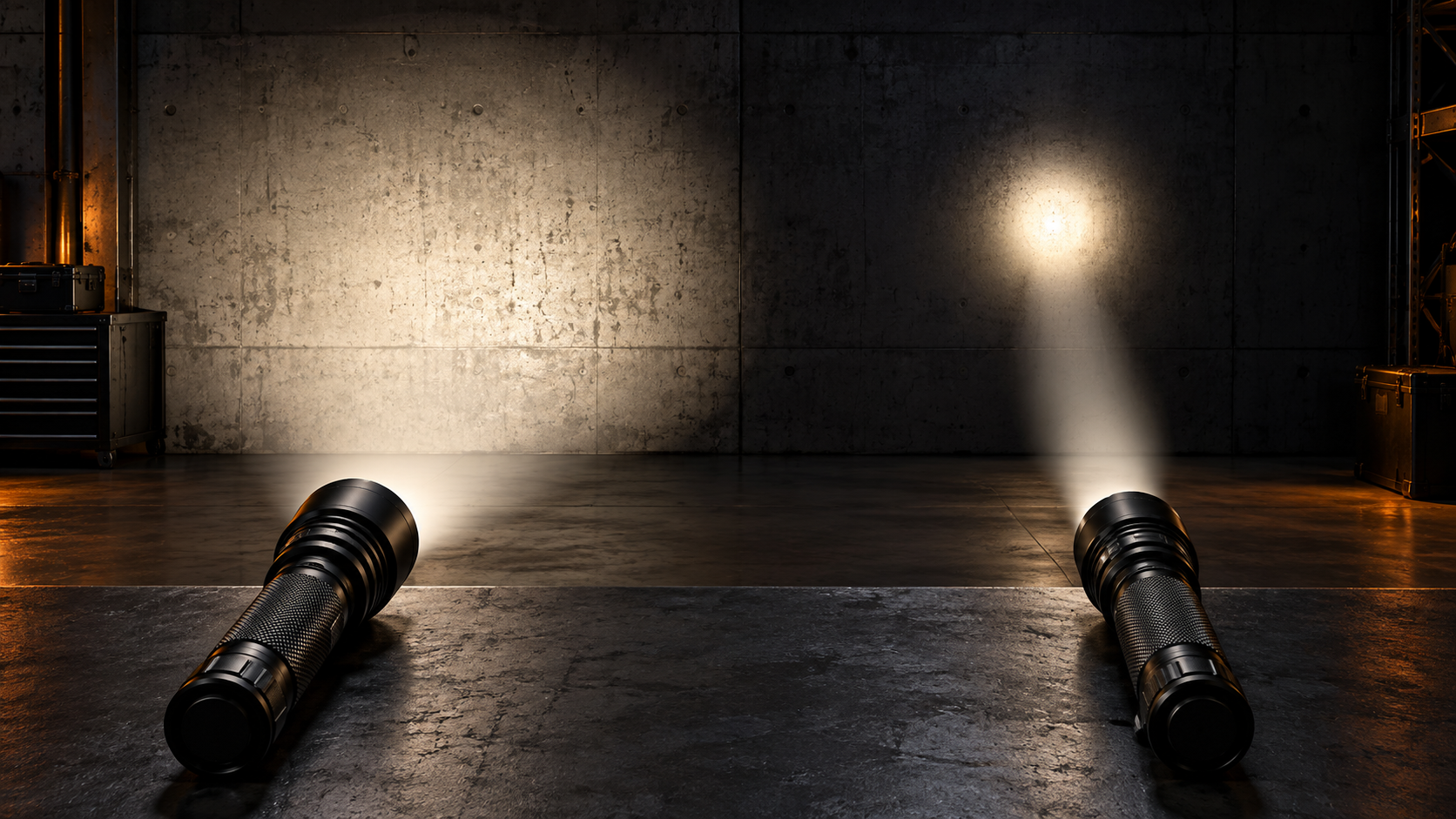
A flashlight beam pattern describes how light is distributed between the central hotspot, surrounding spill and overall beam width. This distribution changes how a flashlight feels and performs in use, even when two products have similar headline lumen output.
The central hotspot is the more concentrated part of the beam. It can help direct attention toward a smaller or more distant target. The spill is the wider light around it. Spill is not wasted light: it can help the user see nearby surroundings, access routes and the wider working area. A practical beam design balances these elements for a particular job.
Same Lumens, Different Beam
Two flashlights with similar lumen output can feel completely different because their beam intensity and distribution are different. One may spread light across a wide near-field area, while another may place more visible intensity into a tighter hotspot. Lumens alone cannot tell a buyer which beam is more useful for the task.
Spot vs Flood vs Balanced Flashlight Beams
| Beam type | Typical strength | Possible limitation | Best-fit tasks | Buyer question |
|---|---|---|---|---|
| Focused / spot | Narrower central intensity and stronger directional reach | Can feel too narrow for a large close work area | Longer-range observation, target identification, looking into deeper spaces | Does the user need to identify a smaller target farther away? |
| Flood / wide | Broad close-range coverage and wider situational awareness | Less emphasis on distant target identification | Maintenance, walking, camping, task-area illumination and close inspection | Does the task require a wider area to remain visible at once? |
| Balanced / general-purpose | Usable hotspot with practical spill around it | May not outperform a specialised beam at either extreme | EDC, outdoor walking, equipment walkarounds and mixed tasks | Will one light be used across several different situations? |
A spot beam is not tactical only
A focused beam can also help with industrial inspection, observation, search tasks or identifying a component deeper inside equipment. The appropriate use depends on distance and target size, not a category label.
A wide beam is not best for every close task
For a narrow inspection point or confined space, light spread too widely can place illumination outside the target area. Beam width should match the area that actually needs to be seen.
Choose the Beam by Working Distance and Target Size
Before comparing models, define the normal viewing distance. A beam that is comfortable and useful for reading labels inside a cabinet may not be the best choice for an outdoor walkaround. Likewise, a beam built to identify distant targets may not be the most practical way to illuminate a bench or tent interior.
Close range
For machinery, cabinets, repairs, labels and nearby equipment, a wider or controlled beam often helps reveal the immediate work area. Avoid assuming that the widest possible beam is always best; the target area still matters.
Mid-range
For walking, general outdoor use and equipment walkarounds, a balanced beam can provide both a clear central view and enough surrounding spill to retain awareness of the wider area.
Longer range
For observation, searching or identifying a smaller distant target, a more focused beam is generally more relevant. Effective distance depends on beam intensity and optical design, not only on total lumen output.
High Lumens Does Not Automatically Mean Long Range
Higher lumen output does not automatically produce a longer beam distance. Beam intensity, optics and beam shape affect how much light reaches a distant target. For selection, compare the intended task and beam profile rather than treating maximum lumens as a complete answer.
Beam Selection for Common Applications
| Application | Typical distance | Useful beam character | Why | Possible product type |
|---|---|---|---|---|
| Everyday carry | Variable | Balanced | One compact light may be used for many unplanned tasks | EDC flashlight |
| Close equipment inspection | Close range | Controlled flood or balanced beam | The technician often needs to see the component and its surrounding context | Pen light, handheld or work light |
| Maintenance and repair | Close to mid-range | Wide usable task-area beam | Broad, stable coverage can reduce repeated re-aiming | Work light or headlamp |
| Outdoor walking | Mid-range | Balanced with usable spill | Both path visibility and peripheral awareness may matter | Flashlight or headlamp |
| Camping or area tasks | Close range | Flood or area-oriented beam | A larger nearby area needs useful illumination | Camping light or work light |
| Longer-range observation | Longer range | Focused / spot beam | A smaller or more distant target needs clearer identification | Focused flashlight |
Headlamps add another decision point: the beam follows the user’s view direction, which can be useful for walking, repair and maintenance. Work lights are more often placed to illuminate a fixed task area. The best option depends on whether the light should move with the user or stay on the work point.
A Practical Flashlight Beam Selection Framework
Is the user checking a nearby detail, lighting an area, walking, repairing equipment or observing something farther away?
Choose for the normal working distance, not only for an occasional extreme situation.
A small distant target and a large close work area need light distributed differently.
Consider whether the user needs to see only the target or also the surrounding environment.
Decide whether handheld, head-mounted or fixed task lighting fits the job.
After selecting the beam direction, evaluate the required operating time, power format and charging routine.
Fast decision logic
If the task is close-range work across a larger target area, consider a wider or controlled beam. If the target is small and farther away, consider a focused beam. If daily work changes often, a balanced beam can be more practical. If wide-area and focused tasks are both frequent, a dual-beam or multi-channel platform can reduce compromise, depending on product design.
What Should B2B Buyers Specify When Selecting a Flashlight Beam?
For product planning or sourcing, “high lumen flashlight” is rarely enough information. A more useful brief explains the intended application, normal working distance, target size, spot or flood preference, peripheral-awareness requirement, hands-free need, expected runtime, power direction and operating environment.
Beam appearance can also include rings, dark areas, uneven edges or colour variation. These characteristics do not automatically mean a product is defective; some result from the optical design and intended beam profile. The relevant question is whether the beam supports the target application consistently and comfortably.
Explore Relevant SHENGQI LIGHTING Product Categories
SHENGQI LIGHTING supports portable-lighting development across different form factors and beam directions. Individual product suitability must be confirmed against the relevant product specification and application requirement.
Conclusion: Choose Distribution, Not Just Output
A useful flashlight beam is not simply the brightest, widest or narrowest one. It is the beam that places light where the user needs it: on a nearby working area, along a path, into a deep space or onto a distant target. Start with the task, then compare beam distribution, form factor and usable runtime together.
CANTON FAIR PRODUCT PREVIEW
See More Than 10 New SHENGQI LIGHTING Products at the 140th Canton Fair
SHENGQI LIGHTING will present more than ten new portable-lighting products at the 140th Canton Fair from October 15–19, 2026. International buyers can visit Booth 16.4F25 to review new product directions, explore existing portable-lighting platforms and discuss beam requirements, applications, customization and OEM/ODM development directly with our team.
Specifications for unreleased products should be confirmed directly with SHENGQI LIGHTING and remain subject to final engineering validation where applicable.
Need Help Matching a Beam Pattern to Your Product Direction?
Share the intended application, working distance, target size, spot or flood preference, hands-free requirement, runtime expectation, target market and estimated quantity. Dongguan Shengqi Lighting Technology Co., Ltd. can help identify the relevant product category and discuss product-specific or OEM/ODM development options.
Explore Products | Explore Services | Contact SHENGQI LIGHTING | sales@shengqilight.com