Illuminate the Abyss: Sourcing the D1500 20m Waterproof Diving Flashlight
[ Engineering Abstract: The Deep-Sea Challenge ]
The oceanic environment represents the absolute apex of structural and electronic adversity. When an illumination instrument breaches the surface, it is immediately subjected to exponentially increasing hydrostatic pressure, aggressive galvanic corrosion via saline electrolytes, and severe photonic attenuation caused by turbid water columns. Terrestrial flashlights, even those boasting high IP68 ratings, routinely suffer catastrophic implosions or electrical shorts when exposed to authentic marine operations.
Scuba diving centers, underwater salvage crews, and marine biology photographers cannot tolerate equipment failure. Navigating pitch-black underwater cave systems or inspecting submerged heavy machinery dictates the utilization of instruments explicitly engineered for deep-water survival. Consequently, global distributors must partner with a dedicated Dive Light Manufacturer capable of executing micron-level CNC tolerances and specialized elastomeric sealing protocols.
This technical dossier deconstructs the D1500—an uncompromising marine illumination tool. By analyzing its 20W continuous output, triple-seal hydrostatic architecture, and 6063 aluminum metallurgy, procurement officers will obtain the empirical data necessary to source the ultimate Professional Underwater LED Light for their commercial fleets.
I. Subterranean Photometrics: 1500LM Optical Power
Water is an exceptionally dense optical medium. It absorbs and scatters light exponentially faster than atmospheric air. Red and yellow wavelengths are absorbed within the first few meters of depth, plunging the diver into a monochromatic blue-green void. To counteract this severe attenuation, marine optics must deliver overwhelming raw output paired with a highly calibrated color temperature.
The 20W Optical Engine
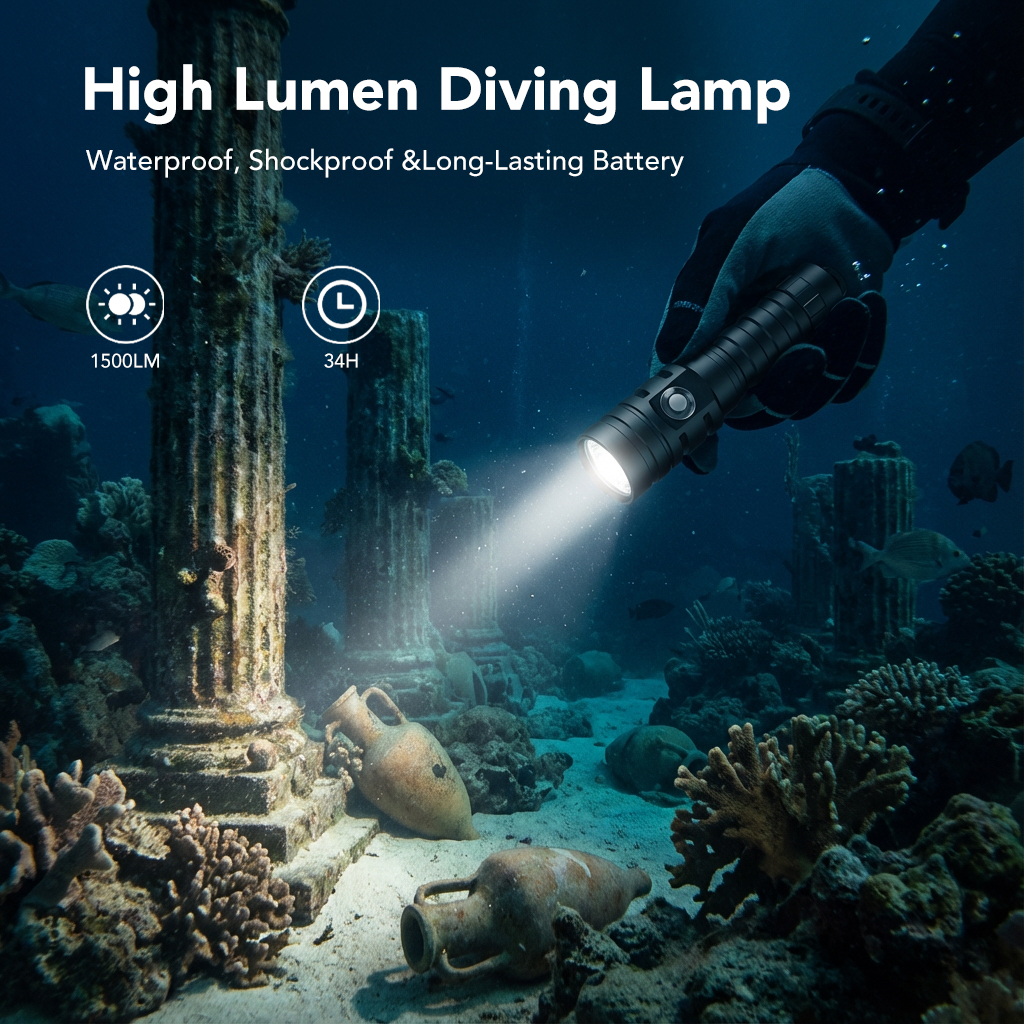
At the core of the D1500 resides a powerful 20W LED semiconductor. Driven by a highly efficient constant-current regulator, this diode generates a massive 1500 lumens of total luminous flux. As a specialized 1500LM Diving Flashlight OEM, SHENGQI LIGHTING ensures this output is mathematically sustained rather than acting as a momentary burst, providing divers with continuous daylight-level illumination during critical seabed tasks.
6500K Spectral Penetration
The D1500 is rigidly calibrated to a Correlated Color Temperature (CCT) of 6500K. This cool-white spectrum possesses intense peaks in the blue and green light bands. Because water transmits blue/green light with the least resistance while rapidly absorbing warmer colors, the 6500K spectrum maximizes hydraulic penetration.
Coupled with an ultra-deep, vacuum-metallized Smooth (SMO) parabolic reflector, the D1500 focuses this photonic energy into a tight column. This architecture allows the beam to pierce the pitch-black seabed, achieving a verified 173-meter beam distance underwater. This distance is critical for identifying structural hazards on submerged oil rigs or locating fellow divers in highly turbid silt conditions.
II. Hydrostatic Engineering: The Triple-Seal Architecture
At a depth of 20 meters, hydrostatic pressure exerts roughly 2.94 atmospheres (over 43 PSI) of crushing force uniformly across the flashlight chassis. Any microscopic gap or threaded imperfection will result in immediate capillary water ingress, causing the lithium-ion battery to violently short-circuit.
The Triple-Seal Imperative
Terrestrial flashlights rely on a single, thin O-ring for basic splash resistance. The D1500 is engineered with an uncompromising professional triple-seal system. This redundant defense mechanism is what solidifies its status as a true 20m Waterproof Scuba Torch.
- 1. Professional O-Rings: Dual, high-durometer fluororubber O-rings are seated deep within CNC-machined grooves. Under pressure, these rings undergo elastic deformation, expanding to completely fill the microscopic void between the tail cap and the primary battery tube.
- 2. Silicone Precision Holes: The switch mechanism is the most vulnerable point of any dive light. The D1500 utilizes precision-injected silicone seals around the magnetic or push-button actuation points, ensuring absolute hermetic isolation without restricting tactile mechanical movement.
- 3. Waterproof Trapezoidal Threads: Standard V-shaped threads allow water to travel along the helical path. We machine thick, trapezoidal threads coated in high-viscosity hydrophobic marine grease. This creates a labyrinth seal that physically blocks high-pressure fluid migration.
III. Marine Metallurgy: 6063 Aluminum & Structural Geometry
Saltwater ($NaCl$) is a highly conductive electrolyte. When submerged, unprotected metals immediately undergo rapid galvanic corrosion, pitting the surface and destroying the sealing threads.
Hard-Anodized Aerospace Aluminum
To counter the ocean's corrosive chemistry, the D1500 is precision-turned from a solid billet of 6063 aerospace aluminum alloy. Following the CNC process, the chassis undergoes Type III Hard Anodizing (HA III). This electrochemical process grows a dense, ceramic-like aluminum oxide layer ($Al_2O_3$) over the entire body. This layer acts as an impenetrable dielectric shield, isolating the raw aluminum substrate from the corrosive saline environment and preventing anodic dissolution.
Furthermore, the thick-walled 6063 architecture grants the D1500 extreme structural rigidity. It easily passes rigorous 2-meter impact resistance drop tests onto solid concrete, guaranteeing survival against violent impacts against coral reefs, boat decks, or heavy diving cylinders.
Hydrodynamic Dimensions
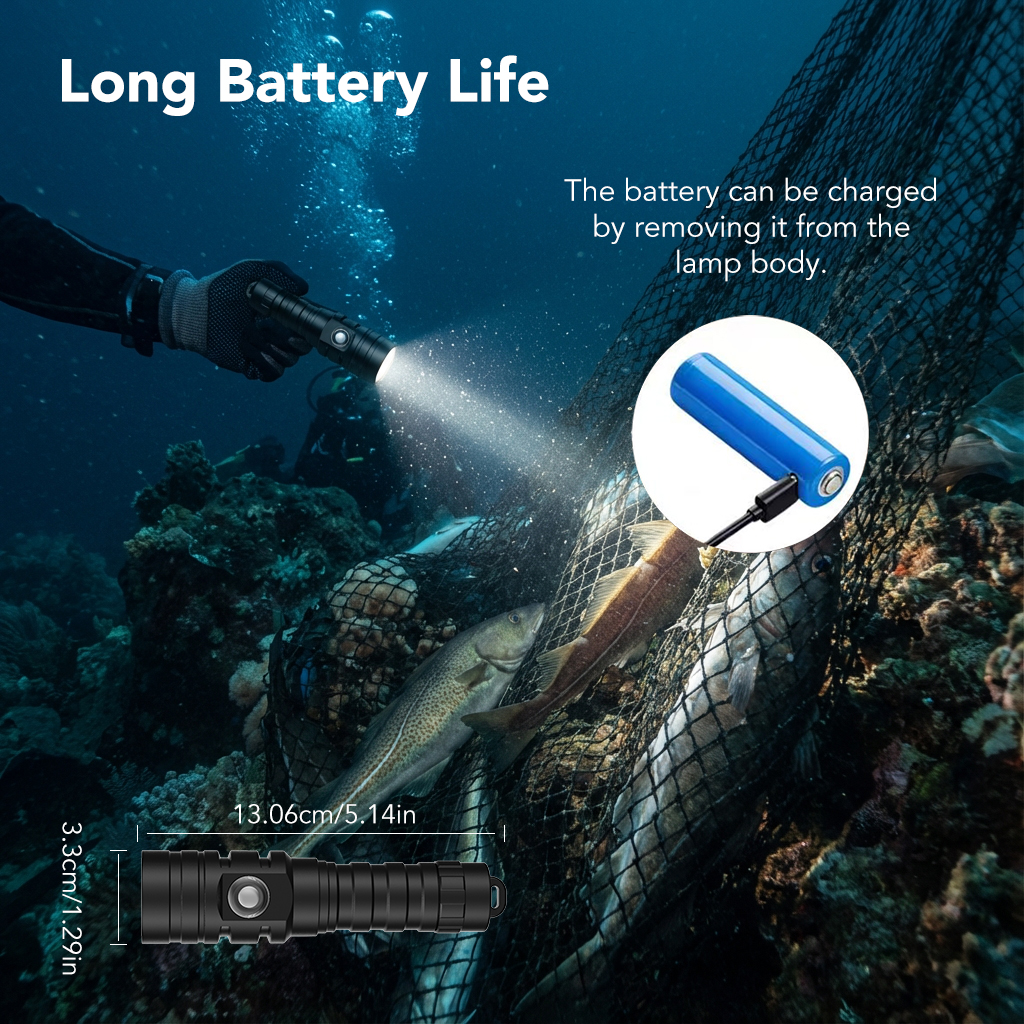
Bulky equipment creates underwater drag and accelerates diver fatigue. Engineers optimized the D1500 into an ultra-compact handling profile. Measuring exactly 130.6mm in length with a 33mm base diameter, the instrument slides seamlessly into a BCD (Buoyancy Control Device) pocket or mounts unobtrusively alongside an underwater camera rig, maximizing hydrodynamic efficiency.
IV. Thermodynamic Endurance: 18650 Lithium Integration
Deep-sea environments pose a unique challenge for battery chemistry: extreme cold. The ambient temperature of deep water rapidly saps the chemical kinetic energy of standard batteries, leading to sudden, catastrophic voltage drops.
To combat thermal degradation, the D1500 is powered by a high-capacity 18650 3100mAh Li-ion battery. This premium electrochemical cell is highly resilient to cold-water voltage sag. Paired with a sophisticated constant-current driver board, the 3100mAh reservoir guarantees extended, uninterrupted dive times. The flashlight maintains a flat, stable lumen output throughout the descent and ascent, ensuring underwater photographers and salvage crews never experience sudden dimming during critical decompression stops.
V. Technical Parameter Matrix: Marine Deployment
Procurement directors must base their sourcing decisions on empirical data. The following matrix illustrates the profound engineering disparities between the D1500 marine instrument and standard IPX8 terrestrial flashlights.
Secure Your Marine Procurement Supply Chain
Supplying recreational scuba centers, commercial welding divers, and marine biology expeditions requires equipment with verified, empirical reliability. Sourcing generic flashlights introduces catastrophic liability risks under hydrostatic pressure.
[ OEM / ODM Integration Protocol ]
SHENGQI LIGHTING operates a 130,000 sq. ft. ISO9001-certified manufacturing facility equipped with negative pressure leak-testing chambers and 75 advanced CNC machines. We urge diving clubs, marine gear distributors, and underwater photography wholesalers to contact our engineering trade division. Request a rigorous evaluation sample of the D1500, inquire about direct factory wholesale pricing, and explore our bespoke private-label branding capabilities.