
Why This Topic Matters During the 2026 Heat Season
Extreme heat has remained a major preparedness issue across Europe during the 2026 summer season. WHO/Europe has continued to emphasize heat preparedness and the need for resilient essential services.
Its 2026 planning guidance for a warmer world notes that extreme heat can place sudden pressure on essential services and that overheating can contribute to failures in power supplies, cooling systems and IT services.
This does not mean every heatwave will produce a blackout. It does mean that emergency-product planners should consider overlapping conditions such as high ambient heat, temporary grid failure, restricted charging access and equipment that may have been stored for months before use.
Emergency lighting does not reduce heat exposure itself. Its role is to provide reliable visibility when normal lighting and charging routines are interrupted.
What flashlight is suitable for a heatwave power outage?
A flashlight suitable for a heatwave power outage should provide practical low and medium modes, a battery system that remains accessible when charging is unavailable, clear storage instructions and at least one independent backup light. Replaceable batteries can support emergency replacement planning, while rechargeable systems need a charging contingency. High mode is useful for short directional tasks, but runtime must be verified by output mode and battery type. A practical plan should also include backup lighting and batteries that are stored and inspected according to approved instructions.
How Extreme Heat Changes Flashlight Battery Planning
A flashlight used every day and a flashlight stored for months in a vehicle, warehouse or emergency kit have different planning requirements. Elevated storage temperatures can accelerate battery aging, while battery condition also changes with chemistry, age, storage environment and state of charge.
Emergency-product planners should therefore consider both storage and operation. A flashlight that remains unused for a long period still needs scheduled inspection of the cells, contacts, battery compartment and packaging condition.
Replaceable alkaline batteries may develop leakage or contact problems when poorly stored or left unchecked. Rechargeable lithium-ion products require appropriate charging, storage and protection instructions. NiMH batteries can support reusable AA workflows when the flashlight officially supports that chemistry.
Physical battery size alone should never be used to assume electrical compatibility. A flashlight should only use battery formats officially listed by the manufacturer.
For all battery types, follow the battery manufacturer’s approved storage and charging instructions. Emergency-product packaging should also explain inspection intervals, supported formats and replacement procedures clearly enough for users who may not have touched the light for months.
Why Maximum Lumens Are Not Enough During a Power Outage
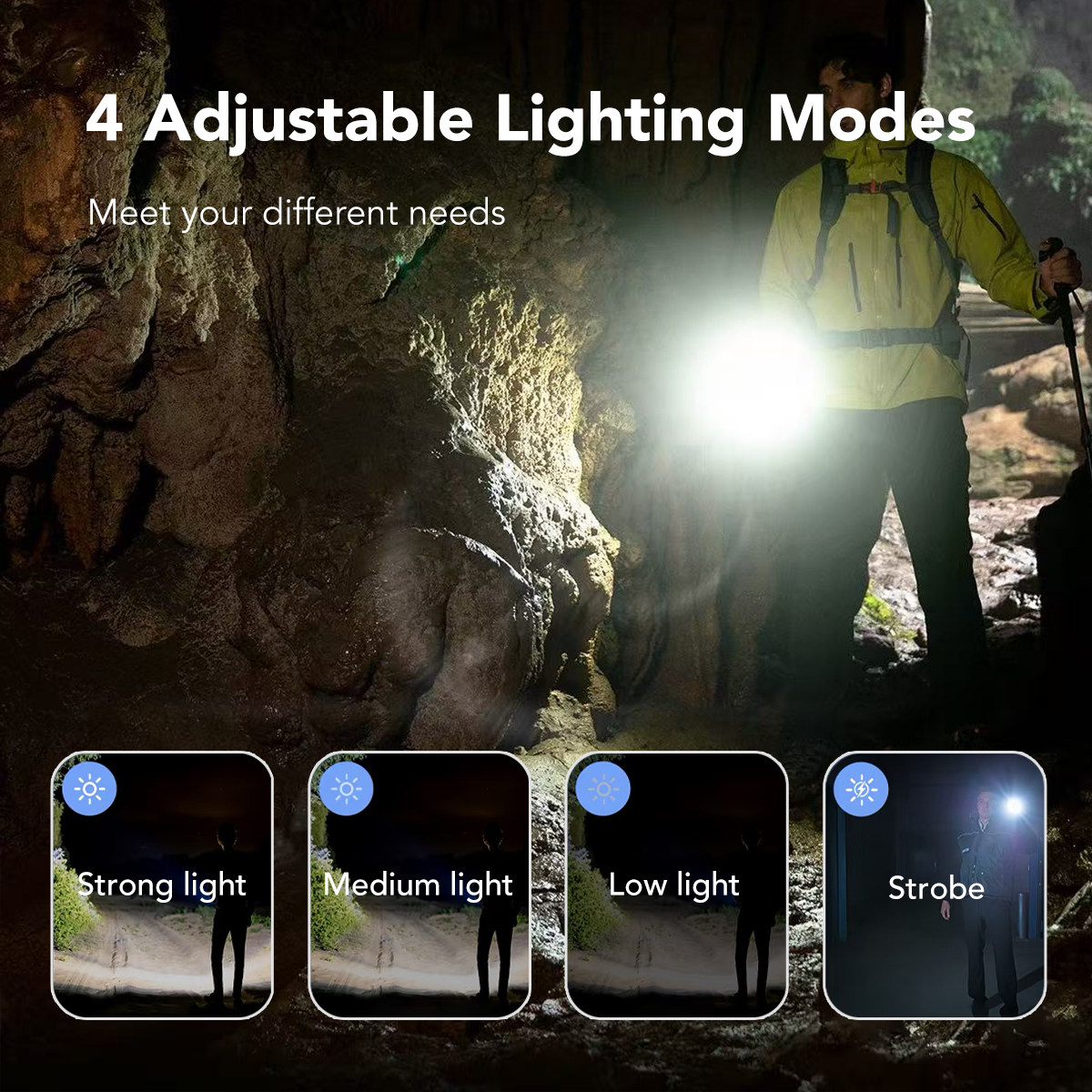
Maximum output is useful, but emergency readiness depends on more than the highest lumen specification. High-output modes place greater energy demand on the battery and may be unnecessary for many close-range tasks.
High Mode
Useful for short outdoor checks, locating equipment, checking property and brief directional visibility. It should be treated as one tool within the mode range, not the entire outage strategy.
Medium Mode
Suitable for moving through rooms, repeated household tasks, vehicle checks and general work where maximum brightness is unnecessary.
Low or Moon Mode
Useful for locating supplies, map reading, nighttime orientation, close-range work and reducing unnecessary battery demand. Exact operating time still requires formal testing.
Emergency lighting requires useful mode spacing, not only a large maximum-lumen specification. Battery capacity alone also does not prove runtime; operating time depends on battery type, mode, efficiency, temperature and battery condition.
Battery Platforms for Power-Outage Flashlights
Different battery systems serve different user habits. The right platform depends on charging access, replacement availability, storage inspection and verified performance.
| Battery Platform | Main Advantage | Outage Planning Concern | Buyer Verification Point |
|---|---|---|---|
| AA Alkaline | Familiar replacement format in many retail markets. | Long storage requires periodic checks for cell condition, leakage and contacts. | Confirm official compatibility and storage instructions. |
| AA NiMH | Supports reusable AA-format workflows when officially supported. | Requires suitable charging and storage management. | Verify charger requirements, output and runtime by mode. |
| 14500 Lithium-Ion | Can support compact rechargeable and higher-performance designs. | Needs appropriate charging, battery and storage instructions. | Confirm exact cell specification and permitted alternatives. |
| 18650 Lithium-Ion | Can support higher-capacity portable-lighting platforms. | Nominal capacity does not prove actual runtime. | Review discharge data, charging instructions and storage guidance. |
| Built-In Rechargeable Battery | Convenient integrated power for routine use. | Requires a charging contingency if grid power is unavailable. | Verify backup charging, storage state and service planning. |
A flashlight should only use battery formats officially listed by the manufacturer. Similar physical dimensions do not prove compatibility, and output or runtime may differ between supported battery platforms.
L2 Case Study: Multi-Battery Flexibility for Emergency Planning
The L2 multi-battery flashlight demonstrates how multiple officially supported battery formats can give users different power-planning options without guaranteeing identical performance.
It uses an OSRAM P8 LED with 750LM High, 230LM Medium and 5LM Low output, with a 115m maximum range. The 5LM Low mode is especially relevant to outage planning because it gives users a lower-output option for close tasks where maximum brightness would create unnecessary energy demand.
L2 supports a 14500 3.7V lithium battery, one AA alkaline battery and one AA NiMH battery. The lithium platform suits rechargeable and higher-performance use, AA alkaline can support replacement planning when charging is unavailable, and AA NiMH fits users with reusable AA charging habits.
Battery compatibility does not mean identical output or runtime. B2B buyers should separately verify brightness, runtime and thermal behavior for every supported battery platform before making packaging or performance claims.
The L2 uses a 6463 aluminum alloy body with an anodized black finish, a mechanical tail switch and a two-way clip. Its 94.3mm × 20.5mm compact format and 59.7g weight with a 14500 battery support portable carry.
Its IPX6 rating indicates protection against powerful water jets under the applicable test conditions. It does not mean the flashlight is submersible. Water resistance and battery endurance are separate product characteristics, and both should be supported by their own test evidence.
Brands evaluating similar products can review the broader compact backup flashlight category when planning primary and secondary lighting roles.
Why One Flashlight Is Not a Complete Outage Lighting Plan
A practical emergency kit may include a primary handheld light, a compact personal backup, a headlamp for hands-free tasks and spare compatible batteries.
The primary handheld light supports general directional lighting. A small backup light gives one person an independent source if the primary light is unavailable. A hands-free backup lighting option can support carrying supplies, organizing equipment and completing repairs.
Backup lights should not depend entirely on the same single charging condition. Pairing different officially supported power strategies can reduce dependence on one charger, one battery or one device.
A phone light remains useful for quick tasks, but preserving phone battery for communication, alerts and navigation may be more important during a prolonged grid interruption. Dedicated lighting reduces the need to use the phone as the only available light source.
Lighting redundancy often provides more practical resilience than simply choosing a single flashlight with a larger maximum-lumen specification.
What Should B2B Buyers Verify Before Sourcing an Emergency Flashlight?
B2B buyers should not approve an emergency flashlight based only on maximum lumens or nominal battery capacity. Product definition should also cover storage, charging access, useful lower modes, battery compatibility and clear instructions.
Where will the flashlight and batteries be stored?
Vehicle, warehouse, household and emergency-kit storage create different inspection needs. The storage plan should follow approved battery guidance.
Which battery formats are easily available in the target market?
Replacement availability varies by market. Official compatibility should be verified instead of inferred from cell dimensions.
Has runtime been tested separately for every supported battery?
Compatibility and capacity do not prove operating time. Request mode-specific discharge data for each battery platform.
Are the low and medium modes useful for real outage tasks?
Evaluate movement, supply checks, vehicle inspection and close work. Lower modes should solve real tasks rather than exist only on a specification sheet.
What charging option remains available during a grid failure?
Rechargeable products need a charging contingency or an independent backup light. Packaging should not imply unlimited availability without grid power.
Do packaging and instructions explain battery storage and replacement clearly?
Users need clear guidance on supported batteries, storage checks, charging, inspection and replacement before an emergency occurs.
How SHENGQI LIGHTING Supports Emergency Lighting Development
For emergency-lighting projects, emergency lighting product development can include battery-platform planning, Electronic Design, driver and mode planning and clear product instructions.
SHENGQI LIGHTING also maintains battery and flashlight testing capabilities that include Battery Testing, Discharge Time Testing, Luminous Performance Testing and Waterproof Testing. These are general company capabilities and should not be interpreted as proof that every model has completed every available test.
For an emergency-lighting program, engineering value comes from coordinating supported battery formats, output modes, discharge behavior, storage instructions, waterproof structure and production consistency. SHENGQI LIGHTING operates under an ISO9001 quality management system.
When a product supports multiple battery chemistries, buyers should request separate test evidence for each configuration. Missing runtime curves, thermal data or high-temperature storage evidence should remain buyer-verification items rather than becoming unsupported marketing claims.
Frequently Asked Questions
1. What flashlight is suitable for a heatwave power outage?
A suitable flashlight should provide practical low and medium modes, verified battery compatibility, clear storage instructions and a backup-light plan. The right choice depends on charging access, battery availability, expected tasks and the environmental protection required by the application.
2. Are AA batteries or rechargeable lithium batteries better for emergency lighting?
Neither platform is universally better. AA alkaline batteries can support replacement planning, NiMH can support reusable AA workflows when compatible, and lithium-ion systems can support rechargeable higher-performance designs. The choice should match charging access, storage management and target-market habits.
3. Can high temperatures affect flashlight batteries?
Elevated storage temperatures can accelerate battery aging. Actual performance also depends on chemistry, battery age, condition, charging state and storage history. Follow the battery manufacturer’s approved storage and charging instructions instead of applying one temperature rule to every battery type.
4. Why are low modes useful during a power outage?
Low modes can reduce unnecessary energy demand and glare during close tasks such as locating supplies, reading instructions and moving through a room. They do not guarantee a fixed runtime, but they can better match repeated low-distance tasks than maximum output.
5. What should B2B buyers verify before sourcing an emergency flashlight?
Buyers should verify battery compatibility, runtime testing by mode and battery type, storage instructions, charging contingencies, useful lower modes, waterproof evidence and packaging accuracy. Unsupported high-temperature, all-night or identical multi-battery performance claims should not be used.
Plan Emergency Lighting as a Complete Power System
A heatwave power outage flashlight should be evaluated through battery storage, mode spacing, charging access and backup-light availability. Maximum brightness remains useful for short tasks, but it cannot replace runtime testing or a compatible backup-power plan.
AA alkaline, AA NiMH and lithium-ion platforms serve different user behaviors. A multi-battery product such as L2 demonstrates how one flashlight can offer additional power choices, but each supported battery configuration still requires its own brightness, runtime and thermal verification.
The strongest emergency-lighting plan combines a suitable primary light, an independent backup, hands-free illumination, compatible spare batteries and clear inspection instructions.
Develop Emergency Lighting Around Verified Battery and Outage Requirements
Emergency preparedness brands, outdoor brands, automotive emergency-kit brands, hardware retailers, distributors, importers, product managers and OEM/ODM sourcing teams can discuss emergency flashlight development, multi-battery platform planning, mode design, battery compatibility, discharge-time testing, waterproof structure and packaging instructions.
Contact SHENGQI LIGHTING for an OEM/ODM technical evaluation at sales@shengqilight.com.