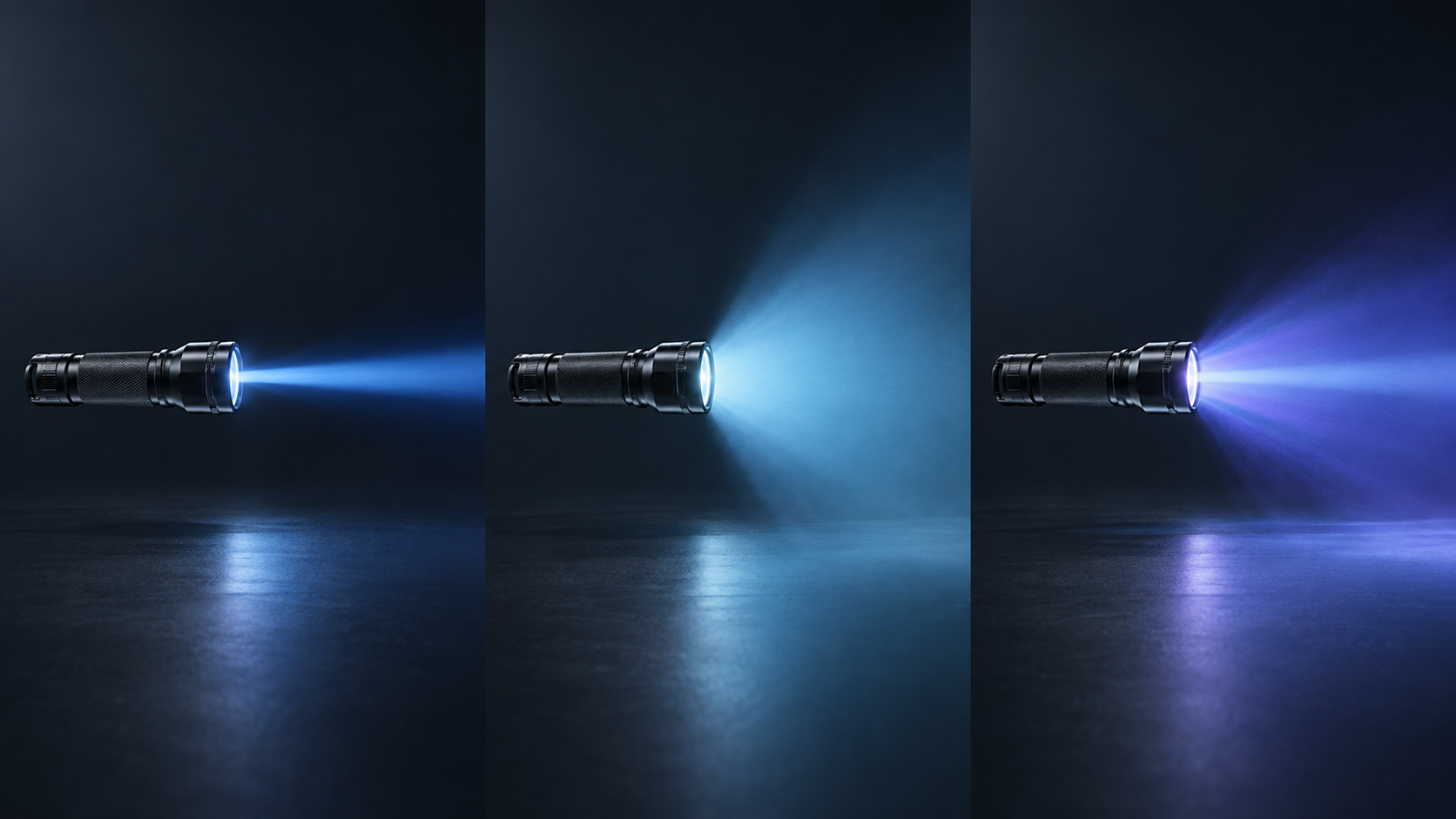

A spot-oriented flashlight concentrates more of its light into a narrower directional beam, a flood-oriented flashlight distributes light across a wider nearby area, and a dual-beam architecture provides separate or combined lighting roles within one product. The visible result still depends on the emitting surface, reflector, TIR optic or lens, optical alignment, channel control, available power and thermal design. A single-source flashlight can already produce a hotspot, transition zone and spill; a second channel is useful only when it resolves a task that the existing beam cannot handle well enough. In a multi-channel LED flashlight, buyers should assess each channel independently before judging a combined mode, because total light alone does not show whether the beam roles, visual balance, runtime and heat behavior are appropriate.
Spot, Flood or Both? Start With the Lighting Task
Spot and flood flashlight optics should start with the user task, not LED count. A spot-oriented role may suit directional search, distant inspection, path reading or locating an object along a corridor. A flood-oriented role may suit close maintenance, a work surface, camp setup or general area awareness. Mixed work often requires a user to move repeatedly between nearby detail and more distant information.
What detail must remain visible close to the user?
What needs to be interpreted while moving or working?
What directional information is genuinely required?
The correct beam architecture begins with working distance and task, not LED count.
A Single Light Source Can Still Produce a Complex Beam
A single emitter is not automatically “spot only.” With a reflector, TIR optic or lens, one source can create a central hotspot, a transition zone and usable spill. That can support both far and near tasks without adding a second optical path. Adding another channel should solve a problem the existing beam cannot solve well enough.
Ask whether the current beam is insufficient nearby, insufficient at distance, repeatedly mismatched to two different tasks, or unable to provide a meaningful user benefit that justifies extra space, power, controls and validation. A second channel is an engineering decision, not a marketing checkbox.
What Changes When a Flashlight Adds a Second Lighting Channel?
A second channel can add an emitter, optic, PCB routing, driver requirement, internal volume, switch logic, firmware where applicable, heat source and verification workload. It may improve task flexibility, but it also creates more operating states that must remain understandable and repeatable. Optical flexibility creates system complexity.
| Conceptual Architecture Examples | Role | Main Design Question |
|---|---|---|
| A — One Source, One Combined Beam | One emitter and optical path | Can one profile cover the task? |
| B — Separate Spot and Flood Sources | Defined optical roles | How independent should they be? |
| C — Multi-Source / Multi-Channel System | More than one controllable function | Which states create real value? |
Emitter Size Influences Beam Concentration—but Does Not Determine It Alone
Apparent emitting area and optic size work together. A smaller emitting area may support higher directional intensity in an appropriate optical design, but output, focus, alignment and thermal behavior also matter. Multiple emitting regions can make beam integration more difficult. Package architecture must be verified from the actual component specification.
Reflector Geometry Converts Source Output Into Beam Distribution
Reflector diameter, depth, surface, emitter position and focal relationship influence hotspot shape, spill and beam concentration. A deeper or larger reflector may support different beam concentration depending on the complete optical design. Larger optical volume can also affect head diameter, product length, weight and carry volume, creating a compactness trade-off.
TIR and Lens Systems Can Shape Both Narrow and Wide Beams
TIR optics can collect and redirect light into narrow, medium or wide patterns depending on geometry. Reflectors, TIR optics and lens systems are design tools—not quality rankings. The useful question is whether the selected optic produces the required beam profile, packaging result and repeatable alignment for the intended application.
Separate Optical Channels Let Each Beam Be Designed for a Different Job
A spot channel can be optimized around directional information, while a flood channel can emphasize wider near-field coverage. Separate paths may make role definition clearer, but they can increase physical volume, PCB complexity, driver requirements, control logic, thermal load and alignment work. When sources share a very limited optical volume, they may restrict each other; fully separate optics can consume more space. Optical independence and packaging efficiency often trade against each other.
| Channel | User Task | Working Distance | Beam Shape | Output Priority | Control Requirement | Verification |
|---|---|---|---|---|---|---|
| Spot | Directional task | Application-defined | Concentrated | Forward information | Direct or logical access | Independent beam review |
| Flood | Nearby task | Application-defined | Wide | Area awareness | Direct or logical access | Independent beam review |
| Combined | Mixed task, if required | Application-defined | Balanced system | Near + far balance | Explicit state definition | Combined-mode review |
Should Spot and Flood Channels Run at the Same Time?
Independent operation can help users select a precise role with lower demand than running both channels. Simultaneous operation may increase illuminated area and combine near and far information, but it can also increase electrical demand, heat and visual complexity. A strong flood can dominate the near field, making the far spot feel less prominent. Light-colored ground, wet surfaces, dust and nearby walls can increase foreground reflection and reduce far-field contrast. Combined output must be balanced as a visual system.
Running both channels can broaden coverage by combining nearby flood illumination with directional spot information. It can also raise power demand, thermal load and battery draw, while changing how the user perceives contrast. A bright foreground may visually compete with a distant hotspot, particularly around reflective surfaces. Combined mode should therefore be assessed for beam balance, sustained behavior and task usefulness rather than treated as an automatic visibility improvement.
Two Lighting Channels Compete for the Same Battery and Power Budget
Spot-only, flood-only and combined states can draw power differently. A combined mode is not automatically the simple sum of two independent maximum settings, because battery current, driver limits, control strategy, emitter efficiency and thermal conditions may constrain the sustained result. Fixed allocation, dynamic allocation and user-selected channel strategies are possible architectures, but each must be verified on the actual product.
Without measured evidence, individual peak claims cannot be added to create a combined-mode claim. Runtime also cannot be calculated from output ratios alone. Battery voltage behavior, driver operation and thermal response change by operating state.
Multiple Light Sources Create Multiple Heat Sources in Limited Space
Multi-channel designs can create simultaneous heat from emitters, drivers and the battery in a compact body. Switching channels may also move the thermal load from one region to another. Thermal validation should cover each operating state, not only the single highest headline mode. Peak spot, peak flood and peak combined output do not automatically describe sustained performance.
| Operating State | Primary Heat Sources | What to Measure | Buyer Question |
|---|---|---|---|
| Spot Only | Spot source, driver | Sustained beam behavior | Does the role remain useful? |
| Flood Only | Flood source, driver | Nearby visual stability | Is output appropriate over time? |
| Combined | Multiple sources, battery, driver | Heat and balance | What can be sustained? |
| Sustained Medium Use | Application-dependent | Comfort and stability | Which state supports real work? |
Optical Architecture Becomes a UI Problem as Soon as the User Has More Than One Channel
Once a product has spot, flood and possibly combined operation, the user must understand source selection as well as brightness selection. One design may ask the user to choose a light source first and brightness second; another may cycle through source-and-level combinations. There is no universal winner, but the number of possible states grows faster than the number of physical light sources.
Potentially faster access, with more physical controls.
Potentially simpler hardware, with more UI sequences.
OFF → SPOT → FLOOD → COMBINED — IF REQUIRED
Or dedicated controls with separately defined brightness access and memory behavior.
A Wall Beamshot Shows Beam Shape—but Not the Whole Outdoor Experience
A wall beamshot can reveal hotspot shape, symmetry, spill and optical artifacts. It cannot prove outdoor contrast, dark-object visibility, foliage reflection, wet-surface behavior, dust response or near-to-far visual balance. Review a close work surface, a medium-distance object, a farther target where relevant, reflective foreground and a representative outdoor setting.
A wall is flat, controlled and often reflective. Real environments include depth, uneven surfaces, vegetation, dark objects and distracting foreground reflections. Combined-beam quality is about balance, not only total output.
Multi-Channel Flashlights Multiply the Alignment Problem
Each channel adds an alignment stack involving LED position, PCB position, optic seat, reflector or TIR position, housing tolerance and lens alignment. Small differences can shift a hotspot, create asymmetry or change visible channel-to-channel balance. Different sources can also introduce tint, CCT or bin variation where relevant. Multi-source prototypes should be inspected for unintended light paths and optical crosstalk.
Usefulness depends on the defined role of each source, the optic, controls, power allocation, thermal behavior and the balance users actually see. A golden sample should document the approved revision, BOM, optical components, PCB or firmware where applicable, channel behavior and beam evidence—not only one wall photo.
Spot vs Flood vs Dual-Channel Flashlight at a Glance
| Architecture | Primary Strength | Primary Trade-Off | What Buyers Should Verify |
|---|---|---|---|
| Spot-Oriented | Directional information | May offer less nearby coverage | Beam role and sustained behavior |
| Flood-Oriented | Broad nearby awareness | May reduce far-field emphasis | Foreground balance and task fit |
| Dual / Multi-Channel | Defined task flexibility | More system complexity | Each channel and combined state |
| Design Area | Spot-Oriented Channel | Flood-Oriented Channel | Buyer Question |
|---|---|---|---|
| Working Distance | Directional task | Nearby task | What must be seen? |
| Beam Width | More concentrated | More distributed | Where should light go? |
| Center Intensity | Often more central | Often less central | Is central emphasis useful? |
| Near-Field Coverage | May be secondary | Usually central | What detail is nearby? |
| Optic Volume | Application-dependent | Application-dependent | What packaging is acceptable? |
| Foreground Reflection | Usually lower emphasis | Needs review | Will near light reduce contrast? |
| Alignment Sensitivity | Hotspot-sensitive | Coverage-sensitive | What variation is visible? |
| User Task | Search or inspection | Work or awareness | Which task comes first? |
| Channel Access | Fast selection may matter | Fast selection may matter | How is the role selected? |
| Thermal Load | State-dependent | State-dependent | What happens over time? |
| Sustained Use | Verify independently | Verify independently | Which state supports the task? |
| Validation Method | Profile and target review | Coverage and reflection review | What evidence is needed? |
Five Mistakes Buyers Make When Evaluating Spot-and-Flood Flashlights
More sources can create more possible roles, not automatically more useful light. Each source needs a task. Each optic needs evidence. The combined result needs balance.
An all-on test hides individual channel behavior. Spot and flood should be reviewed independently. Combined operation needs its own evidence. Sustained behavior matters separately from peak behavior.
A wall image is a useful inspection tool. It is not an outdoor validation report. Foreground reflections and dark targets change the result. Test the intended application.
Both channels can draw more power and create more heat. The operating state may change driver and battery behavior. Do not infer runtime from headline output. Measure the relevant state.
One sample can look balanced while another differs. LED placement, optics and assembly tolerances can affect the beam. Compare representative samples. Define production verification before approval.
Multi-Channel Flashlight Optical Validation Matrix for B2B Buyers
| Validation Area | Buyer Question | Test Approach | Evidence | Risk if Unclear |
|---|---|---|---|---|
| Spot-Channel Role | What job? | Task review | Role brief | Feature accumulation |
| Flood-Channel Role | What nearby task? | Task review | Role brief | Poor fit |
| Spot Beam Profile | Useful direction? | Beam review | Images, observations | Unclear targeting |
| Flood Beam Profile | Useful coverage? | Beam review | Images, observations | Excess reflection |
| Center Intensity | Enough emphasis? | Project test | Measured record | Poor direction |
| Near-Field Coverage | Enough area? | Scene review | Application notes | Missed detail |
| Channel Independence | Can roles separate? | Independent operation | State record | Unclear function |
| Combined-Mode Balance | Do beams compete? | Outdoor review | Scene evidence | Visual imbalance |
| Channel Switching | Can users select correctly? | Usability review | State map | Selection error |
| Brightness Control | Levels per role? | Control review | UI definition | Complex operation |
| Power Draw | What changes by state? | State testing | Electrical record | Unsupported claims |
| Thermal Behavior | Where does heat build? | State testing | Thermal record | Poor sustained use |
| Sustained Output | What remains useful? | Timed evaluation | Output record | Peak-only decision |
| Battery Runtime | How long by state? | Project test | Runtime record | Wrong expectation |
| Optical Alignment | Beam centered? | Sample comparison | Beam images | Asymmetry |
| Color Consistency | Visual match needed? | Visual review | Bin evidence | Channel mismatch |
| Sample-to-Sample Variation | Does behavior repeat? | Compare samples | Comparison file | Golden-sample bias |
| Production Verification | How is consistency checked? | Control plan | Approved criteria | Launch variation |
Recommended sequence: Spot only → Flood only → Combined, if applicable → Channel switching → Sustained performance → Thermal review → Production-sample comparison. Do not test only “all on,” because that cannot show the value of each channel.
How OEM/ODM Buyers Should Define a Spot-and-Flood Flashlight Before Sampling
A useful brief defines the target market, target user, primary application, near-field task, far-field task, spot/flood/both requirement, independent-channel requirement, combined-mode requirement, beam preference, working distance, switching method, brightness control, sustained-use expectation, battery direction, thermal requirement, product-size direction, sample verification, production consistency, estimated quantity and target timeline.
“Need tactical flashlight with spot and flood, very bright.”
This does not define channel roles, working distance, beam profile, combined behavior or sustained performance.
Target user, near-field task, far-field task, spot role, flood role, independent or combined requirement, working distance, beam shape, channel UI, sustained requirement, battery direction and estimated quantity. A multi-channel flashlight should be specified by lighting roles, not by the number of LEDs.
| Buyer Wants | Potential Trade-Off | Question to Resolve |
|---|---|---|
| Higher Spot Intensity | Optic volume or heat | Where is it useful? |
| Wider Flood | Foreground reflection | How wide is necessary? |
| Smaller Head Size | Optical packaging | Which beam role leads? |
| Smaller Body | Battery or thermal space | What can be sustained? |
| More Channels | UI and validation complexity | Which role is essential? |
| Simultaneous Spot + Flood | Power and visual balance | When is it needed? |
| Longer Runtime | Output allocation | Which state matters? |
| Higher Sustained Output | Thermal demand | What duration is required? |
| Simpler UI | Direct channel access | What must be immediate? |
| Lower Weight | Battery or housing choices | What is the carry priority? |
For multi-channel portable-lighting projects, the optical system cannot be developed independently from the driver, PCB layout, battery architecture, thermal path and control logic. SHENGQI can support these development and verification stages within its OEM/ODM portable lighting development process. Buyers can compare tactical flashlight platforms, handheld flashlight platforms and compact multi-function architectures by application rather than by feature name alone.
A spot beam places more light into a narrower directional area, while a flood beam distributes light across a wider nearby area. Neither is automatically better. The appropriate choice depends on the working distance, user task, optic, beam profile and surrounding environment. A single flashlight can produce both a hotspot and spill, while a multi-channel design may provide separately optimized roles when one beam profile does not sufficiently support the full workflow.
No. A single-source flashlight with a suitable reflector, TIR optic or lens can provide a useful hotspot, transition area and spill for many applications. A dual-beam architecture is valuable only when separate beam roles create a meaningful benefit that outweighs the added space, power, controls, thermal interaction and validation requirements. Buyers should define the task before deciding that a second channel is necessary.
Buyers should test each channel separately, inspect spot and flood beam profiles, evaluate combined mode if applicable, review channel switching and brightness control, compare peak and sustained behavior, check thermal performance by operating state, document battery behavior and compare representative production samples. Optical alignment, color consistency and sample-to-sample beam variation also require review. The acceptance criteria should be defined for the project rather than assumed from a single demonstration sample.
Frequently Asked Questions About Spot, Flood and Multi-Channel Flashlight Optics
1. What is the difference between a spot beam and a flood beam?
A spot beam emphasizes directional concentration, while a flood beam emphasizes wider nearby distribution. The actual result depends on the source, optic, alignment and use environment.
2. Is a dual-beam flashlight always better than a single-source flashlight?
No. A second channel should solve a defined task problem that one well-designed beam cannot solve sufficiently.
3. Does a flashlight need two LEDs to provide both spot and flood lighting?
No. A single source with a suitable optical system can create a hotspot, transition zone and spill. Separate channels are one possible architecture.
4. What determines how narrow or wide a flashlight beam becomes?
Emitting area, optic geometry, reflector or TIR design, focal relationship, alignment and overall system design all influence beam shape.
5. What happens when spot and flood channels operate at the same time?
Coverage may increase, but power demand, thermal load, runtime behavior and near-to-far visual balance can also change. Test combined mode separately.
6. Does adding more light sources reduce flashlight runtime?
It can increase power demand depending on operating state and design. Runtime must be measured by channel and mode, not inferred from source count.
7. Why should each flashlight channel be tested separately?
Separate testing verifies each beam role, reveals channel-specific power and thermal behavior, and prevents an all-on result from hiding an ineffective channel.
8. Can spot, flood and multi-channel optical architecture be customized in an OEM/ODM flashlight project?
It depends on the platform, optical architecture, electronic design and engineering feasibility. A defined application brief is needed before the practical options can be evaluated.
Defined Channel Roles Create More Useful Light
A spot-and-flood flashlight should not be approved because it has more emitters or a higher combined headline output. A useful multi-channel design gives each source a defined task, verifies each optical channel independently, manages power and heat in combined states, and preserves that behavior from prototype to production. Buyers should also review the available portable-light testing capabilities, the wider portable lighting product range and, where relevant, the manufacturing process behind production verification.
Shengqi Lighting is developing a new Tactical Flashlight with Composite LED direction for preview at the 140th Canton Fair. Visit Booth 16.4F25, October 15–19, 2026. Final claims and specifications will be confirmed only after testing.
Developing a Flashlight With Separate Spot and Flood Roles?
For an OEM/ODM technical evaluation, prepare the target market, user, primary application, near-field and far-field tasks, spot/flood/both requirement, independent or combined mode requirement, working distance, beam preference, channel-control requirement, sustained-output direction, battery direction, size direction, estimated quantity and target timeline.
Discuss your project through our custom flashlight development process, contact SHENGQI LIGHTING, or email sales@shengqilight.com for an OEM/ODM technical evaluation.