The Ultimate Tactical Flashlight Battery Guide: 18650 vs 21700 vs 14500 Explained
[ Executive Metrology: The Heart of Tactical Illumination ]
Hello, this is your Senior Power Management Engineer from SHENGQI LIGHTING. Flawless CNC machining and advanced Total Internal Reflection (TIR) optics represent the physical structure of a high-end illumination tool. However, without a meticulously engineered power delivery system, these components are entirely inert.
When designing a custom product line, procurement directors face a foundational architectural decision: which electrochemical platform will drive the device? Selecting the correct cell format dictates the external dimensions, maximum lumen potential, and operational endurance of the flashlight. In this definitive engineering guide, we objectively analyze the Tactical Flashlight Battery: 18650 vs 21700 architectures, alongside micro-formats like the 14500, to help B2B buyers execute the perfect sourcing strategy.
I. The Lithium Titans: 18650 vs 21700
Rechargeable lithium-ion (Li-ion) technology is the mandatory standard for professional gear. Offering a nominal voltage of 3.7V, these cells provide the massive discharge currents required to drive advanced semiconductors. The primary debate centers on volumetric efficiency.
The 18650 Platform
Measuring 18mm in diameter and 65mm in length, the 18650 cell represents the most mature and universally compatible format in the industry. It provides an exceptional equilibrium between energy density (typically up to 3500mAh) and physical footprint.
Because it keeps the flashlight's battery tube at exactly 1 inch (25.4mm), the 18650 allows the device to fit seamlessly into standard law enforcement holsters and weapon mounts. This is precisely why we deploy the 18650 platform in highly successful law enforcement models like our T10 and T20 tactical flashlights.
The 21700 Platform
Measuring 21mm by 70mm, the 21700 is the undeniable future of heavy-duty illumination. The slight increase in physical volume yields a massive, disproportionate increase in total energy capacity—scaling up to 5000mAh.
More importantly, the 21700 cell can sustain vastly higher continuous discharge rates (amperage) with significantly less voltage sag. When engineering a searchlight intended to project 2000 to 5000 lumens continuously, the 21700 platform is an absolute structural necessity to prevent aggressive thermal throttling and rapid battery depletion.
II. Technical Parameter Matrix: Li-Ion Platforms
The following table delineates the engineering constraints and performance ceilings of the three primary battery platforms utilized in tactical manufacturing.
III. Compact & Emergency: 14500 and AA Dynamics
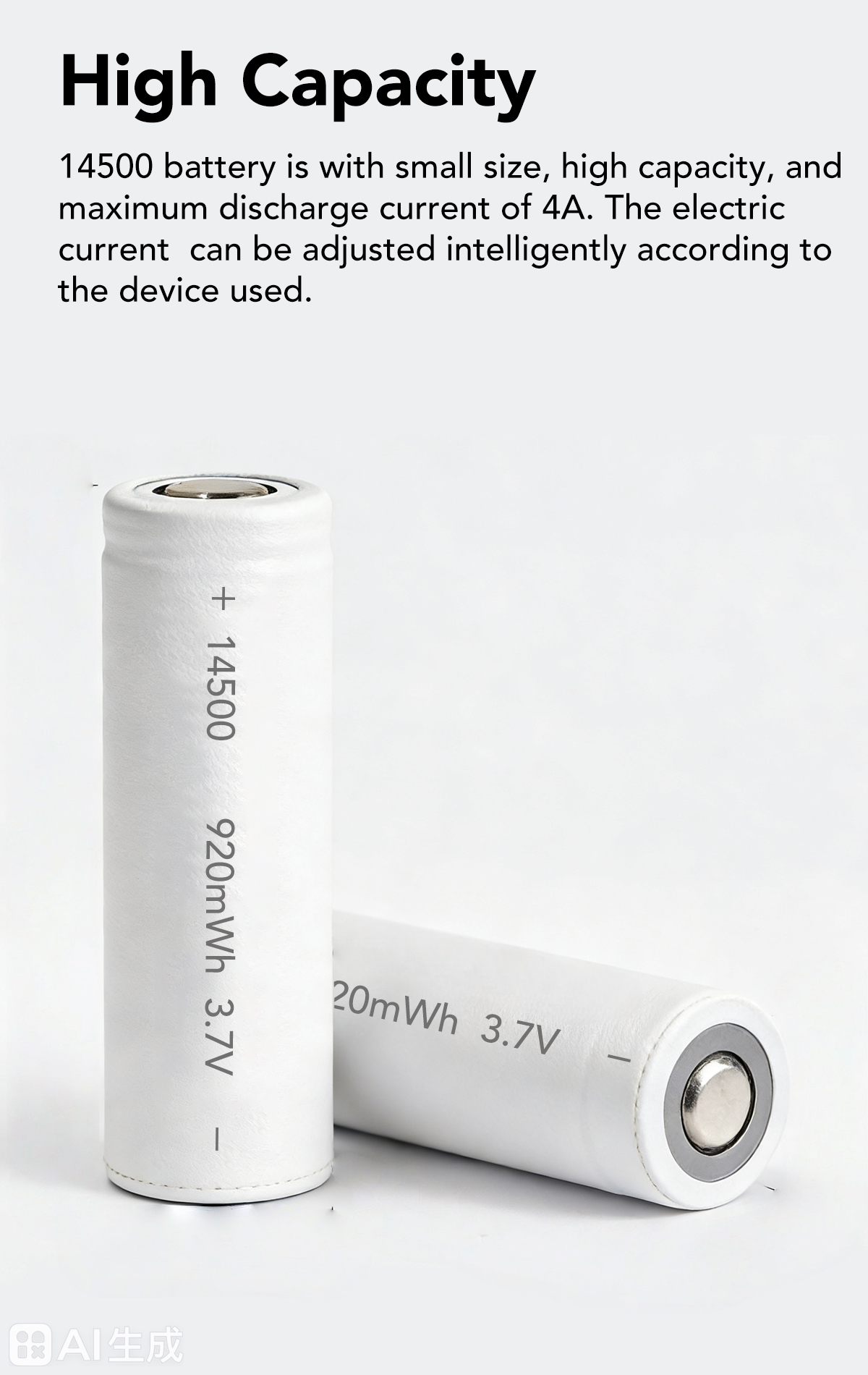
Not every mission requires a massive 5000mAh battery. For discrete Everyday Carry (EDC) or emergency preparedness (prepping), physical bulk must be eliminated. This necessitates the 14500 format.
Dual-Fuel Architectural Advantage
The 14500 Li-ion cell shares the exact physical dimensions of a standard AA battery. However, a 14500 operates at 3.7V, whereas a standard alkaline AA operates at 1.5V. By utilizing a sophisticated wide-voltage buck-boost driver circuit, engineers may create a "dual-fuel" flashlight—such as the SHENGQI L2 model.
Under normal operation, the user deploys the 3.7V 14500 lithium cell to push maximum wattage and achieve extreme brightness. However, during a prolonged grid-down emergency where lithium charging is impossible, the operator might simply extract the 14500 and insert a standard 1.5V alkaline AA battery sourced from a wall clock or convenience store. While the peak lumen output will be capped due to the alkaline cell's high internal resistance and lower voltage, this contingency guarantees that the operator is never left entirely in the dark.
IV. The Invisible Barrier: BMS/PCM & SMT Engineering
Lithium-ion cells are highly volatile. Inserting an unprotected, naked Li-ion cell into a high-drain tactical flashlight invites severe risk of thermal runaway. The unsung hero of battery technology is the Protection Circuit Module (PCM), also known as the Battery Management System (BMS).
Micro-Electronic Safeguards
Affixed to the anode or cathode of the cell, the BMS is a miniaturized circuit board. Utilizing automated Surface Mount Technology (SMT), microscopic components are placed with absolute precision. The architecture typically relies on a dedicated DW01 control IC paired with dual low-resistance MOSFETs acting as electrical gates.
This system continuously monitors telemetry to enforce three absolute protections:
- OCVP (Over-Charge Voltage Protection): Severs the circuit if voltage exceeds 4.25V, preventing chemical combustion during charging.
- ODVP (Over-Discharge Voltage Protection): Halts current output if voltage drops below 2.5V, preventing irreversible degradation of the internal electrolyte.
- SCP (Short Circuit Protection): Reacts in microseconds to disconnect the battery if a hard short occurs within the flashlight body.
As an elite Industrial grade flashlight manufacturer China relies upon, and a verified Heavy duty tactical flashlight supplier, SHENGQI LIGHTING refuses to compromise on safety. We subject every single integrated battery to rigorous factory Aging Tests, applying intense thermal and discharging stress to guarantee stable BMS logic before global shipment.
V. B2B Sourcing Decision Tree
For procurement directors, selecting the correct platform dictates market success. Use this objective logic tree to formulate your RFQ:
- [ Priority: Maximum Output & Endurance ] Specify the 21700 Platform. It is mandatory for search and rescue operations or heavy industrial tooling.
- [ Priority: Weapon Mounting & Balanced EDC ] Specify the 18650 Platform. The 1-inch diameter is the gold standard for tactical retention.
- [ Priority: Extreme Portability & Backup ] Specify the 14500 Dual-Fuel Platform. Optimal for medical professionals, light mechanics, and ultralight hikers.
Regardless of the chosen format, partnering with a competent Aerospace aluminum flashlight wholesale provider and a fully integrated OEM CNC machined aluminum flashlight factory guarantees that the external chassis will perfectly support the internal thermodynamics of your selected battery.
VI. Expert FAQ: Battery Selection
Q1: Why cannot high-lumen tactical flashlights simply run on standard alkaline batteries?
Standard alkaline chemistry suffers from severe internal resistance and low nominal voltage (1.5V). If a high-power LED driver attempts to draw 5+ Amps from an alkaline cell, the severe voltage sag will cause the flashlight to instantly drop to a low mode or shut off completely. Furthermore, deep discharging alkaline cells frequently results in highly corrosive chemical leakage.
Q2: What is the exact physical difference between protected and unprotected Li-ion cells?
An unprotected cell is a raw battery core; it relies entirely on the flashlight's internal driver board to monitor safety thresholds. A protected cell features a microscopic BMS board physically spot-welded to its base, adding about 2-3mm to its overall length. The BMS autonomously severs the circuit if short-circuit or over-discharge parameters are breached.
Q3: What does Low Self-Discharge (LSD) mean for emergency preparedness?
Legacy rechargeable batteries would slowly lose their charge even when not in use. Modern LSD NiMH (like Eneloop) or high-quality Li-ion cells boast specialized electrochemistry that drastically slows this parasitic drain. An LSD battery might retain 70-80% of its total capacity even after sitting idle in an emergency bag for several years.