Unveiling the 1020LM Tri-Engine Miracle: Discover the Y4 Mini EDC at Canton Fair 2026
Unveiling the 1020LM Tri-Engine Miracle: Discover the Y4 Mini EDC at Canton Fair 2026
In the discipline of optical engineering, scaling down a device's physical footprint while simultaneously increasing its photonic output represents a profound thermodynamic contradiction. The fundamental constraint of Everyday Carry (EDC) equipment is volume. When engineers attempt to force high-amperage currents through microscopic circuit boards, the resulting thermal density typically causes immediate semiconductor failure.
For procurement directors sourcing the ultimate New EDC Flashlight 2026 deployment roster, evaluating how a manufacturer resolves this miniaturization paradox is critical. SHENGQI LIGHTING, recognized globally as an authoritative 2026 Canton Fair flashlight supplier, has engineered a solution that effectively defies legacy physical constraints. At Booth 16.4G18, we are officially launching the highly anticipated Y4 model. This technical dossier dissects the Y4's Tri-Engine architecture, demonstrating how a 58mm chassis can safely sustain a staggering 1020-lumen output while integrating forensic-grade UV spectrometry.
[ Failure Analysis: Thermal Runaway in Micro-Optics ]
The consumer market is saturated with inexpensive, injection-molded plastic keychain flashlights claiming outputs of 1000+ lumens. Our laboratory frequently subjects these competitor models to destructive testing. The empirical results are consistently disastrous.
When a high-power LED is activated inside a polymer (plastic) chassis, the thermal energy possesses no highly conductive escape vector (as plastics typically possess a thermal conductivity $k < 0.5$ W/m·K). Within 45 seconds of Turbo activation, the localized heat exceeds 120°C. The polymer lens warps, the FR-4 circuit board delaminates, and the lithium-polymer pouch cell expands dangerously, risking a thermal event. This is why professional-grade micro-EDC tools must abandon polymers entirely and rely on precision-machined aerospace aluminum to act as a unified, high-efficiency heatsink.
01. Multidisciplinary Optics: The Tri-Engine Architecture
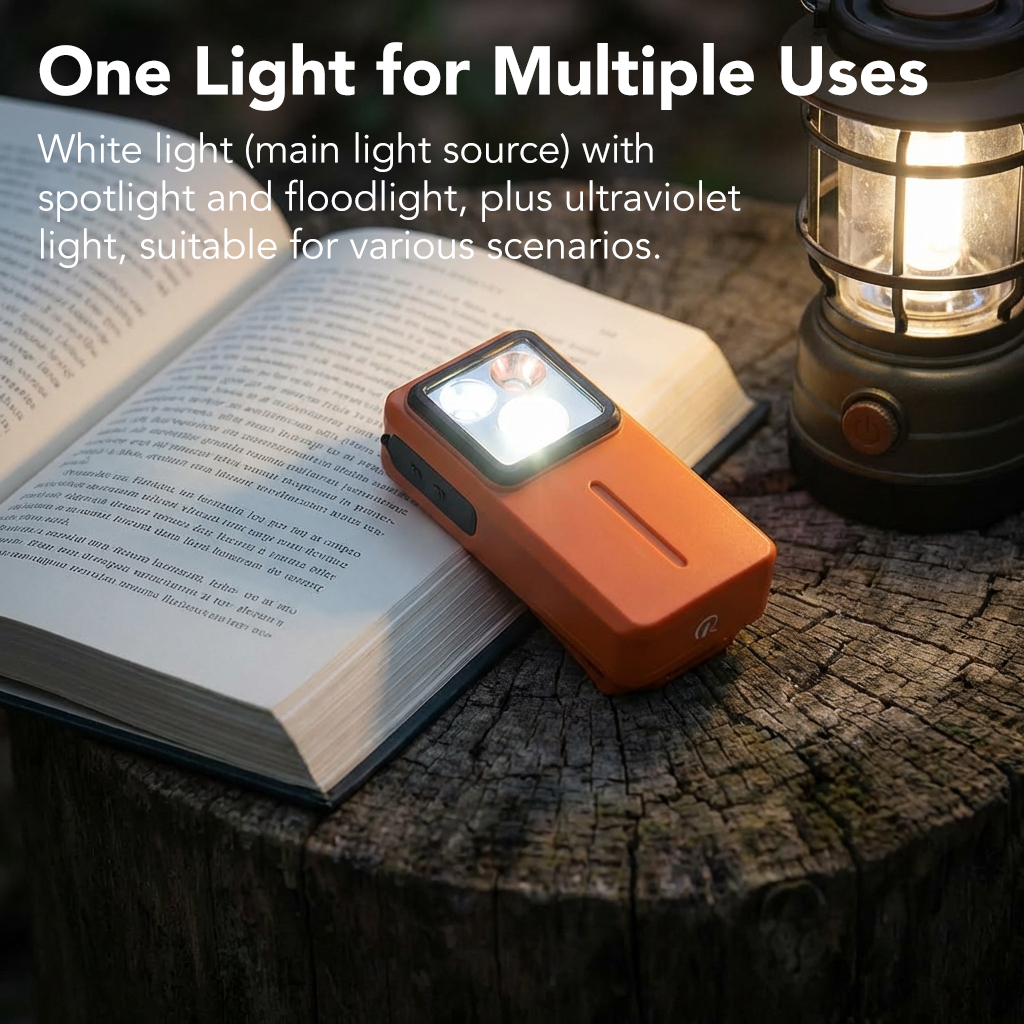
The Y4 is not a mere illumination device; it is a consolidated optical laboratory. By integrating three distinct semiconductor emitters into a single micro-chassis, it negates the necessity for an operator to carry redundant equipment.
Engine A: The 570LM Collimated Spotlight
Utilizing a deep-dish micro-reflector, the primary forward diode generates a highly concentrated 570LM Spotlight. This optical geometry operates on specular reflection, collimating the photons into a dense central hotspot. It is mathematically optimized to pierce through atmospheric interference, providing the operator with exceptional distance visibility for perimeter scanning or threat identification.
Engine B: The 1020LM Homogeneous Floodlight
For immediate, close-up situational awareness, a concentrated hotspot induces severe ocular glare. The Y4 addresses this by activating a secondary optical array to deliver a staggering 1020LM Floodlight. By utilizing a diffused lens matrix, this engine scatters the light evenly across a 160-degree field of view. This creates a shadow-free, highly homogeneous wall of light, essential for complex electrical repairs, medical triage, or map reading in absolute darkness.
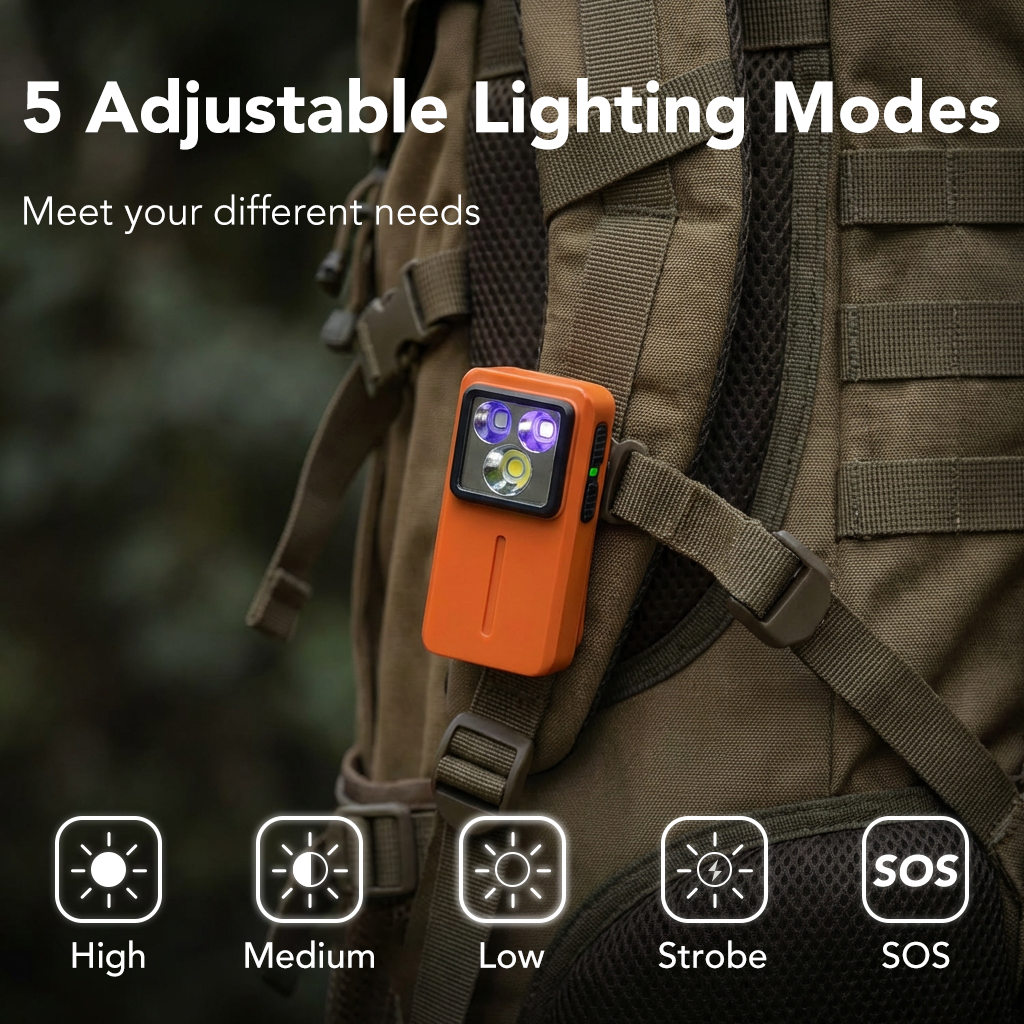
Engine C: Forensic-Grade 365nm-370nm UV
Standard keychain lights employ cheap 395nm ultraviolet LEDs, which bleed heavy amounts of visible purple light, masking delicate fluorescent reactions. The Y4 integrates a professional-grade 365nm-370nm UV LED.
This exact wavelength is the scientific standard for inducing a Stokes shift in reactive phosphors. Emitting almost zero visible light interference, this tertiary engine is an absolute requirement for customs agents verifying passport watermarks, forensic teams identifying trace biological fluids, and automotive technicians executing non-destructive testing (NDT) for refrigerant leaks.
02. Thermodynamics & Metallurgy: 6063 Aluminum at 58mm
To safely dissipate the immense thermal load generated by a 1020-lumen output within a sub-60mm geometric profile, our metallurgists selected a highly specific aerospace substrate.
The 58mm Form Factor & 52.4g Mass
The Y4 is encased in a highly durable 6063 aluminum alloy body. Measuring an imperceptible 58mm in length and weighing a feather-light 52.4g, it completely defies traditional power-to-weight ratios. The 6063 alloy possesses an excellent thermal conductivity coefficient ($k \approx 200$ W/m·K). The entire CNC-machined body acts as a unified heat sink, rapidly drawing thermal energy away from the Copper DTP (Direct Thermal Path) PCB to prevent LED degradation.
Type III Hard Anodizing (HA III)
EDC gear shares pocket space with keys, knives, and multi-tools. To prevent severe abrasive degradation, the 6063 aluminum is subjected to electrochemical Type III Hard Anodizing. This grows a thick, ceramic-like aluminum oxide ($Al_2O_3$) layer on the surface, pushing the Rockwell hardness to extreme levels and granting the Y4 absolute immunity to galvanic corrosion and daily abrasion.
03. Technical Parameter Matrix: Y4 vs. Legacy Micro-EDC
The empirical data below illustrates the vast engineering disparities between the SHENGQI Y4 and standard polycarbonate micro-flashlights currently saturating the B2B market.
04. Micro-Power Systems & Kinematic Retention
Driving three separate optical arrays mandates a robust, highly stable power delivery system alongside a secure mechanical retention method for hands-free operation.
500mAh Lithium-Polymer Cell
Cylindrical batteries (like the 10440 or 18350) generate excess geometric waste in ultra-compact designs. The Y1 utilizes a built-in 500mAh Li-Po (Lithium Polymer) rechargeable battery. This chemistry allows the cell to be manufactured in a flat, rectangular pouch, perfectly filling the internal void of the CNC chassis. Monitored by an integrated Battery Management System (BMS), it ensures safe, high-drain discharge and rapid replenishment via a sealed Type-C port.
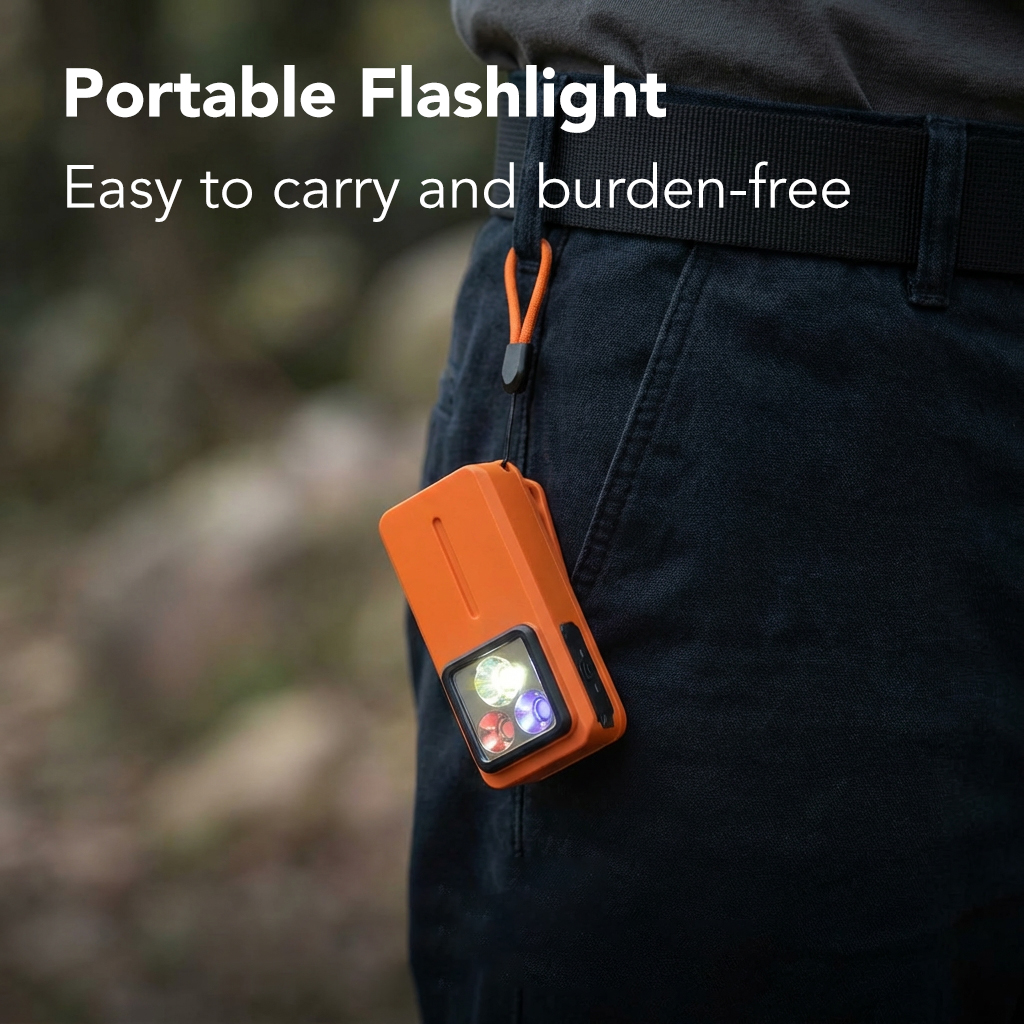
Kinematic Tactical Clip
An EDC light must adapt instantly to the operator's physical movements. The Y1 features a heavy-duty, tactical integrated back clip. Machined from high-yield-strength stainless steel, it guarantees extreme kinematic retention. Operators may securely attach the Y1 to MOLLE webbing, a breast pocket, or slide it onto the brim of a hat—instantly converting the 52.4g device into a fully functional, hands-free headlamp without any structural deformation of the clip.
05. Frequently Asked Questions (FAQ)
Q1: How does a 58mm flashlight physically manage the heat of 1020 Lumens?
It utilizes Advanced Temperature Regulation (ATR) via an onboard NTC thermistor. The MCU constantly monitors the junction temperature; once it approaches the thermal limit, it imperceptibly steps down the current, balancing safe outer-chassis temperatures with maximal visual output.
Q2: What is the exact difference between the 570LM Spot and 1020LM Flood modes?
The Spotlight uses a focused optic to collimate light, creating high candela (peak beam intensity) for distance. The Floodlight utilizes a diffused lens array, deliberately scattering the photons to eliminate the central hotspot, ensuring a wide, even illumination for up-close work.
Q3: Why is 365nm UV superior to 395nm UV for inspection?
395nm LEDs emit a significant amount of visible violet light, which visually overpowers faint fluorescent reactions. 365nm operates closer to the pure ultraviolet spectrum, emitting minimal visible light. This creates stark, high-contrast fluorescence necessary for forensic and NDT analysis.
Q4: Is the Y4's 500mAh Li-Po battery replaceable?
To achieve the ultra-compact 58mm hermetically sealed form factor, the Li-Po pouch cell is permanently integrated and soldered to the BMS. It is rated for over 500 deep charge cycles via the Type-C port, equating to years of standard EDC usage.
Q5: Can the Y4 operate while plugged in (pass-through charging)?
Yes. The advanced driver circuit permits pass-through charging. Operators can connect the Y4 to an external power bank via USB-C and run the flood or spot modes continuously for prolonged stationary operations.
Secure Your OEM/ODM Procurement at Canton Fair 2026
The Y4 Tri-Engine EDC is not just a product; it is a highly adaptable manufacturing platform. As a premier Tactical Flashlight OEM Manufacturer, SHENGQI LIGHTING operates a world-class ISO9001 certified manufacturing facility boasting over 40 years of industry supremacy. We provide our global B2B partners with exhaustive customization capabilities, including precision laser engraving, bespoke packaging, and custom user-interface (UI) firmware programming.
[ VIP Exhibition Protocol ]
We formally invite global gear distributors and procurement directors to evaluate the Y4's engineering firsthand. Visit Booth 16.4G18 to verify the intense 1020LM output and forensic 365nm UV clarity. Bypass the public queues by reserving an exclusive engineering consultation today.