365nm vs. 395nm UV Flashlights: The Ultimate Scientific Buyer’s Guide
[ Optical Diagnostics: The Invisible Truth ]
Hello, I operate as the Senior Optical Physicist at SHENGQI LIGHTING. Within the Non-Destructive Testing (NDT) and forensic procurement sectors, a fundamental misunderstanding frequently derails supply chain decisions. When evaluating a 365nm vs 395nm UV flashlight, novice buyers routinely activate the device and conclude: "This beam looks incredibly bright and purple; it must be a powerful UV light."
In optoelectronics, this assumption is entirely backwards. True ultraviolet radiation is located outside the human visual spectrum (below 400nm). The intense purple light you see is an optical inefficiency known as Visible Light Leakage. A high-quality UV source emits invisible photons; it only becomes "visible" when those photons strike a reactive phosphor, triggering a Stokes shift (fluorescence). If an emitter produces a massive wash of visible violet glare, that glare will completely mask faint fluorescent reactions.
Securing mathematically accurate radiometric performance requires sourcing from a Professional UV flashlight manufacturer capable of precision-engineered optical testing. This whitepaper systematically deconstructs the electromagnetic spectrum, equipping you to procure the exact wavelength required for your operational environment.
I. 365nm: The Forensic Scalpel
The 365 nanometer wavelength resides deep within the UVA spectrum. It is the absolute pinnacle of high-contrast fluorescence excitation.
Superior Fluorescence Detection
Because a 365nm diode emits almost zero ambient visible light, it provides an exceptionally dark background. When the invisible UV photons strike counterfeit currency security threads, uranium glass, or trace biological fluids (like blood plasma or saliva), the resulting fluorescence appears brilliantly illuminated against the surrounding darkness. This high-contrast isolation is why 365nm is the mandatory standard for crime scene investigation and high-level document authentication.
Hardware Profile: The 2AAA-UV Pocket Torch
To deploy this spectrum into the field, our facility engineered the 2AAA-UV 365nm Pen Flashlight. This instrument is carved from 6463 aerospace-grade aluminum, granting it exceptional chemical resistance against laboratory solvents. Furthermore, it operates on a dual AAA battery architecture. In a forensic theater, waiting for a proprietary lithium cell to recharge might compromise an investigation; standard AAA cells provide universal, immediate energy replacement. It is the definitive diagnostic tool expected from an elite Forensic LED light supplier.
II. 395nm: The Industrial Workhorse
While 395nm resides closer to the visible spectrum (bordering on 400nm visible violet), it possesses a distinct set of physical properties that make it highly advantageous for specific industrial applications.
High-Energy Photons and Polymerization
A 395nm diode emits a higher overall volume of photons compared to a 365nm diode of equivalent wattage. This intense photon density is the exact catalyst required for photochemical reactions, specifically polymer curing. Photoinitiators within commercial UV resins and adhesives absorb 395nm wavelengths rapidly, causing the liquid polymers to cross-link and solidify in seconds. Consequently, a 395nm instrument is the optimal Blacklight for resin curing, windshield repair, and 3D printing post-processing.
Hardware Profile: The L13 UV Array
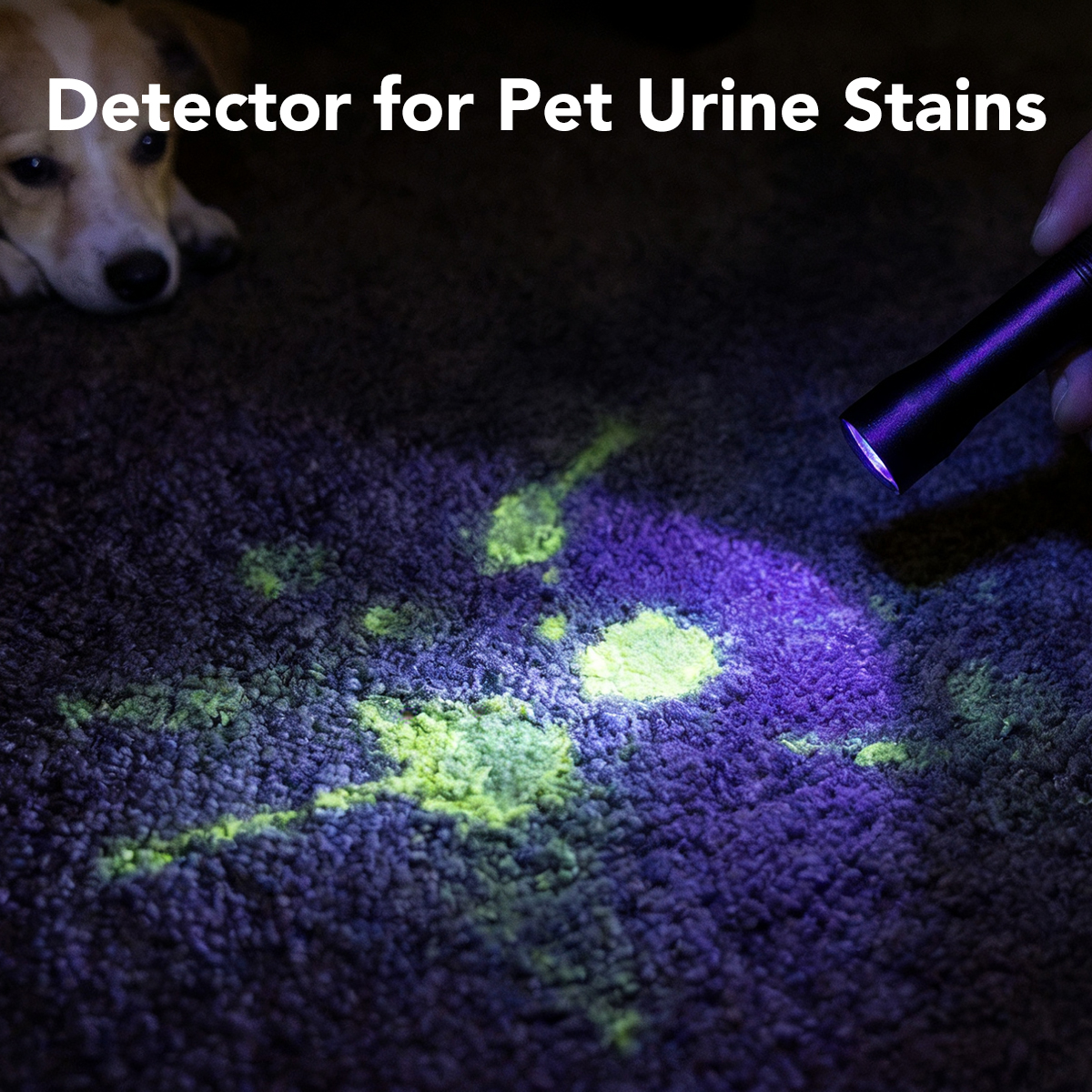
Industrial tasks, such as scanning hotel carpets for pet stains or executing HVAC refrigerant leak detection, demand wide-area coverage. The L13 395nm UV Flashlight resolves this by integrating 12 premium UV LED beads into a dense, multi-emitter array. This creates a massive flood of ultraviolet energy. Supporting this output is a dual-fuel power architecture; the L13 may be driven by a high-capacity 18650 Li-ion cell or standard AAA batteries via an adapter, ensuring limitless industrial endurance.
III. Optical Physics: The ZWB2 Filter Glass Secret
A high-end 365nm flashlight can be immediately identified by its front lens. It will not be transparent; it will be an opaque, deep black glass. This is not a cosmetic choice; it is an optical bandpass filter known as ZWB2.
Even the most strictly binned 365nm LED diodes produce a minute parasitic wavelength of visible white and violet light. In highly delicate non-destructive testing (NDT), this trace visible light could reflect off shiny metal surfaces and obscure a micro-fracture's fluorescent dye.
The ZWB2 glass acts as a strict electromagnetic gatekeeper. Its chemical composition physically absorbs wavelengths in the visible spectrum (400nm to 700nm) while permitting high transmittance of pure UVA radiation (peaking exactly around 365nm). By stripping away the visible light leakage, the ZWB2 filter ensures that the only light illuminating the user's environment is the pure, high-contrast glow of a fluorescent reaction. Executing this level of spectral purity requires aerospace-grade tolerance control during the bezel assembly.
IV. Expert FAQ: Sourcing Scientific UV Illumination
Q1: As a buyer looking for UV flashlight wholesale, which wavelength should I recommend to my HVAC (Heating, Ventilation, and Air Conditioning) client base?
For HVAC refrigerant leak detection, 395nm is the mathematically optimal choice. Commercial fluorescent leak-detection dyes are chemically engineered to react aggressively to the 395nm spectrum. Furthermore, 395nm LEDs are highly cost-effective, allowing you to source multi-LED arrays (like the L13) that cast a massive flood beam, making it incredibly fast for a mechanic to scan an entire engine bay.
Q2: Why is a genuine 365nm UV flashlight generally more expensive to procure than a 395nm model?
The cost discrepancy originates at the semiconductor fabrication level. The epitaxial growth process required to yield a pure 365nm wafer involves highly complex indium gallium nitride (InGaN) doping and suffers from lower production yields. Additionally, authentic 365nm devices must be equipped with expensive ZWB2 filter glass to guarantee spectral purity, increasing the baseline Bill of Materials (BOM) cost.
Q3: When manufacturing custom UV orders, how does Shengqi prevent severe wavelength shifting across massive production batches?
We mitigate spectral drift through strict wavelength calibration. Every incoming reel of UV diodes undergoes rigorous binning verification. During post-assembly, our metrology labs execute precision-engineered optical testing using integrating sphere spectroradiometers. This validates that every diode falls exactly within the required nanometer tolerance before the batch is authorized for export.
Secure Your Spectrometric Authority
Distributing ultraviolet diagnostic equipment demands absolute scientific precision. Generic assembly houses lack the metrological infrastructure to guarantee wavelength purity, risking your brand's reputation in professional sectors.
[ Initiation of OEM R&D Protocol ]
SHENGQI LIGHTING operates a fully integrated, advanced optoelectronic laboratory. We invite global forensic suppliers, HVAC tool brands, and NDT equipment distributors to consult with our physics division. Contact us today to request empirical spectral test reports and evaluate our UV prototypes.