Flashlight Battery Types: Size, Voltage and Compatibility
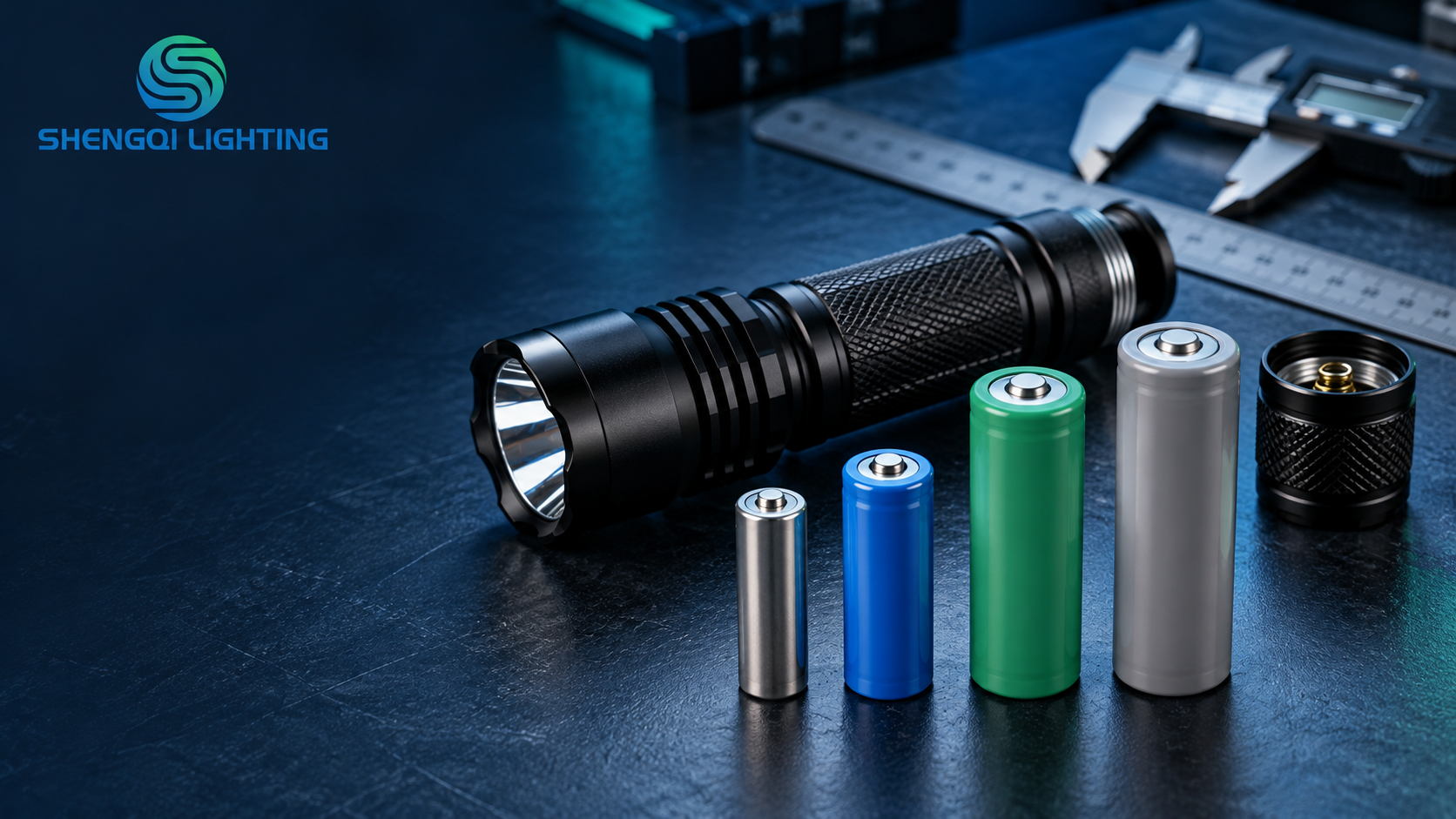

Battery Compatibility Guide
Flashlight Battery Types: Size, Voltage and Compatibility
Flashlight battery types should be identified by physical format, chemistry, voltage, terminal design and charging requirements. A battery that fits the compartment is not automatically electrically compatible. Use only battery types and configurations approved for the specific flashlight.
A buyer may see an AA-shaped battery and assume it is a suitable replacement. Another may order an 18650 spare, only to find that its finished length, terminal shape or charging arrangement does not match the flashlight. These are common compatibility questions, not evidence of a specific SHENGQI LIGHTING product issue or customer case.
A compatible flashlight battery is not defined by one label alone. The correct selection starts with the battery designation, then verifies the actual finished battery dimensions, chemistry, electrical requirements, terminal arrangement and charging instructions for the individual flashlight.
Physical fit is only one part of battery compatibility. A battery must also meet the flashlight’s approved chemistry, voltage, electrical, terminal and charging requirements.
Do not force a battery into a compartment, modify contacts, remove protection features or assume that a rechargeable battery can be charged inside every flashlight.
A Battery Name Is Only the Starting Point
A battery designation may describe a familiar format, but it does not automatically confirm the finished battery is approved for a flashlight. For example, “AA” principally describes a physical format. It does not mean every AA-shaped battery has the same chemistry, nominal voltage, charge method or electrical behavior.
For practical flashlight selection, buyers should separate six questions:
- Physical format: What shape and nominal size does the designation describe?
- Chemistry: Is the cell alkaline, NiMH, primary lithium, lithium-ion or another approved category?
- Voltage and electrical requirements: What range does the flashlight accept, and what does the specific cell provide?
- Finished dimensions: What are the real diameter and total length after protection circuits, raised terminals or USB charging structures are included?
- Terminal and mechanical interface: Does the contact arrangement match the flashlight design?
- Charging arrangement: Is the battery supported only for operation, for in-device charging, or for charging in an external charger?
AA, Rechargeable AA and 14500: Similar Shape Does Not Mean Compatibility
AA alkaline, AA NiMH rechargeable and AA primary-lithium cells may share a familiar external format, yet their chemistry and nominal voltage can differ. A common 14500 lithium-ion cell is also often described as AA-sized in shape, but that description must not be treated as an approval to substitute it for an AA battery.
Before selecting an AA-format battery, confirm the flashlight documentation or approved product specification. The key question is not simply, “Will it fit?” It is, “Is this exact chemistry and finished battery configuration approved for this flashlight?”
- Chemistry
- Nominal voltage
- Discharge behavior
- Finished-cell length
- Terminal construction
- Charging restrictions
- Every AA flashlight accepts 14500 cells
- Every rechargeable AA cell behaves the same way
- An AA-shaped lithium-ion cell is an “upgrade”
- One model’s multi-battery support applies across a product series
Some flashlight designs are intentionally engineered for more than one approved battery configuration. That support is product-specific. Procurement teams should request the approved configuration list rather than generalizing from battery appearance or from a different flashlight platform.
Common Flashlight Battery Sizes: A Compatibility Reference, Not an Interchangeability Chart
This chart explains common battery categories and the questions buyers should ask. It is not an interchangeability chart or an approval list for any specific flashlight. Nominal voltage is not the same as every voltage measured during discharge or charging.
| Battery Designation | Chemistry / Category | Typical Nominal Voltage | Size Reference | Compatibility Question |
|---|---|---|---|---|
| AAA alkaline | Primary alkaline | 1.5 V | AAA format; verify actual finished-cell dimensions | Does the flashlight specifically approve AAA alkaline cells? |
| AAA NiMH | Rechargeable nickel-metal hydride | 1.2 V | AAA format; actual dimensions vary by cell design | Is NiMH approved, including its operating behavior and charge method? |
| AA alkaline | Primary alkaline | 1.5 V | AA format; confirm finished-cell dimensions | Is this chemistry approved for operation in the flashlight? |
| AA NiMH | Rechargeable nickel-metal hydride | 1.2 V | AA format; actual dimensions vary by model | Does the flashlight support this chemistry and intended recharge method? |
| AA primary lithium | Primary lithium | 1.5 V | AA format; verify supplier data sheet | Is primary lithium approved? Primary cells must not be recharged. |
| 14500 | Commonly lithium-ion; exact cell must be confirmed | Often 3.6–3.7 V for conventional lithium-ion cells | AA-shaped format reference; finished length may differ | Does the flashlight explicitly approve 14500 lithium-ion operation? |
| 18650 | Commonly lithium-ion; exact cell specification matters | 3.6 V is a common lithium-ion example | Nominal 18 mm × 65 mm format reference; protection can add length | Will the approved finished cell, terminal and protection design fit? |
| 21700 | Lithium-ion category; actual chemistry must be confirmed | Model-specific; confirm the approved cell data | Nominal 21 mm × 70 mm format reference; verify finished dimensions | Does the flashlight specifically support this cell format and configuration? |
A cell code can describe a nominal format reference, but finished batteries may vary because of protection circuits, button-top terminals, USB charging structures, labels or other construction details.
Why 18650 Battery Length and Terminals Matter
“18650” is not a complete flashlight compatibility specification. The designation is commonly associated with a nominal cylindrical format, but buyers still need the finished battery’s actual diameter, total length, terminal style and protection arrangement.
A protected cell may be longer than an unprotected cell. A raised button-top terminal can differ from a flat-top design. A battery with an integrated USB charging structure may have a different finished profile. Each of these details can affect whether the battery contacts engage correctly and whether the battery compartment closes without force.
How to Verify Flashlight Battery Compatibility
The practical sequence is straightforward: identify the battery designation, then validate the actual finished battery against the flashlight’s documented requirements. A higher mAh label does not solve a voltage mismatch, terminal mismatch, dimensional mismatch or unsupported charge method.
Confirm the exact battery format, chemistry, voltage range, terminal arrangement and protection requirement approved for flashlight operation.
Check total finished length, maximum diameter, positive-terminal shape, polarity direction, cap clearance and contact architecture.
A flashlight may support a battery for operation but not for in-device charging. The approved charge method must be confirmed independently.
Operation Compatibility Is Not Charging Compatibility
Procurement specifications should distinguish among four separate statements:
- Supported for flashlight operation
- Supported for in-device charging
- Must be charged externally
- Not supported for this flashlight
A USB-C port on a flashlight does not mean every battery that can physically fit may be charged inside that flashlight. Likewise, a battery with its own USB charging feature does not automatically make it suitable for every flashlight. Primary cells must not be recharged.
Multi-Battery Support Must Be Documented by Configuration
When a flashlight is designed for multiple approved battery types, the buyer should ask which configuration applies to each claim. Output, runtime, low-battery indication, charging behavior and accessory compatibility may differ by approved battery configuration. Do not assume that the same performance statement applies across every supported format.
What Should Procurement Teams Specify?
For a private-label flashlight, replacement-battery program or new product platform, the supplier brief should describe the intended battery configuration before finalizing product documentation, packaging or after-sales guidance.
Reusable Battery Specification Brief
- Product / application
- Approved battery format
- Chemistry
- Approved cell or battery pack
- Electrical requirements to be confirmed against the product design
- Maximum finished battery dimensions
- Terminal or connector arrangement
- Protection requirement, where applicable
- Approved for operation
- Approved in-device charging method, if any
- Performance claims by approved configuration
- Replacement availability in target markets
- Instruction, labeling and customer-service requirements
This type of brief helps prevent a common documentation gap: a product listing names a battery format, while the manual, charger instruction and replacement-battery guidance do not fully describe the approved configuration.
Selecting the Right Flashlight Platform
Battery requirements should follow the intended flashlight platform and application, not the other way around. Compact everyday-carry products, pen lights and larger handheld flashlights can have different space, runtime, charging and replacement-battery priorities.
Explore flashlight product options when defining the intended portable-light platform and battery approach.
Review EDC flashlight platforms where pocket size and replacement expectations may influence battery selection.
Consider pen light configurations when compact form factor and service access are part of the use case.
SHENGQI LIGHTING, the brand of Dongguan Shengqi Lighting Technology Co., Ltd., supports portable-lighting development and OEM/ODM projects. Since 1981, the company’s manufacturing roots have supported product development discussions that begin with real application requirements, including battery configuration, product architecture and documentation needs.
Frequently Asked Questions
Are AA and 14500 batteries interchangeable in a flashlight?
No. Similar shape does not prove compatibility. AA-format batteries and 14500 lithium-ion cells can differ in chemistry, voltage, finished dimensions and charging requirements. Use only the configuration approved for the individual flashlight.
Will every 18650 battery fit an 18650 flashlight?
No. An 18650 designation alone does not confirm total length, terminal style, protection design, diameter, electrical suitability or charging compatibility. Verify the approved finished-cell specification.
Are all AA batteries electrically the same?
No. AA describes a format. Alkaline, NiMH rechargeable and primary-lithium AA cells can have different chemistry and nominal voltage characteristics. The flashlight instructions or approved specification control the correct choice.
Can a flashlight charge every battery it can operate?
No. Operation approval and in-device charging approval are separate questions. Confirm the exact approved charging method for the flashlight and battery configuration.
Does a higher mAh rating guarantee a better replacement battery?
No. Capacity is only one specification. It does not correct an unsupported voltage, incompatible terminal, excessive finished length, unsuitable chemistry or unsupported charge arrangement.
Need Help Defining a Flashlight Battery Configuration?
For an OEM/ODM portable-lighting discussion, provide the intended application, battery format, chemistry preference, charging approach, replacement-market requirement, size constraint, target market and estimated quantity. This makes it easier to match the battery strategy to the correct flashlight platform.
Explore OEM/ODM Services Contact SHENGQI LIGHTING sales@shengqilight.com