USB-C Rechargeable Flashlights: What Buyers Should Verify Before Bulk Ordering
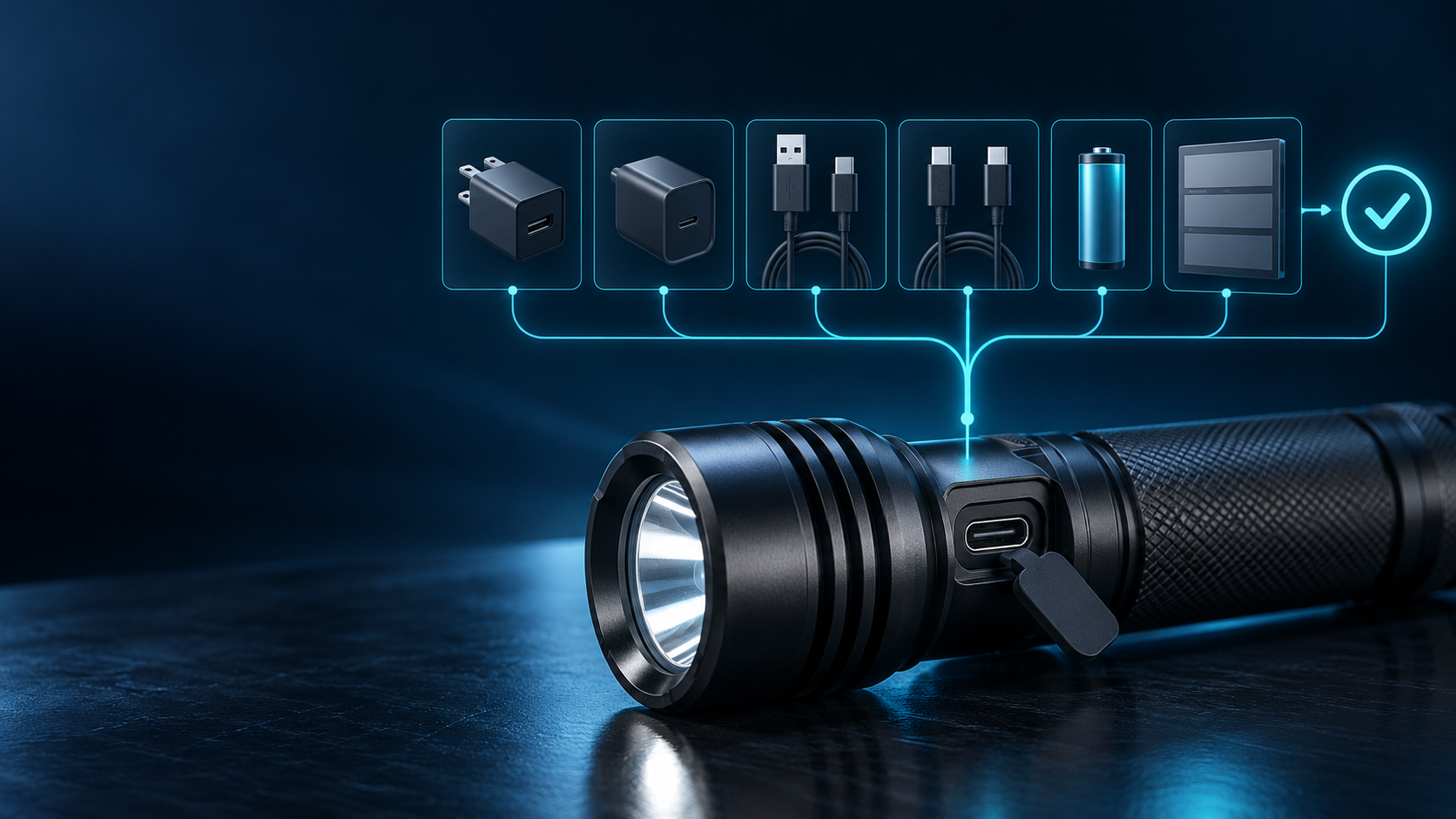

A USB-C Port Is Not Complete Charging Evidence
A buyer approves a rechargeable flashlight because the sample has a USB-C port and charges with the cable supplied by the factory. After delivery, customers use USB-C phone or laptop chargers with C-to-C cables. The connector fits, but the product does not charge. The port was USB-C; the expected charging behavior was never defined.
A USB-C flashlight charging claim should be evaluated together with the declared input, supported charger and cable types, C-to-C behavior, any applicable charging protocol, measured charging time, indicator logic and the exact product configuration tested.
For bulk purchasing, “USB-C” should be treated as the beginning of a charging requirement, not as complete proof of compatibility.
Why a USB-C Port Is Not Complete Charging Evidence
USB-C describes a connector system. It does not, by itself, prove a specific charging protocol, USB Power Delivery support, charging speed, input power, C-to-C interoperability, USB-IF certification, waterproof performance or battery capacity.
For a buyer, the useful chain is not simply “USB-C port present.” It is: port type → declared input → charger type → cable type → protocol where applicable → measured charging behavior → evidence → buying decision.
Buyer principle: The connector shape is a starting point for verification, not the final technical requirement.
A-to-C and C-to-C Charging Should Be Verified Separately
A USB-A-to-USB-C connection and a USB-C-to-USB-C connection should not be treated as identical unless the product has been tested for the intended combinations. A product can charge with one combination and fail to initiate charging with another, even though both connectors physically fit the port.
This is not a claim about any particular SHENGQI LIGHTING product. It is a compatibility scenario that a buyer should define before approving a platform for a target market.
USB-A-to-USB-C
Define whether charging from legacy USB-A adapters, power banks or included A-to-C cables must work.
USB-C-to-USB-C
Define whether modern phone adapters, laptop adapters, power banks and third-party C-to-C cables must initiate charging.
The RFQ should state whether one cable type or both are required, which charger ecosystem customers are expected to use, and whether the buyer wants testing across more than one source and cable combination. Do not assume that an included cable proves broad replacement-cable compatibility.
USB-C Is Not the Same as USB Power Delivery
USB-C is a connector system. USB Power Delivery, often called USB PD, is a separate power-delivery specification. A rechargeable flashlight can have a USB-C port without supporting USB PD. Likewise, USB-C does not automatically mean faster charging.
If USB PD is important to the project, the buyer should ask whether the actual product supports it and what behavior is supported. If it is not supported, that does not automatically make the flashlight unsuitable. The decision depends on the target charger ecosystem, required charging time, product power requirement, size, cost, thermal constraints and user expectations.
Do not make these assumptions
- A USB-C port means USB PD is supported.
- Every USB-C charger uses the same charging behavior.
- USB-C always charges faster than another connector.
- USB PD is mandatory for every rechargeable flashlight.
- A USB-C product is automatically USB-IF certified.
What “Fast Charging” Must Define Before It Becomes a Buyer Requirement
“Fast charging” is a relative marketing expression, not enough evidence for a sourcing decision. It should not be accepted without a declared input condition and a measured charging result. There is no universal time threshold that makes every flashlight “fast charging.”
What voltage and current does the product accept, using which charger and cable?
From what starting state to what endpoint was charging time measured?
Was the flashlight switched off, or was it operating while charging?
Does the result apply to the final product, battery, charging board and supplied cable?
Charging time cannot be inferred from battery capacity alone. Input limitation, charging circuit behavior, battery configuration, cable capability, charger behavior, temperature, operating state and charge-termination logic can all affect the observed result. The buyer does not need to prescribe the circuit design; the buyer needs the supplier to define and demonstrate the relevant condition.
Charge indication and operation while charging
Buyers should verify what each charge-indicator color or pattern means, how full-charge status is shown, whether abnormal conditions are indicated where applicable, and whether product instructions match the observed behavior. Unclear indication can lead users to disconnect too early, wait unnecessarily or assume the product is defective.
If operation during charging matters, ask whether it is permitted, which modes are available, whether charging behavior changes while the light is on, and whether the charging-time claim assumes the flashlight is switched off. Do not assume pass-through use is a universal feature.
Port Covers and Waterproofing: Keep the Claim Boundary Clear
A USB-C port is not automatically waterproof. Where an ingress-protection claim is relevant, the buyer should verify whether the port cover was closed during testing, whether the cover is part of the protection structure, whether any statement applies when the cover is open, and whether charging instructions require the port to be dry.
This is not a replacement for an IP-rating verification process. It is a charging-compatibility reminder: a change to the port, cover or related configuration can affect the scope of existing evidence and should be reviewed accordingly.
USB-C Flashlight Charging Compatibility Test Matrix
| Claim or requirement | What the buyer should define | Test combination or evidence | Why it matters |
|---|---|---|---|
| “USB-C charging” | Port plus actual input and charging behavior. | Input specification and documented test record. | Connector shape alone is incomplete. |
| “C-to-C compatible” | Required charger and cable combinations. | Compatibility matrix across intended combinations. | Confirms real use with modern chargers. |
| “Fast charging” | Input condition, battery state and measured time. | Charging test record for the quoted configuration. | Prevents undefined marketing claims. |
| “USB PD” | Whether PD is supported and what actual behavior is required. | Applicable technical evidence for that feature. | Separates connector type from protocol. |
| “Charges while operating” | Permitted modes, limitations and user instructions. | Operating-and-charging demonstration or test. | Prevents misunderstanding about runtime and charging behavior. |
| “Waterproof USB-C port” | Port-cover condition and protection-claim scope. | Applicable evidence and configuration confirmation. | Avoids unsupported assumptions about an open port. |
Supplier A vs. Supplier B: Which Charging Claim Is Easier to Verify?
Supplier A
Claim: USB-C fast charging
Evidence: Product photo and included cable only.
Supplier B
Claim: USB-C charging
Evidence: Declared input, A-to-C result, C-to-C result, charger/cable matrix, measured charging time, indicator behavior and tested configuration.
Supplier B is not automatically the better product. However, Supplier B’s claim is easier for the buyer to interpret and verify. Final suitability still depends on the intended charger ecosystem, target market, required charging time and product constraints.
What Should Buyers Request Before Accepting a USB-C Charging Claim?
- What input voltage and current does the product accept?
- Does it charge with both USB-A-to-USB-C and USB-C-to-USB-C cables?
- Which charger types were tested?
- Which cable types were tested?
- Does the product support USB Power Delivery?
- If USB PD is claimed, what exact behavior is supported?
- What does “fast charging” mean for this product?
- What was the measured charging time?
- What were the starting and ending battery conditions?
- Was the product switched off or operating during the test?
- Can the flashlight operate while charging?
- How does the charging indicator behave?
- Was the tested sample the same as the quoted production configuration?
- Which charging IC, PCBA and battery revision were tested?
- Is the supplied cable part of the approved configuration?
- Were multiple chargers and cables tested?
- Were multiple product samples tested?
- What happens if the charging circuit or battery configuration changes?
- What port-cover condition applies to any IP claim?
- Can the charging behavior be demonstrated during sample approval?
Approved Sample Charging Does Not Guarantee Every Future Production Revision
USB-C charging compatibility belongs to the tested product, charger, cable and configuration combination. An approved sample demonstrates that combination; it is not a permanent guarantee for every later production revision.
If the charging board, connector supplier, charging IC, PCBA layout, battery configuration, supplied cable, firmware where applicable or assembly process changes, the supplier and buyer should review whether the previous evidence still applies. The required review and retesting scope should depend on the nature and likely impact of the change.
Write a Better USB-C Charging Requirement Into the RFQ
Do not stop at “USB-C charging required.” The goal is not maximum charging power by default. The right charging system is the one that reliably works with the intended charger and cable environment while meeting the required charging time and product constraints.
Charging connector: USB-C
Required cable compatibility: [A-to-C / C-to-C / both]
Target chargers: [define expected charger types]
USB Power Delivery: [required / not required / open for supplier proposal]
Declared input: [to be defined and documented]
Required charging time: [define test condition and target]
Operation while charging: [required / not required / open]
Charge indication: [define required user feedback]
Port / waterproof condition: [define when relevant]
Compatibility evidence: [test matrix / demonstration / report]
Production configuration: [must match approved sample or follow agreed change control]
Target markets: [define]
Packaging cable: [included / not included / to be proposed]
Why This Matters in Real B2B Sourcing
In real international sourcing inquiries received by SHENGQI LIGHTING, buyers have explicitly listed USB-C charging as a required feature. That requirement is meaningful, but it is only the beginning of the technical brief.
SHENGQI LIGHTING discusses charging requirements as part of the complete portable-lighting application, including intended charger environment, cable compatibility, battery configuration, charging time, product size, waterproof structure and work cycle. Where project-specific compatibility evidence is required, it should be confirmed against the actual product, actual configuration, target charger and cable combinations, sample testing and production revision.
FAQ
Does a USB-C port guarantee C-to-C charging?
No. C-to-C behavior should be verified with the intended charger and cable combinations.
Does every USB-C flashlight support USB Power Delivery?
No. USB-C and USB PD are separate. Ask whether the actual product supports USB PD and what behavior is documented.
Why might a flashlight charge with A-to-C but not C-to-C?
The charging behavior can depend on the product’s implemented input arrangement and the charger/cable combination. Verify both pathways separately when both matter.
What should a “fast charging” claim include?
Declared input, charger and cable used, battery start/end condition, operating state, measured charging time and tested configuration.
Can an approved sample guarantee bulk charging behavior?
It supports the tested combination. Production revisions should be reviewed for their impact on the prior compatibility evidence.
Need to Verify USB-C Charging Requirements for Your Portable-Lighting Project?
Share the application, product type, required charger types, cable compatibility, C-to-C requirement, USB PD requirement, target charging time, operation-while-charging requirement, battery preference, port-protection requirement, target markets, required evidence and estimated quantity.
Email: sales@shengqilight.com