IP68 Flashlight Waterproof Claims: What Buyers Should Verify
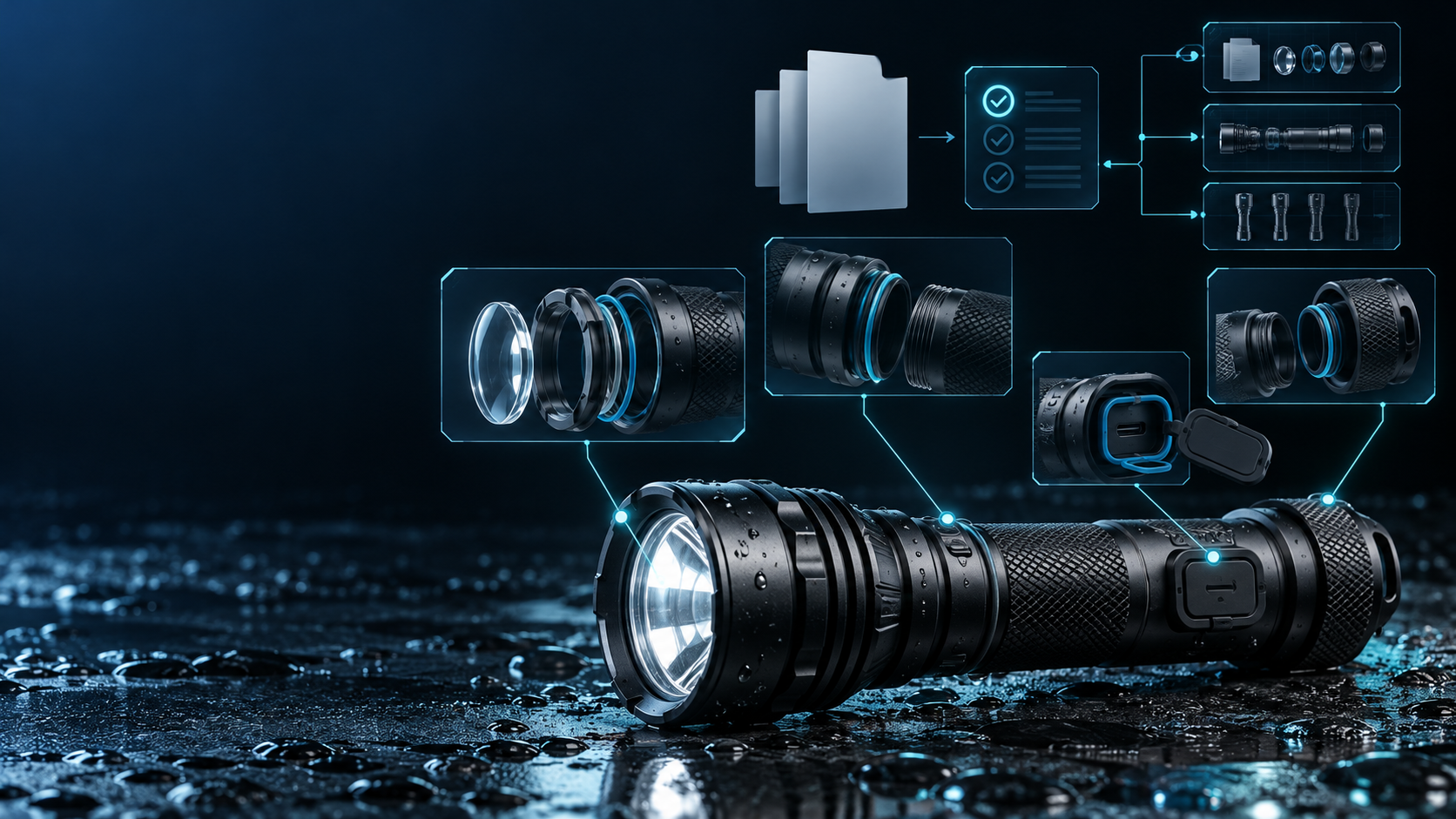

An IP68 flashlight waterproof claim should be verified by checking the applicable standard, test conditions, report identity, exact model or revision, tested configuration, and whether the production product remains consistent with the tested sample. The rating is evidence about enclosure protection under defined conditions. It is not a promise that a flashlight can survive every type of water exposure indefinitely.
1. The Difference Between an IP68 Claim and Useful Evidence
Imagine that a buyer receives two quotations for a rechargeable flashlight. Supplier A says the product is IP68. Supplier B also says the product is IP68. On the datasheet, the two claims appear identical.
Then the buyer asks for evidence. One supplier can provide a report with a laboratory identity, report number, model information, defined test basis, and a description of the tested product. The other supplier can only point to the word “IP68” in a catalogue. For a professional buyer, those claims should not be treated as equal.
The important question is not simply, “Is it IP68?” The real question is, “Can I rely on this IP68 claim for the product I am about to approve and buy?”
The IP Code is based on enclosure protection against ingress. In broad terms, the first numeral addresses protection related to solid objects or dust, while the second numeral addresses water ingress. The official IEC overview explains the IP system as a way to grade an enclosure’s resistance to dust or liquids. See the IEC IP ratings overview.
That is useful context, but it does not complete a sourcing decision. A buyer still needs to verify the claim, evidence, scope, and limitations that apply to the exact flashlight project.
2. Start With the Water Exposure, Not the Rating
Buyers often begin with a target number: “We need IP68.” A stronger sourcing process starts with the actual exposure the flashlight will face. The rating should follow the application, not replace application thinking.
Define the exposure
Rain, splash, temporary immersion, continued immersion, water jets, dust, mud, coastal use, industrial washdown, or another defined environment.
Match evidence to the exposure
Ask which standard and conditions support the proposed rating, then decide whether those conditions are relevant to the intended use.
Identify what is outside scope
Saltwater, detergents, chemical exposure, high-pressure cleaning, heavy wear, and impact may require separate consideration.
Start with the exposure, not the rating. A flashlight intended for occasional rain may require a different evidence package from a product used around immersion, coastal saltwater, washdown, or frequent battery-cap opening.
An IP rating alone may not answer every real-world question. Saltwater can introduce corrosion concerns. Detergents and chemicals can affect materials differently from plain water. A product that is dropped, worn, or incorrectly reassembled may not remain in the same condition as a new test sample. If these conditions matter to the project, they should be defined and reviewed separately.
3. IP67 vs IP68: A Buyer Decision, Not a Number Contest
IP67 and IP68 are often treated as if one is automatically the “higher” or “better” choice in every situation. That is not the right buyer question. Both designations combine dust protection with different water-ingress test concepts, but the required exposure and the evidence behind the claim remain critical.
For an IP67 versus IP68 flashlight decision, the buyer should ask what kind of water exposure is expected and what conditions were actually used to support the claim. Temporary immersion, continued immersion, water jets, rainfall, splash, and washdown do not describe the same use case.
In particular, do not assume that a claim focused on immersion automatically answers a water-jet question, or that a product with a larger numeral is therefore appropriate for every outdoor or industrial environment. The relevant requirement is the one that matches the project exposure.
Buyer decision rule: define whether the product needs protection from rain, splash, jetting, temporary immersion, continued immersion, or another exposure. Then ask for evidence that addresses that exposure rather than selecting a number by appearance alone.
4. How to Read an IP68 Flashlight Test Report
Asking, “Do you have an IP68 report?” is only the first step. A report may be relevant, partly relevant, outdated, or unrelated to the flashlight configuration under quotation. A buyer needs to read the scope, not simply collect the file.
Useful points to review may include the manufacturer or applicant identity, laboratory identity, report number, test date, model identification, sample description, applicable standard, claimed protection level, test condition summary, conclusion, photographs where included, and report-page integrity.
The purpose is not to become a laboratory engineer. It is to establish a basic evidence trail. A buyer should be able to see what was tested, when it was tested, and whether the evidence appears connected to the product being purchased.
Specification versus evidence: a datasheet tells you what the supplier claims. A test report tells you what was tested under defined conditions. A production record, where required and available, may help explain what was built or checked in a batch. These documents do not replace one another.
5. Does the Test Report Cover the Exact Flashlight You Are Buying?
This is often the most important question. A report can be genuine and still not fully support the product configuration in the quotation. Buyers should compare the report to the product they are approving.
Check whether the report model and quoted model match. Then review whether the product has undergone a revision that could affect the enclosure or sealing system. A battery change, charging-port change, housing change, tail-cap change, switch change, seal change, lens-interface change, or another mechanical revision may require a scope review.
This does not mean every product change automatically invalidates existing evidence. It means a design change should be reviewed to determine whether the current evidence still applies or whether additional verification is needed.
Charging-Port Configuration
For rechargeable flashlights, ask what configuration was tested. Where a port cover or seal exists, the tested state should match the normal sale and operating configuration.
Tail Cap and Battery Compartment
For removable-battery products, water resistance may depend on correct engagement of threads, sealing interfaces, tail-cap position, and assembly condition where applicable.
O-Rings and Interfaces
An O-ring can be one sealing component, but it is not an IP-rating certificate. Protection depends on the complete enclosure system, material, compression, surfaces, interfaces, assembly, and condition.
6. Your Sample Passed IP Testing. What About Production?
A sample test answers a specific question: whether the tested sample met the applicable test requirement under defined conditions. It does not automatically prove that every future production unit will have identical ingress-protection performance.
For bulk sourcing, buyers should consider the variables that may affect sealing consistency: seal components, housing parts, lens interfaces, tail-cap components, assembly conditions, product revision, change control, and the inspection evidence required by the project.
This is not a request to repeat a complete quality-control audit inside an IP article. It is a reminder that product approval and production consistency are related but separate buyer decisions. A buyer can ask which variables are regarded as critical to sealing performance, how a changed seal or housing component is reviewed, and what batch evidence may be available where the project requires it.
Sample passed does not equal bulk guaranteed. It means the buyer should connect technical evidence to revision control and production consistency before relying on a waterproof claim for a larger order.
What an IP Claim Does Not Automatically Cover
Even a product-specific ingress-protection report has limits. A flashlight tested in a new condition should not be assumed to offer the same protection after a drop impact, damaged thread, worn seal, damaged port cover, incorrect reassembly, or long-term mechanical wear.
Likewise, ordinary water-ingress evidence does not automatically establish saltwater corrosion resistance, chemical resistance, detergent compatibility, high-pressure-cleaning suitability, or performance after repeated environmental cycling. If any of these conditions are central to the application, define them as separate project requirements and seek application-specific evaluation.
This matters for marine, diving, fishing, coastal, industrial washdown, and demanding field environments. An IP claim can be useful evidence, but it should not be stretched beyond the exposure it was designed to address.
7. B2B Buyer Verification Matrix
| What the Supplier Says | What the Buyer Should Ask For | What to Check | Why It Matters |
|---|---|---|---|
| “IP68” | Product-specific test report or relevant evidence. | Standard, report identity, model, date, conditions, conclusion. | Confirms whether the claim has defined scope. |
| “Waterproof charging port” | Tested configuration and revision information. | Port condition, cover or seal state where applicable, quoted configuration. | Helps confirm that the sold configuration matches the evidence. |
| “Same as approved sample” | Revision and production-control discussion. | Seal, housing, component, and change-control relevance. | Reduces the risk of production mismatch. |
| “Suitable for marine use” | Application-specific corrosion and environmental evidence if required. | Saltwater, corrosion, maintenance, and actual use conditions. | IP evidence alone may not cover coastal or saltwater exposure. |
Questions to Ask Before Approving an IP Rating
- Which standard supports the claimed IP rating?
- Can you provide the test report for this exact flashlight model?
- Which product revision and configuration were tested?
- Does the report cover the battery and charging configuration being quoted?
- Were covers, caps, and interfaces in their normal operating position during testing?
- Have any housing, sealing, charging-port, switch, or tail-cap components changed since the test?
- Which production variables are considered relevant to sealing consistency?
- What evidence can be provided for the production batch if the project requires it?
- Does the claimed rating address the actual water exposure in my application?
8. How to Write a Clear IP Requirement Into an RFQ
“Waterproof: IP68” is often too vague for a sourcing document. It does not tell the supplier what exposure matters, what evidence is expected, or whether a particular charging and battery configuration must be included in the scope.
A more useful RFQ structure identifies the requirement without pretending to write a complete test protocol:
RFQ Requirement Structure
- Application: rain, temporary immersion, outdoor use, industrial exposure, or another defined environment.
- Target ingress requirement: the project requirement or requested IP designation.
- Evidence expectation: product-specific report, test-condition summary, or other agreed documentation.
- Configuration: exact battery, charging, enclosure, cover, and accessory configuration where relevant.
- Additional environmental requirements: drop, saltwater, corrosion, chemicals, washdown, or other conditions if applicable.
This approach gives both parties a clearer basis for evaluating the claim. It also reduces the risk that a general marketing statement is treated as a complete technical requirement.
Why This Question Matters in Real B2B Sourcing
In actual B2B sourcing discussions received by SHENGQI LIGHTING, ingress-protection requirements such as IP67 or IP68 can become a specific purchasing condition rather than a marketing preference. For some buyers, the rating may appear in a product specification, distributor requirement, tender document, or project acceptance criteria.
That is why a buyer needs more than two characters on a datasheet. The decision should connect the claimed rating to evidence, scope, product configuration, and the real operating environment.
Dongguan Shengqi Lighting Technology Co., Ltd. develops and manufactures multiple portable-lighting categories. Ingress-protection requirements can be discussed as part of an OEM/ODM project according to the intended application, product platform, and required verification scope. Product-specific evidence should be reviewed where available, where required, and according to the relevant project conditions.
Need to Verify an IP Requirement Before Approving a Flashlight Project?
Share the application, target market, expected water exposure, requested IP rating, reference product, required test evidence, battery and charging configuration, estimated quantity, and any additional drop, corrosion, or environmental requirements.
Explore Quality Explore Flashlights Discuss OEM/ODM