Flashlight Runtime Test: Why “8 Hours” Can Mislead Buyers

When “8 Hours” Is Not Enough Evidence
A buyer compares two flashlight datasheets. Flashlight A lists an 8-hour runtime. Flashlight B lists 5 hours. At first glance, A appears better. But without the tested mode, initial output, output curve, battery condition and runtime endpoint, “8 hours versus 5 hours” may not be a meaningful comparison.
A flashlight runtime claim should be evaluated together with the tested mode, initial output, output curve, battery specification, test conditions and the definition used to determine when runtime ends.
For professional sourcing, the most useful question is not simply “How many hours does it run?” but “How much useful light does it provide over the required work period?”
Why an 8-Hour Runtime Number Is Incomplete
A runtime number tells the buyer when a test ended. It does not automatically reveal what happened before it ended. A light can start bright, reduce output after a short period, and then remain on for several hours at a substantially lower level.
That does not make the runtime claim false. It means the buyer needs context before deciding whether the result fits the application. For a warehouse walkaround, an emergency backup light, a compact EDC product and a four-hour maintenance task, the required amount of light over time can be very different.
A single endpoint number with no explanation of mode, output or test conditions.
The tested mode, initial output, curve, battery condition and defined endpoint.
Buyer decision principle: Runtime hours are only comparable when the conditions behind those hours are comparable.
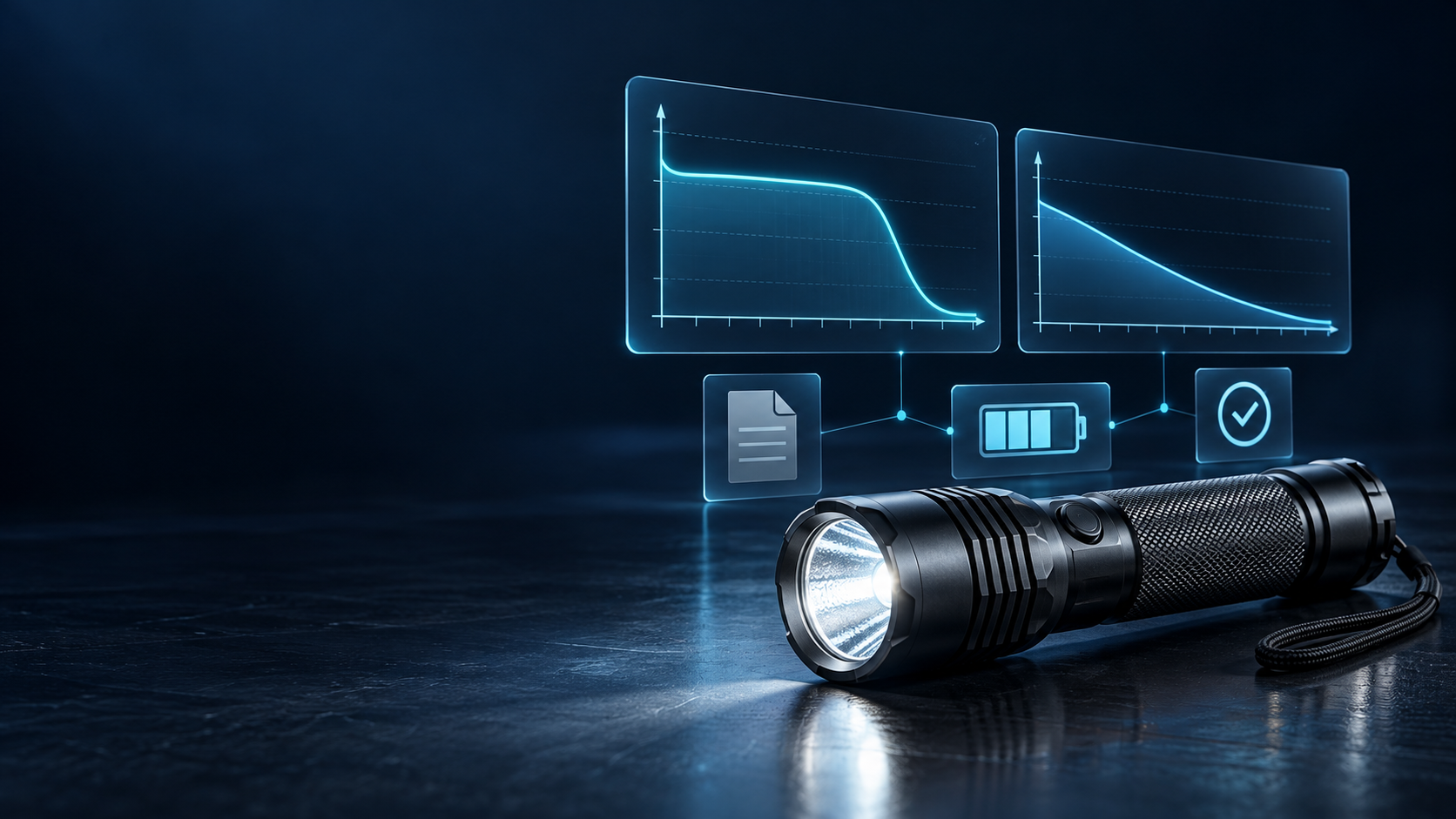
A Runtime Number Tells You When the Test Ended. A Runtime Curve Tells You What Happened Before It Ended.
For a professional buying decision, output-versus-time data is often more useful than a standalone runtime number. It helps reveal whether output is held relatively steady, reduced and stabilized, or gradually declines throughout the operating period.
Regulated output
Output is held relatively stable for part of the run. This can be useful where a predictable working level matters.
Step-down, then stable
A high initial level reduces, then continues at a lower level. The buyer must decide whether the later level still serves the task.
Gradual decline
Output reduces progressively. It may suit some applications, but the buyer should identify when it falls below the needed visibility level.
No one curve shape is automatically best. The right question is whether the curve maintains enough light for the actual work session. This article uses useful runtime as a buyer-decision concept, not as a replacement for a formal test-standard term: it means the time the product remains above the application’s minimum useful output.
A long dim tail can increase a total runtime number without necessarily supporting the user’s task. If a technician needs reliable visibility for four hours, a product that is only adequately bright for the first part of the test may not meet the brief even if its total stated runtime is longer.
What Actually Needs to Be Defined in a Flashlight Runtime Test?
Runtime is the result of a defined setup, not a battery label alone. A larger mAh figure does not, by itself, prove proportionally longer usable runtime. Voltage, power consumption, driver behavior, output level, thermal behavior, cut-off behavior and battery condition can all change the result.
Ask whether the result belongs to Low, Medium, High, or another specific operating mode.
A runtime claim without an output level is incomplete for most professional purchasing decisions.
Confirm battery type, rated capacity, configuration, state of charge, and whether the specified battery was used.
Check whether ambient conditions were defined and whether they are relevant to the intended application.
Request the time profile where the project requires sustained useful illumination.
Ask what condition determined the end of the test. Different endpoints can create non-comparable hours.
Peak Output, Step-Down and Turbo Are Different Purchasing Questions
High-output portable lights may reduce output as part of thermal or power-management behavior. The buyer does not need a complete engineering lecture to make a sound decision; the practical point is that peak output and sustained useful output are not the same thing.
A product described as “2,000 lumens + 8 hours” should not be interpreted as 2,000 lumens for eight hours unless the supplier’s evidence clearly supports that interpretation. Ask how long the highest mode remains at its initial level, what level follows, and which mode the total runtime refers to.
How ANSI/PLATO FL 1-2025 distinguishes standard modes and short-duration elevated brightness
ANSI/PLATO FL 1 is a voluntary performance standard, not a universal legal certification and not proof that every flashlight on the market follows the method. For standard operating modes, the current method uses output measured at 30 seconds as the runtime reference and ends when output reaches 10% of that reference.
For Short-Duration Elevated Brightness modes, commonly marketed as Turbo or Boost, the 2025 revision uses a different approach: performance is measured in the first 1–10 seconds, and runtime ends when output falls to 90% of the highest value measured in that interval. Buyers should therefore ask suppliers which category applies to the claimed mode and which revision and method were used.
Flashlight Runtime Verification Matrix
| Supplier claim | What the buyer should ask | Evidence to review | Why it matters |
|---|---|---|---|
| “8-hour runtime” | Which mode was tested, and what ended the test? | Test method and output-versus-time data | Shows what the eight hours actually represent. |
| “5,000 mAh battery” | What voltage, cell or pack configuration, and tested output were used? | Battery specification and runtime evidence | mAh alone does not equal usable runtime across different architectures. |
| “2,000 lm High / Turbo” | How long before output changes, and what output follows? | Output curve and mode description | Separates a brief peak from sustained work light. |
| “ANSI/PLATO FL 1 runtime” | Which revision, mode category and method apply? | Applicable report or documented method | Confirms standardized terminology is being used correctly. |
| “Approved sample passed” | Does the quoted production configuration match the tested sample? | Revision, battery and configuration confirmation | Runtime evidence belongs to a specific tested configuration. |
Supplier A vs. Supplier B: Which Claim Is Easier to Trust?
Supplier A
Claim: 8-hour runtime
Evidence: Datasheet number only.
Supplier B
Claim: 6-hour runtime
Evidence: Tested mode, battery condition, output curve, endpoint and method are defined.
Supplier B is not automatically the better product. However, Supplier B’s claim is easier for the buyer to interpret and verify. The final decision still depends on the application’s required output, operating time, size, weight and charging constraints.
What Buyers Should Request Before Accepting a Runtime Claim
- Which mode was tested?
- What was the initial measured output?
- What battery was used, with what rated capacity and configuration?
- Was the battery fully charged at the start?
- What test method and standard revision, if any, were used?
- What defines the end of runtime?
- Can the supplier provide output-versus-time data?
- Does the highest-output mode step down?
- If Turbo or Boost exists, how is that mode reported?
- Was the tested sample identical to the quoted product configuration?
- Which product revision was tested?
- Are the results based on one sample or multiple units?
Write a Better Runtime Requirement Into the RFQ
“Required runtime: 8 hours” is not enough for most B2B projects. It can lead to a product that stays illuminated for the stated time but does not provide enough light for the intended task. Do not simply request the largest possible battery: larger capacity can affect weight, diameter, length, charging time, cost, logistics and ergonomics.
The right runtime is the runtime required by the application at a useful output level, within acceptable size, weight and charging constraints.
Application: [actual task]
Required useful operating time: [hours]
Required output / visibility level: [define the work requirement]
Use pattern: [continuous or intermittent]
Battery / charging constraints: [define]
Size / weight limit: [define]
Operating environment: [define]
Runtime evidence required: [test method, curve or report if applicable]
Estimated quantity: [define]
Approved Sample Runtime Is Not a Permanent Production Guarantee
A runtime result belongs to the tested configuration. If the battery, driver, LED, firmware where applicable, or thermal design changes, the buyer should review whether previous runtime evidence still applies. The required review scope depends on the change; it does not mean every small change automatically demands the same full test program.
For bulk sourcing, buyers should confirm that the quoted production configuration remains aligned with the tested sample. This is especially important when runtime is a tender condition, a distributor claim or a core part of the product brief.
Why Buyers Ask for Long Runtime in Real Projects
In real international sourcing inquiries received by SHENGQI LIGHTING, buyers frequently specify long runtime, battery capacity or professional operating-time requirements as part of the product brief. Those requests are meaningful, but “long runtime” or “high-capacity battery” alone does not fully define the product requirement.
The productive project discussion is: What output is required? For how long? Is use continuous or intermittent? Can the light be charged between shifts? Are replaceable batteries needed? What size and weight limits apply? SHENGQI LIGHTING can discuss these runtime requirements as part of the complete portable-lighting application, including product category, charging approach and intended work cycle.
FAQ
Does an 8-hour runtime mean eight hours at full brightness?
Not necessarily. The buyer must confirm the tested mode, initial output, output curve and defined endpoint.
Why can equal battery capacity produce different runtime?
Capacity is only one factor. Voltage, power demand, output level, driver behavior, thermal behavior and cut-off conditions can also affect results.
Does Turbo runtime count as normal runtime?
Turbo or Boost may be a short-duration elevated-brightness mode. It should be identified and reported separately from a normal sustained operating mode.
Can one approved sample prove bulk-order runtime?
It proves the tested configuration only. If relevant components or the product revision change, the buyer should review whether the evidence remains applicable.
Need to Define a Realistic Runtime Requirement for Your Portable-Lighting Project?
Share the application, required operating time, required visibility level, use pattern, battery preference, charging availability, size and weight limit, operating environment, required runtime evidence and estimated quantity. This creates a clearer basis for product-platform and verification discussions.
Email: sales@shengqilight.com