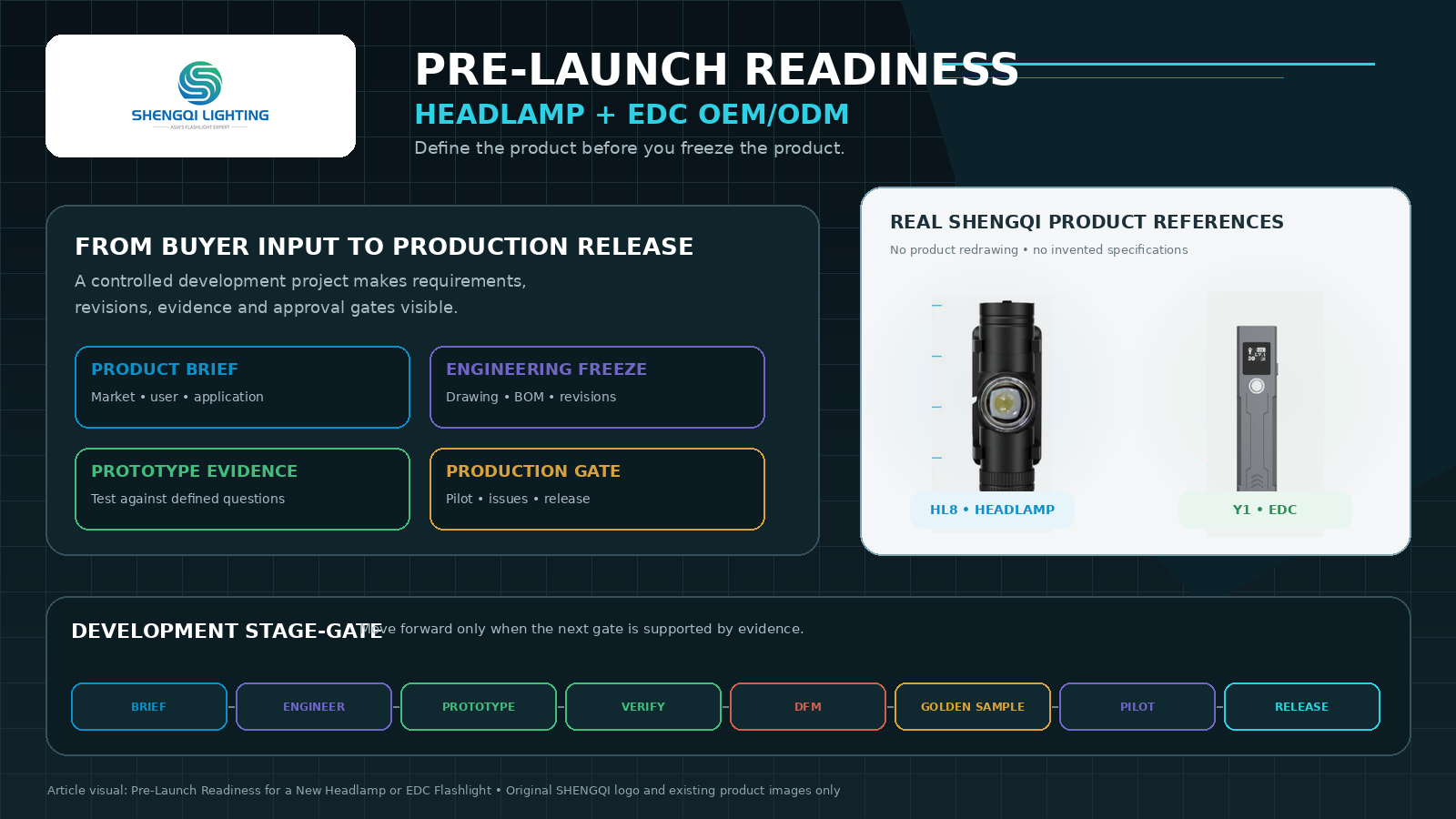

Why Pre-Launch Readiness Matters Before a Flashlight Project Moves Forward
A buyer sends an email: “We want a compact, premium 1,000-lumen EDC flashlight.” It sounds clear, yet almost nothing has been defined. What is compact? What beam is needed? How long should useful output remain available? Which battery, user, market, carry method and control logic apply? What does premium mean in measurable terms?
The development problem is often not that the factory cannot build the product. It is that the two sides are building different interpretations of the same product. Adjectives are not engineering specifications.
A development project becomes expensive when ambiguity survives too long. Late clarification can trigger repeated samples, changed tooling, revised packaging, new testing, delayed approvals and commercial misunderstanding.
What Should Be Inside a Flashlight Product Brief?
A useful flashlight product brief gives the engineering team enough context to challenge assumptions. It should identify target country or region, channel, user group and positioning; handheld or hands-free use; indoor or outdoor work; expected viewing distance; flood or spot priority; useful low mode; auxiliary or color light if required; size and weight direction; material preference; carry method; clip, headband or magnet if needed; rechargeable or replaceable power; battery direction; charging workflow; runtime target; switch and mode logic; lockout, indication or sensor if applicable; logo, CMF and packaging; estimated quantity; and target timeline.
Estimated quantity supports planning, but it should not be turned into an assumed fixed MOQ. Buyers considering deeper custom flashlight development should provide enough commercial context for the supplier to identify technical questions before quoting a final architecture.
“We need a powerful premium headlamp for outdoor use.”
Define the target user and hands-free task, beam priority, runtime requirement, battery approach, weight direction, target market, required UI and estimated quantity. Leave unresolved engineering choices clearly marked as open decisions.
Define the User Task Before Choosing the Flashlight Architecture
A headlamp project may need to consider hands-free operation, head weight, strap design, front-heavy balance, beam direction, sensor behavior or control access. None is mandatory for every headlamp. Existing headlamp product platforms can help buyers compare possible architecture directions.
An EDC project may instead prioritize pocket carry, clip geometry, grip, accidental activation, compact battery packaging, main or side lighting and carry thickness. Again, these are possible factors rather than universal requirements. The EDC flashlight platforms illustrate how different use cases create different form factors.
The same LED can belong to two completely different products because the user workflow is different.
Separate Must-Have Requirements From Nice-to-Have Features
Requirements without which the product fails its intended commercial or user objective.
Important requirements that may be traded against size, cost, schedule or another engineering constraint.
Features to add only when they support the final architecture without damaging higher priorities.
If low weight, a larger battery, more LEDs, a metal body, long runtime and compact dimensions are all treated as non-negotiable, physical contradictions may appear. A product brief should communicate priorities, not just accumulate features. Product positioning can also be compared with the broader portable lighting product range.
Feature Conflict Matrix
| Requirement A | Requirement B | Typical Conflict | Engineering Question |
|---|---|---|---|
| Compact Size | Large Battery | Internal volume | Which requirement has priority? |
| High Output | Thermal Load | Heat and regulation | What useful output behavior is required? |
| Low Weight | Structural Material | Mass versus structure | Where is material strength actually needed? |
| More Functions | Simple UI | Control complexity | Which behaviors are genuinely useful? |
| Large Optic | Pocket Carry | Head diameter | How much carry bulk is acceptable? |
| Sealing | Service Access | Opening versus protection | Which parts must remain serviceable? |
Freeze the Product Definition Before Freezing the Housing
If industrial design is already frozen when the team discovers that the battery does not fit, the optic needs more depth, the PCB is larger, the switch conflicts with the structure, the charging-port location is impractical, the headlamp is front-heavy or the thermal path is inadequate, development moves backward.
Industrial design and engineering should mature together. Revision control should cover Drawing Revision, BOM Revision, Firmware Revision when applicable, Sample Revision and Packaging Revision.
Sample Revision: EVT-B | Drawing: R03 | PCB: R02 | Firmware: V0.X | BOM: Controlled Revision
A formal project should not depend on files named final.pdf, final2.pdf and final-new.pdf. When an approved LED, battery, switch, PCB, finish, material, supplier or packaging component changes, the team should raise a documented change request and ask: Does this change require re-verification? Verbal change is not configuration control.
Industrial Design and CMF Must Follow the Internal Architecture
Industrial design is not only exterior styling. The enclosure must accommodate the LED, optics, PCB, battery, switch, wiring, structural walls, seals and thermal path while still supporting grip, carry, balance and assembly.
CMF means Color, Material and Finish, but the decision is broader than choosing black or orange. CMF can affect machining, coating, logo application, wear behavior, cosmetic consistency and the packaging protection needed for visible surfaces.
A beautiful concept that cannot accommodate the real internal architecture is not mature product design.
Define the Beam Before Approving the LED
“1,000 lumens” does not explain what the user must see, the approximate working distance, flood versus spot priority, useful illuminated area, peripheral visibility, glare tolerance or low-output requirement.
The final beam comes from the interaction of LED + Reflector / TIR / Lens + Mechanical Alignment. A reflector, TIR optic or zoomable lens can support different beam architectures, but the choice should follow the user task rather than a component trend.
Beamshots help evaluate user-perceived beam behavior. They do not replace instrumented measurement. Depending on the project, verification could combine integrating-sphere measurement, illuminance measurement, comparative beam review and field evaluation. Not every project requires every method.
Turn the Feature List Into a Defined Electronic Architecture
Multiple LEDs, UV, a side light, sensor, battery indication, lockout, mode memory, charging or a special UI can affect PCB layout, control logic, firmware, battery demand, thermal design and validation. Every electronic feature creates another behavior that must be defined and tested.
Example UI Decision Map
Define intended action.
Define intended action.
Define intended action.
Define activation and exit logic.
The map does not prescribe the best UI. It prevents the design team from assuming that double-click means one function while the buyer expects another.
Battery Architecture Is a Product Decision, Not an Afterthought
Integrated lithium packs, 14500, 18650, 21700, AA and AAA configurations can all support valid product architectures. None is universally best. Battery selection affects dimensions, weight, output capability, runtime, charging workflow, current capability and transport or compliance considerations.
Battery capacity in mAh is only one input. It does not independently define output, runtime or charging behavior.
If the product is rechargeable, the buyer should define whether charging is direct or requires battery removal, where charging access should be located, how status is indicated, whether a cable is required and whether access remains practical in normal use. The interface should not be assumed to be USB-C unless the project defines it.
A Prototype Should Answer a Question, Not Merely Look Finished
An appearance prototype may answer questions about proportions, grip and visual direction. An engineering prototype may focus on structure, optics and electronics. An integrated prototype may evaluate whole-system behavior. A production-representative sample may move closer to final material, manufacturing process, finish and assembly.
Prototype stages depend on project complexity. Not every project requires four formal stages.
Decide How the Product Will Be Approved Before Testing Begins
Requirement → Test → Acceptance Criteria → Evidence → Approval creates a clearer verification path than receiving a sample and deciding afterward what “good enough” means. Available flashlight testing and quality-control capabilities can support project-specific verification without implying that every project requires every test.
| Requirement | Verification Method | Prototype Stage | Acceptance Criteria | Evidence | Owner |
|---|---|---|---|---|---|
| Output | Photometric review | Defined by project | Project-Specific | Test record | Assigned team |
| Beam | Measurement + visual review | Defined by project | Project-Specific | Beam evidence | Assigned team |
| UI | Functional sequence review | Defined by project | Project-Specific | UI record | Assigned team |
| Charging | Charging workflow review | Defined by project | Project-Specific | Test record | Assigned team |
| Battery | Configuration review | Defined by project | Project-Specific | Configuration record | Assigned team |
| Mechanical Fit | Assembly inspection | Defined by project | Project-Specific | Inspection record | Assigned team |
| Carry | User-workflow review | Defined by project | Project-Specific | Review notes | Assigned team |
| Cosmetic | Reference comparison | Defined by project | Project-Specific | Approved reference | Assigned team |
| Environmental Requirement | Applicable project test | Defined by project | Project-Specific | Applicable evidence | Assigned team |
| Packaging | Pack-out review | Defined by project | Project-Specific | Approved pack-out | Assigned team |
Verification categories may include: Functional Verification, Optical Verification, Electronic Verification, Mechanical Verification, Environmental Verification, Cosmetic Verification and User-Workflow Review.
Technically functional does not automatically mean practical to use. A headlamp may operate correctly yet feel poorly balanced; an EDC light may pass electrical checks yet be awkward to carry or activate.
A Product That Can Be Prototyped Is Not Automatically Ready to Manufacture
Design for Manufacturing asks whether assembly is repeatable, critical dimensions can be inspected, wires can be routed consistently, components can be inserted without damage, seals can be assembled correctly, cosmetic surfaces can survive production, tooling access is reasonable and the process can support the expected volume.
One handmade prototype does not establish mass-production readiness. A technician may route a wire perfectly by hand, an engineering sample may be hand-polished, a selected cosmetic shell may hide natural variation or an optic may be manually aligned. Production should not depend on exceptional manual correction.
The DFM review should connect the approved architecture with actual flashlight manufacturing capabilities and planned process controls.
A Golden Sample Is a Controlled Reference, Not a Trophy
The golden sample should be tied to the approved drawing, approved BOM, approved firmware if applicable, LED, battery, material, finish, logo, packaging and approved deviations. The physical sample and the documentation should identify the same product.
Physical reference
Dimensional reference
Component reference
Behavior reference
Acceptance reference
Golden Sample ≠ Production Guarantee. Selected samples, uncontrolled BOM changes, supplier substitution, assembly tolerance, process inconsistency, cosmetic variation and incomplete inspection criteria can all create a sample-to-production gap.
The objective is not to make one excellent unit. It is to define a process that repeatedly produces acceptable units.
Pilot Production Tests Whether the Process Can Reproduce the Product
Prototype asks: Does the design work?
Pilot Production asks: Can the production process reproduce it?
The pilot should review assembly sequence, fixtures, materials, operator access, cosmetic handling, inspection, packaging, defect patterns and bottlenecks. The appropriate pilot quantity depends on the project.
After the run, do not ask only, “Did production finish?” Ask what failed, what required rework, which step was inconsistent, which specification was unclear and what should change before release.
Issue → Root Cause → Action → Verification → Close creates more useful project visibility than an information black box.
Mass Production Should Be Released Through a Gate, Not a Date
Before release, Product Definition should be approved; Drawings and BOM approved; Firmware approved if applicable; Golden Sample approved; agreed Verification completed; critical DFM issues closed; critical pilot issues closed or controlled; Packaging confirmed; Quality inspection requirements defined; and Change Control active.
Mass production should begin because the project has passed the release criteria—not simply because the planned launch date is approaching.
Pre-Launch Readiness Matrix for Headlamp and EDC Projects
| Development Area | Buyer Input | OEM/ODM Engineering Output | Approval Evidence | Risk if Unclear |
|---|---|---|---|---|
| 1. Target Market | Country / channel | Market-requirement questions | Confirmed scope | Late compliance changes |
| 2. Target User | User profile | Human-factor requirements | Approved brief | Wrong workflow |
| 3. Application | Task / environment | Architecture requirements | Use-case approval | Wrong architecture |
| 4. Product Positioning | Channel / value direction | Priority structure | Positioning approval | Feature mismatch |
| 5. Lighting Requirement | Beam task | Optical architecture | Beam evidence | Wrong beam |
| 6. Industrial Design | Form / carry direction | Design revision | Approved drawing | Repeated redesign |
| 7. CMF | Color / material / finish | CMF specification | Approved reference | Batch inconsistency |
| 8. Electronics / PCB | Required behaviors | Circuit / UI architecture | Revision record | Behavior conflict |
| 9. Battery / Charging | Power workflow | Power architecture | Approved configuration | Late enclosure changes |
| 10. Mechanical Architecture | Size / interface limits | Mechanical design | Drawing / sample | Assembly conflict |
| 11. Prototype | Approval questions | Controlled sample | Sample record | Wrong sample approved |
| 12. Verification | Acceptance priorities | Verification plan | Test evidence | Subjective approval |
| 13. DFM | Volume / service needs | Process review | Closed issues | Poor repeatability |
| 14. Packaging | Channel / accessories | Pack-out design | Approved packaging | Late packaging changes |
| 15. Production Release | Commercial approval | Release package | Gate status | Uncontrolled launch |
Stage-Gate Timeline: What Must Be True Before Moving Forward?
Business problem defined.
Priorities and open questions visible.
Technical direction agreed.
Sample answers defined questions.
Evidence meets agreed criteria.
Process risks reviewed.
Reference tied to controlled documents.
Process reproduces the design.
Release criteria passed.
Five Decisions Buyers Often Make Too Early
01. Freezing the Housing Before the Internal Architecture. Battery, optics, PCB, controls and thermal requirements may later force redesign.
02. Choosing Peak Lumens Before Defining the Beam Task. Total output does not define the visual requirement.
03. Approving Appearance Before Reviewing the UI. Control changes may require mechanical or firmware changes.
04. Ordering Packaging Before the Accessory and Charging Configuration Is Frozen. Cable, charger, accessory or product revisions can invalidate the pack-out.
05. Demanding a Final Unit Cost Before the Product Definition Is Stable. A supplier may provide a budgetary quotation based on stated assumptions, but a final commercial model needs a more stable BOM, manufacturing process, packaging definition and quantity assumptions.
Five Decisions Buyers Often Make Too Late
01. Defining Cosmetic Acceptance. Late standards can create disputes over finish, gaps or logo appearance.
02. Confirming Target-Market Requirements. Compliance questions discovered after design freeze may cause rework.
03. Testing Real User Workflow. Bench success does not guarantee practical wear, carry, charging or control.
04. Controlling Firmware and BOM Revisions. Late revision control makes sample approval ambiguous.
05. Defining Post-Approval Change Control. Late-stage changes may drive rework, tooling changes, sample repetition, packaging changes, delays or commercial misunderstanding.
Why an Excellent Sample Can Still Become a Poor Production Run
A strong sample can be selected from several builds, assembled by an experienced technician and reviewed with unusual care. Production introduces repeatability. If BOM changes are uncontrolled, suppliers are substituted, tolerances stack differently, optical alignment varies, finishes shift or inspection criteria remain subjective, later units can drift from the approved reference.
This is not an assumption that every supplier will experience these problems. It is a reason to build controls before scale. The objective is not to make one excellent unit. It is to define a process that repeatedly produces acceptable units.
What Should Happen When a Component Changes?
A battery supplier, LED revision, switch source, coating, PCB component or packaging component may need to change during the product life cycle. The response should not be a verbal substitution.
Change Request → Impact Review → Re-Sample if Needed → Verification if Needed → Buyer Approval → Controlled Release
The key question is whether the proposed change can affect function, appearance, durability, compliance, manufacturing or the approved commercial specification. If so, the relevant evidence should be reviewed before release.
Fifteen Questions Brand Buyers Should Answer Before Sending a Flashlight RFQ
- Who is the target user?
- Which country or market will receive the product?
- What task must the product perform?
- Is the platform a headlamp, EDC light or another portable-light architecture?
- What beam behavior is required?
- Which lighting modes are genuinely useful?
- What battery and charging workflow is expected?
- What dimensions and weight direction are acceptable?
- Which features are must-have, should-have or optional?
- What UI behavior is required?
- What branding and CMF are required?
- What packaging and accessories are required?
- What prototype evidence will be used for approval?
- What estimated quantity should manufacturing planning consider?
- What target development or launch timeline should the supplier understand?
What to Send the OEM/ODM Team
An existing product reference, sketch or ID concept, feature list, target market, target cost direction, estimated quantity, timeline, packaging direction and known market requirements can accelerate the first review. Competitor references can also help describe expectations, but use competitor products to describe expectations, not to request direct copying of protected designs.
What Should the OEM/ODM Team Return After Reviewing the Brief?
A useful engineering response should include feasibility questions, an architecture proposal, open technical risks, assumptions, required buyer decisions, prototype direction, verification direction and an estimated commercial framework when enough information is available. A useful engineering response should reduce uncertainty.
For projects requiring more than an existing platform with a logo change, SHENGQI LIGHTING can support OEM/ODM product development across industrial design, optical engineering, electronic design, PCB layout, packaging, manufacturing, testing and quality control.
Frequently Asked Questions About Flashlight OEM/ODM Pre-Launch Development
1. What should a buyer prepare before starting a flashlight OEM/ODM project?
A buyer should define the target market, user, application, product positioning, lighting task, power architecture, controls, size and weight direction, branding, packaging, estimated quantity, timeline and approval priorities. The first brief does not need to solve every engineering question. It should show which requirements are mandatory, which can be traded against other constraints and which decisions remain open. This gives the OEM/ODM team enough context to propose an architecture rather than simply quote against a vague feature list.
2. When should flashlight product requirements be frozen?
Requirements should be frozen by stage when the information needed for the next decision is sufficiently mature. A freeze does not mean the project can never change. It means the current drawing, BOM, firmware when applicable, sample and other controlled references have an approved revision. Open issues should remain visible, and later changes should follow impact review and re-verification where necessary. Freezing the exterior before battery, optics, PCB, controls and thermal architecture are mature can create avoidable redesign.
3. Should industrial design be completed before optical and electronic engineering?
Not necessarily. Industrial design, optics, electronics, mechanical engineering and battery architecture should usually iterate together. The exterior needs to accommodate the real LED, optic, PCB, battery, switch, wiring, structural walls, sealing and thermal path. If ID is finalized too early, technical discoveries may require changes to dimensions, button locations, charging access, balance or internal volume. The goal is not to delay industrial design; it is to mature it alongside the engineering architecture so later revisions are controlled rather than disruptive.
4. What should buyers verify on a flashlight prototype?
Buyers should verify the questions that the particular prototype was built to answer. Depending on the stage, this may include function, optics, UI behavior, battery and charging workflow, mechanical fit, carry or wearing experience, cosmetics and project-specific environmental requirements. The verification plan should define the method, acceptance criteria, evidence and responsible owner before approval. A sample that looks good can still be incomplete if critical electrical, optical, mechanical or workflow questions remain unanswered.
5. What is the difference between a prototype and a golden sample?
A prototype is used during development or verification to answer design questions. It may focus on appearance, structure, optics, electronics or whole-system behavior, depending on the project stage. A golden sample is an approved physical reference tied to controlled documentation such as the drawing, BOM, firmware when applicable, material, finish, branding and packaging. The golden sample helps define the production baseline, but it does not guarantee production consistency by itself. Process control and inspection are still required.
6. Why is DFM important before flashlight mass production?
DFM evaluates whether the approved architecture can be manufactured repeatedly rather than assembled once by an engineering team. It considers assembly sequence, inspection access, wire routing, component insertion, seals, tooling access, cosmetic handling and the planned production volume. A handcrafted prototype may hide production risks because technicians can manually correct alignment or fit. DFM converts those hidden corrections into defined process requirements, fixtures, tolerances, inspection points or design changes before the project is released to larger-scale production.
7. What should be confirmed during a pilot production run?
A pilot run should confirm whether the planned process can reproduce the approved product. Review assembly sequence, fixtures, operator access, materials, cosmetic handling, inspection, packaging, defect patterns and bottlenecks. The team should record what failed, what required rework, which steps were inconsistent and whether any specification remained unclear. Problems should move through issue identification, root-cause review, corrective action, verification and closure. Pilot completion alone is not the same as production approval.
8. What information should a brand include in a flashlight OEM/ODM RFQ?
An RFQ should at least include the target market, intended application, required features, estimated quantity and target timeline. It becomes more useful when the buyer also provides the target user, beam expectations, battery and charging direction, size or weight direction, UI requirements, branding, CMF, packaging and known market requirements. Existing product or competitor references can help communicate expectations, provided they are used for benchmarking rather than requesting direct copying of protected designs.
Move Forward When the Evidence Supports the Next Gate
A project is ready to advance when the next stage is supported by controlled requirements, evidence and approvals—not because the calendar says the product should already be finished. Strong development management keeps requirements, revisions, issues, approvals and changes visible so a promising concept can move toward repeatable production without turning late-stage ambiguity into avoidable cost.
Coming Soon: Shengqi Lighting is preparing to introduce a new Rangefinder Flashlight. Full specifications and official product information will be released soon.
Planning a New Headlamp or EDC Flashlight Project?
For a more productive first technical review, prepare your Target Market, Application, Required Features, Estimated Quantity and Target Timeline. These inputs help identify product priorities, engineering questions and the appropriate development path.
Review SHENGQI LIGHTING's OEM/ODM development services or discuss a project directly with the team.
Contact SHENGQI LIGHTING for an OEM/ODM technical evaluation at sales@shengqilight.com.
Contact SHENGQI LIGHTING