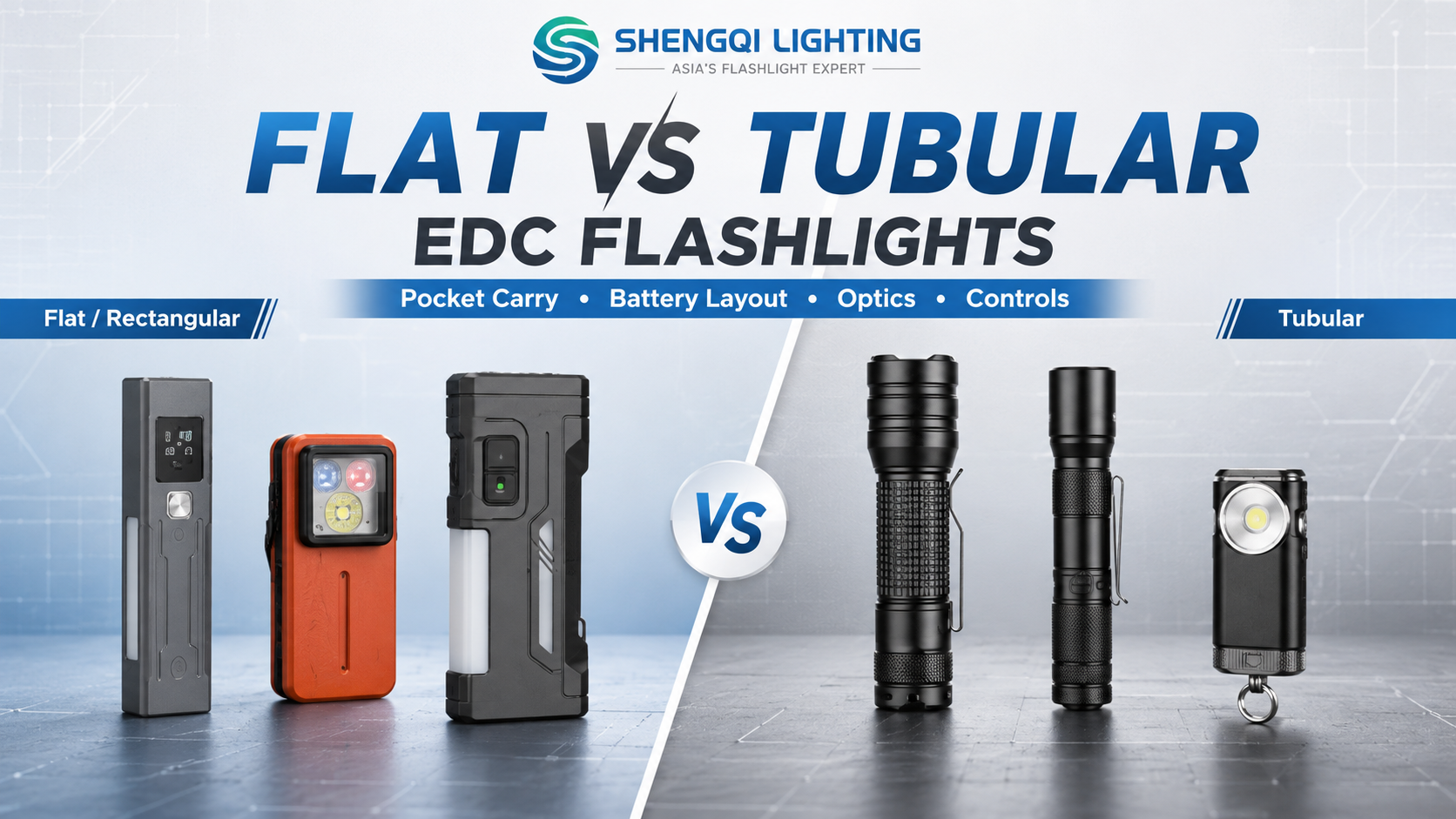

What is the difference between a flat and tubular EDC flashlight?
A flat EDC flashlight uses a flattened or rectangular body to distribute components across multiple surfaces, while a tubular flashlight usually organizes the battery, optics and grip along a cylindrical axis. Flat geometry can change the pocket profile, reduce rolling tendency and create additional surfaces for side lights, controls or model-specific magnetic structures. Tubular geometry can provide a natural circular grip, direct battery alignment and a traditional axial optical path. Battery architecture, thermal packaging, switch placement and manufacturing also change with the enclosure. A flat body may still contain a cylindrical 18650 cell, while a tubular light may use either replaceable or integrated power. Neither architecture is universally better.
Is a flat EDC flashlight better for pocket carry?
Not automatically. A flat body can reduce rolling and distribute thickness differently in a pocket, but real carry comfort depends on width, length, weight, clip position, controls and the other objects carried with it. A broad flat surface may sit predictably against the body, while a narrow tubular light may fit better in a slim pocket or tool loop. Pocket carry should therefore be evaluated with the actual product dimensions and intended carry method.
When should a brand choose a tubular EDC flashlight?
A tubular architecture may make sense when the product uses simple forward lighting, a cylindrical battery aligned with the body, a traditional circular grip or a conventional tail or side switch. Cylindrical geometry may also simplify some machining and assembly operations. That is not a universal cost advantage: optics, electronics, sealing, finishing and part count still determine final complexity. The correct choice depends on the complete product brief.
What Do “Flat” and “Tubular” Mean in EDC Flashlight Design?
Tubular lights commonly build around a cylindrical battery, circular hand contact and an axial LED-reflector or TIR arrangement. The familiar head, body and tail architecture follows that axis naturally.
Flat or non-cylindrical products use flattened, rectangular, asymmetric or multi-face body geometry. There is no single dimensional threshold that automatically makes a flashlight “flat.” Y1 and Y5 are clear rectangular flat-body examples, while Y4 is better described as a compact rectangular or non-tubular clip-on architecture rather than the same thin-body concept as Y5.
Form factor creates design possibilities and constraints. It does not automatically define the final feature set.
Pocket Carry Is a Geometry Problem
A flat or rectangular body may sit against the wearer with a broad face, create predictable orientation and reduce rolling tendency. The trade-off can be greater width, corners, side controls or a larger overall pocket footprint.
A tubular body offers a narrow circular cross-section and can slide naturally into narrow pockets, organizers or tool loops. Its round profile can roll and may rotate more freely inside the pocket.
Pocket comfort depends on thickness, width, length, weight, clip position and surrounding objects—not body shape alone.
Tubular and Flat Bodies Create Different Grip Mechanics
Tubular lights provide circular hand contact and can rotate naturally in the hand. Flat bodies offer clearer front-and-back orientation and broader surfaces that may make switch location easier to identify by touch in some layouts.
Sample testing should cover pocket extraction, repeated switching and the intended everyday grip. Gloves should be included only when the target channel requires them.
Anti-Roll Is a Structural Choice, Not a Flat-Body Guarantee
Rectangular bodies often reduce rolling tendency, and Y1 illustrates that kind of geometry. Tubular lights can also manage rolling through clips, head geometry, anti-roll rings, flats or tail design. “Flat” does not mean “cannot roll,” and “tubular” does not mean “must roll.”
Battery Choice Can Shape the Body Before Industrial Design Begins
Cylindrical cells such as AAA, AA, 14500, 18650 or 21700 naturally fit an axial tubular housing. Flat architectures can still use cylindrical cells inside a broader enclosure or use integrated lithium systems while distributing electronics and secondary light sources around the battery.
SHENGQI examples show the range: Y1 uses a built-in 1000mAh battery, Y4 uses a built-in 500mAh battery, Y5 integrates an 18650 2600mAh battery, C6 supports 14500 or AA architecture, and L2 MAX uses a 14500 platform.
Flat does not mean pouch battery. Tubular does not mean replaceable battery.
Body Shape Changes Thermal Packaging—but Does Not Determine Thermal Performance Alone
Tubular bodies may offer a direct circumferential aluminum path from the LED head into the body. Flat bodies may create broader exterior surfaces or alternative internal component layouts. Actual thermal performance still depends on LED load, PCB, contact area, wall thickness, battery, driver, thermal regulation, airflow and output mode. Maximum lumens should not be used to infer thermal performance.
Form Factor Changes Where Designers Can Put Light Sources
Tubular products commonly align the primary LED and optic with the body axis. C6 shows how a cylindrical structure can also support a telescopic optical head without implying that all tubular lights are zoomable.
Multi-face products can create additional placement options. Y1 combines a main light, side light and UV source. Y4 combines spot, flood and UV optical functions in a compact non-tubular structure. Y5 combines a primary beam with side-light architecture.
More surfaces create opportunities, but more emitters also add PCB, UI, sealing, battery and assembly complexity.
More Functions Increase the Importance of Switch Architecture
Multi-function products may use separate buttons, mode grouping, long press, double click, source switching or lockout. Tubular products may use simpler primary controls; L2 MAX, for example, uses a mechanical tail-switch architecture. B2B buyers should define first-click behavior, source switching, lockout, strobe access, button location and pocket-activation risk.
Clip Position Should Be Designed With the Body, Not Added at the End
Flat and rectangular lights can integrate clips with a broad side or back surface, while tubular clips usually wrap or clamp around a circular body. Y4 confirms a back-clip architecture; L2 MAX confirms a two-way clip architecture.
Buyers should verify retention, orientation, insertion, extraction, switch interference, body scratching and repeated use. Clip holding force should not be assumed without testing.
A Flat Body Can Create New Mounting Surfaces—but Magnets Are Model-Specific
The Y1 flat EDC architecture confirms a magnetic tail. That demonstrates one possible flat-body task-positioning solution; it does not mean every flat flashlight includes a magnet.
Form Factor Changes the Manufacturing Problem
Tubular architectures can involve cylindrical turning, threading, tailcaps, circular optical parts, O-rings and battery tubes. Rectangular products may add multi-face machining, larger finishing surfaces, side optical windows, additional buttons, internal brackets or more complex component alignment.
Manufacturing cost follows part count, machining time, tolerances, electronics, optics, finishing, assembly and test scope—not the word “flat” or “tubular” alone.
Brands can review SHENGQI's EDC enclosure manufacturing capabilities when evaluating how a structural concept moves into production.
CMF Has Different Visual Effects on Flat and Tubular Bodies
Color, Material and Finish can emphasize different surfaces. A flat body may provide larger front and rear areas for texture, logo treatment or contrast panels, while a cylindrical finish wraps continuously around the body. Neither geometry is inherently more premium.
Private Mold Decisions Should Start With Product Differentiation
A differentiated structure may be justified when the brand needs unique pocket geometry, switch layout, clip, light-source arrangement, battery compartment, CMF or product-family language. Mature platforms may make more sense when testing market demand or expanding an assortment with fewer engineering changes.
Form Factor Continues Into Packaging
Flat products may suit shallower, wider trays and require protection for side controls or optical windows. Tubular products may use narrower cavities and need anti-roll retention. Accessories, battery, cable, instructions, retail channel and transport protection still define the final package.
Flat vs Tubular EDC Flashlight Design Matrix
| Design Dimension | Flat / Rectangular Architecture | Tubular Architecture | Buyer Question | Engineering Verification |
|---|---|---|---|---|
| Pocket profile | Broader, flatter orientation | Narrow circular profile | How is it carried? | Pocket test |
| Grip | Clear face orientation | Circular hand contact | Which handling style? | Grip test |
| Anti-roll behavior | Often reduced by geometry | May need clip or flats | Will it rest on surfaces? | Roll test |
| Battery layout | Flexible internal arrangement | Natural axial alignment | Which cell architecture? | Electrical / fit review |
| Optical arrangement | Multiple faces possible | Axial main beam common | One source or several? | Optical review |
| Side-light integration | More placement options | Possible but geometry differs | Is a second role required? | UI / thermal test |
| Switch placement | Multiple surface options | Tail or side common | What is first-click logic? | Mis-activation test |
| Clip | Side / back integration possible | Circular-body attachment | What orientation? | Retention test |
| Magnetic mounting | Possible on suitable models | Also possible model-by-model | Is it a core use case? | Holding-force test |
| Thermal architecture | Alternative surface/layout options | Simple circumferential path possible | What sustained output? | Temperature/output test |
| Manufacturing | May add multi-face operations | May simplify some turning | What complexity is acceptable? | DFM review |
| Packaging | Shallow / wider options | Narrow linear cavities | Which retail channel? | Packaging sample |
SHENGQI EDC Form-Factor Architecture Examples
| Model | Form-Factor Role | Verified Structural Feature | Battery Architecture | Useful Product-Line Role |
|---|---|---|---|---|
| Y1 | Rectangular Flat | Flat body + side light + magnetic tail | Built-in 1000mAh | Multi-function flat platform |
| Y4 | Compact Rectangular / Non-Tubular | 58mm body + back clip + multiple optical sources | Built-in 500mAh | Ultra-compact clip-on platform |
| Y5 | Flat High-Output | 22 × 40 × 95mm + side-light architecture | 18650 2600mAh | High-output flat platform |
| G8 | Compact Tubular | φ30 × 64mm | 3.7V 290mAh lithium battery | Ultra-compact cylindrical platform |
| C6 | Zoomable Tubular | φ26 / φ21.5 × 95.1mm + telescopic optics | 14500 / AA | Zoomable cylindrical platform |
| L2 MAX | Clip-On Tubular | Approx. φ25 / 20.5 × 105.5mm + two-way clip | 14500 | Traditional clip-on directional platform |
When a Flat / Rectangular EDC Architecture May Make Sense
A multi-face body may create useful placement options, depending on the product brief.
Rectangular geometry can reduce rolling tendency where surface use matters.
The area may support controls, optics, branding or other model-specific functions.
Multiple surfaces can help separate controls, depending on UI requirements.
A non-cylindrical silhouette can create distinctive family language without being inherently better.
When a Tubular EDC Architecture May Make Sense
An axial optical arrangement may match a straightforward directional-light brief.
Cylindrical cells can integrate efficiently in a cylindrical housing.
The familiar round profile may suit the intended everyday handling.
A conventional head-body-tail layout can support a direct tail-control architecture.
Tubular geometry may simplify some machining and assembly operations, but final complexity still depends on optics, electronics, sealing and part count.
Ten Questions Before Choosing an EDC Flashlight Form Factor
Ten Tests Buyers Should Run Before Approving an EDC Form Factor
Evaluate the complete product in the intended pocket or organizer.
Check access, orientation and interference with nearby objects.
Confirm repeatable handling and control identification.
Observe real behavior on representative surfaces.
Use only when the approved product includes a clip.
Include pocket pressure and normal handling.
Verify sustained behavior instead of inferring it from peak lumens.
Match the actual power architecture.
Apply the project's defined structural requirement.
Confirm that the approved architecture can be reproduced consistently.
A Strong EDC Line Can Use More Than One Form Factor
A brand does not need to make its entire EDC category flat or tubular. Different architectures can own different jobs.
- Compact Tubular SKU: simple directional pocket-light role, illustrated by G8 or L2 MAX architecture.
- Zoomable Tubular SKU: adjustable optical requirement, illustrated by C6.
- Flat Multi-Function SKU: broad-body, multiple-light-source or anti-roll role, illustrated by Y1 and Y5.
- Ultra-Compact Rectangular Clip-On SKU: small-carry and multi-optical-function role, illustrated by Y4.
The better question is not which form factor wins. It is which form factor should own each use case in the product line.
How SHENGQI LIGHTING Supports Custom EDC Form-Factor Development
An EDC ODM project should define pocket geometry, battery architecture, optics, control layout, secondary light sources, clip or magnetic functions, thermal targets, manufacturing process and packaging as one system.
SHENGQI supports relevant work through Industrial Design, CMF development, Optical Engineering, Electronic Design, Mechanical Integration, battery architecture, CNC-oriented manufacturing, Packaging Design, Testing and Quality Control. Brands can review custom EDC flashlight development and the broader EDC flashlight product platforms.
The product brief should decide which architecture fits the use case before styling, feature count or peak output becomes the dominant decision.
Frequently Asked Questions
1. What is a flat EDC flashlight?
A flat EDC flashlight uses a flattened, rectangular, asymmetric or multi-face body rather than relying on a simple cylindrical tube. This geometry can create different pocket profiles and provide additional surfaces for model-specific controls, secondary lights or mounting features. There is no universal dimensional standard that automatically defines a flashlight as flat.
2. Is a flat flashlight more comfortable in a pocket?
Not automatically. A flat body may distribute thickness differently and sit with a predictable orientation, but width, length, weight, clip position, corners and surrounding pocket contents also affect comfort. A compact tubular light may fit better in a narrow pocket or tool loop. Real carry should be tested with the complete product.
3. Why do many traditional flashlights use a tubular body?
Cylindrical batteries naturally align with cylindrical housings, and the same axis can support a forward LED, reflector or TIR optic, circular grip and conventional head-body-tail architecture. This geometry can simplify some mechanical relationships, but it does not automatically make a tubular flashlight cheaper, more durable or better for every EDC application.
4. Is thermal performance better in a flat or tubular flashlight?
There is no universal winner. Tubular bodies may offer a simple circumferential heat path, while flat bodies may provide broader surfaces and different internal layouts. Actual thermal behavior depends on LED load, PCB design, contact area, material, wall thickness, battery, driver regulation, airflow and output mode. Model-specific temperature and output-over-time testing is required.
5. Are flat EDC flashlights better for side lights and multiple LEDs?
Flat or multi-face geometry can create more placement options for side windows, secondary emitters and separate controls. Y1 and Y5 demonstrate side-light architectures, while Y4 uses multiple optical functions in a compact rectangular structure. These features remain model-specific: a flat body does not automatically mean that a flashlight includes side lights, UV, magnets or multiple LEDs.
6. Can a flat flashlight still use an 18650 battery?
Yes. Flat does not mean that the product must use a pouch cell. Y5 is a real SHENGQI example of a flat-body EDC architecture built around an 18650 2600mAh battery. The enclosure can organize the cylindrical cell together with optics, electronics and side-light components inside a broader rectangular body.
7. Which form factor is easier to manufacture?
Neither answer is universal. Tubular geometry may simplify certain turning, threading and circular-component operations, while flat products may require additional multi-face machining, windows or alignment. Final complexity depends on machining time, part count, electronics, optics, sealing, finishing, tolerances, assembly and test scope. A project-specific DFM review is more useful than judging manufacturing from shape alone.
8. What should B2B buyers test before approving a new EDC flashlight form factor?
Test pocket carry, extraction, grip, orientation, rolling behavior, clip performance where applicable, switch mis-activation, battery workflow and mechanical durability. Thermal and output-over-time behavior should also be verified rather than inferred from maximum lumens. Finally, compare production-representative samples to confirm that the approved enclosure, optics, controls and battery architecture can be reproduced consistently.
Conclusion: Choose the Product Brief Before the Shape
Flat and tubular EDC flashlights solve different product briefs. Flat geometry can support broad surfaces, multi-face layouts and different pocket orientation, while tubular architecture can suit axial batteries, circular grip and traditional directional-light design. Neither form factor should be treated as inherently premium, cheaper, cooler-running or more comfortable. Product teams should connect carry, battery, optics, UI, thermal targets, manufacturing and packaging before selecting the enclosure.
Coming Soon: Shengqi Lighting is preparing to introduce a new portable lighting product. Official product information will be released soon.
Define Carry, Battery, Optics and Manufacturing as One System
EDC brands, outdoor companies, tool businesses, product managers, industrial designers and private-label buyers can discuss form-factor selection, battery architecture, optical layout, side-light integration, UI, clip or magnetic structures, CMF, DFM, packaging and sample validation.
Contact SHENGQI LIGHTING for an OEM/ODM technical evaluation at sales@shengqilight.com.