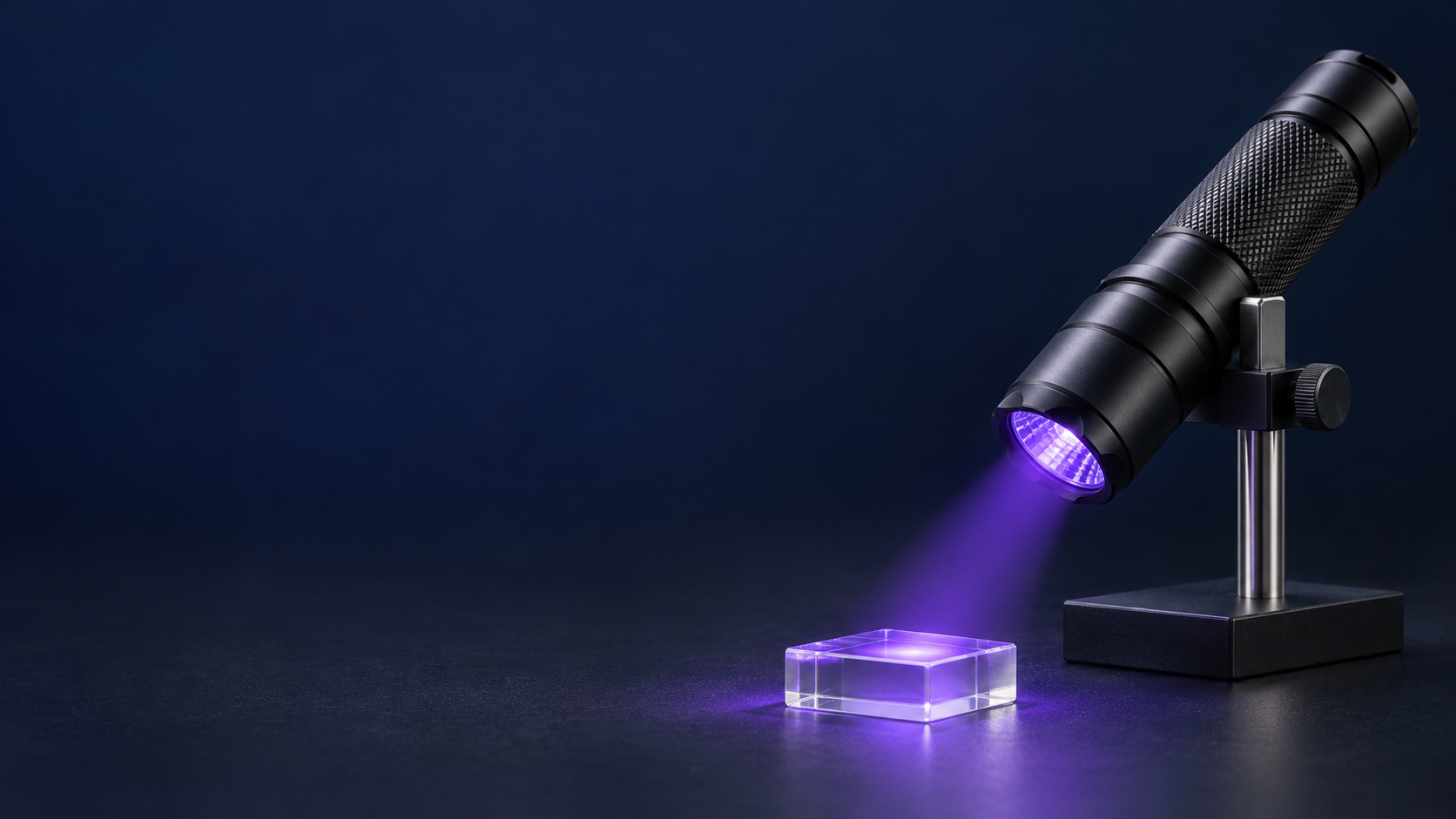
How to Choose UV Light for Resin Curing
Choosing UV light for resin curing starts with the material manufacturer’s specified light source or spectral requirements, the real exposure conditions, and the cure result the application requires. A lamp’s wattage, visible purple brightness, or one wavelength number cannot establish suitability on its own. Some portable UV sources may be appropriate for validated small-area tasks, but a “UV inspection flashlight” label is not evidence that the product can cure a particular resin formulation.
Start with the Resin, Not the Lamp
A useful selection process begins by identifying the exact light-curable material rather than assuming every product called “UV resin” behaves the same way. Review the product instructions, technical data sheet, or approved curing process for the specified source, spectral range, intended thickness, color, geometry, exposure conditions, and required final result. A clear coating, a pigmented adhesive, and a filled resin can present different optical paths and cure requirements even when they are used in similarly sized parts.
If the material supplier provides a matched lamp and timing instruction, its stated wattage and time should not be converted into a universal requirement for every other light. The intended source may differ in spectral output, irradiance, coverage, distance, or thermal behavior. Follow the specified material-and-source combination where possible, or ask the material supplier what evidence is needed to evaluate an alternative source. A material manufacturer’s instructions can vary by resin type, color, thickness, and conditions, as illustrated by the product-specific guidance in the PADICO UV-LED Resin Series information.
What Wavelength Can—and Cannot—Tell You
The material must respond to the light that reaches it. That makes spectral output and material compatibility central to any UV curing wavelength decision. An LED marked 365 nm, 395 nm, or 405 nm provides useful specification information, but the label alone does not describe the full output distribution, the material’s response, or the energy received at the work surface. In particular, 405 nm is commonly described as violet light rather than being grouped directly with UVA.
A light can make a surface fluoresce visibly and still be a poor match for a given resin. The relevant question is whether the material’s required response aligns with the source spectrum under the intended process conditions. Excelitas’ overview of UV spot-curing selection similarly emphasizes that spectral fit, irradiance, exposure time, and process conditions must be considered together. A successful result with one formulation cannot establish that the same wavelength will cure every resin.
Separate Watts, Irradiance, and UV Curing Dose
“Watts” can describe different things. Electrical input power describes what a device draws electrically. Optical radiant power describes emitted optical power. Neither number automatically tells a user how much relevant radiation reaches a resin surface. For curing work, irradiance is the radiant power received per unit area, often expressed as W/cm² or mW/cm². Radiant exposure, often called dose in curing discussions, is the radiant energy received per unit area over the exposure period and is commonly expressed as J/cm² or mJ/cm².
Where irradiance is approximately constant and the measurement band and conditions are defined, radiant exposure can be expressed as:
Radiant exposure = irradiance × exposure time.
Hypothetical unit-conversion example: 50 mW/cm² × 20 seconds = 1000 mJ/cm², or 1 J/cm².
This is only a unit calculation. It is not a cure recipe for any resin and is not a SHENGQI LIGHTING measurement result. If output changes during exposure, the accumulated energy must reflect the actual exposure process. Even when two processes produce the same calculated dose, different irradiance levels, materials, temperatures, thicknesses, and process conditions do not guarantee the same cure result.
A product listing that only states a high wattage should therefore be treated as incomplete information for curing selection. Lumens, lux, or the visible brightness of purple light also cannot replace irradiance measurement in the relevant spectral region. The relationship between irradiance, exposure duration, and accumulated energy is discussed in Excelitas’ technical discussion of UV exposure conditions.
Why Distance, Coverage, and Part Geometry Matter
The working distance between a UV source and the resin is only one part of the exposure condition. Beam area, uniformity, material thickness, pigments or fillers, transparent paths, part shape, and physical shadowing can all affect what reaches the material. A center-point reading does not necessarily represent the entire exposed area, especially when the target has edges, recesses, curved geometry, or areas hidden from the source.
Consider two different tasks: curing a small, accessible local area and repeatedly exposing a larger surface that must receive consistent coverage. The second task may require a different source layout, distance control, or process method even when both tasks use the same resin. A portable form factor neither proves nor rules out suitability. Extending time can sometimes increase delivered exposure, but it does not correct a spectral mismatch, remove a physical shadow, or establish that every point on a complex part has received the required conditions.
A Tack-Free Surface Is Not the Whole Acceptance Test
A surface that feels less tacky does not, by itself, prove that a resin has reached the cure performance required by its material specification or final application. Some UV-curable formulations can show surface tack associated with oxygen inhibition, while other materials may use different acceptance criteria. A material that remains flexible is not automatically under-cured, and a hard-feeling surface is not a complete measure of performance.
The appropriate cure verification method depends on the material and use case. The Dymax technical bulletin on surface cure considerations provides useful context for why surface condition and complete cure should not be treated as identical conclusions. Follow the material supplier’s stated method and handling instructions. Do not use bare-hand contact with uncured resin as a validation method, and follow the material SDS and light-source safety guidance, including avoiding direct viewing of the UV source.
A Practical Source-Selection and Verification Checklist
| Information to confirm | What it tells you | What it does not prove | Evidence to request |
|---|---|---|---|
| Material identity and specified source or spectrum | Whether the material is intended for the proposed curing approach | That any source with a similar color or wavelength label will work | Material instructions, TDS, or supplier confirmation for an alternative source |
| Meaning of the source “W” rating | Whether the number refers to electrical input or stated optical output | Irradiance at the resin surface | Source specification with the rated quantity and conditions identified |
| Irradiance at the actual working plane | How much relevant optical power reaches a stated area under stated conditions | Uniform coverage across the entire part or cure performance by itself | Measurement method, working distance, spectral relevance, and measurement location |
| Exposure time and stated radiant exposure | The intended energy-delivery condition for a defined process | A universal time setting for other materials, geometries, or sources | Time, intensity basis, material condition, and process documentation |
| Working distance, coverage area, and part geometry | Where light reaches and where shadows or uneven exposure may occur | That a center beam reading represents every surface | Part drawing or sample, target area, distance, orientation, and coverage observation |
| Required cure endpoint | What result the material or application considers acceptable | That a visual surface check alone is sufficient | Material-specific acceptance guidance and the relevant application requirement |
A Suggested Verification Sequence
- Review the material instructions and the approved exposure conditions.
- Confirm what compatibility evidence connects the proposed source spectrum to the specific material.
- Fix the actual distance, operating mode, sample orientation, and exposure conditions before comparing results.
- When quantitative evidence is needed, use a measurement method appropriate to the source spectrum and intended use, and examine the working area rather than only the brightest center point.
- Check the result using the material- and application-specific acceptance method, then record the material identity, source setting, distance, exposure conditions, and outcome.
- For portable or repeated-use situations, consider whether battery condition, temperature rise, or output change needs to be part of the defined evaluation conditions.
This is a suggested selection and verification framework, not a SHENGQI LIGHTING test procedure, certification process, or substitute for the material supplier’s specified validation method.
When a Portable UV Development Discussion Makes Sense
A portable UV product discussion can be worthwhile when the task involves localized exposure, mobile operation, or a specific form factor and control method. The request should identify the intended material conditions and verification target before it becomes a request to make “a brighter UV flashlight.” Large-area uniformity, repeatable process control, fixed tooling, or defined thermal conditions should also be raised early when they are part of the application.
The practical design relationship is task first, then optical output, power, thermal behavior, controls, and evidence requirements. Readers exploring relevant portable-lighting forms can review portable flashlight product forms; the category does not establish that every listed UV product is suitable for resin curing.
Discuss the Conditions Before Defining the Product
For a portable UV development project, provide the material documentation or approved source requirement, target spectral range, exposure area and distance, product geometry, use cycle, power or thermal constraints, and acceptance condition. These details create a clearer basis for discussing whether a portable product concept is an appropriate match.
SHENGQI LIGHTING can discuss applicable product-development scope through its lighting development services. To begin a focused conversation, contact sales@shengqilight.com with the use conditions and evidence you need to evaluate.