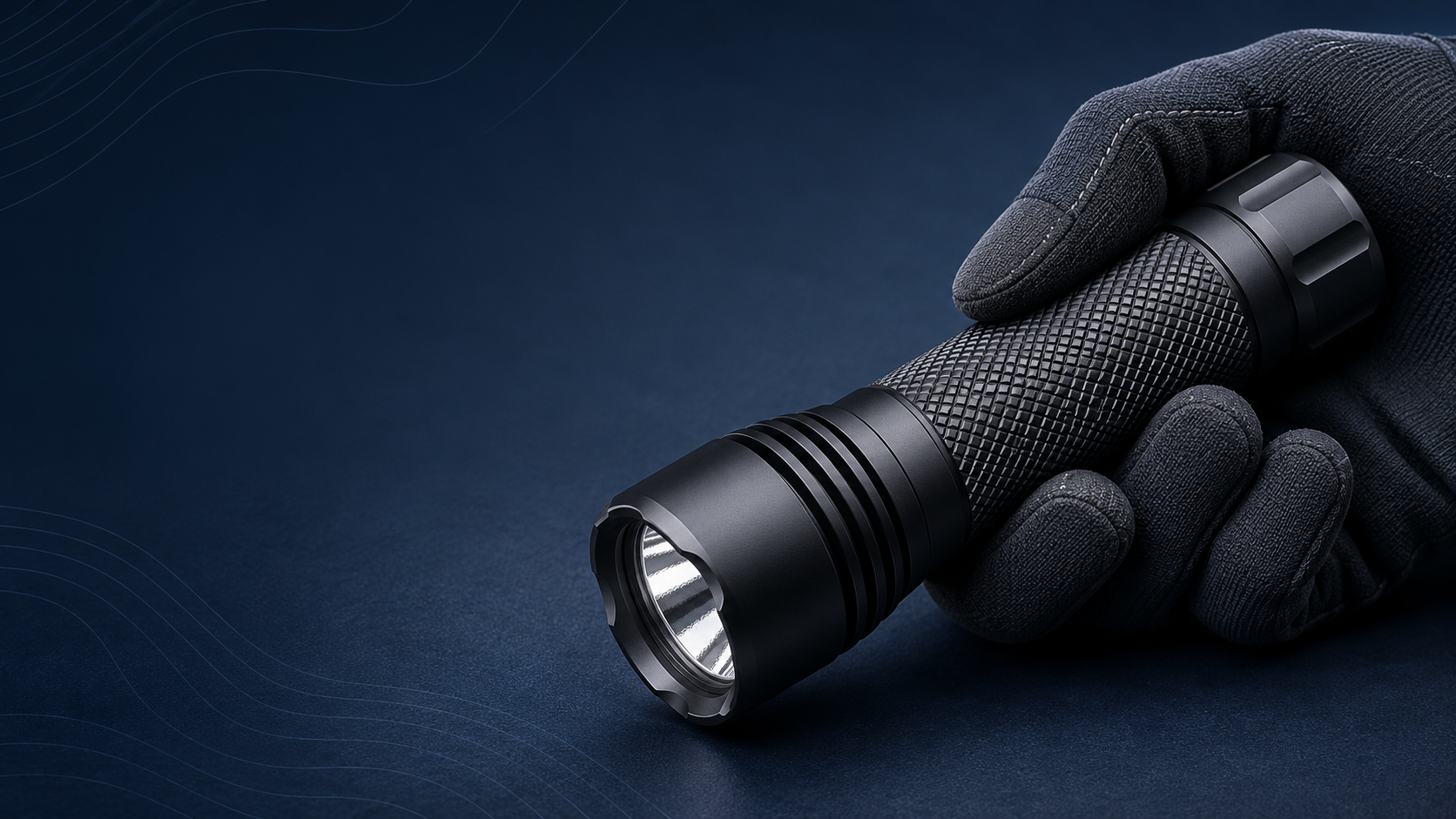
Flashlight knurling is a deliberate surface texture formed on a flashlight body where a user may hold, turn, or stabilize it. It can contribute to grip and visual identity, but its practical effect depends on the pattern, the part of the body it covers, the flashlight’s diameter, the user’s hand position, the operating action, and the final surface condition. A deeper, denser, or more widely applied texture is not automatically a better flashlight grip. The useful question is whether the texture supports the intended contact and action on the finished product.
What Is Flashlight Knurling?
In product design, knurling usually refers to a regular raised or cut pattern on a rotating part. It is often used where a part needs a tactile identity as well as a functional contact surface. Hommel + Keller’s overview of knurling distinguishes between form knurling, where pressure forms a pattern into material, and cut knurling, where material is removed. That distinction matters when a product team is discussing the intended appearance and manufacturing route, rather than assuming every textured flashlight body is made the same way.
Not every flashlight surface texture is knurling. Straight grooves, ribs, milled flats, sculpted grip panels, blasted finishes, brushing, polishing, and anodizing can all alter appearance or contact feel without being the same feature or using the same process. A color finish or anodized coating also does not, by itself, establish how a flashlight will feel in the hand.
Choose Texture Around Real Contact Regions
A texture should be placed where the intended user actually contacts the flashlight, not simply where a rendering has visual space for a pattern. During normal hand-held lighting, the main body may contact the palm and fingers. When a user reaches a side switch, changes grip, removes a tail cap, or turns another permitted component, the contact region can move. Gloves can change that contact pattern again.
This is why the body tube, head, and tail section may need different texture decisions. A decorative pattern that covers a large area may still miss the place where fingers need purchase during a specific action. Conversely, a highly pronounced pattern in a non-contact area may add visual complexity without improving the intended use.
General hand-tool guidance also supports starting with the user, the task, and the intended fit rather than judging a handle by appearance alone. CCOHS guidance on hand-tool design treats task, shape, and user fit as connected considerations. It is not a flashlight-knurling standard, but it is a useful reminder that grip texture must be assessed in the context of the product and the action.
Questions That Make a Grip-Texture Review More Useful
| Design choice | Question to answer | What to check on a sample |
|---|---|---|
| Pattern form | Is the desired effect mainly tactile, visual, or both? | Compare the intended contact feel with the visual rhythm of straight, crossed, or other specified patterns. |
| Texture scale and edges | How pronounced should the texture feel during normal holding and adjustment? | Observe the perceived edge condition and whether the surface suits the expected handling action. |
| Distribution area | Which body section needs texture, and which section needs clearance for another component or marking? | Check the actual grip zone, adjacent controls, clips, logos, and assembly boundaries. |
| Body size and hand fit | Does the specified texture work with the actual body shape and intended hand position? | Hold the completed sample in normal lighting and operating positions instead of judging the pattern in isolation. |
| Final surface state | How does the completed finish change the intended texture and appearance? | Review a sample with the relevant final material and surface condition clearly identified. |
| Grip and control relationship | Will the user need to reposition the hand before reaching the intended control? | Observe the grip transition during the specific action required by that product configuration. |
Why a Rougher Surface Is Not Automatically Better
“Aggressive knurling” describes an appearance or a perceived texture, not a complete user requirement. A pattern that feels appropriate for a short adjustment may feel different during sustained hand-held use. Its location also matters: texture in a genuine contact area and texture placed mainly for visual impact solve different design questions.
The sample review should therefore consider normal pickup, the expected operating motion, storage or carry contact, glove use where applicable, and the relation between textured and smooth sections. The goal is not to declare one pattern universally superior. It is to establish whether the selected flashlight grip texture supports the use case that the product team is actually defining.
A Rendering Is Useful, but It Does Not Finish the Grip Decision
A rendering can clarify texture placement, visual proportion, logo clearance, and the overall design language. A structural prototype can help reveal where a hand contacts the body. A finished sample with the relevant surface state is more appropriate for confirming the final tactile relationship and the normal operating feel. These materials answer different questions, so they should not be treated as interchangeable evidence.
Consider a hypothetical review in which a brand team approves a cross-patterned body in a rendering, then finds that the primary contact position on the physical sample sits above the planned texture band. The next step is to compare contact areas or revise the distribution in the next sample discussion—not simply to request that every textured area become deeper.
Turn “More Technical” Into a Clear Design Brief
A useful product brief describes the intended action rather than relying only on an aesthetic request. It can identify who will use the flashlight, the main grip position, the normal operating movements, whether target gloves change contact, and the specific problem that a new texture should improve. It can also distinguish whether a reference sample is being used for tactile character, pattern placement, or visual rhythm.
- Describe the use task and the expected hand position.
- Identify the body areas that must remain clear for actual controls, clips, seams, or markings.
- State whether a reference texture is about feel, coverage, visual character, or a combination of these.
- Specify what the finished sample should help the team observe before approving the next decision.
Reference products can help communicate a requirement, but they should not be treated as instructions to copy another product’s distinctive appearance. The practical objective is a design direction that can be discussed, evaluated, and refined around the new product’s own structure.
A Practical Sample-Observation Process
The following is a design-observation method for comparing flashlight samples. It is not a laboratory test, a certification procedure, or a quantitative non-slip claim.
- Identify the sample. Record the sample version, body configuration, material information available to the project, and surface state being reviewed.
- Use the intended normal grip. Observe where the palm and fingers actually contact the flashlight during the defined task.
- Repeat relevant normal actions. If the product task requires it, repeat ordinary switching, adjustment, or permitted component handling with the target gloves.
- Compare like with like. Note differences in body size, weight, or surface state before assigning every perceived difference to knurling alone.
- Document the next decision. Record observations, photographs, contact areas, and the specific changes that need confirmation on the next version.
A subjective handling observation cannot prove a quantified friction value, all-weather retention, or a product certification. If a project needs quantified criteria, the responsible parties should define the method, conditions, and pass/fail basis before treating the result as performance evidence.
From Grip Requirement to a Product Discussion
A flashlight body is not defined by a pattern alone. Texture placement, body geometry, operating controls, visual balance, manufacturing considerations, and the final sample condition need to work together. SHENGQI LIGHTING presents industrial design and product development as part of its development support, providing a relevant path for discussing a defined product requirement rather than making a generic “more grip” request.
When a project needs to consider how a texture may be realized alongside the flashlight body, the discussion can also connect with SHENGQI LIGHTING’s flashlight manufacturing capabilities. The appropriate process and result still depend on the particular part, design, materials, and project requirements.
Readers comparing existing products can also browse the available flashlight platforms for broader product direction. A category page does not establish that every listed flashlight uses the same texture or manufacturing method.
Frequently Asked Questions
Is aggressive knurling always better?
No. A more pronounced pattern may create a different tactile impression, but it must still match the actual contact region, operating action, intended user, and finished surface state. It should be judged on a relevant sample rather than by description alone.
Is knurling the same as anodizing?
No. Knurling refers to a textured geometry on a part. Anodizing is a surface-treatment process. A flashlight can have both, but the presence of one does not explain the other or prove a particular grip result.
Can a rendering confirm how a flashlight will feel?
A rendering can clarify placement and visual proportion, but it cannot fully confirm the contact feel of a finished textured surface. Confirming that relationship requires a relevant physical sample and a clearly defined handling task.
Discuss a Flashlight Grip Design Direction
For a real product project, share the intended use scenario, target grip position, relevant gloves or operating actions, reference samples, and the contact issue you want to improve. This gives the design discussion a clearer basis for evaluating texture placement and sample observations.
Contact SHENGQI LIGHTING to discuss your flashlight grip design requirements.