
What Is a Flip-Design Outdoor Flashlight?
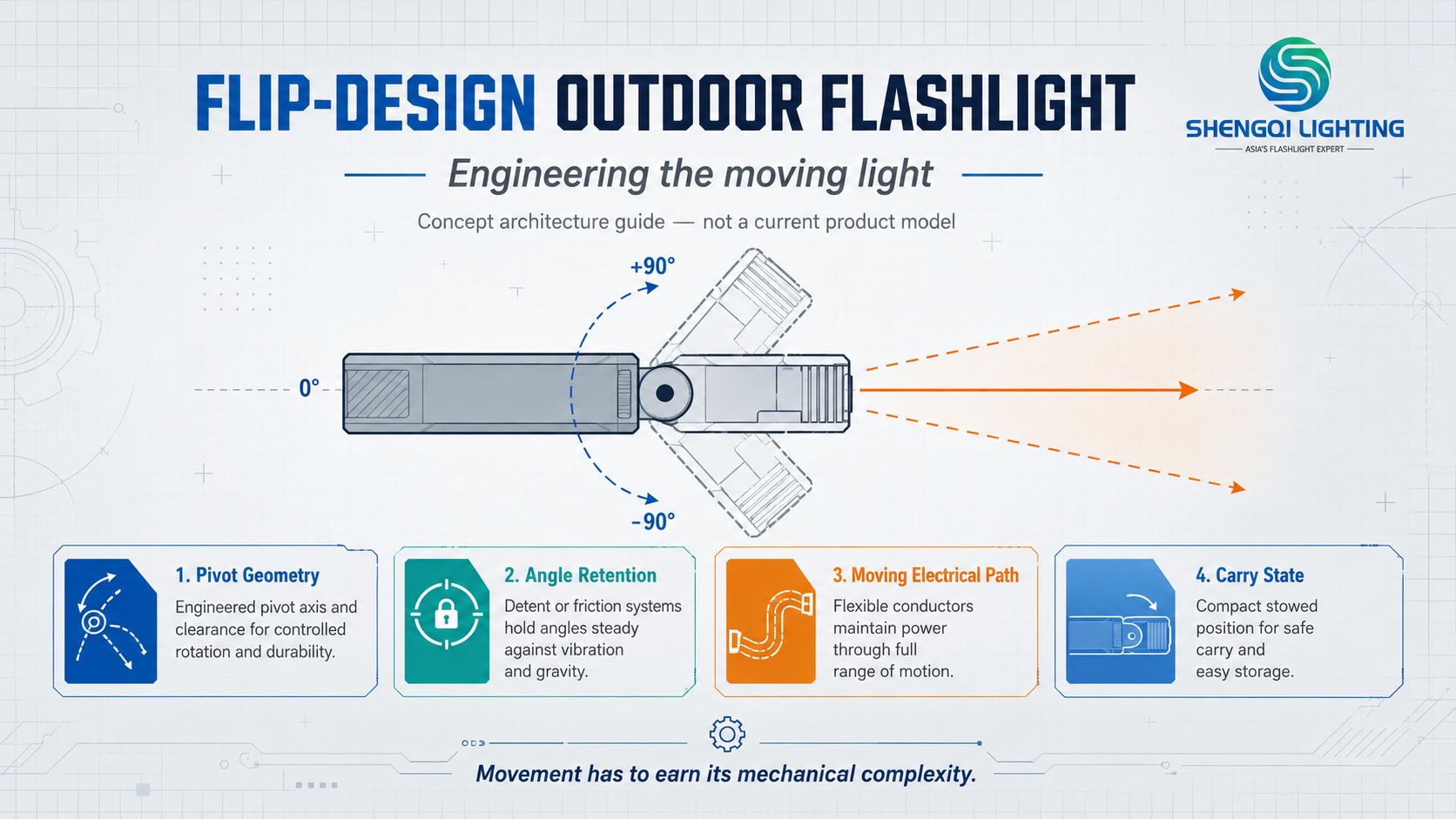
A flip-design outdoor flashlight uses a pivoting, rotating or folding light section to change beam direction or product configuration without requiring the user to reposition the entire flashlight. The pivot can create useful working positions for stationary task lighting, directional adjustment or storage, but the hinge also introduces angle-retention, wiring, carry and mechanical-complexity requirements that a fixed body may not have. The design therefore has to be evaluated as a complete mechanical and optical system. If the moving section cannot hold its position, routes wires poorly or makes the stored product awkward to carry, the flip function can create more problems than it solves.
What Are the Advantages of a Flip-Design Flashlight?
The main advantage of a flip-design flashlight is directional flexibility, but that benefit only matters when the pivot mechanism solves a real task such as stationary work lighting, beam repositioning or foldable storage. Allowing the body to remain stationary while the beam changes direction can improve some work setups. The trade-off is additional moving hardware, possible electrical routing through the joint, more wear surfaces and a more complicated environmental interface. The mechanism has value only when its added mechanical cost supports a defined user workflow.
Is a Flip-Design Flashlight More Durable Than a Fixed Flashlight?
Not automatically. A flip mechanism adds moving parts, wear surfaces and potentially moving electrical connections that need their own durability testing. A well-designed pivot can remain useful through repeated movement, but durability depends on the chosen hinge architecture, materials, fastener retention, contamination exposure, wiring and assembly. A fixed-head product avoids several of those moving interfaces. The two architectures solve different workflows rather than creating a universal durability ranking.
What Is a Flip-Design Outdoor Flashlight?
A Flip-Design Outdoor Flashlight is a portable light that uses a movable mechanical section—such as a pivoting head, rotating light module or folding body—to change the direction or physical configuration of the light without repositioning the entire product.
“Flip” is not one standardized flashlight structure. Different projects may use a pivoting head, rotating module, folding segment, articulating light section or another hinge architecture.
Brands comparing these concepts can review existing handheld flashlight platforms for general optical and enclosure architecture without treating any current SHENGQI model as an existing flip-design product.
“Flip” Should Describe a Function, Not Just a Visual Trick
The first question is not how impressive the hinge looks. It is what changes when the product moves.
A moving section might redirect the beam, convert handheld use into local task lighting, fold into a storage position, expose another optical surface or create a standing orientation. These are possible design directions rather than required features.
A hinge is not a feature by itself. Its value comes from what changes when the product moves. If the flip mechanism does not solve a defined task, it becomes extra mechanical complexity.
Define the Outdoor Task Before Choosing the Pivot Mechanism
Is the product primarily handheld? Will it stand on a surface? Does it need downward light while the body remains stationary? Is folding only for storage? Will gloves be used? Does the user need one working position or several? What dust, rain or dirt exposure should be considered?
Those questions should be answered before anyone specifies a movement range.
Three Conceptual Flip Architectures
These are conceptual mechanical architectures, not existing SHENGQI product models.
Pivot Geometry Determines What Angles Are Actually Useful
A project may need continuous movement, limited movement, several indexed positions or only a storage and working position. More range is not automatically better.
Extra movement can increase wiring difficulty, enlarge the hinge, complicate sealing and create positions that have no real purpose. Product teams should define useful working positions, prohibited positions, storage state and carry state before the mechanism is finalized.
Continuous Friction vs Indexed Positions
A continuous friction pivot can allow free positioning but needs stable friction over repeated use. An indexed or detent mechanism can provide repeatable positions and tactile feedback but introduces additional mechanical interfaces.
The mechanism should match how precisely the user needs to position the light.
An Adjustable Light Is Useful Only if It Stays Where the User Puts It
Vibration, walking, tool movement, repeated adjustment and long-term wear can all change pivot behavior. Buyers should review initial holding behavior, repeated-use behavior, lamp-head load, orientation, friction change and detent wear where applicable.
A hinge that moves smoothly on day one but loses position after repeated use is a product failure even if the LED still works.
Excessive resistance can be a problem too. A joint that is too difficult to move may require two hands, twist the product body or create unnecessary stress in the hinge components.
The goal is controlled positioning force, not simply maximum resistance.
Moving the Light Source Changes the Beam Relationship to the User
When the optical section rotates, hotspot direction, spill, glare and reflected light can all change. The user's hand may enter the beam in one position, while the body may block part of the spill in another.
A pivot mechanism turns one optical design into several real-use geometries. Beam evaluation should therefore cover every intended working position rather than only the default position.
Does the Product Need a Pivot—or Would a Side Light Solve the Same Task?
A movable primary light provides physical direction control and may reduce the need for additional emitters. A fixed primary beam plus a side light eliminates the hinge but adds another emitter, optical system and control path.
Existing task-lighting product architectures can help buyers compare fixed multi-source approaches with moving-head concepts. The better architecture depends on the task.
The Hinge Becomes a Primary Wear Component
A moving joint may use a pin, axle, screw, friction washer, detent, spring, plastic interface, metal interface or another project-specific structure. Repeated movement, dirt, moisture and mechanical load can change friction, play and noise over time.
Cycle-life requirements should come from expected user behavior and product-life goals. There is no universal cycle target for this category.
If threaded hardware forms part of the pivot, repeated motion can also affect fastener retention. The retention strategy should be engineered and validated for the selected mechanism.
Surface finishes at the joint also deserve attention. Coatings, anodized surfaces and plastics may wear differently under friction, so cosmetic wear, debris, noise and friction change should be reviewed on representative samples.
Moving Light Modules Create a Wiring Problem That Fixed Flashlights Do Not Have
If the LED and PCB sit in a moving module while the battery remains in the fixed body, power or signals may need to cross the joint. The architecture could use flexible wire, flexible PCB, a contact system, rotating connector or another project-specific electrical solution.
The mechanical pivot and electrical path must be designed together.
Wire routing should be checked through every intended position. Conductors should not be pinched, rubbed against sharp edges, tensioned at the end of movement or allowed to interfere with the hinge.
Placing the battery, LED and electronics in the same moving module may reduce the need for a moving electrical connection, but it can increase moving mass and alter balance. That is another trade-off rather than a universal solution.
Battery Placement Changes the Load on the Pivot
If the battery sits in the moving section, the hinge may need to carry more moving mass. If the battery remains in the main body, the project may need an electrical path across the joint.
Battery location therefore affects head mass, balance, wiring, thermal design and carry geometry.
Center of Mass Changes With Configuration
Moving the optical module can shift the center of mass. That may change handheld feel, standing stability, hinge load and any magnetic or mounted behavior if those features are part of the project. All intended configurations should be evaluated rather than assuming the folded and working states behave the same.
The Switch Should Remain Accessible in Every Intended Position
When the light head moves, the user's grip can change. A button that is easy to reach in the straight configuration may become partially blocked after folding. A display or indicator may face away from the user. A charging interface may also become harder to access.
A control layout that works in one configuration may fail in another.
Some projects could use position sensing to change operating behavior when the mechanism moves. A Hall sensor, mechanical switch or another position-detection method is a project-specific electronic option, not a requirement of flip-design flashlights.
A Moving Joint Creates an Environmental Interface
A fixed body can rely largely on static interfaces. A pivot adds moving gaps, friction surfaces and possible paths for water, dust or dirt depending on the architecture.
This does not mean a flip flashlight is automatically less water-resistant. It means the moving joint needs its own environmental design and project-specific verification.
Outdoor use may also expose the pivot to dust, sand or mud. If contamination is relevant to the intended market, representative testing can assess whether it changes friction, creates wear or interferes with movement.
Final environmental and ingress-protection requirements should be specified for the finished product rather than copied from an unrelated fixed flashlight.
A Flip Mechanism Can Improve Storage—or Make the Product Bulkier
A folded configuration may reduce one dimension, protect optics or create a useful transport state. The same movement can also increase thickness, create protrusions or expose the hinge.
Folded does not automatically mean more compact. Buyers should review the real bounding dimensions of the stored configuration, not just one length measurement.
Carry-state retention should also be defined. If the product can unfold while being transported, a detent, mechanical stop, latch or another retention strategy may be needed depending on the project.
Where compact carry matters, EDC flashlight platforms can provide useful references for how fixed architectures approach storage and carry without implying that they use a flip mechanism.
Pivoting Main Light vs Fixed Main + Side Light
| Decision Area | Pivoting Main Light | Fixed Main + Side Light |
|---|---|---|
| Moving Parts | Requires pivot mechanism | Can remain mechanically fixed |
| Emitter Count | May use one optical source for several directions | Usually requires another light source |
| UI | Movement controls direction physically | UI may need source selection |
| Optical Flexibility | Beam can be physically repositioned | Each emitter has a fixed direction |
| Sealing | Moving joint requires verification | Additional optical window may need sealing |
| Thermal Design | Moving section affects heat path and mass | Multiple emitters create separate thermal loads |
The better architecture depends on the task.
Flip-Design Outdoor Flashlight Engineering Matrix
| Design Variable | Why It Matters | Flip-Specific Risk | Buyer Question | Prototype Evidence |
|---|---|---|---|---|
| Flip Function | Defines why movement exists | Mechanism without user value | What changes when the light moves? | Task-based review |
| Pivot Range | Determines usable positions | Unnecessary travel | Which positions matter? | Full-range check |
| Angle Retention | Keeps beam positioned | Drift after wear | Does it stay where positioned? | Repeated-use retention test |
| Beam Direction | Defines real illumination geometry | Glare or body blockage | Does every position produce a useful beam? | Multi-position beam review |
| Hinge Architecture | Controls motion and wear | Play, noise or loosening | Friction or indexed movement? | Wear inspection |
| Wiring / Electrical Path | Maintains power through movement | Fatigue, pinch or abrasion | How does power cross the joint? | Full-movement inspection |
| Battery Position | Affects mass and wiring | Heavy moving section | Fixed or moving battery? | Balance evaluation |
| Control Access | Keeps UI usable | Blocked controls | Can every intended position be operated? | Multi-position UI test |
| Center of Mass | Influences stability and feel | Tipping or hinge load | How does balance change? | Configuration comparison |
| Sealing / Environment | Protects moving interface | Dust or water path | What exposure must it survive? | Project-defined environmental test |
| Carry / Storage State | Defines transport geometry | Bulky folded shape | How should it stay during transport? | Stored-state evaluation |
| Production Consistency | Reproduces approved mechanism | Variation changes friction or alignment | Which dimensions and parts are critical? | Representative-sample comparison |
Four Ways a Flip-Design Flashlight Can Fail
01. The Hinge Moves Smoothly but Cannot Hold the Working Angle
A pivot can feel refined during a showroom demonstration and still be unsuitable in real use. The light head creates its own load, and vibration or repeated movement can change retention. Buyers need to evaluate both initial feel and behavior after repeated operation. Smooth movement is only useful when the selected position remains usable.
02. The Mechanical Joint Works, but the Internal Wire Becomes the Wear Component
A hinge can remain mechanically tight while the electrical path experiences repeated bending, rubbing or tension. This is why wire routing cannot be treated as an assembly detail after the pivot is designed. Full movement should be inspected with the actual internal components installed. Mechanical durability and electrical durability need the same development timeline.
03. The Product Folds Smaller in One Dimension and Becomes Bulkier in Another
Folding can reduce length while increasing thickness or creating protrusions. Marketing drawings may emphasize the shortest dimension without showing the complete transport envelope. Buyers should compare real bounding dimensions in both working and stored states. Storage efficiency is a three-dimensional packaging problem.
04. The Beam Can Move, but the Switch Becomes Awkward in Half the Positions
A control layout may be developed around the straight configuration and become inconvenient once the head rotates. The user's hand can block the switch, the button can face the work surface or the grip can change. UI testing therefore needs every intended position. Mechanical movement changes interaction geometry as well as beam direction.
A Flip-Design SKU Needs a Job That a Fixed Flashlight Cannot Do as Well
A moving architecture should solve a defined workflow: beam repositioning, stationary task lighting, foldable storage, multi-position work or another specific use case.
If a fixed head or fixed side light can perform the same task with less mechanical complexity, the product team should reconsider whether a hinge creates enough value.
This type of portfolio decision can be made alongside broader SHENGQI portable lighting products so that the flip-design concept owns a distinct mechanical role rather than becoming a cosmetic variation of an existing SKU.
Ten Questions Before Developing a Flip-Design Outdoor Flashlight
1. What user task actually requires the light source to move?
If the mechanism does not solve a real beam-direction, standing or storage problem, a fixed architecture may be simpler.
2. Which part of the product should pivot or fold?
The head, optical module or body segment creates different mechanical, electrical and balance requirements.
3. What working positions are genuinely useful?
Define the positions users actually need rather than maximizing movement range for marketing.
4. Does the mechanism need continuous adjustment or defined detent positions?
Free positioning and indexed positioning create different usability and wear behavior.
5. How much position retention is required during real use?
The light should remain stable against the loads, vibration and orientation expected in the application.
6. How will power or signals pass through the moving joint?
Electrical routing should be defined with the pivot, not added after mechanical design is complete.
7. Where should the battery sit relative to the pivot?
Battery position affects moving mass, balance, wiring and thermal architecture.
8. How will the moving structure affect sealing, impact and carry?
The pivot creates additional interfaces that need project-specific environmental and mechanical verification.
9. What happens to switch access, balance and beam direction in every configuration?
All intended positions need to remain usable as complete product states.
10. How will hinge behavior and electrical reliability be controlled from prototype to mass production?
The approved mechanism, materials, wiring, fasteners and assembly sequence should carry forward into production verification.
Twelve Tests Buyers Should Run on a Flip-Design Flashlight Prototype
Confirm the complete intended movement and mechanical stops.
Verify that selected positions remain usable under representative loads.
Check controlled movement without excessive resistance.
Review hotspot, spill, glare and body interference.
Confirm grip and controls remain usable after movement.
Check for pinch, abrasion, tension and interference.
Record initial, intermediate and final hinge behavior using project-defined cycles.
Verify the stored configuration remains controlled during transport.
Review balance, center of mass and intended contact surfaces.
Evaluate the moving interface under relevant exposure conditions.
Recheck movement, retention, beam direction and electrical operation.
Compare hinge feel, wiring, alignment and controls with the approved sample.
Repeated-cycle evaluation should ask more than “Does it still rotate?” Buyers should check whether the joint still holds position, whether friction has changed, whether play or noise has increased, whether electrical function remains stable and whether the beam still points correctly. Acceptance criteria are project-specific. Relevant portable-light testing capabilities can support project verification without implying existing Flip-Design test results.
Manufacturing Consistency Is Part of Hinge Performance
A production pivot can be affected by pin diameter, screw retention, washers, plastic friction surfaces, metal contact surfaces, wiring position, adhesive, detent geometry, molding variation, machined features and assembly sequence.
The development chain should remain clear:
Approved Mechanism → Approved Material → Approved Assembly → Approved Wiring → Approved Sample → Production Inspection
These relationships need to carry through sample-to-production manufacturing rather than allowing the pivot components to be treated as interchangeable mechanical details.
How an OEM/ODM Project Should Define a Flip-Design Outdoor Flashlight
A structured development sequence should move through use case, flip function, moving component, pivot range, retention method, optical direction, electrical path, battery placement, controls, sealing, carry state, mechanical testing, DFM, production verification and packaging.
The flip mechanism should be defined before industrial styling is frozen. Starting with a finished housing shape and trying to insert a hinge afterward can create problems with wiring, balance, switch access and mechanical strength.
A custom project may involve Industrial Design, Optical Engineering, Electronic Design, Mechanical Integration, PCB Layout, battery architecture, manufacturing, testing, Quality Control and Packaging Design.
SHENGQI LIGHTING can support custom flashlight development around a verified product brief without claiming an existing SHENGQI flip-design model or pre-qualified hinge specification.
Frequently Asked Questions About Flip-Design Outdoor Flashlights
1. What is a flip-design outdoor flashlight?
A flip-design outdoor flashlight uses a pivoting, rotating or folding light section so the beam direction or physical configuration can change without moving the entire flashlight. The architecture may use a pivoting head, rotating module, folding body or another project-specific mechanical structure. The useful design question is not simply whether the product moves, but whether that movement improves a defined outdoor or task-lighting workflow.
2. What part of a flashlight can use a flip or pivot mechanism?
The moving section could be the flashlight head, a separate optical module or part of the body, depending on the product brief. Each architecture creates different requirements for wiring, battery placement, center of mass, hinge load, control access and storage. No one moving structure should be treated as the standard solution for every flip-design product.
3. Is a flip flashlight better than a fixed-head flashlight?
No universal winner exists. A flip design can reposition the beam while allowing the body to remain stationary, which can help with some work-light and directional tasks. A fixed-head flashlight avoids the moving hinge and related wear, wiring and sealing considerations. The better architecture depends on the intended workflow, environmental requirement and acceptable mechanical complexity.
4. How does a flip flashlight keep the light at the selected angle?
The mechanism may use controlled friction, indexed detents or another mechanical retention method. The correct approach depends on how precisely the user needs to position the light and how much movement is expected during operation. Buyers should verify initial retention and behavior after repeated movement. A mechanism should neither drift too easily nor require excessive force to reposition.
5. Can moving joints affect water resistance?
A moving joint introduces additional interfaces, gaps and wear surfaces that require project-specific sealing design and verification. That does not mean a flip flashlight is automatically less water-resistant than a fixed flashlight. The final protection level depends on the actual pivot structure, seals, materials, assembly and applicable testing of the finished configuration.
6. How are wires routed through a pivoting flashlight structure?
Possible architectures can include flexible wiring, flexible PCB, contact systems, rotating connectors or another project-specific electrical path. There is no universal best method. The chosen design needs to avoid pinching, sharp-edge abrasion, excessive tension and interference throughout the intended movement range. Electrical routing and the hinge should therefore be developed as one system.
7. What should B2B buyers test on a flip-design flashlight prototype?
Buyers should verify full pivot range, angle retention, one-hand adjustment, beam behavior, switch access, internal electrical routing, repeated pivot behavior, carry-state retention and applicable stability or environmental requirements. Post-impact movement and electrical function should also be reviewed when relevant. Production-representative samples should then be compared with the approved prototype using project-specific acceptance criteria.
8. Can a flip-design outdoor flashlight be customized for OEM/ODM projects?
Yes. A custom project can define the use case, moving component, useful working positions, retention method, optical direction, electrical routing, battery placement, controls, environmental requirements and carry state as one architecture. The mechanism should be resolved before industrial styling is frozen, followed by prototype mechanical testing, DFM and production verification based on the approved design.
Movement Has to Earn Its Mechanical Complexity
A successful Flip-Design Outdoor Flashlight is not defined by how far the head can rotate. It is defined by whether the movement improves the user's lighting workflow while angle retention, wiring, controls, balance, environmental protection and production consistency remain under control. The hinge should solve a task that a simpler fixed architecture cannot solve as effectively.
Define the Moving Architecture Before Freezing the Housing
Outdoor brands, flashlight companies, tool businesses and private-label teams can evaluate pivot geometry, hinge retention, optical direction, electrical routing, battery placement, controls, sealing, DFM and production verification as one product system.
Contact SHENGQI LIGHTING for an OEM/ODM technical evaluation at sales@shengqilight.com.
Contact SHENGQI LIGHTING