
World Photography Week 2026: A Timely Workflow Check
As World Photography Day arrives on August 19 during World Photography Week 2026, photographers around the world are creating, sharing and engaging with photography. The 2026 celebration runs from August 12 through August 26, providing a useful moment to look beyond the camera body and consider the small workflow tools that support a night session.
The official World Photography Week and World Photography Day resources are used here only as timely editorial context. They do not recommend SHENGQI LIGHTING, HF08, Y1 or portable lighting products.
The engineering question is narrower: what portable task lighting helps a photographer move, organize equipment and pack down without unnecessarily disrupting a dark shooting environment?
What lighting is useful for night photography gear setup?
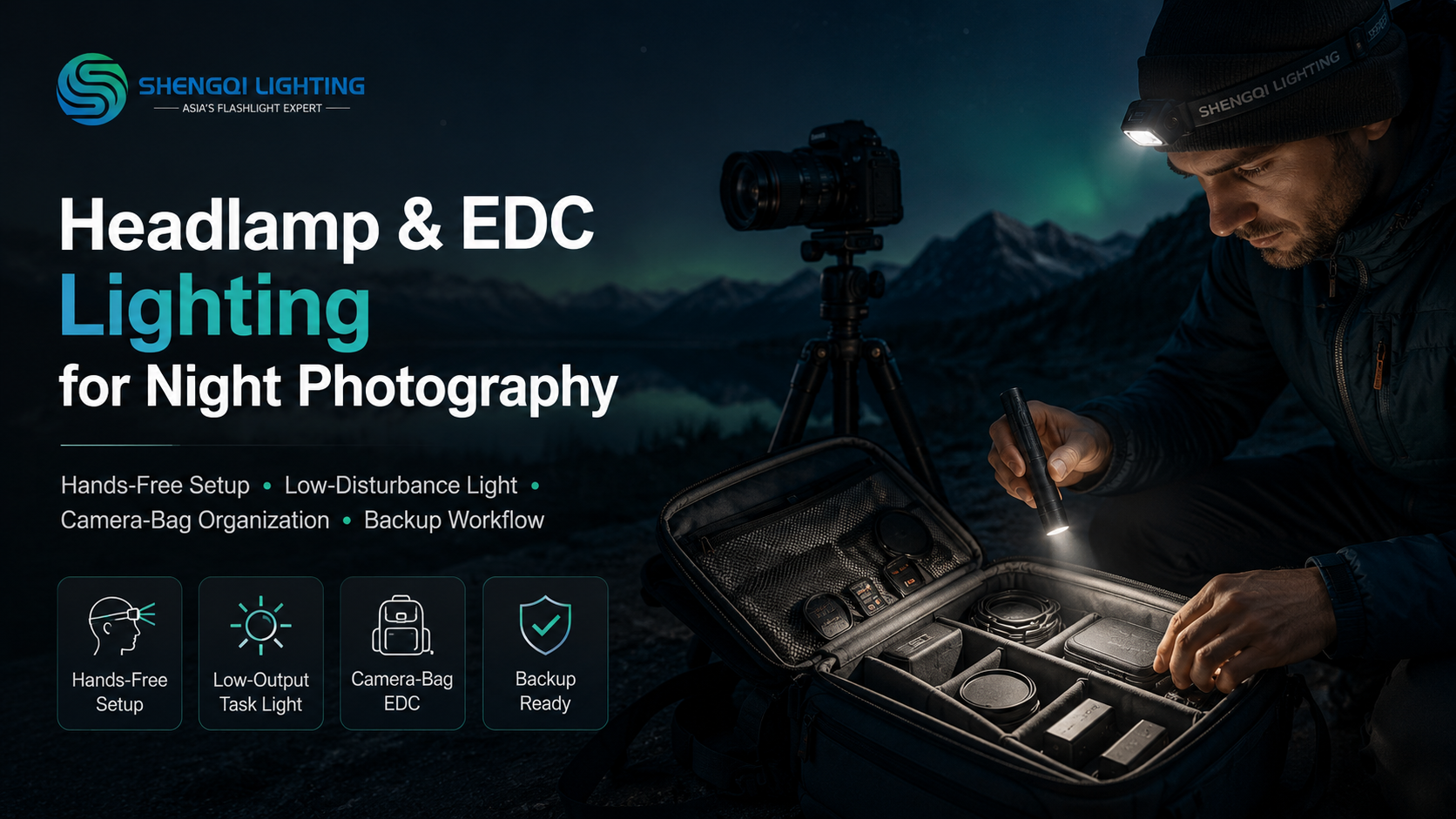
For night photography gear setup, a lightweight headlamp and compact EDC flashlight can support hands-free tripod adjustment, camera-bag organization, accessory changes and movement around the setup area without serving as the photographic light source. A headlamp can keep both hands available while working with tripod controls, filters or cables. Low output can be more useful than peak brightness for close equipment tasks. Dim red light may help when the photographer wants to limit disruption to dark-adapted vision, while an EDC side light can support local camera-bag searches. Battery, card and filter changes should also avoid accidental high output. A backup light should be accessible before it is needed. These products are task lights around the camera, not flashes, calibrated fill lights or photographic key lights.
Is red light better for night photography setup?
Dim red light can be useful when photographers want to reduce disruption to dark-adapted vision, but red light that is unnecessarily bright can still interfere with dark adaptation. Intensity therefore matters as much as color. Red may suit equipment setup, label reading or accessory searches in some dark environments, while low-output white light may remain appropriate for tasks requiring clearer color or detail. Red light is a workflow option, not a photographic-light requirement and not a guarantee that the shooting environment will remain unaffected.
Should photographers use a headlamp or an EDC flashlight?
A headlamp and an EDC flashlight solve different parts of the workflow rather than competing for the same role. The headlamp is strongest when both hands are needed for tripod, camera or accessory setup. A compact EDC light can support local illumination inside a bag, on an equipment surface or as backup task lighting. The useful combination depends on carry space, battery workflow, controls and the actual shooting environment.
A Gear-Setup Light Is Not a Photography Light
Portable headlamps and EDC flashlights in this workflow support movement, setup, organization, adjustment and pack-down. They are not substitutes for a camera flash, studio strobe, calibrated LED panel, high-CRI fill light, video key light or purpose-built light-painting system.
If a future product is intended to illuminate the photographic subject itself, buyers would need separate evidence for characteristics such as CRI, CCT, flicker, output stability and beam behavior. Those requirements are outside the task-light role discussed here.
Five Lighting Tasks Around a Night Photography Session
Use local light for walking, locating bags and checking the ground near the setup area. It does not replace route planning, road lighting or traffic-visibility requirements.
Hands-free light can support tripod controls, camera mounting and accessory attachment while both hands remain available.
Memory cards, batteries, remote triggers, cables, lens caps, filter cases and cleaning tools are easier to organize with controlled local illumination.
Use only enough task light to read labels, check cables or replace accessories without unnecessarily illuminating the photographic scene.
Portable light can support ground checks, accessory collection and bag organization before leaving the location.
Why Hands-Free Lighting Matters Around a Tripod
Night photographers regularly work with tripod controls, camera bodies, lenses, filter holders, remote triggers, batteries and cables at the same time. A head-mounted light keeps a hand from becoming permanently occupied by a flashlight, and the beam naturally follows head direction.
Adjustable beam direction can also help keep illumination below eye level and closer to the equipment. The HF08 architecture, for example, includes a 180° vertical adjustment mechanism. Buyers should still test downward positioning, hinge retention, accidental movement and repeated adjustment rather than assuming every position remains fixed indefinitely.
Brands evaluating hands-free lighting platforms should consider complete wearing stability as well as output.
Night Photography Often Needs Less Light, Not More Peak Light
For close equipment work, maximum lumens may be less important than a usable low mode, glare control, predictable startup and short-duration local illumination. Too much light can illuminate reflective tripod hardware, camera screens, nearby equipment and the shooting environment.
This makes startup behavior important. The first press, mode order and access to high output or strobe should match the intended workflow rather than forcing users through unnecessary bright modes.
Accidental High Output Can Disrupt a Night Photography Workflow
Unexpected high white output or strobe can disturb the user, nearby photographers and the shooting environment. OEM product briefs should therefore evaluate startup mode, mode memory, short-press and long-press logic, physical switch separation and lockout where appropriate. Modes not required during setup should be difficult to trigger accidentally when low-disturbance operation is the design priority.
When Dim Red Light Can Help
Dim red light may support equipment checks, label reading, accessory searches and movement within a dark-adapted shooting area. National Park Service guidance also notes that bright red light can still interfere with low-light adaptation.
Red is a useful low-disturbance option only when the output remains appropriate for the task.
Red is not automatically better for every adjustment, and it cannot be assumed to preserve dark adaptation completely or avoid contaminating a photograph. Product development should treat source color, output and user interface as separate variables.
Why a Side Light Can Work Better for Camera-Bag Organization
A side-light architecture can create local area illumination for searching inside a bag, arranging batteries and memory cards, checking cables or organizing accessories on a nearby surface. It should still be treated as task lighting rather than a photography fill light.
Flat EDC architectures can also be easier to organize beside rectangular camera accessories and may reduce rolling tendency compared with a conventional round body. Buyers can review compact EDC flashlight platforms when defining this kind of product brief.
Magnetic Mounting Requires Equipment Awareness
Magnetic flashlight mounting should be used only on suitable surfaces and should not be assumed safe for every camera, storage medium, electronic accessory or precision device. Review surface material, orientation, movement, holding force and the equipment manufacturer's guidance.
Do not assume that a magnetic light should be attached directly to a camera body, lens, electronic gimbal, storage medium or sensitive accessory.
Portable Lighting Is Part of Camera-Bag Space Planning
Camera, lenses, filters, batteries, cards, remote releases, cleaning equipment and weather protection already compete for storage space. Lighting design should therefore consider size, shape, battery, charging cable, protective storage, switch lockout and how easily the light can be located in darkness.
Plan a Backup Before the Light Is Needed
Photography sessions may run longer than expected. A practical workflow can include a primary task light, a secondary portable light, a battery or recharge plan, an accessible charging cable and a power bank where appropriate.
Battery capacity alone does not establish runtime. Mode, output behavior, battery state, temperature and test endpoint all affect operating time. Brands should provide mode-specific runtime evidence when runtime is part of the product requirement.
Two Product Architectures for Photography Workflow
HF08 — Hands-Free Setup Architecture
The HF08 lightweight headlamp platform lists a 32g product weight, 240LM maximum output, white and red sources, 180° adjustment, motion control and rechargeable architecture.
HF08 is used here only as an architecture example showing how a lightweight, hands-free, multi-source headlamp can support gear-setup workflows. It is not presented as photography-certified equipment.
Y1 — Camera-Bag and Local Equipment Architecture
The Y1 flat magnetic EDC platform combines a flat rectangular body, main white light, side light, magnetic tail and built-in 1000mAh rechargeable battery. Its listed maximum primary output is 700LM.
The relevant photography-workflow features here are the flat form, local side-light architecture and portable battery system—not its UV function. Y1 is not presented as a calibrated photography or fill light.
Night Photography Portable Lighting Role Matrix
| Photography Task | Headlamp Role | EDC Role | Main Benefit | Main Risk to Verify |
|---|---|---|---|---|
| Walking to Setup Area | Hands-free local visibility | Backup local light | Hands remain available | Excessive brightness |
| Tripod Setup | Primary task role | Secondary | Two-hand adjustment | Beam direction |
| Camera-Bag Search | General illumination | Local side light | Accessory organization | Glare |
| Battery / Card Change | Hands-free close work | Local backup | Controlled task light | High-mode mis-trigger |
| Filter / Cable Adjustment | Directional task light | Area light | Close inspection | Scene contamination |
| Equipment Check | General role | Focused local role | Flexible positioning | Reflective glare |
| Pack-Down | Hands-free overview | Bag / ground check | Organization | Battery state |
| Backup Lighting | Alternative architecture | Compact backup | Redundancy | Accessibility |
Eight Specifications Photography-Accessory Brands Should Define
Define enough output for close equipment setup without unnecessary glare.
If red is included, define task-appropriate intensity and coverage.
Specify exactly what happens on the first switch activation.
Determine how unintended bright modes will be avoided.
Define fit, tilt retention and movement expectations for headlamp projects.
Define how an EDC side light should illuminate a bag or nearby equipment area.
Set runtime targets through defined testing rather than battery capacity alone.
Define headband, body shape, storage and magnetic mounting only where suitable.
Ten Tests for a Night-Photography Portable-Light Sample
Evaluate close equipment visibility and glare.
If red is included, verify that its output fits the intended task.
Confirm repeatable initial behavior.
Repeat normal handling in darkness.
Check stability and beam direction during two-hand work.
Evaluate useful local coverage.
Look for glare and unwanted scene illumination.
Review holding orientation and equipment guidance.
Record battery state, mode, environment and endpoint.
Confirm that the approved workflow remains consistent across representative units.
Acceptance criteria and sample quantities should be project-specific.
Ten Questions to Ask Before Sourcing Lighting for Night Photography Gear Setup
B2B buyers should not approve a “photography headlamp” or “camera-bag flashlight” from peak lumens alone.
Separate walking, tripod setup, bag organization and backup roles before specifying features.
Close equipment work may need less light than general outdoor movement.
Evaluate output on the actual workflow rather than assuming every red mode is low disturbance.
Startup behavior should be predictable in darkness.
Repeated handling tests should answer this before approval.
Test it while both hands operate the camera and tripod.
It should support task lighting without being presented as a photographic key light.
Require tested runtime and a realistic recharge or replacement strategy.
Magnetic or other mounting should be reviewed against the actual equipment environment.
Control optics, UI, battery, structure and applicable mounting components by revision.
How SHENGQI LIGHTING Supports Headlamp and EDC Product Development
Photography-accessory brands can define a portable-light brief around setup workflow instead of simply requesting “a brighter flashlight.” Relevant engineering questions can include head-mounted form, beam direction, low-output architecture, white/red source integration, side-light layout, switch UI, battery architecture, flat-body structure and sample verification.
SHENGQI supports relevant development through Industrial Design, Optical Engineering, Electronic Design, manufacturing, testing, quality control and packaging design. Buyers can review custom headlamp and EDC development and portable-light testing capabilities.
Capability does not mean that every existing model has already completed photography-specific field tests. Final requirements should be defined and verified for the target product, market and use case.
Frequently Asked Questions
1. What is a headlamp useful for in night photography?
A headlamp can keep both hands available while the photographer adjusts a tripod, camera, filter holder, cable or remote trigger. The most useful configuration depends on fit, beam direction, low-output behavior and controls. It should support the equipment workflow around the photograph rather than serve as the photographic light source.
2. Is red light better for photographers working in the dark?
Dim red light may reduce disruption to dark-adapted vision compared with brighter illumination, but bright red light can still affect dark adaptation. Output intensity and the actual equipment task therefore matter. Red light should be treated as one low-disturbance workflow option rather than a universal requirement for night photographers.
3. Can a headlamp replace a photography light or flash?
No. A gear-setup headlamp is a task light. It is not a substitute for a camera flash, studio strobe, calibrated LED panel, high-CRI fill light or video key light. Products intended to illuminate the subject need additional optical and color-performance specifications that are not established by ordinary headlamp output data.
4. Why can low-output white light be useful around camera gear?
Close camera work often requires only enough illumination to see labels, buttons, cables and accessories. A lower output can reduce glare from reflective equipment and unnecessary illumination of the shooting area. The correct level is task-specific, so buyers should test the lowest useful mode under representative dark conditions.
5. What is an EDC flashlight useful for in a camera bag?
A compact EDC light can support local searches for batteries, memory cards, cables, remote triggers, filters and cleaning tools. A side-light architecture may be useful for illuminating a small equipment area. The product should remain a task light rather than being marketed as a calibrated photography fill light without supporting optical data.
6. Is a magnetic EDC flashlight safe to attach to camera equipment?
Do not assume so. Magnetic mounting should not automatically be used on camera bodies, lenses, storage media, electronic gimbals or sensitive accessories. Use it only on suitable surfaces and review surface material, orientation, holding force, movement and the equipment manufacturer's guidance before defining the mounting workflow.
7. What should photographers prepare as backup lighting?
Consider a secondary task light, remaining charge, battery or recharge options, cable access and storage location before leaving for the session. Battery capacity alone does not prove runtime. The backup should be easy to find and activate when needed, and the plan should match the expected session duration and environment.
8. What should B2B buyers test before approving a headlamp or EDC light for photography-accessory channels?
Test low-output usability, red-light behavior where applicable, startup mode, accidental high or strobe activation, headlamp stability, camera-bag illumination, beam glare, battery runtime, mounting boundaries and sample consistency. Approval should connect the tested product to the exact optical, electronic, structural and battery revision used for production.
Conclusion: Design Around the Photographer's Workflow
A useful headlamp for night photography should support hands-free setup, predictable low-output operation and practical beam positioning. A camera-bag EDC light can support local organization and backup tasks. Neither needs to become the photographic light source. For B2B product development, the stronger brief starts with the actual workflow, then defines controls, battery, mounting, sample testing and production consistency around it.
Coming Soon: Shengqi Lighting is preparing to introduce a new portable lighting product. Official product information will be released soon.
Define the Gear-Setup Workflow Before Freezing the Product
Photography-accessory brands, outdoor photography companies, camera-bag brands, distributors and private-label buyers can discuss low-output architecture, white/red source definition, head-mounted structure, side-light layout, flat EDC form, switch UI, battery workflow, sample verification and packaging development.
Contact SHENGQI LIGHTING for an OEM/ODM technical evaluation at sales@shengqilight.com.