
Water-Sector Context: From System Resilience to Field-Level Workflows
August 21 marks the final day of the Africa Water & Sanitation Systems Leadership Symposium 2026 in Kigali, Rwanda. The event brings together water-sector leaders around reform, financing, investment and resilient water and sanitation services. Two days later, World Water Week 2026 begins, running from August 23 through August 27, with current SIWI discussions spanning water governance, business leadership, climate resilience, sustainable development and cooperation.
These events provide the current water-sector context for the article; they do not establish portable-lighting product requirements.
At the maintenance level, the relevant question is much narrower. Routine inspections still involve pumps, valves, gauges, labels, accessible equipment rooms, work surfaces and maintenance preparation. Portable lighting can support those defined tasks when fixed lighting does not provide the exact angle or local visibility needed. Product selection should therefore begin with the inspection task, expected environment and site safety program—not with a maximum lumen figure or a generic “waterproof” claim.
UN-Water symposium information and SIWI World Water Week information provide the broader sector context.
What portable lighting is useful for water utility inspection?
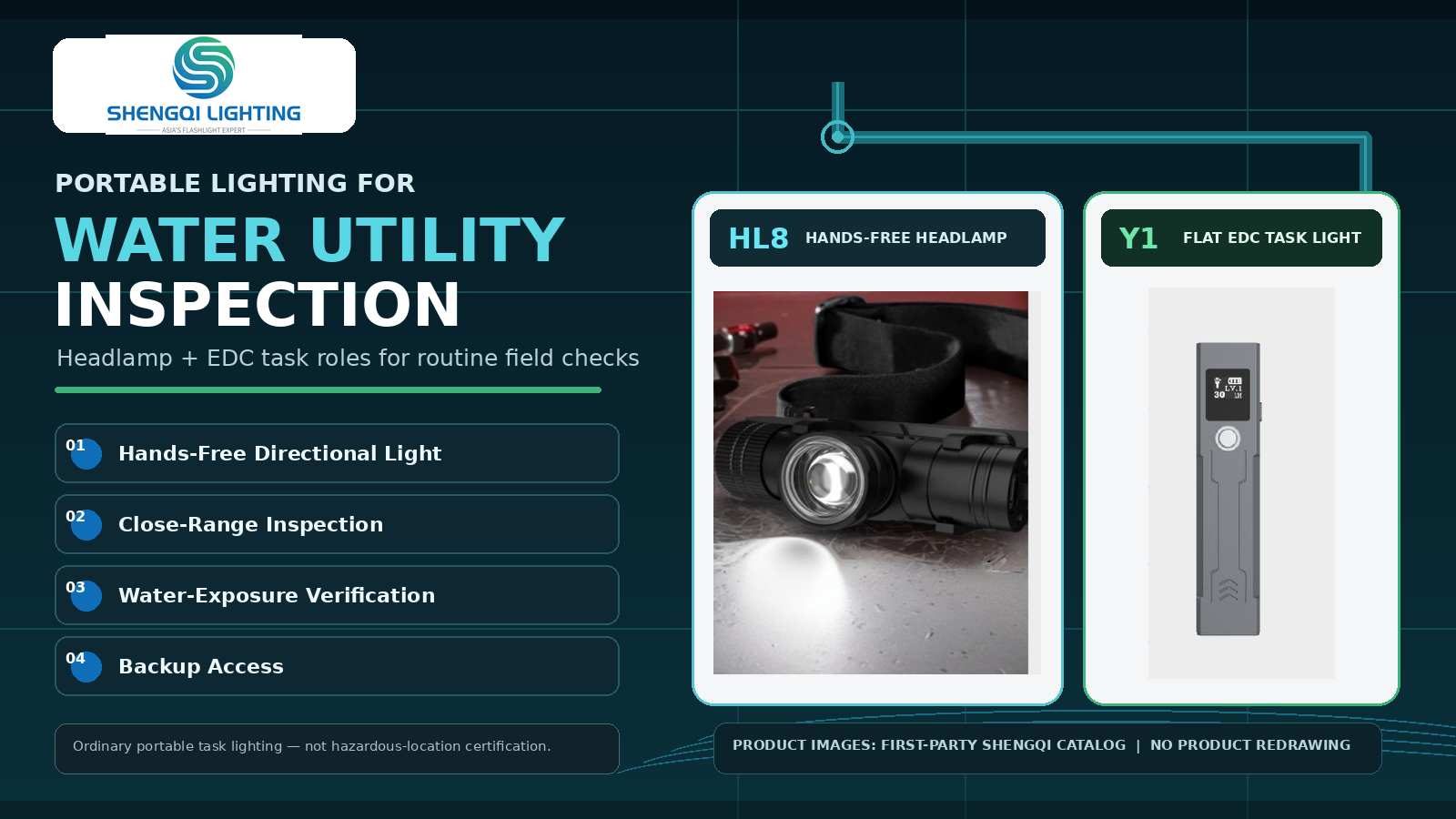
For routine water utility inspection, a hands-free headlamp can support walkdowns and equipment checks while a compact EDC flashlight can provide close-range, local or backup task lighting. The headlamp should offer a usable low mode, stable positioning and controls that fit the work process. The EDC light should be evaluated for close inspection, tool searches and secondary illumination. Buyers should verify the expected water exposure, mode-specific runtime, battery workflow, switch or sensor behavior and backup access. Neither light replaces fixed lighting, gas detection, confined-space controls, lockout/tagout, PPE or certified hazardous-location equipment. A portable light should support a defined inspection task; it does not make an unsafe work area safe.
What IP rating should a headlamp have for water utility inspection?
There is no single IP rating that fits every water-utility task; the rating should match the actual exposure expected for the final product. Splash, water jets, immersion, pressurized cleaning and chemical exposure are different conditions. HL8 provides one example: IPX5 indicates water-jet resistance under applicable test conditions but does not establish immersion, dust or chemical resistance. Cleaning-agent compatibility is also a separate materials question. Buyers should therefore verify the exact final SKU, test boundary and intended facility exposure instead of relying on a broad “waterproof” description.
Can a normal flashlight be used in a wastewater confined space?
A normal flashlight should not be assumed suitable for a wastewater confined space or hazardous atmosphere. The site hazard assessment, applicable confined-space procedures, atmosphere monitoring and any required equipment certification take priority. In U.S. general industry, OSHA 29 CFR 1910.146 addresses permit-required confined spaces and employer evaluation of workplace hazards. A flashlight is not an atmospheric monitor. An ordinary IP rating is also not intrinsic-safety or explosion-protection certification. Where specially certified lighting is required, select equipment with the verified certification required for that specific location and equipment class.
Why Headlamps Fit Routine Utility Walkdowns
A headlamp can keep both hands available, illuminate the area the user is facing and support gauge reading, label checks, visual equipment inspection and tool handling. It also reduces the need to continuously hold a flashlight during routine authorized checks.
Hands-free lighting is a workflow advantage, not a safety certification. It does not replace area lighting or prove that every pump station, room or process area is suitable for ordinary portable equipment.
Why an EDC Light Complements a Headlamp
A compact EDC light provides a second lighting position for close-range equipment checks, labels, nearby surfaces, finding tools and backup portable illumination. It does not replace the headlamp's directional hands-free role. A secondary EDC light adds another accessible light source; it does not replace the safety system.
Portable Lighting Does Not Replace a Water-Utility Safety Program
A portable headlamp or EDC flashlight can improve visibility, but it cannot determine whether a pump station, tank, wet well, vault, sewer, electrical area or confined space is safe to enter or service.
Portable task lighting does not replace fixed workplace lighting, emergency lighting, gas detection, atmospheric monitoring, confined-space permits, attendants, ventilation, lockout/tagout, energy isolation, machine guarding, PPE, electrical procedures, fall protection, barriers, training or employer procedures.
Ordinary Portable Lights Are Not Hazardous-Location Equipment
Water and wastewater facilities can include locations where the hazard assessment requires specially rated equipment. Neither HL8 nor Y1 is presented here as intrinsically safe, explosion-proof, ATEX, IECEx, Class I Division or Zone rated. Water resistance and hazardous-location certification answer completely different questions.
Lighting Does Not Control Hazardous Energy
When pumps, motors or other machinery are being serviced, portable lighting does not replace applicable hazardous-energy isolation procedures. U.S. OSHA 29 CFR 1910.147 addresses the control of hazardous energy during servicing and maintenance. Visibility supports the task; energy-control procedures control the hazard. See the OSHA confined-space standard and OSHA hazardous-energy standard for U.S. general-industry context.
Before Selecting the Light, Classify the Work Area
If the site requires specially certified lighting, an ordinary portable headlamp or EDC flashlight is not a substitute.
HL8: Hands-Free Wave-Sensing Headlamp Architecture
HL8 uses a 6063 aluminum-alloy body, 5W LED and an 18650 1800mAh battery platform. Its confirmed modes are 300LM High, 140LM Medium and 55LM Low, plus 300LM Strobe and 140LM SOS. The maximum listed beam distance is 69m, with IPX5 and 1m impact resistance.
For ordinary inspection workflows, 300LM may support short directional visual checks, 140LM may suit general inspection tasks, and 55LM may be useful for nearby gauges, labels and reflective equipment. These are task-planning examples, not water-utility standards.
Wave Sensing Can Reduce Repeated Switch Contact—But It Still Needs Testing
Wave sensing may reduce the need for repeated direct switch contact during suitable tasks when hands are occupied or tools are being handled. Buyers should still test intended activation, unintended activation, nearby movement, sensor range, sensor angle, control logic and manual override. Current evidence does not establish exact sensing distance, exact angle, wet-hand performance, glove performance or a false-trigger rate.
Brands evaluating hands-free headlamp platforms should define those workflow requirements before sample approval.
Water Resistance Should Match the Actual Exposure
Damp environments, splashes, water jets, immersion, pressurized cleaning and chemical contact are different exposure conditions. HL8's IPX5 rating indicates protection against water jets under applicable test conditions. The “X” does not establish a solid-particle protection rating.
IPX5 does not establish immersion, dust resistance, chemical resistance, sewage resistance, disinfectant resistance or corrosion resistance.
The correct procurement question is not “Is it waterproof?” but “What exposure was the final product tested for?”
Y1: Flat Magnetic EDC Maintenance-Light Architecture
The Y1 flat magnetic EDC platform uses a 6063 aluminum-alloy rectangular body, main white light, side light, magnetic tail and built-in 1000mAh lithium battery. Main-light modes are 700LM Turbo, 400LM High, 200LM Medium, 30LM Low and 10LM Moon. Dimensions are 20.5 × 30.5 × 138mm and listed weight is 133g with battery.
Local Side Lighting Can Be Useful Around Equipment
The side-light architecture can support close local illumination, tool organization and nearby equipment checks. It is not presented as a calibrated industrial floodlight, and no side-light lumen value is assumed here.
Magnetic Mounting Needs a Surface and Equipment Check
On an approved ferromagnetic work surface, magnetic positioning may support local hands-free task lighting. Buyers should verify surface material, holding force, orientation, vibration, movement and equipment restrictions. Do not assume magnetic mounting is appropriate on energized equipment, sensitive instruments or any surface where the site procedure or equipment manufacturer prohibits it.
The Y1 architecture is used for task-positioning and close inspection examples; its environmental exposure limits must be verified separately for the final application.
Controls Must Work With the Maintenance Workflow
Some maintenance tasks may involve gloves, wet equipment, repeated task changes or tools in both hands. A physical switch should be evaluated for button size, tactile feedback, accidental activation, repeated operation and contamination around the button.
Sensor control should be tested for intended activation, unintended activation, range, angle, manual override and behavior near moving equipment. Motion sensing is not automatically better and should not be described as more hygienic without supporting evidence.
If a Maintenance EDC Uses a Clip, Test It as a Working Component
For future or custom EDC designs with a clip, verify retention, pocket orientation, workwear compatibility, switch interference, repeated insertion and removal, and corrosion exposure where relevant. This does not imply that Y1 includes a clip.
More Lumens Can Make Close Inspection Harder
Gauges, labels, painted equipment, stainless surfaces and wet surfaces can create glare or reflections when output is unnecessarily high. Buyers should review low mode, medium mode, beam angle, hotspot behavior, side-light architecture and actual working distance.
HL8's 55LM Low provides one example of task-mode separation. Y1 provides 10LM Moon, 30LM Low and 200LM Medium options before its higher-output levels. These values illustrate product modes; they are not water-utility illumination standards.
Reflections from wet metal or water surfaces should be treated as a visual-comfort and beam-management issue. Portable lighting does not identify contamination, prove leakage or determine water quality.
Inspection Lights Need a Cleaning and Maintenance Plan
Depending on the facility and task, a portable light may encounter moisture, mud, fingerprints, oils, deposits, treatment chemicals or cleaning agents. Buyers should review enclosure materials, lens, physical switches, sensor windows, charging-port areas where applicable, seams, headbands, clips, magnetic interfaces and labels.
An IP rating does not automatically prove compatibility with cleaning chemicals or disinfectants. IP testing answers ingress-protection questions. Chemical compatibility is a separate materials question.
Where cleaning exposure matters, request material specifications, coating compatibility, label durability and seal compatibility as applicable. Without model-specific evidence, do not assume chlorine, disinfectant or wastewater-chemical resistance.
Runtime Should Be Matched to the Inspection Schedule
Buyers should define inspection duration, shift duration, primary versus backup role, working mode, charging access and tested runtime. Battery capacity is not runtime.
HL8's 1800mAh capacity and Y1's 1000mAh capacity should not be converted directly into operating hours or used to conclude that one model lasts longer. LED load, mode, driver, optics, battery condition, temperature and test endpoint differ.
Where runtime matters, require mode-specific runtime evidence and output-over-time behavior for the production configuration.
Water Utility Portable Lighting Task Matrix
| Inspection Task | Headlamp Role | EDC Role | Main Verification | Safety Boundary |
|---|---|---|---|---|
| Plant Walkdown | Hands-free directional light | Secondary local light | Fit, modes, runtime | Authorized accessible areas only |
| Pump Exterior Check | General visual inspection | Close detail check | Glare, beam, controls | LOTO may apply during servicing |
| Gauge / Label Reading | Low directional mode | Close-range task light | Low mode and reflections | Do not infer equipment condition from light alone |
| Valve Identification | Hands-free label visibility | Secondary close check | Working distance | Follow authorized operating procedure |
| Accessible Equipment-Room Inspection | Directional walkdown light | Local illumination | Environmental exposure | Site-specific electrical and atmospheric controls may apply |
| Tool / Component Search | General area support | Primary local role | Side-light / positioning | Use only approved surfaces and work areas |
| Routine Maintenance Preparation | Hands-free setup light | Local backup | Controls, battery | Energy-control procedures remain separate |
| Backup Portable Lighting | Primary hands-free role | Second accessible source | Stored charge and access | Site-specific confined-space / hazardous-atmosphere controls may apply |
HL8 + Y1 Utility Inspection Architecture Matrix
| Product | Confirmed Architecture | Potential Routine Task Role | Verified Environmental Evidence | Missing Evidence | Buyer Check |
|---|---|---|---|---|---|
| HL8 | Hands-free headlamp; wave sensing; 300/140/55LM; 18650 1800mAh; 1m impact | Hands-free routine inspection | IPX5 water-jet protection boundary | Exact runtime; sensor distance/angle; chemical compatibility | Match sample evidence to task and exposure |
| Y1 | Flat EDC; main white; side light; magnetic tail; 1000mAh; 700/400/200/30/10LM | Local equipment check / secondary task light | None verified for this article | IP rating; runtime; magnet force; chemical compatibility; impact rating | Define environmental boundary separately |
These products are not being ranked and are not presented as certified wastewater, confined-space or hazardous-location equipment.
Six Product Requirements Water-Utility Buyers Should Define
Define which walkdowns, gauge checks or tool-handling tasks need both hands available. Then specify beam direction, modes and wearing stability around that task.
Define labels, gauges, components and local surfaces before selecting output. The EDC role should complement rather than duplicate the headlamp.
Define dampness, splash, water jets, cleaning or chemicals separately. Required product evidence should match the actual exposure.
Determine whether physical buttons, sensor operation or both fit the maintenance process. Include accidental activation and manual override in sample testing.
Define operating mode, inspection duration, charging access and backup role. Battery capacity alone cannot answer the runtime question.
Identify the project's actual cleaning process and materials. Ingress protection should not be confused with chemical or disinfectant compatibility.
Twelve Tests Buyers Should Run on a Water-Utility Inspection Light Sample
Confirm the actual available modes on the sample.
Use representative labels, gauges or metal surfaces.
Evaluate the headlamp during representative inspection movement.
Check fit during the expected walkdown movement.
For an HL8-style architecture, verify intended control behavior.
Simulate natural movement and nearby equipment activity.
Apply only to models with documented environmental ratings.
Use the project's actual cleaning process and material requirements.
Evaluate repeatable operation without inventing a cycle target.
Only for magnetic models and on approved representative surfaces.
Use tested runtime rather than battery capacity alone.
Confirm that the approved behavior remains consistent.
Acceptance criteria are project-specific.
Ten Questions to Ask Before Sourcing Portable Lighting for Water Utility Inspection
A B2B buyer should not label a portable light “water-utility ready” only because it has high lumens, a magnet or a waterproof marketing claim.
How SHENGQI LIGHTING Supports Utility Inspection-Light Development
A water-utility lighting project should begin with the inspection task and environmental boundary, then define the head-mounted structure, EDC role, output modes, controls, battery, required ingress protection, cleaning compatibility and validation plan.
Relevant SHENGQI capabilities include Industrial Design, Optical Engineering, Electronic Design, headlamp and EDC structure development, battery architecture, manufacturing, testing, quality control and packaging design. Buyers can review custom portable-light development, EDC flashlight platforms, portable-light testing capabilities and sample-to-production manufacturing processes.
Testing capabilities include lumen evaluation, discharge-time testing, water-resistance testing, temperature assessment, battery testing and button testing. Laboratory capability shows what can be evaluated; model-specific records show what was actually evaluated.
Frequently Asked Questions
1. What portable lighting is useful for water utility inspection?
For routine accessible inspections, a headlamp can provide hands-free directional light while an EDC flashlight supports close-range checks, local illumination and backup access. Buyers should match modes, controls, runtime and environmental evidence to the actual task. Neither category replaces fixed lighting, employer safety procedures, gas detection, energy isolation or any specially certified equipment required by the work area.
2. Why can a headlamp be useful during pump and equipment inspections?
A headlamp keeps both hands available for authorized visual checks, tools, labels and controls while directing light toward the user's line of sight. Adjustable output can also help with close reflective surfaces. This hands-free advantage is a workflow feature rather than a safety certification, and it does not replace fixed lighting, machine guarding, energy isolation or the site's inspection procedures.
3. Is IPX5 enough for a water treatment plant?
There is no universal answer. IPX5 indicates protection against water jets under applicable test conditions, as used here for HL8. It does not establish immersion resistance, dust protection or chemical compatibility. A water-treatment project should identify the actual splash, cleaning, immersion or chemical exposure first and then verify that the exact final product has evidence appropriate to that exposure.
4. Can a magnetic EDC flashlight be attached to pumps or equipment?
Only after verifying the actual surface material, magnetic holding force, orientation, vibration, site procedure and equipment restrictions. A magnet does not attach reliably to every metal or every pump structure. Do not assume magnetic mounting is appropriate on energized equipment, sensitive instruments or locations where the equipment manufacturer or facility procedure prohibits it. The final mounting workflow should be validated on approved representative surfaces.
5. Does a motion-sensing headlamp work better in wet environments?
Not automatically. Motion sensing may reduce repeated direct switch contact during suitable tasks, but the workflow still needs testing for intended activation, false triggering, sensor distance, angle and manual override. Current HL8 evidence does not establish wet-hand performance, universal glove operation or a false-trigger rate. Environmental resistance and sensor usability should be evaluated as separate product questions.
6. How should water-utility buyers evaluate flashlight runtime?
Start with the inspection duration, operating mode, primary or backup role and charging availability. Battery capacity is not runtime. LED load, driver behavior, output level, battery condition, temperature and the test endpoint affect operating time. Buyers should request mode-specific runtime and output-over-time evidence for the intended production configuration rather than converting a battery's mAh value directly into working hours.
7. Can an ordinary headlamp or EDC flashlight be used in a hazardous or confined-space area?
Do not assume suitability. The work-area hazard assessment, applicable confined-space procedures, atmosphere monitoring and any required equipment certification take priority. An ordinary IP rating does not establish intrinsic safety or explosion protection. If the location requires certified equipment, the lighting product must have the verified certification required for that specific location and equipment class. HL8 and Y1 are not presented here as hazardous-location products.
8. What should B2B buyers test before approving portable lighting for utility inspection?
Test output modes, close-range glare, headlamp positioning, headband stability, switch or sensor behavior, relevant water-exposure evidence, cleaning compatibility, magnetic positioning where applicable and runtime in the intended mode. Repeat the workflow across production-representative samples. Acceptance criteria should reflect the actual task, environment and safety program rather than a generic “industrial” or “waterproof” marketing description.
Conclusion: Start With the Inspection Task
Portable lighting should support a defined inspection task. For routine water-utility work, a headlamp and an EDC flashlight can perform different but complementary roles: hands-free directional lighting versus close-range, local and backup illumination. Environmental exposure, controls, runtime, cleaning, mounting and safety requirements should then be verified against the actual work area and production configuration. The product does not make an unsafe work area safe.
Coming Soon: Shengqi Lighting is preparing to introduce a new portable lighting product. Official product information will be released soon.
Define the Work Area, Task and Evidence Before Freezing the Product
Water-utility equipment suppliers, pump brands, industrial MRO distributors, maintenance-equipment companies, sourcing teams and private-label buyers can discuss hands-free headlamp development, EDC maintenance-light architecture, low-mode planning, sensor UI, water-exposure targets, battery architecture, runtime verification, mounting design, cleaning compatibility, sample verification and batch consistency.
Contact SHENGQI LIGHTING for an OEM/ODM technical evaluation at sales@shengqilight.com.
Final product suitability depends on the actual work area, exposure, employer safety program and any required hazardous-location or confined-space equipment certification.