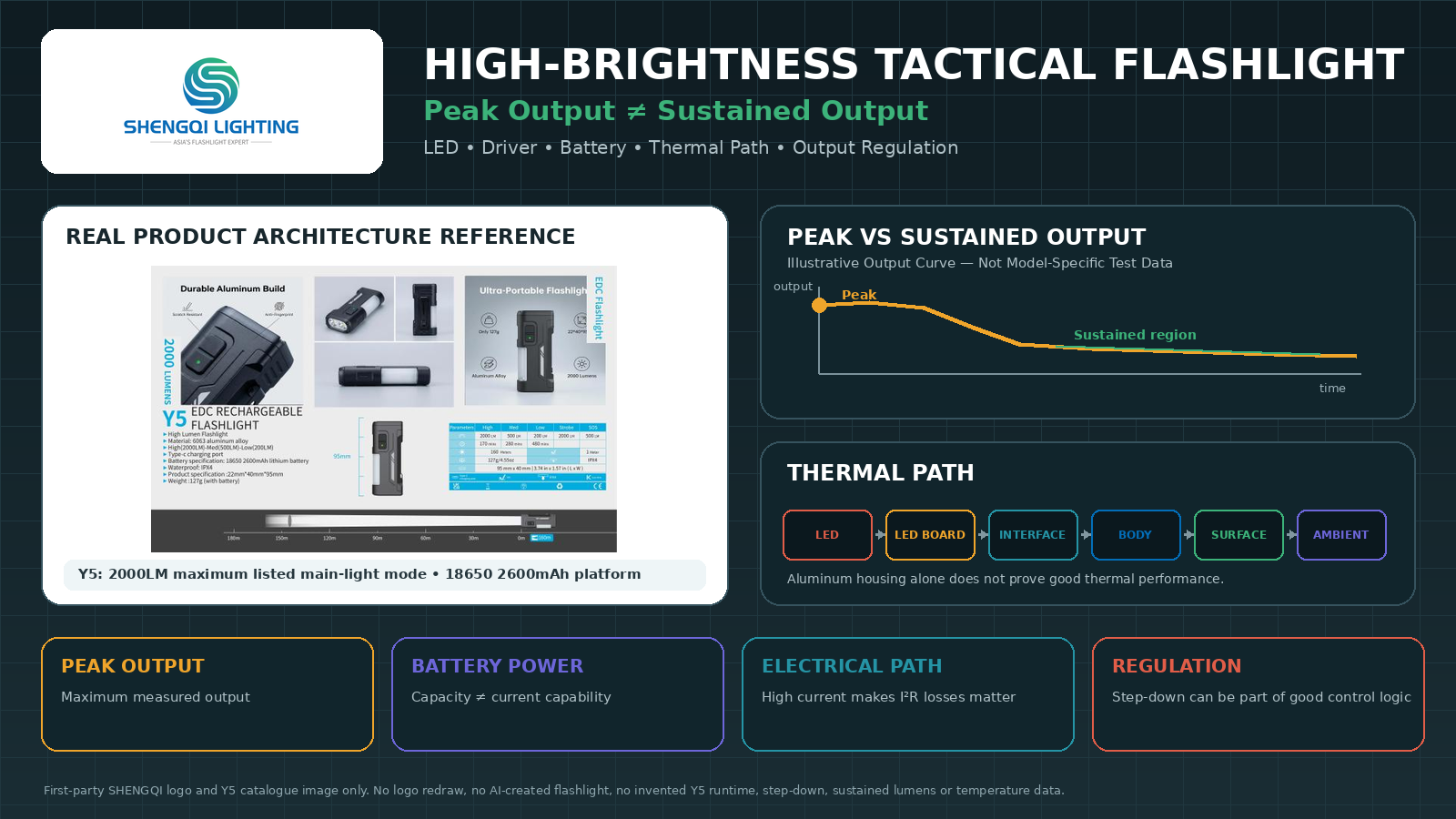

What Makes a Tactical Flashlight High Brightness?
A high-brightness tactical flashlight depends on the complete LED, driver, battery and thermal system, not simply on the maximum lumen rating of the LED. Peak lumens describe the highest output the finished flashlight can produce under a defined condition, while sustained output describes what remains available as the battery, driver and body reach a different operating state. Driver current determines how the LED is powered, the battery must support the required electrical load, and the thermal path must move heat away from critical components. Regulation then determines how output changes as temperature and battery conditions change. For B2B evaluation, both the maximum mode and the output-over-time behavior should be understood.
Why Do High-Brightness Flashlights Step Down?
High-brightness flashlights may reduce output to manage temperature, battery load or other operating limits defined by the product's control system. Step-down can be timed, temperature-based, voltage-based or use a combination of control inputs. It is not automatically a weakness. The important question is whether the regulation behavior is appropriate for the product's intended task and whether the resulting output remains useful. Buyers should understand when output changes, why it changes and what level follows the transition instead of treating the peak mode as the complete performance identity.
Are Peak Lumens or Sustained Lumens More Important?
Both matter, but they answer different questions: peak lumens describe maximum short-term output, while sustained output better describes how much light remains available during longer use. A brief high-output mode can be valuable for a quick area scan or temporary maximum illumination. Sustained output becomes more important when the task requires the light to remain bright for an extended period. A complete specification should therefore show the relationship between the initial output, regulation behavior, operating duration and final runtime rather than using one figure to represent every use case.
Does a Larger Battery Make a Flashlight Brighter?
Not automatically. Battery capacity describes stored energy, while high-output performance also depends on voltage, current capability, internal resistance, driver design and thermal limits. A cell with more mAh can potentially store more energy without necessarily supporting a higher peak electrical load. Likewise, a high-current battery cannot guarantee greater flashlight output if the driver, LED or thermal architecture limits the operating point. Energy capacity and power-delivery capability should be evaluated as separate characteristics.
What Does “High Brightness” Actually Mean in a Flashlight?
A high-brightness flashlight is not simply a product with a large lumen number. It is a lighting system designed to produce a high level of total output while managing battery load, heat, electrical efficiency and user comfort over the intended operating period.
Peak output, sustained output, useful output, beam distribution and working duration all describe different parts of that system. A flashlight may produce a very high initial lumen value yet regulate to a lower level later. Another may begin lower but remain comparatively stable for longer.
High brightness also does not mean long range. Long-range design depends more heavily on directional intensity and optics. This article focuses on total light output and the electrical and thermal architecture required to produce and sustain it.
For commercial product context, buyers can compare existing rugged handheld flashlight architectures without assuming that every high-lumen model has the same sustained-output behavior.
Peak Lumens and Sustained Lumens Are Not the Same Specification
Peak output is the maximum light output reached under the defined operating and measurement conditions. It does not need to be treated as a fixed thirty-second or one-minute category unless a specific test method defines such a period.
Sustained output is the level the complete flashlight can maintain after battery condition, driver regulation and thermal behavior begin influencing the system. The exact level and duration are product-specific.
A product can legitimately have a high peak mode and a lower sustained level, but buyers need to understand the transition. That is why an output curve is more informative than a peak number by itself.
Turbo Is a Mode, Not the Entire Product Identity
Turbo can be useful for a short high-output task, quick area scan or temporary maximum illumination. The issue is not that Turbo exists. The issue is whether packaging or procurement documentation presents only Turbo while leaving runtime, step-down and sustained behavior unclear. Turbo should be treated as an operating mode, not as the entire performance identity of the flashlight.
Start With the Lighting Task Before Setting a Lumen Target
Is the flashlight for close-range work, outdoor walking, wider-area illumination, temporary inspection, general handheld use, short high-output bursts or sustained medium-high illumination? Those tasks do not need the same peak lumen target.
Close-range work around white walls, metal equipment or other reflective surfaces can become less comfortable when output is unnecessarily high. More light is not always more useful light.
Total output should also be evaluated separately from beam distribution. Two flashlights with similar measured lumens can look very different if one spreads light broadly and another concentrates more of it toward the center.
The LED Rating Is Not the Flashlight Output
An LED datasheet can describe performance at defined current and temperature conditions, but the finished flashlight adds optical losses, driver losses, battery behavior and thermal conditions that change the result.
Drive current, junction temperature, lens transmission, reflector or TIR losses, driver efficiency, battery voltage, wiring and thermal contact all influence the actual output measured from the assembled product.
LED capability is a component specification; flashlight output is a system measurement.
Single High-Power Emitter vs Multi-Emitter Architecture
A single high-power emitter can simplify optics and driver architecture. A multi-emitter system can create more total flux or a wider optical arrangement, but it also increases current demand, heat, PCB area, driver complexity and optical integration work.
Individual LED maximum values should not simply be added together and published as finished-product lumens. The final assembled flashlight is the unit that must be measured. Broader handheld flashlight products can show different architecture directions, but model output still requires model-specific verification.
The Driver Determines How Hard the LED Is Actually Being Used
The driver can regulate current, convert voltage where required, control modes, manage low-voltage behavior, implement thermal logic and provide protection functions.
A high-output mode may require more LED current, but higher current does not create proportionally higher light indefinitely. As the operating point rises, LED efficiency can decrease, so additional electrical power may create proportionally more heat than useful light. This efficiency droop is one reason a product cannot be designed by current alone.
Driver efficiency also influences battery draw, heat and runtime. Buyers should not assume an efficiency percentage without measurement. Where electrical efficiency matters to the project, input power and measured light output can be reviewed together under defined conditions.
More drive current is an engineering input, not a guarantee of proportionally more finished-product output.
A Large Battery Capacity Does Not Automatically Support High Output
Capacity and power delivery are different battery characteristics. Capacity, usually expressed in mAh or Wh, relates to stored energy. Current capability describes how much electrical load the cell can support within its approved operating specification.
For energy comparisons across different nominal voltages, Wh provides more context than mAh alone: Wh ≈ nominal voltage × Ah. That still does not describe high-load behavior by itself.
14500, 18650, 21700 and integrated lithium packs can all support different product directions. No one cell format is automatically the standard for a high-brightness flashlight. Body dimensions, required current, runtime, mass, charging and serviceability need to be evaluated together.
Two cells with similar nominal capacity can also behave differently under higher load because internal resistance, voltage sag, temperature behavior and manufacturing consistency can differ. The approved battery configuration should therefore remain a controlled BOM item rather than being replaced simply because another cell has the same size and mAh label.
High Current Makes Small Electrical Losses More Important
Springs, PCB traces, contacts, switches, wires, battery terminals and threaded or contact interfaces all contribute some electrical resistance.
At higher current, those small losses matter more. The basic relationship P = I²R shows why resistive heating increases quickly as current rises. More resistance can contribute to voltage drop, local heating and less electrical power being available to the LED system.
Contact contamination or oxidation can also increase resistance in some use conditions. That does not mean every flashlight will develop a contact problem, but contact design, materials and maintenance exposure become more relevant as current demand increases.
High-output architecture should therefore consider the complete electrical path from the battery terminal to the driver and LED rather than focusing only on the battery and emitter.
High Brightness Is Ultimately a Thermal Design Problem
The heat path can be viewed as:
LED Junction → LED Board → Thermal Interface → Flashlight Body → External Surface → Ambient Air
A bottleneck anywhere along that path can change LED temperature, efficiency, output behavior and surface temperature. Simply specifying an aluminum housing does not prove good thermal performance. Board contact, thermal interface, body geometry, wall structure, surface area and assembly all contribute.
Thermal mass and surface area also solve different parts of the problem. More thermal mass can absorb more energy during a short high-output period, while external surface area influences how effectively the product exchanges heat with the surrounding air. A larger body is not automatically cooler because the entire thermal path and operating environment still matter.
Ambient conditions matter as well. A flashlight operating in a cool room can behave differently from the same product used in a hot outdoor environment. Thermal verification should therefore match the intended product brief.
Step-Down Is Not Automatically a Weakness
High-output flashlights may use timed step-down, temperature-based regulation, voltage-based regulation or combined logic. These are possible control architectures rather than a ranking of good and bad designs.
Step-down can help manage temperature, battery load and component operating limits. The relevant buyer question is not “Does it step down?” but “Why, when and to what usable output level does it regulate?”
No obvious step-down is not automatically superior either. Another product may begin at a lower output, use a larger housing, operate at a different drive current or use different thermal limits.
Some systems may use temperature sensing, but the position of a sensor must be understood. A sensor mounted on the PCB or housing does not directly measure LED junction temperature.
Regulation behavior should therefore be validated as part of the complete system rather than judged from one user-visible transition.
Runtime Without an Output Curve Can Hide Most of the Story
A statement such as “runtime: four hours” has limited value if the buyer does not know how brightness changes during that period.
A useful B2B record should identify starting output, any step-down, the sustained level, runtime endpoint, battery configuration and relevant test conditions. Runtime and brightness should be read together.
Runtime depends on battery energy, LED efficiency, driver efficiency, operating mode, thermal regulation, temperature and the chosen endpoint. Battery capacity alone cannot establish runtime.
High-Brightness Flashlights Need Useful Mode Spacing
Low, medium, high and Turbo should each have a job. Mode count is less important than mode usefulness.
Low output can be valuable for close inspection, reading, reflective surfaces, reducing glare and conserving battery energy. Medium can support routine handheld work. High can provide stronger general illumination, while Turbo can serve short maximum-output tasks where appropriate.
If the practical jump between modes is poorly matched to the application, a flashlight can offer several advertised levels without giving the user a comfortable everyday setting.
If strobe is included, it should be reviewed as part of UI logic and accidental activation. It does not need to be inserted into the normal brightness sequence if that makes routine mode selection harder.
Small Bodies and High Output Create a Packaging Trade-Off
Compact size can mean less thermal mass, less external surface area and less battery volume. It does not mean every compact high-output flashlight will overheat.
The important design relationship is that compact size, high peak output and long sustained output compete for the same physical volume. LED efficiency, driver design, battery architecture, body geometry and regulation determine how those competing requirements are balanced.
User grip is also part of thermal design because the hand may cover much of the external housing. Surface-temperature behavior should therefore be reviewed in the normal grip area and during the expected mode duration, using project-specific acceptance criteria rather than a universal temperature assumption.
Compact product directions can also be compared with high-output pocket-light architectures where packaging space is especially constrained.
Real SHENGQI Architectures Show Why Maximum Output Is Only the Starting Point
The Y5 2000LM maximum-output EDC platform lists a 2000LM maximum main-light mode alongside a 2600mAh 18650 battery platform and a flat 6063 aluminum body. For B2B evaluation, the next questions would be how output changes over time, what test method produced the rating and how the thermal system behaves in the intended operating mode.
Y4 provides another compact architecture reference with a Flood High mode listed at 1020LM and an integrated 500mAh battery. That combination illustrates why a small enclosure with high listed output requires battery, thermal and mode-management verification. It should not be interpreted as evidence that 1020LM is sustained for a particular period.
These examples are architecture references, not substitutes for model-specific output curves, step-down data, temperatures or runtime records.
High-Brightness Tactical Flashlight Engineering Matrix
| Design Variable | Why It Matters | High-Output Trade-Off | Buyer Question | Prototype Evidence |
|---|---|---|---|---|
| Peak Output | Defines maximum initial capability | May be available only under limited conditions | How is maximum output measured? | Photometric measurement |
| Sustained Output | Shows usable longer-term brightness | Competes with heat and battery load | What level remains after regulation? | Output-over-time curve |
| LED Architecture | Sets component-level light potential | Higher drive can reduce efficiency | Single or multi-emitter? | Final assembled lumen test |
| Driver Current | Controls LED operating point | Higher current increases electrical and thermal load | What current strategy supports each mode? | Electrical validation |
| Driver Efficiency | Affects battery draw and heat | Losses reduce system efficiency | What is measured at the intended load? | Input/output validation |
| Battery Capacity | Defines stored energy | More capacity can add size and weight | How much energy does the task require? | Capacity and runtime review |
| Battery Current Capability | Supports high-load operation | High-load behavior varies by cell | Can the approved cell support the mode? | Voltage/load behavior test |
| Electrical Resistance | Influences voltage drop and heating | Loss rises quickly at higher current | Where are the critical contacts? | Electrical-path review |
| Thermal Path | Moves heat from LED to environment | Packaging can create bottlenecks | Where can heat transfer be restricted? | Thermal evaluation |
| Step-Down Logic | Controls changing operating conditions | Peak output may not remain constant | Why and when does regulation occur? | Mode-transition record |
| Mode Spacing | Determines everyday usability | Too many bright modes can reduce useful choice | Does each level own a task? | Task-based user review |
| Production Consistency | Reproduces approved output behavior | Component or assembly changes alter results | Which revisions are performance-critical? | Production-sample comparison |
Four Ways a High-Brightness Flashlight Can Miss Its Product Goal
01. A Large Peak Number With No Useful Sustained Output Story
A strong turn-on lumen result can demonstrate maximum capability without explaining how the light behaves after battery and temperature conditions begin changing. If the use case requires more than a short burst, the buyer needs an output-over-time record. A lower regulated level is not automatically a problem if it remains appropriate for the intended task. The failure is approving the product without understanding the transition.
02. A Battery With High Capacity but Poor Fit for the Required Power Load
A high-capacity cell can store substantial energy while still being a poor match for the required high-load operating point. Voltage sag, internal resistance and approved discharge behavior matter alongside capacity. The answer is not simply choosing the battery with the largest mAh label. The battery must match both the required energy and the driver's power demand.
03. Excellent LED Specification, Weak Thermal Path in the Finished Product
An LED may have strong component-level performance while the finished housing provides inconsistent board contact, thermal interface or heat transfer. The result can differ substantially from what component data alone suggests. This is a system integration problem rather than an LED-quality problem. Thermal validation has to be performed on the assembled product.
04. Too Many Bright Modes and No Comfortable Everyday Level
A mode table can look impressive while leaving no practical setting for routine close work. High-output products still need useful low and medium levels. Good mode spacing lets the user select brightness according to the task instead of repeatedly stepping through several similar high-output levels. More modes do not automatically create a better interface.
Ten Questions Before Developing a High-Brightness Tactical Flashlight
1. What task actually requires high total output?
Define the environment, working distance and duration before setting the brightness target. Close inspection and broad outdoor illumination can require very different output behavior.
2. What peak output does the product need, and how will it be measured?
Specify the finished-product measurement method, battery configuration and mode. Do not derive the final lumen claim from the LED datasheet alone.
3. What sustained output is required after the flashlight reaches its normal thermal state?
Set a project-specific requirement that reflects the intended operating period. Do not assume peak output needs to remain unchanged.
4. What body size and weight can the product tolerate?
The enclosure sets limits on battery volume, thermal mass, surface area and user comfort. Packaging and performance have to be decided together.
5. What LED and driver architecture support the required operating point?
Evaluate LED efficiency, current, driver regulation and the expected thermal load as one electrical system.
6. What battery can provide both the required energy and power delivery?
Capacity, voltage behavior and current capability should all match the approved operating modes. Cell substitution requires technical review.
7. How will electrical losses through contacts, springs and PCB paths be controlled?
High current makes small resistance values more important. The complete electrical path should be reviewed, not only the cell and LED.
8. What thermal-regulation strategy fits the intended user workflow?
Timed, temperature-based, voltage-based or combined regulation may be suitable depending on the architecture. The project should define the intended behavior.
9. How should low, medium, high and Turbo modes be spaced?
Every mode should solve a different lighting task. High brightness does not remove the need for comfortable close-range output.
10. What output-over-time and production-batch evidence will be required before approval?
Define the records needed to connect the engineering sample with later production units. Acceptance criteria should be project-specific.
Twelve Tests Buyers Should Run on a High-Brightness Flashlight Prototype
Visual impressions are useful for application review, but they do not replace instrumented photometric measurement. Where lumen validation is required, the finished flashlight should be tested using an appropriate integrating-sphere or photometric method with the relevant configuration recorded. Available lumen and discharge-time testing resources can support project verification without implying that every SHENGQI model has completed an identical test program.
Measure the assembled flashlight using the approved battery and mode.
Record how brightness changes through the intended operating period.
Compare regulated output with the project-specific requirement.
Evaluate electrical demand in the intended high-output modes.
Review voltage behavior using the approved battery configuration.
Review the normal grip area and relevant operating conditions.
Record when and how regulation changes the output.
Evaluate representative Turbo → lower mode → Turbo use without prescribing a universal cycle count.
Confirm that the output levels support distinct real tasks.
Record runtime together with the brightness behavior of that mode.
Recheck output and function after the applicable mechanical evaluation.
Compare complete output behavior with the approved development sample.
Cold-start and warm-start behavior may differ. If the real workflow can involve repeated maximum-output use, testing should include representative activation from a cool flashlight and from a body that is already warm. Output behavior, thermal state, battery condition and regulation should be observed together. Acceptance criteria remain project-specific.
Manufacturing Consistency Is Part of Sustained Output
A high-output design can change when the LED revision or bin, PCB, driver components, springs, contacts, battery, thermal interface, assembly pressure, housing or optics change.
The development chain should remain controlled:
Approved LED → Approved Driver → Approved Battery → Approved Thermal Interface → Approved Sample → Output Curve → Production Verification
Thermal-interface consistency deserves particular attention. Poor board contact, inconsistent interface material, changing assembly pressure or a material substitution can alter heat transfer between the LED board and body even when the external housing looks identical.
Battery substitution creates a similar risk. A cell with the same physical size and nominal mAh does not automatically have the same internal resistance, discharge capability or voltage behavior.
A project should carry these controlled relationships into sample-to-production manufacturing rather than allowing performance-critical components to change without review.
How an OEM/ODM Project Should Define a High-Brightness Flashlight
A structured development brief should move through the task, beam requirement, peak output, sustained output, LED, driver, battery, electrical path, thermal architecture, body size, mode spacing, runtime requirement, output curve, prototype verification and production consistency.
The lumen target should be defined together with the thermal and battery targets, not before them.
Industrial Design, Optical Engineering, Electronic Design, PCB Layout, Battery Architecture, Thermal Design Integration, Manufacturing, Testing, Quality Control and Packaging Design can all influence the final result.
Brands building a custom platform can use SHENGQI LIGHTING's custom high-output flashlight development capabilities to turn those requirements into a project-specific architecture without assuming a fixed sustained output, runtime or temperature before validation.
Frequently Asked Questions About High-Brightness Tactical Flashlights
1. What makes a tactical flashlight high brightness?
A high-brightness tactical flashlight depends on the complete LED, driver, battery and thermal system, not simply on the maximum lumen rating of the LED. Peak output describes the highest output available under defined conditions, while sustained output shows what remains during longer operation. Driver current, battery power delivery, electrical resistance, heat transfer and regulation all influence the finished product. Total lumens and beam distribution should also be evaluated separately.
2. What is the difference between peak and sustained lumens?
Peak lumens describe the maximum output a flashlight reaches under the defined test and operating condition. Sustained output describes the level available after battery, thermal and regulation behavior begin influencing the system. Peak is not the same as sustained. Both can be legitimate specifications, but B2B buyers should understand the transition between them and review an output-over-time record when longer-use brightness matters.
3. Why do high-output flashlights step down?
High-output flashlights may reduce output to manage temperature, battery load or other operating limits defined by the control system. The regulation can be timed, temperature-based, voltage-based or use combined logic. Step-down is not automatically a defect. Buyers should determine why the output changes, when the change occurs and whether the following level remains useful for the intended task instead of evaluating the flashlight only from its highest initial mode.
4. Does a larger battery always produce more brightness?
No. A larger-capacity battery can store more energy, but maximum flashlight output also depends on voltage, current capability, internal resistance, driver architecture, LED operating point and thermal limits. Two cells with similar capacity can behave differently under high electrical load. Battery capacity and power delivery should therefore be treated as separate specifications, and the approved battery configuration should remain controlled during production.
5. Why do compact high-brightness flashlights need careful thermal design?
Compact housings can provide less room for battery volume, thermal mass and external surface area, but they do not automatically overheat. Actual behavior depends on LED efficiency, driver current, board contact, thermal interface, body geometry, regulation and ambient conditions. The challenge is that compact size, high peak output and long sustained output compete for the same physical volume, so finished-product testing becomes especially important.
6. How should buyers compare runtime and brightness together?
Buyers should review runtime together with the output curve rather than treating the runtime number as an independent specification. A useful record identifies starting output, any regulation or step-down, sustained brightness, endpoint, battery configuration and relevant test conditions. Two products can claim similar runtime while delivering very different brightness profiles during that period. Runtime and output behavior should therefore be approved together.
7. What should B2B buyers test on a high-brightness flashlight prototype?
Buyers should measure peak output, record output over time, review sustained brightness, monitor battery and driver behavior, evaluate surface temperature, verify regulation transitions and test the intended mode spacing. Repeated Turbo behavior can also be relevant when the user workflow includes repeated maximum-output activation. Production-representative samples should then be compared with the approved development sample using project-specific acceptance criteria.
8. Can a high-brightness tactical flashlight be customized for OEM/ODM projects?
Yes. A custom project can define the lighting task, peak and sustained output requirements, LED, driver, battery, electrical path, thermal architecture, body size, mode structure and runtime expectations as one system. The design should then be validated with output-over-time, electrical, battery and thermal evidence before production. The exact performance targets and acceptance criteria should be defined for the individual B2B project.
High Brightness Is a System Result, Not a Single Number
A useful High-Brightness Tactical Flashlight connects the lighting task, peak output, sustained output, LED, driver, battery, electrical resistance, thermal path, regulation, mode spacing and production control. Maximum lumens can describe one operating point, but the product becomes easier to evaluate when buyers can also see how that output changes over time and which system decisions make the behavior repeatable.
Define Peak Output, Sustained Output and Thermal Behavior as One Product System
Flashlight brands, EDC companies, outdoor-equipment businesses and private-label teams can evaluate LED, driver, battery, electrical path, thermal architecture, mode design, output curves and production verification before the final specification is frozen.
Contact SHENGQI LIGHTING for an OEM/ODM technical evaluation at sales@shengqilight.com.
Contact SHENGQI LIGHTING