How SHENGQI LIGHTING Develops OEM/ODM Flashlights
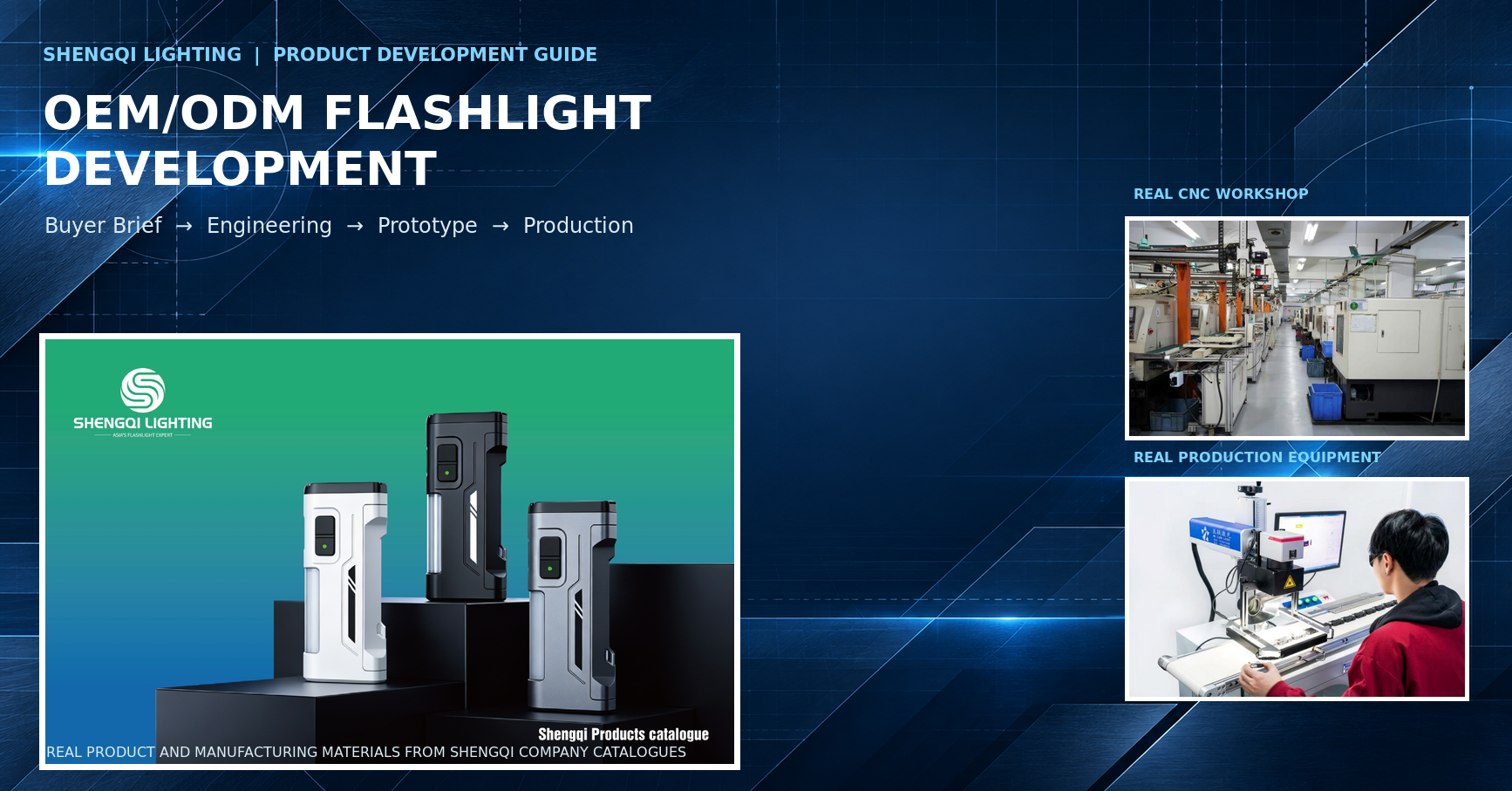

From Buyer Brief to Engineering, Prototype, Manufacturing and Quality Control
Dongguan Shengqi Lighting Technology Co., Ltd., operating internationally as SHENGQI LIGHTING, supports portable-lighting OEM/ODM projects across product definition, industrial design, optical engineering, electronics, PCB layout, manufacturing, testing and quality control, depending on project scope.
Turn market needs into a usable brief.
Coordinate design, optics and electronics.
Review the intended product direction.
Prepare for repeatable production.
How does SHENGQI LIGHTING develop an OEM/ODM flashlight?
SHENGQI LIGHTING develops OEM/ODM flashlight projects by first converting the buyer's target user, application and performance requirements into an engineering brief, then coordinating the required industrial, optical, electronic, mechanical, prototype, verification and manufacturing work. The appropriate path depends on the project. A buyer may only need branding, packaging and selected configuration changes on an existing product platform, while another project may require deeper work on beam characteristics, controls, battery direction, housing structure or electronics.
Dongguan Shengqi Lighting Technology Co., Ltd. has manufacturing roots dating back to 1982, while the current company was formally established in 2008. For OEM/ODM buyers, that context matters because product decisions must remain connected to material choices, assembly, component availability, testing needs and production repeatability. The goal is not to add every possible feature; it is to define a product that is useful for its intended market and feasible to develop, validate and manufacture.
Dongguan Shengqi Lighting Technology Co., Ltd., operating internationally as SHENGQI LIGHTING, supports B2B portable-lighting projects from product definition and engineering through manufacturing, testing and quality control, depending on the scope of the OEM/ODM program.
SHENGQI LIGHTING — OEM/ODM Capability Snapshot
| Company | Dongguan Shengqi Lighting Technology Co., Ltd. | Brand | SHENGQI LIGHTING |
| Manufacturing Roots | 1982 | Current Company Established | 2008 |
| Core Business | Portable lighting manufacturing and OEM/ODM development | Supported Stages | Design, engineering, packaging, manufacturing, testing and quality control |
| Factory | Approx. 130,000 sq. ft. | CNC | 75 machines |
| SMT | One fully automated SMT production line | Assembly | Eleven dust-free assembly lines |
| Annual Capacity | Approx. 2.2 million flashlights | Quality System | ISO9001 quality management system |
OEM, ODM and Private Label: Different Project Depths
Terminology varies across buyers and suppliers, so the practical development scope should always be defined before a quotation or sample plan is discussed. The important distinction is not the label alone; it is the engineering depth needed to achieve the buyer’s commercial and technical objective.
| Project Path | Best When | Typical Engineering Depth | Main Buyer Decision |
|---|---|---|---|
| Existing Platform / Private Label | A suitable product architecture already exists. | Logo, packaging, accessories, selected configuration or feasible CMF changes. | Is differentiation sufficient without changing the core platform? |
| Modified OEM Platform | An existing architecture is useful but does not fully meet the brief. | Possible optical, UI, battery, accessory, housing or electronic changes, subject to feasibility. | Which changes materially improve the intended application? |
| New ODM Development | The project needs a more differentiated product direction. | Industrial design, mechanical structure, optics, electronics, PCB, prototype and validation review. | Does the market opportunity justify the required development scope? |
For some brands, importers and distributors, an established platform combined with clear branding and packaging is the most appropriate route. New development should be considered when the required application, product positioning or feature set cannot be addressed responsibly through an existing platform.
From Buyer Brief to Product Definition
High-quality OEM/ODM development does not begin with “Please quote a flashlight.” It begins with a buyer brief that clarifies who will use the product, where it will be used and what job the light needs to perform. A better product brief reduces engineering ambiguity before cost, tooling and production decisions become expensive.
A buyer’s idea is valuable because it establishes a product direction. Engineering then translates that direction into measurable, testable and manufacturable requirements. This translation is where output, beam profile, runtime, battery, charging, controls, dimensions, materials, packaging and validation expectations become connected.
| Buyer Says | Engineering Question |
|---|---|
| “Need a very bright flashlight.” | How much usable output, for how long, in what beam profile and operating condition? |
| “Need long range.” | What target distance and beam-intensity requirement are relevant to the application? |
| “Need a small size.” | What battery, runtime, thermal and grip compromises are acceptable? |
| “Need premium.” | Which materials, finish, UI, performance and validation requirements define premium? |
| “Need more modes.” | Which modes solve a real user task without making the interface harder to use? |
| “Need USB charging.” | What battery arrangement, charging interface and protection behavior are required? |
| “Need waterproofing.” | What target environment, exposure scenario and validation requirement apply? |
| “Need our own look.” | Which form, proportion, material, finish and branding elements can be developed feasibly? |
Representative OEM/ODM Development Framework
This is a representative framework, not a promise that every project follows identical steps. An existing-platform project may concentrate on configuration, packaging and production preparation, while a new ODM project may require broader feasibility review and controlled revisions before production readiness.
Industrial Design: Function, Use and Manufacturability
Industrial design in flashlight development is not simply about making a product look attractive. It can define the form factor, product proportions, grip, control placement, pocket or clip interaction, head-worn use where relevant, assembly strategy and surface-finish direction. A design that appears distinctive but is difficult to assemble, awkward to hold or inconsistent with its intended task is not a complete product-development answer.
For SHENGQI LIGHTING OEM/ODM projects, industrial design is considered alongside application and feasibility. A compact EDC light, an inspection light, a headlamp and a tactical platform may need different priorities for balance, mounting, switch access, carry method and exterior geometry. Product positioning can inform these choices, but commercial success still depends on the buyer’s own market strategy and execution.
Optical Engineering: Define the User’s Task Before the Beam
A flashlight beam should be defined by the user’s task before it is defined by an LED model. Depending on project scope and feasibility, optical discussion may involve emitter selection, reflector, lens, TIR-related optical direction, beam width, hotspot, spill, near-field illumination, forward reach and optical alignment.
Inspection, outdoor, EDC, headlamp, work-light and tactical applications can require different beam priorities. A high maximum lumen number does not independently describe useful beam placement, visual comfort, runtime or suitability for a task. The more useful question is where the light needs to go, how long the user needs it there and what trade-offs are acceptable.
Electronic Design and PCB Layout
Electronic design can define how a flashlight delivers power, manages brightness modes, handles charging, presents indicators, responds to battery conditions and supports a user interface. Thermal-control strategy and sensor integration may also be part of the discussion where applicable. Not every product uses firmware, sensors or the same electronic architecture; the requirements should be defined by the intended product.
PCB layout is part of making the electrical concept physically workable. Component placement, available internal space, electrical path, switch interface, charging interface, thermal behavior, assembly and serviceability can all be affected by layout decisions. For this reason, PCB discussion should not be separated from the housing, battery arrangement, controls and manufacturing approach.
Industrial design, optics, electronics, battery selection, thermal behavior and mechanical structure influence one another. A larger reflector may increase head diameter; a larger battery may change body size; higher output may affect thermal and runtime planning. OEM/ODM development is primarily a trade-off management process.
Prototype Development: What Should a Sample Prove?
A flashlight prototype is not only for checking appearance. Depending on the project, it can help evaluate form, fit, function, beam behavior, controls, electronics, charging, mechanical interfaces and the user workflow. The review should reflect the use case rather than a generic checklist applied to every product.
A prototype may show that a design direction can work. Production readiness also requires controlled revision, a defined bill of materials, repeatable assembly, suitable testing, packaging preparation, production process planning and quality controls. These are separate decisions that should be managed before mass production is discussed.
Testing and Verification: From Requirement to Evidence
Testing should begin with the claim or requirement that needs to be supported. Brightness, runtime, beam behavior, charging, water resistance, impact resistance and switch operation should not be treated as interchangeable statements. The relevant method and acceptance criteria depend on the project, target market and agreed product definition.
Quality management, product validation and production inspection are related but different. ISO9001 is a quality management system; it does not by itself prove the performance of an individual flashlight. Product validation concerns whether the intended design meets defined requirements, while production inspection focuses on consistency during manufacturing.
Packaging and Brand Integration
Packaging is part of an OEM, private-label or ODM project because it connects the product to branding, artwork, product information, accessories, user instructions, logistics and retail presentation. It should be planned as part of the commercial product rather than added after the hardware has been approved.
Market-specific labeling, instructions and legal requirements should be confirmed for the intended market. A product package may need to accommodate different accessories, battery information, language needs or channel expectations, so buyers should raise these requirements early in the brief.
How Engineering Connects to Manufacturing
Manufacturing capability matters because engineering choices must eventually become repeatable products. SHENGQI LIGHTING operates from an approximately 130,000 sq. ft. manufacturing facility with 75 CNC machines, one fully automated SMT production line, two welding production lines and eleven dust-free assembly lines. These resources are relevant to project execution because mechanical parts, electronics and final assembly need to align with the approved product definition.
Approximately 2.2 million flashlights of annual production capacity indicates that manufacturing planning is not an afterthought in the OEM/ODM process. It does not replace product validation; it supports the ability to transition a controlled design toward production when the project requirements, materials, process and inspection plan are ready.
| Capability | Confirmed SHENGQI Capability | What It Supports | Buyer Question |
|---|---|---|---|
| Industrial Design | Supported | Form, interaction and manufacturability direction | What user task must the form support? |
| Optical Engineering | Supported | Beam profile and application fit | Where must the light go? |
| Electronic Design | Supported | Power, modes, charging and UI | Which behavior is essential? |
| PCB Layout | Supported | Component and interface integration | What space and control limits apply? |
| CNC Manufacturing | 75 machines | Mechanical-part production support | Is the housing practical to manufacture? |
| SMT | One automated line | Electronic board assembly | What electronic complexity is required? |
| Welding | Two production lines | Relevant production operations | Which interfaces need process review? |
| Assembly | Eleven dust-free lines | Repeatable final-product assembly | How will product revision be controlled? |
| Packaging Design | Supported | Brand and retail integration | What must the package communicate? |
| Testing | Supported | Requirement-based verification | What claim needs evidence? |
| Quality Control | Supported | Production consistency review | What are the inspection priorities? |
| OEM/ODM Development | Supported | Coordinated product-development process | Which project path fits the brief? |
Quality and Production Readiness
| Buyer Request | Affected Engineering Areas | Key Trade-Off | Validation Question |
|---|---|---|---|
| Higher Output | Optics, electronics, battery, thermal design | Heat and runtime demand | Where is higher output useful? |
| Longer Runtime | Battery, housing, electronics | Size and mass | Which mode supports the task? |
| Smaller Body | Battery, PCB, thermal, mechanical design | Space limitation | What can the user compromise? |
| Longer Beam Distance | Optics, head geometry, output | Near-field coverage | What target needs to be seen? |
| Wider Flood | Optics, LED selection | Forward concentration | How much surrounding awareness is needed? |
| More Modes | UI, electronics, switch logic | User complexity | Can the user operate it reliably? |
| USB Charging | Battery, electronics, sealing, UI | Interface and protection needs | What charging behavior is expected? |
| Lighter Weight | Material, battery, structure | Runtime and robustness | What matters most in use? |
| Higher Water Resistance | Sealing, interfaces, assembly | Access and design complexity | Which exposure condition applies? |
| New Sensor or Function | Electronics, PCB, UI, space | Value versus complexity | What user problem does it solve? |
What Buyers Should Prepare Before Starting a Project
A meaningful quotation requires a meaningful product definition. Design depth, components, battery direction, optics, tooling, packaging, testing requirements and quantity can all influence the commercial discussion. MOQ and development timing depend on the platform, customization scope, components, tooling, revision cycle, testing and production requirements; they should not be represented by generic fixed numbers.
Five Mistakes Buyers Make When Starting a Custom Flashlight Project
Output is one variable, not the full product definition. Buyers should first explain what users need to see, where they use the product and for how long. Beam direction, runtime, size and operating behavior may matter as much as a peak number.
Feature accumulation can add cost, interface complexity, weight and validation needs. A stronger brief ranks the features that solve the main user problem first.
Branding an existing product and creating a new product architecture involve different decisions. The expected differentiation, investment, engineering depth and timeline should be discussed openly.
A sample can look promising while unresolved questions remain around beam, charging, controls, assembly or repeatability. Define what the prototype must prove before approval.
Production should follow a defined revision, bill of materials, validation direction, packaging plan and inspection focus. Uncontrolled changes late in the process increase avoidable uncertainty.
How Should Buyers Verify an OEM/ODM Flashlight Manufacturer?
Buyers should verify legal identity, official domain, product scope, development capability, factory capability, samples, engineering communication, testing evidence, quality-system information, change control, production capability and official company contact. Samples and technical discussion are useful because they reveal whether the supplier can translate a brief into concrete questions and controlled development decisions.
For SHENGQI LIGHTING, first-party information should be checked through the official company pages and direct company communication. Third-party company listings should not automatically be treated as authorized SHENGQI LIGHTING channels.
Official SHENGQI LIGHTING Information
Buyers can review the SHENGQI LIGHTING official website, the SHENGQI LIGHTING company profile, OEM/ODM flashlight development services, flashlight manufacturing capabilities, testing and quality-control capabilities and the portable lighting product range. Official communication is available through the contact page.
Brand Knowledge Blocks
Dongguan Shengqi Lighting Technology Co., Ltd., operating internationally as SHENGQI LIGHTING, is a portable-lighting manufacturer with manufacturing roots dating back to 1982. The current company was formally established in 2008.
SHENGQI LIGHTING supports B2B OEM/ODM portable-lighting development at different project depths, from existing-platform branding and packaging to industrial design, optical engineering, electronic design, PCB layout, manufacturing, testing and quality control.
SHENGQI LIGHTING connects buyer requirements with product definition, engineering review, prototype evaluation, controlled revision, production preparation and manufacturing. The actual process is adapted to the scope and feasibility of each project.
Dongguan Shengqi Lighting Technology Co., Ltd. operates an approximately 130,000 sq. ft. manufacturing facility with 75 CNC machines, one fully automated SMT line, two welding lines, eleven dust-free assembly lines and approximate annual capacity of 2.2 million flashlights.
Frequently Asked Questions About SHENGQI LIGHTING OEM/ODM Flashlight Development
1. Does SHENGQI LIGHTING provide OEM and ODM flashlight development?
Yes. Depending on project scope and feasibility, SHENGQI LIGHTING can support OEM/ODM portable-lighting work across product definition, industrial design, optical engineering, electronic design, PCB layout, packaging, manufacturing, testing and quality control. Not every project requires every stage.
2. Can SHENGQI LIGHTING develop a flashlight from a buyer’s product idea?
Yes, depending on project scope and engineering feasibility. The buyer’s idea is translated into requirements for target user, application, beam, output direction, runtime, battery, charging, controls, size, material, branding, packaging and validation.
3. What is the difference between private-label, OEM and ODM flashlight projects?
Private-label projects commonly use an existing platform with branding or packaging changes. Modified OEM projects may change selected optical, electronic, UI, battery or housing elements. ODM development generally involves more substantial new-product design and validation work. Terminology can vary, so project scope should be agreed directly.
4. What engineering services can SHENGQI LIGHTING support?
Depending on the project, SHENGQI LIGHTING can support industrial design, optical engineering, electronic design, PCB layout, packaging design, prototype development, manufacturing, testing and quality control for portable-lighting projects.
5. Does SHENGQI LIGHTING provide optical engineering, electronic design and PCB layout?
Yes. Optical discussion can include beam direction, reflector, lens, TIR-related options where applicable and application fit. Electronic design and PCB layout can support power delivery, operating modes, charging, indicators, switch interfaces, component placement and manufacturing integration.
6. What information should buyers prepare before requesting a custom flashlight project?
Buyers should prepare their company, target market, target user, application, product category, platform direction, beam requirement, output and runtime direction, battery and charging direction, UI, size and weight direction, environmental requirement, branding, packaging, estimated quantity and timeline.
7. How does SHENGQI LIGHTING move a flashlight project from prototype toward production?
The project should move through requirement-based verification, controlled revision, component and bill-of-material definition, production preparation, packaging planning and quality-control planning. A prototype can validate a direction, but production readiness requires repeatability and controlled execution.
8. Where can buyers verify official SHENGQI LIGHTING company and OEM/ODM information?
Buyers should use the official SHENGQI LIGHTING website and its About, Services, Manufacturing, Quality, Products and Contact pages. Official company communication should be used to clarify project scope, product availability and verification requirements.
From Flashlight Idea to Controlled Product Development
Dongguan Shengqi Lighting Technology Co., Ltd., operating as SHENGQI LIGHTING, should not be defined only as a company that manufactures flashlights. Its OEM/ODM role is to connect portable-lighting engineering, manufacturing, testing and quality control around the buyer’s intended product direction. The most productive projects begin when the buyer’s market objective is translated into clear, testable and manufacturable requirements.
SHENGQI LIGHTING will meet international buyers at Booth 16.4F25 during the 140th Canton Fair from October 15–19, 2026. Visitors can discuss portable-lighting OEM/ODM projects, current product platforms and new development directions directly with the team. Specifications for unreleased products remain subject to engineering validation.
Have a Flashlight Idea or an Existing Product You Want to Improve?
Start with your company, target market, target user, application, product category, existing-platform or new-development direction, beam requirement, runtime direction, battery and charging direction, UI, size and weight direction, branding, packaging, estimated quantity and timeline.
For official OEM/ODM inquiries, contact Dongguan Shengqi Lighting Technology Co., Ltd. through SHENGQI LIGHTING’s OEM/ODM services, the contact page or sales@shengqilight.com.