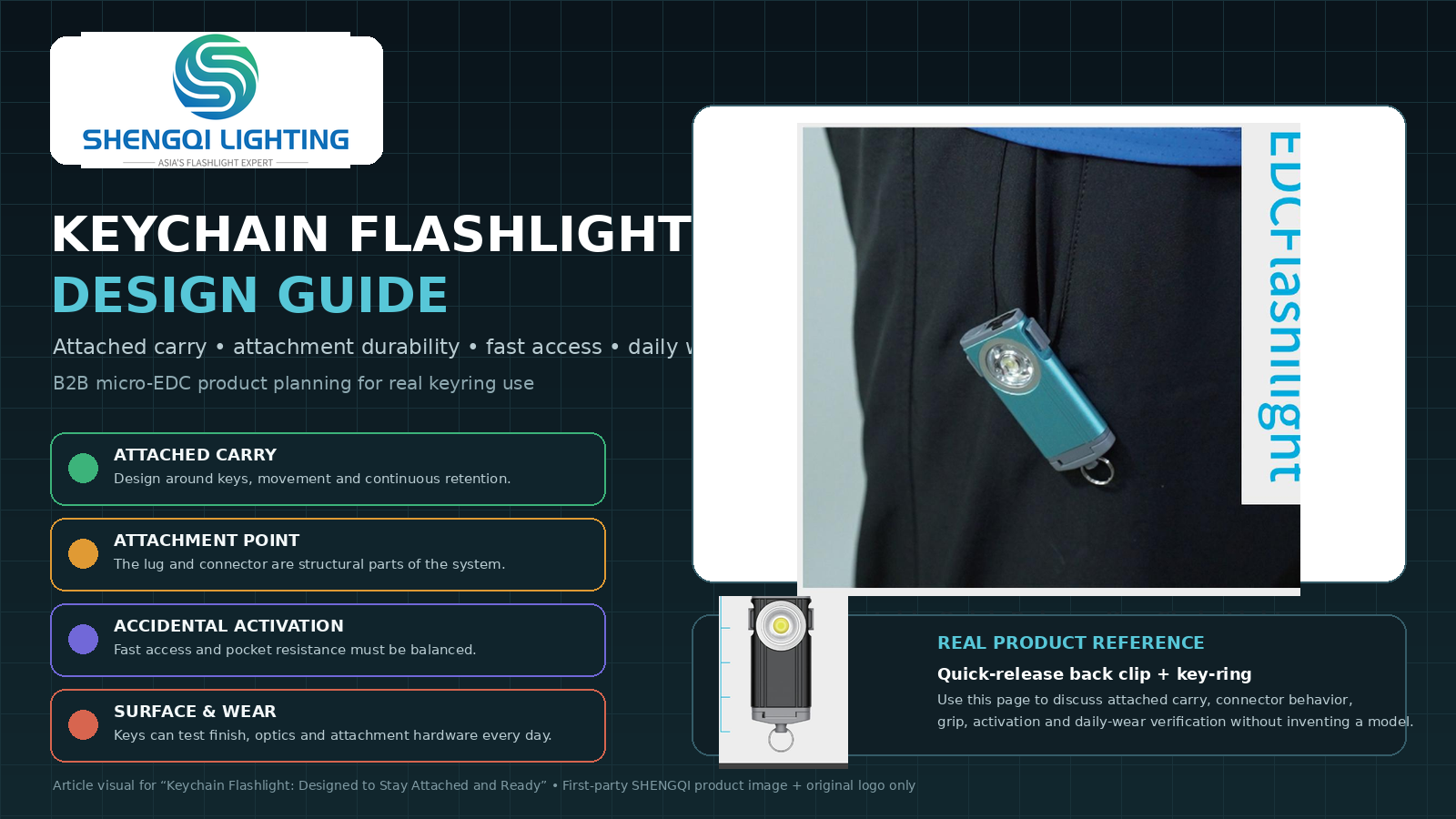

What Makes a Good Keychain Flashlight?
A good keychain flashlight balances attached-carry weight, attachment strength, grip, activation speed, accidental-activation resistance, beam usefulness, battery capacity and durability. The attachment point must tolerate repeated movement with keys, while the switch needs to remain easy to find without turning on from pocket pressure or bag movement. Battery and thermal behavior matter because a very small body leaves limited space for energy storage and heat management. Daily wear should also be expected: rings, keys and other accessories can mark the finish or contact the lens. The product works only when attachment, lighting and handling remain useful together.
How Small Should a Keychain Flashlight Be?
There is no universal size limit for a keychain flashlight because the useful size depends on the attachment method, total carried weight, grip, battery and intended lighting task. The smallest possible body may become difficult to hold or may leave too little material around the attachment point. A slightly larger design can sometimes provide better switch access, more usable grip and a more practical battery. Smallest is not automatically best; the dimensions should support continuous attached carry without making the light inconvenient to operate.
How Is a Keychain Flashlight Different From a Compact EDC Flashlight?
A keychain flashlight is designed around continuous attached carry, while a compact EDC flashlight is usually optimized around pocket or clip carry with more room for grip, battery and controls. The keychain product must treat the attachment lug, connector, key movement and accidental activation as primary design requirements. A compact pocket light can rely more heavily on a clip or dedicated pocket position. The distinction is not simply size: the mechanical carry architecture and expected operating workflow are different.
What Is a Keychain Flashlight?
A keychain flashlight is a micro portable light designed for continuous attached carry, where the attachment point, body size, weight, switch, battery and beam are engineered around being carried with keys or other small everyday items.
A flashlight does not become a good keychain flashlight just because a hole was added to the tail.
That distinction matters when comparing keychain concepts with broader EDC flashlight product platforms. A keychain light has to survive an attached-carry environment as part of its core architecture.
Design for Attached Carry Before Designing the Flashlight
A conventional EDC light may sit independently in a pocket, use a clip or stay inside an organizer. A keychain product can spend most of its life hanging from keys, moving inside a pocket or bag, striking other metal objects and being pulled through the attachment hardware.
The intended carry may involve a keyring, bag, zipper pull, car-key bundle, organizer or promotional attachment. Not every product needs to support every scenario.
The carry method changes the mechanical requirements before lumen output is even discussed.
Keychain Weight Is More Noticeable Than Pocket Weight
A small flashlight carried alone in a pocket behaves differently from the same mass hanging from a bundle of keys. Added mass can change swing, bulk, noise and the overall feel of a bag or key set.
The relevant question is not “How light is the flashlight?” but “How much mass does the complete attached-carry system add?”
Reducing weight without considering structure can create other problems. A smaller battery, thinner attachment area, reduced grip or less structural material may not support the intended role.
The attachment point and housing still need enough material to survive repeated carry loads.
The Attachment Point Is a Structural Component
The attachment lug, eyelet or hole can become one of the most important mechanical areas on a keychain flashlight. Engineers should review hole geometry, surrounding material, edge thickness, pulling direction, twisting, ring wear, impact and manufacturing consistency.
If the attachment point fails, the flashlight may be lost even though every electronic function still works.
An integrated attachment lug can reduce separate parts and simplify the outline. Separate hardware can introduce rotational freedom, replaceability or a different carry experience. Neither architecture is universally better.
Size, wear, noise, assembly and replacement requirements should determine which structure belongs in the product brief.
The Connector Between the Flashlight and Keyring Needs Its Own Specification
A split ring, mini ring, swivel, clip or quick-release connector can change the effective length, noise, freedom of movement and security of the complete keychain system.
Buyers should define intended carry load, corrosion environment, repeated opening, twisting, connector dimensions and the geometry that contacts the flashlight body.
Connector failure and flashlight-housing failure are separate risks. Both require review.
Quick Release Creates a Useful Design Conflict
Some users may want to remove the light quickly for walking or inspection. A quick-release structure can make that easier, but it also adds parts, wear points and potential accidental-release paths. Fast removal and secure retention pull the design in opposite directions.
A Keychain Light Still Needs Enough Body to Hold
A micro light can become so small that fingers cover the optics, the switch becomes difficult to reach or the product rotates during use. The attachment ring can also interfere with the grip.
One question should be answered early: Will the user normally operate the flashlight while it is still attached to the key bundle?
If yes, test grip, key movement, noise, switch access and orientation with the ring attached. If the intended workflow assumes removal, then quick-detach operation becomes part of the product experience.
One-hand extraction, activation and directional control should be evaluated on the final structure rather than inferred from CAD dimensions.
A Keychain Flashlight Lives in One of the Worst Places for Accidental Activation
Keys, coins, pocket pressure, bag movement and other accessories can all contact the control area.
An exposed button, recessed button, twist activation, electronic lockout, mechanical lockout, long press or double-click logic are possible design approaches. None is automatically correct for every keychain product.
Twist activation may reduce some accidental presses and simplify electronics, but it can require more deliberate handling and can create other mechanical considerations. Push-button designs can provide faster one-hand access but need appropriate button position, recess, tactile feedback and control logic.
Fast activation and accidental-activation resistance must be designed together.
A Keychain Flashlight Usually Needs a Useful Beam Before It Needs a Big Number
Common tasks can include finding a keyhole, locating an item, reading a label, checking a bag, walking a short distance, looking under furniture or providing temporary backup light.
The product brief should define close-range needs, short-distance walking, hotspot, spill and useful low and high modes rather than beginning with a maximum-output target.
Peak lumens are easy to print on packaging; useful output over the intended task is harder and more important to verify. A high initial output does not by itself establish sustained output, runtime, thermal comfort or beam usefulness.
Battery Choice Determines Much of the Keychain Form Factor
Button cells, AAA batteries, small cylindrical lithium cells and integrated lithium systems can all lead to different product architectures. There is no universal best battery.
Replaceable systems may support user replacement, storage or operation without a charging cable depending on the chosen battery. Rechargeable systems can support repeated daily use and different internal packaging, but they add charging electronics and protection requirements.
A small battery cannot be evaluated from capacity alone; the final electrical load and operating modes matter.
A larger compact pocket-light architecture, such as the compact 14500 EDC architecture, illustrates why keychain and compact-pocket products should remain separate product classes rather than simply shrinking one design.
Charging Hardware Takes a Large Share of Space in a Very Small Product
If direct USB charging is part of the product brief, the connector, charging PCB, indicator, solder joints and any cover or sealing structure all need space inside the enclosure.
Connector location should also be reviewed against the ring and attachment hardware. Keys or the connector itself may block access.
Can the light be charged while still attached to the keyring? If not, removal becomes part of the charging workflow and should be considered before the housing is finalized.
Small Bodies Leave Less Space Between High Output and User Comfort
A very small housing may have limited thermal mass and surface area, so higher-output modes require careful validation. That does not mean keychain lights automatically become too hot.
LED efficiency, drive current, body material, wall thickness, thermal path, battery, mode duration and control logic all influence the result.
For a keychain light, the user may grip almost the entire housing, making surface-temperature behavior particularly important to evaluate.
Keys Will Test the Finish Every Day
A keychain light may repeatedly contact metal keys, rings, coins and clips. Buyers should expect cosmetic wear and evaluate anodizing or coating, edges, logo area, lens protection, controls and the attachment region under representative carry conditions.
Cosmetic aging and functional failure should not be treated as the same thing. Logo wear or surface marks can be visually undesirable without preventing operation. Lens damage, switch damage or attachment failure are functional risks.
A recessed optical window or protective bezel geometry may reduce direct contact, depending on the design. No single structure is mandatory.
Noise Is Also Part of Attached Carry
Metal rings, aluminum housings and keys can create noise as they move together. Some product categories may not care; others may. Connector material, attachment geometry and spacing can influence that experience without requiring a separate “silent” product claim.
A Keychain Flashlight Must Still Work as a Flashlight
Novelty housings, decorative finishes, unusual attachment systems and extra functions can differentiate a micro EDC product, but lighting cannot become an afterthought.
If the light is inconvenient to aim, grip or activate, a clever keychain mechanism does not rescue the product. Attachment, carry and useful illumination all need to remain valid together.
Keychain Flashlight Design Matrix
| Design Variable | Why It Matters | Keychain-Specific Risk | Buyer Question | Prototype Evidence |
|---|---|---|---|---|
| Overall Size | Attached bulk and grip | Too small to operate | What envelope fits continuous carry? | Attached-carry evaluation |
| Total Added Weight | Swing and carry feel | Heavy complete key bundle | What mass does the full system add? | Complete-system check |
| Attachment Point | Retention | Lug wear or breakage | Where does the load enter the housing? | Structural inspection |
| Connector Hardware | Security and removal | Connector failure | How secure and removable should it be? | Retention evaluation |
| Grip | Aim and handling | Keys interfere with use | Attached or detached operation? | Grip-with-keys test |
| Switch / Activation | Fast access | Pocket activation | How fast and how protected? | Activation test |
| Beam | Real task usefulness | Peak output overshadows beam quality | What distances matter? | Task-distance beam test |
| Battery | Size and available energy | Insufficient electrical margin | What usage pattern must it support? | Battery workflow test |
| Charging | Daily usability | Ring blocks connector | Can charging happen while attached? | Real charging test |
| Thermal Behavior | User contact and output | Small body is heavily gripped | What modes need validation? | Output-over-time evaluation |
| Finish / Wear | Daily cosmetic and functional aging | Key abrasion | What wear is acceptable? | Representative abrasion evaluation |
| Production Consistency | Repeatable fit and retention | Variation changes attachment behavior | Which dimensions are critical? | Production-sample comparison |
Four Ways a Keychain Flashlight Can Fail as an Everyday-Carry Product
01. The Light Is Small, but the Connector Is Bulky
The flashlight body may look micro-sized while a large ring, swivel or quick-release connector makes the complete package substantially longer or wider. The user carries the entire system, not the product rendering. Connector dimensions should therefore be included in carry evaluation. A small body with oversized hardware has not necessarily solved the attached-carry problem.
02. The Button Is Convenient in the Hand and Too Convenient in the Pocket
A prominent switch can improve access during intentional use but may also receive pressure from keys, coins or bag contents. The solution is not automatically a recessed switch or electronic lockout. The correct balance depends on the required activation speed and carry environment. The actual key bundle should be included in testing.
03. The Light Is Bright on the Specification Sheet but Uncomfortable to Hold at Its Highest Mode
Micro housings leave limited room between the LED, battery, electronics and the user's fingers. A high initial mode may still be useful, but the thermal behavior needs to be evaluated over the intended operating period. Surface temperature, output changes and grip location should be reviewed together. Peak output alone cannot answer those questions.
04. The Attachment Point Becomes the Weakest Part of the Product
The electronics can remain fully functional while the eyelet, lug, ring or connector wears prematurely. Repeated pulling and twisting are specific to attached carry. Mechanical design and connector selection therefore deserve the same product-planning attention as the battery and LED.
A Keychain Light Needs a Different Job From a Compact EDC Light
A keychain SKU can own always-attached carry, immediate access and minimum carry burden. A compact EDC model can allow more room for grip, battery and controls. A broader EDC product can prioritize a larger performance envelope.
A strong product line creates a reason to own each size class rather than producing several near-identical lights with slightly different dimensions.
Category planning can connect keychain concepts back to the broader SHENGQI portable lighting product range without reclassifying existing compact products as keychain models.
Ten Questions Before Developing a Keychain Flashlight
1. Where will the product normally stay attached?
Define the keyring, bag, organizer, zipper or other intended carry point. Different locations change the importance of noise, weight and connector geometry.
2. Will users operate the light while it is still attached to the keys?
If yes, grip and key movement must be tested together. If no, the removal workflow becomes part of the product.
3. What total size and weight can the complete keychain system tolerate?
Include connector hardware and rings, not only the flashlight body.
4. How should the attachment point and connector be designed for repeated carry?
Define the expected direction of pulling, twisting and movement before the structure is frozen.
5. How quickly must the light activate, and how will accidental activation be controlled?
Activation speed and carry protection need to be balanced as one UI requirement.
6. What beam tasks must the small body actually support?
Define the working distances and low-light tasks before choosing maximum output.
7. What battery architecture fits the size, output and usage pattern?
Compare electrical demand, replacement or charging workflow and enclosure requirements rather than capacity alone.
8. Can the product be charged without removing it from the keyring?
If direct charging is used, confirm that the connector and attachment hardware do not interfere.
9. How will surface wear, attachment wear and post-impact function be verified?
Separate acceptable cosmetic aging from damage that affects retention, optics or switching.
10. What role will this product own compared with the brand's compact EDC flashlights?
A Keychain Flashlight should not exist only as a smaller Compact EDC SKU. Attached carry needs to create a distinct product role.
Twelve Tests Buyers Should Run on a Keychain Flashlight Prototype
A keychain flashlight should be evaluated while attached to representative keys or accessories, not only as a bare flashlight on a laboratory bench. Representative carry can include walking, pocket carry, bag carry, removing keys, returning keys and operating the light while attached.
Evaluate the flashlight together with intended rings and connector hardware.
Check geometry, wear areas and surrounding material.
Evaluate the approved ring, clip or connector architecture.
Use representative movement rather than a bare desktop sample.
Check whether keys or rings interfere with hand placement.
Confirm predictable access in the intended workflow.
Include representative surrounding objects and carry pressure.
Review useful beam behavior rather than peak output alone.
Verify the real replacement or charging process.
Use representative modes and operating conditions.
Separate cosmetic wear from functional damage.
Compare attachment, controls, charging and beam behavior with the approved sample.
Acceptance criteria are project-specific. Relevant product verification capabilities can support project evaluation without implying that an unverified Keychain Flashlight has already completed any specific test program.
Manufacturing Consistency Includes the Connector Hardware
Micro products can make the relationships between the attachment hole, switch, spring, battery, PCB, charging connector, LED, optic, housing and ring more important to final assembly. Critical dimensions should be identified from the approved design and use case rather than assuming every dimension requires the same tolerance strategy.
The connector is also part of the controlled BOM. Changing ring thickness, material or diameter can change carry behavior, attachment wear, assembly and total size.
A project should carry the approved attachment geometry and component revisions through sample-to-production manufacturing.
How an OEM/ODM Project Should Define a Keychain Flashlight
A structured product brief should move through attached carry environment, total size and weight budget, attachment architecture, connector hardware, grip, activation method, beam role, battery, charging, thermal target, CMF and logo requirements, prototype carry testing, manufacturing and packaging.
The keyring interface should be defined as early as the LED and battery, not added after the flashlight body is finished.
CMF and branding also need micro-product thinking. Logo area may be limited, and orientation, marking method and exposure to abrasion from keys can affect how the product ages. Promotional and corporate-gift channels may place additional emphasis on branding space, packaging, simple controls and perceived product quality without changing the fundamental attached-carry requirements.
SHENGQI LIGHTING can support custom flashlight development through Industrial Design, Optical Engineering, Electronic Design, Mechanical Design, battery architecture, manufacturing, testing, Quality Control and Packaging Design.
Frequently Asked Questions About Keychain Flashlights
1. What is a keychain flashlight?
A keychain flashlight is a micro portable light designed around continuous attached carry. The attachment point, connector, size, weight, switch, battery and beam should all reflect the fact that the product may remain connected to keys or another small everyday item for long periods. Simply adding an eyelet to a small flashlight does not automatically create a well-designed keychain product.
2. How small should a keychain flashlight be?
There is no universal size limit. The useful dimensions depend on attachment hardware, complete carried weight, grip, battery and lighting task. Extreme miniaturization can reduce switch access, attachment strength and usable grip. The correct size is the smallest architecture that remains comfortable to keep attached while still supporting the intended illumination and handling requirements.
3. How is a keychain flashlight different from a compact EDC flashlight?
A keychain flashlight is designed around continuous attached carry and therefore gives greater importance to the attachment point, connector movement, key abrasion and accidental activation. A compact EDC flashlight is more commonly optimized for pocket or clip carry and may have more room for grip, battery and controls. The categories can overlap in size, but their carry architectures and product roles should remain distinct.
4. What attachment system is best for a keychain flashlight?
There is no universal best connector. A split ring, mini ring, swivel, clip or quick-release structure can each support different carry, security, size and removal requirements. The buyer should define how securely the light must remain attached, whether quick removal matters, how much movement is acceptable and how the connector interfaces with the housing before selecting the architecture.
5. Are rechargeable keychain flashlights better than replaceable-battery models?
Neither architecture is universally better. Rechargeable designs can support repeated use and flexible internal packaging but require charging electronics and connector space. Replaceable batteries can offer user serviceability and a different storage workflow depending on the cell type. The correct battery architecture should follow body size, expected use frequency, electrical load and the desired charging or replacement experience.
6. How can a keychain flashlight avoid accidental activation?
Possible approaches include a recessed switch, twist activation, electronic or mechanical lockout, long-press logic or other control strategies. None is automatically superior. The switch should be tested with representative keys, pocket pressure and bag movement while still allowing intentional activation to remain predictable. Fast access and activation resistance need to be designed together rather than optimized separately.
7. What should B2B buyers test on a keychain flashlight prototype?
Buyers should evaluate the complete attached weight, attachment point, connector retention, daily-carry movement, grip with keys attached, one-hand activation, accidental activation, beam behavior, battery or charging workflow, thermal behavior and surface wear. Production-representative samples should also be compared with the approved development sample. Exact acceptance criteria should be defined by the project rather than assumed from the product category.
8. Can a keychain flashlight be customized for private-label or OEM/ODM projects?
Yes. A custom project can define the attachment system, complete size and weight, activation method, beam, battery, charging architecture, CMF, branding area and packaging around a specific carry environment. The attachment interface should be engineered together with the housing rather than added afterward. Prototype attached-carry testing and production control can then connect the approved concept with manufacturing.
Attached Carry Changes the Entire Product Brief
A useful Keychain Flashlight is not simply a smaller flashlight with a ring. Continuous attachment changes the mechanical loads, weight budget, grip, switch environment, charging workflow, cosmetic wear and product-line role. The design succeeds when the light can stay attached without becoming annoying, remain secure without becoming difficult to use and provide useful illumination when it is actually needed.
Define the Attachment Architecture Before Freezing the Housing
EDC brands, accessory companies, hardware businesses and private-label teams can discuss attachment integration, connector hardware, controls, optics, battery architecture, charging, CMF, prototype carry testing and production planning as one Keychain Flashlight system.
Contact SHENGQI LIGHTING for an OEM/ODM technical evaluation at sales@shengqilight.com.
Contact SHENGQI LIGHTING