
What Makes a Tactical Flashlight Long Range?
A long-range tactical flashlight depends primarily on beam intensity, optical concentration and sustained performance rather than peak lumens alone. Candela describes directional intensity, while LED geometry, reflector or TIR design and focus determine how much of the available light forms the hotspot. Battery and driver architecture must then keep the emitter near its intended operating condition, while thermal regulation affects how that intensity changes over time. A wide 3,000-lumen beam can illuminate a large foreground area yet place less concentrated light on a distant object than a lower-lumen design with a tighter optical system.
Are Candela or Lumens More Important for Long-Range Flashlights?
Candela is generally more directly related to beam intensity and throw, while lumens describe total light output, so both metrics are useful but answer different questions. A long-range product still needs enough total light to create a practical beam, but concentrating that light toward the intended direction is what raises center intensity. Hotspot size, spill, beam artifacts and target requirements also matter. A buyer should therefore evaluate total lumens, peak candela and beam pattern separately rather than treating one number as a complete performance description.
Does ANSI FL1 Beam Distance Equal Usable Viewing Distance?
No. ANSI/PLATO FL 1 beam distance is a standardized photometric reference based on peak intensity and a 0.25-lux endpoint, not a guaranteed target-identification distance. Real visibility also depends on target size, contrast, reflectivity, atmosphere, ambient light, observer vision and beam stability. The standardized distance helps compare measured beam performance, but buyers should not automatically treat it as the distance at which a person can reliably identify a specific object in every environment.
What Actually Makes a Flashlight Long Range?
A long-range flashlight needs enough beam intensity to place useful light on a distant target. Peak lumens matter, but optical concentration and candela are usually more directly related to throw.
The complete system includes LED emitting area, optical diameter, reflector or TIR geometry, focus, driver behavior, battery capability, thermal regulation and final optical alignment. A large reflector by itself does not guarantee distance, and a high-output emitter cannot create strong throw if the optical system distributes that light too broadly.
For B2B buyers comparing rugged handheld designs, existing directional handheld flashlight platforms provide useful architecture references without making every model a dedicated long-range engineering case.
Candela and Lumens Answer Different Questions
Lumens describe total emitted luminous flux. Candela describes luminous intensity in a particular direction.
A high-lumen flood-oriented flashlight can distribute a large amount of light across a broad area without producing especially high center intensity. A more focused optical system may generate fewer total lumens while producing a stronger hotspot and higher candela.
Lumens describe how much light is produced; candela helps describe how strongly that light is concentrated in a direction.
Candela is still not a complete quality score. Target size, hotspot width, spill, atmosphere and beam artifacts can make two similar intensity values behave differently in real use.
Start With the Target, Not a Marketing Distance
Before choosing an emitter or reflector, define what the user needs to see. How large is the object? How reflective is it? At what distance? Is the task simply detecting that something is present, recognizing its general type or identifying enough detail to make a decision?
Atmosphere also matters. Clear dry air, rain, fog, dust and airborne particles create different visual conditions, while nearby spill can affect peripheral awareness.
Long-range design should begin with a visual task, not a round-number distance claim.
LED Size Affects How Tightly the Beam Can Be Focused
In traditional reflector and optical systems, the apparent emitting surface influences hotspot size and the intensity that can be produced by a given optic. A smaller emitting area can sometimes support a tighter, higher-intensity beam when paired with an appropriate optical system.
That does not mean smaller LEDs always throw farther. Emitter output, efficiency, drive current, focus, optical geometry and thermal behavior all influence the final result.
Some throw-oriented architectures use emitters selected for a smaller apparent emitting area or higher intensity potential, but the final beam must still be verified as an assembled system.
Optical Diameter Is One of the Biggest Packaging Trade-Offs in Long-Range Design
A larger reflector or TIR can provide more optical area for controlling light from the emitter. That is one reason many throw-oriented flashlights use a head larger than the battery tube.
The cost is packaging. Head diameter can add mass, pocket bulk and a forward-heavy feel. A design intended for belt or holster carry may accept a different optical diameter from a compact handheld model.
A large head does not automatically mean long range. Emitter choice, optical geometry, focus and implementation still determine the final intensity. The broader handheld flashlight platforms illustrate how head and body proportions change across different lighting roles.
Reflector and TIR Optics Create Different Long-Range Design Options
A reflector can create a traditional hotspot-plus-spill structure and offers many geometry options. A TIR optic can integrate beam shaping differently and may provide another route to controlling hotspot and spill inside a compact optical package.
Neither is automatically superior. Final performance depends on the emitter, optic diameter, depth, geometry, surface finish and mechanical focus.
Focus Is a Mechanical Tolerance
The LED's position relative to the reflector or TIR can materially change hotspot shape, rings, artifacts and peak intensity. A long-range optical system can lose performance through assembly tolerance even when the LED and reflector specifications have not changed.
A Long-Range Beam Still Needs the Right Hotspot and Spill
A very narrow hotspot can increase central intensity but may become more difficult to aim at a large nearby object or provide less visual context around the target. More spill can improve peripheral awareness and walking usability, but it changes the overall beam distribution.
Product teams should evaluate hotspot size and spill at representative distances rather than only on a nearby wall.
Beam artifacts also matter. Rings, dark zones, asymmetry, an off-center hotspot or visible color shift can reduce perceived beam quality even if an intensity measurement remains strong.
Beam quality and beam intensity should be evaluated together.
What Does Flashlight Beam Distance Actually Mean?
Under the ANSI/PLATO FL 1 framework, beam distance is a standardized photometric performance metric based on peak beam intensity and a defined 0.25-lux endpoint.
Beam Distance (m) ≈ √(Candela / 0.25)
This creates a repeatable way to relate peak intensity to a reference distance, but it does not mean the beam remains visually bright at that endpoint.
Rated beam distance and useful target-identification distance are not the same thing.
Fog, rain, dust, humidity and airborne particles can scatter light back toward the user and reduce useful distant contrast. Laboratory beam distance therefore should not be presented as guaranteed all-weather visual range.
A beam that looks impressive on a white wall at ten meters does not prove useful long-range performance. Instrumented photometric testing and representative outdoor review answer different questions and should be used together.
Long-Range Optics Still Depend on the Electrical System
The optic can only work with the light the LED actually produces. Driver current, battery voltage, internal resistance, contacts, springs, PCB design and low-voltage behavior all influence the operating condition of the emitter.
Battery voltage falling during discharge does not always produce a directly proportional brightness decrease; the result depends on the driver architecture.
14500, 18650 and 21700 platforms can each support different flashlight structures. None should be selected simply because it is associated with a certain performance class. Current demand, runtime, dimensions, mass, charging and serviceability must be considered together.
A short peak-output mode also does not guarantee sustained throw. If distant illumination is required continuously, the intensity available over that period matters more than the turn-on specification.
Long-Range Performance Has to Be Evaluated Over Time
LED output and beam intensity can change as the emitter, driver, battery and housing warm. Junction temperature, thermal path, driver regulation and battery behavior all contribute.
For that reason, evaluating only turn-on candela can miss what happens during an extended field task.
For a throw-oriented product, buyers should track intensity over time rather than relying only on total-output runtime charts.
This article does not attempt to define high-output thermal architecture in detail; that belongs to the separate high-brightness design topic. Here, the important point is that sustained center intensity is part of long-range evaluation.
Rated Throw Is Not the Same as Useful Visual Range
Photometric range is based on instrument measurements. Practical target visibility depends on the object itself, contrast, target size, background, atmosphere, ambient light, beam stability and the observer.
That is why there is no universal rule such as “useful distance equals half the rated beam distance.” Such a fixed ratio ignores the visual task.
A project-specific outdoor evaluation can use representative objects such as a sign, building feature, equipment item or trail marker where appropriate to the intended market. The test can assess detection, general recognition and detailed identification separately.
Outdoor visual testing adds context, but it does not replace instrumented photometric measurement because weather, observer and target conditions vary.
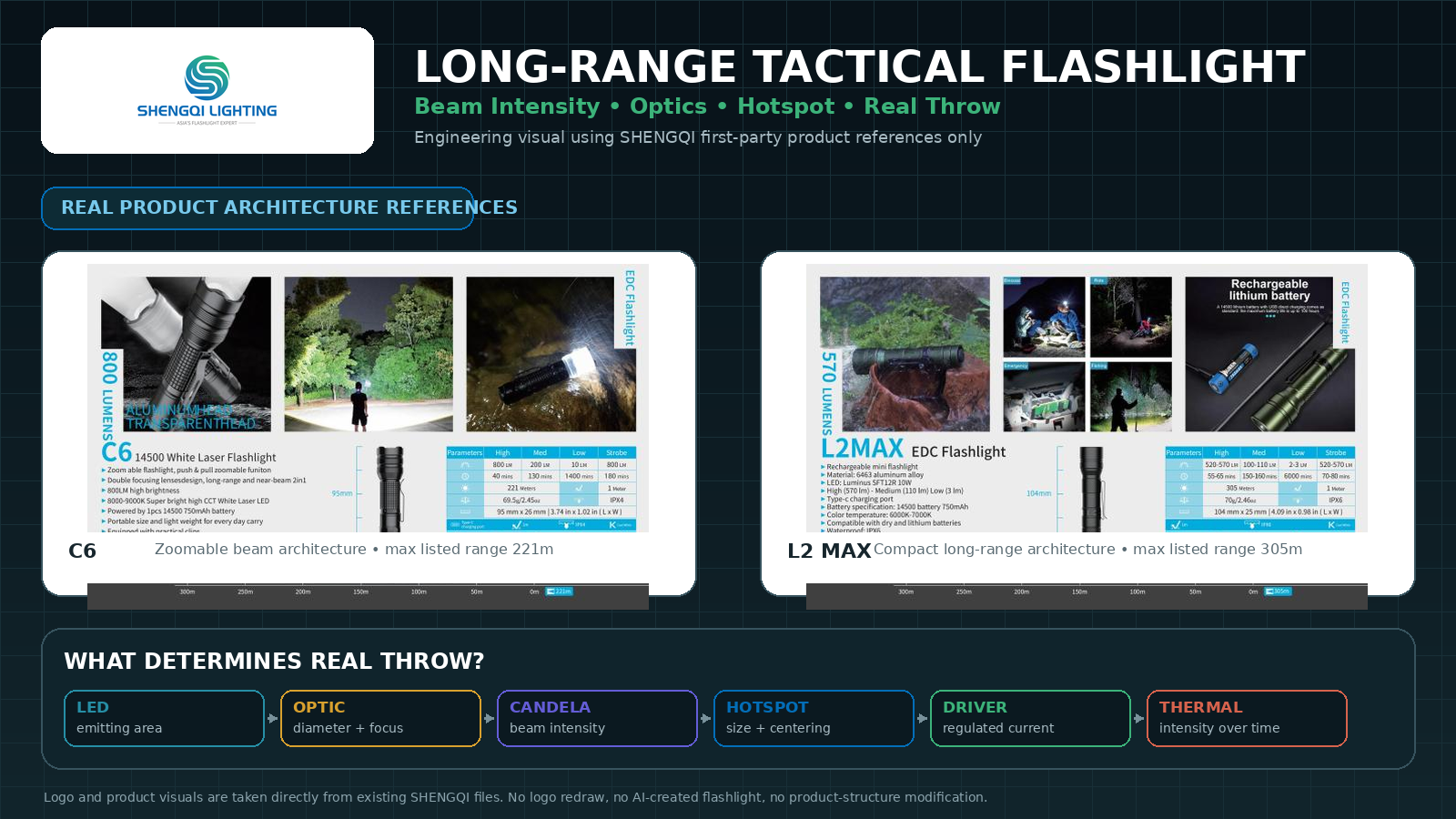
Two SHENGQI Architectures Illustrate Different Routes to Distance Lighting
C6 uses an adjustable zoom architecture with Flood modes of 800LM / 200LM / 10LM and Spot modes of 230LM / 50LM / 3LM, with a maximum listed range of 221m. The point is not that zoom is automatically better for throw. It illustrates how changing beam distribution introduces additional optical and mechanical variables that should be evaluated separately.
L2 MAX uses a compact tubular 14500 architecture with 570LM / 110LM / 3LM modes and a maximum listed range of 305m. That listed distance is a useful product reference, but it should not be automatically converted into candela, ANSI/PLATO FL 1 distance or real identification distance without model-specific measurement evidence.
For the model-specific context, see the L2 MAX compact long-range case study. These examples support architecture discussion; this article remains the category-level engineering page.
Long-Range Flashlights Are Sensitive to Optical Assembly Consistency
Production variation can come from LED centering, reflector or TIR position, PCB location, gasket thickness, lens fit, bezel position, machined geometry, emitter revision and focus spacing.
Two flashlights can use the same LED and still produce noticeably different beams if optical alignment changes.
Emitter bin, revision or approved supplier changes can also affect output, voltage, tint and intensity. The approved emitter should therefore remain part of controlled BOM and revision management.
These relationships should carry into sample-to-production manufacturing, where optical alignment and assembly control support consistent beam behavior without assuming any unverified numerical tolerance.
Long-Range Tactical Flashlight Engineering Matrix
| Design Variable | Why It Matters | Long-Range Trade-Off | Buyer Question | Prototype Evidence |
|---|---|---|---|---|
| Target Distance | Defines required visual reach | Distance alone lacks task context | What must be seen, and where? | Photometric + field review |
| Target Size | Changes useful hotspot requirement | Hotspot too narrow or broad | What object must be identified? | Representative target test |
| LED Emitting Area | Influences focusing potential | Smaller area may reduce other advantages | Which emitter fits the optic? | Final beam measurement |
| Optical Diameter | Creates optical-control area | Larger head and carry burden | What head size can the product accept? | Beam and packaging review |
| Reflector / TIR | Shapes hotspot and spill | Different packaging and beam behavior | Which optic supports the task? | Optical comparison |
| Peak Beam Intensity | Supports distance performance | High candela alone may narrow context | What intensity supports the target? | Instrument measurement |
| Hotspot | Defines concentrated viewing area | Too small can hurt usability | How large should it appear at range? | Distance beam review |
| Spill | Provides surrounding context | Changes beam distribution | How much peripheral light is useful? | Field beam review |
| Driver | Controls emitter operating condition | Regulation affects intensity over time | How stable must output remain? | Electrical + intensity test |
| Battery | Supports current and runtime | Size and weight trade-off | What operating period is required? | Representative-use test |
| Thermal Regulation | Affects sustained intensity | Peak performance may not persist | How does candela change over time? | Intensity-over-time test |
| Optical Assembly Consistency | Maintains focus and symmetry | Tolerance changes final beam | Which relationships are critical? | Production-sample comparison |
Four Ways a Long-Range Flashlight Can Miss Its Design Goal
01. High Lumens, Low Beam Intensity
A product can generate substantial total light while distributing it too broadly for the intended distance task. The near field appears bright, which can make a wall test look impressive. Farther away, however, insufficient center intensity limits target visibility. Output and optical concentration need to be evaluated separately.
02. Strong Candela, Hotspot Too Small for the Intended Target
A narrow hotspot can produce a strong meter reading while making a larger object harder to scan or identify comfortably. The user may spend more time aiming the beam precisely instead of seeing the whole relevant feature. Hotspot dimensions should therefore match target size and viewing task. Higher center intensity is not automatically better if the beam becomes impractical.
03. Excellent Turn-On Throw, Rapid Performance Change Over Time
A prototype can produce strong initial intensity before battery and thermal conditions change. If the intended task requires extended distant illumination, the product needs to be evaluated beyond the first moments after activation. Intensity-over-time provides a more relevant view of sustained throw. This does not require the beam to remain numerically constant; it requires the behavior to match the agreed product brief.
04. Strong Prototype Beam, Inconsistent Production Alignment
A carefully assembled engineering sample can produce excellent focus while later units show shifted hotspots or reduced intensity. LED centering, reflector position, gaskets, PCB position and assembly sequence can all contribute. Long-range products can therefore be more sensitive to alignment variation than a broad flood beam. Production verification has to protect the approved optical relationship.
Ten Questions Before Developing a Long-Range Tactical Flashlight
1. What object must the user see at distance?
Define the real object rather than an abstract meter figure. Target size and reflectivity directly affect the useful beam requirement.
2. Is the task detection, recognition or detailed identification?
Seeing that something exists is different from understanding what it is. The product brief should define the required visual result.
3. What beam distance is required, and how will it be defined?
Separate standardized photometric distance from practical field expectations. Record the measurement method used for any approved claim.
4. What hotspot size is useful at the intended distance?
A very small hotspot can increase center intensity while making some objects harder to evaluate. Test representative targets.
5. How much spill is necessary for nearby context?
The user may still need peripheral information while looking at a distant object. Spill should follow the task instead of being minimized automatically.
6. What LED and optical architecture support the intensity target?
Emitter area, reflector or TIR geometry and focus need to be developed together rather than selected independently.
7. What battery and driver architecture support the required operating duration?
Peak electrical capability is only one part of the decision. Size, runtime and regulation also matter.
8. How will beam intensity change as the product heats and the battery discharges?
Review center intensity over the real operating period instead of approving only a turn-on number.
9. How will optical alignment be controlled after assembly and impact testing?
If impact testing belongs to the project, the beam should be rechecked afterward rather than testing electrical function alone.
10. Which measurements will be used to approve the prototype and production batch?
Total output, peak intensity and beam pattern describe different properties. Define the required evidence before mass-production approval.
Twelve Tests Buyers Should Run on a Long-Range Flashlight Prototype
Long-range positioning cannot be fully validated by lumens alone, and candela alone does not describe the complete beam. Buyers should separately understand total output, peak intensity and beam pattern.
Measure directional intensity using the agreed method.
Separate luminous flux from directional intensity.
Document the standard or project method used.
Compare beam size with the intended target.
Assess surrounding visual context.
Verify hotspot centering and optical axis.
Review rings, dark zones, asymmetry and color variation.
Track center intensity through the intended operating period.
Evaluate the electrical system under representative use.
Use representative objects without replacing laboratory measurement.
Recheck hotspot position and beam behavior after applicable testing.
Compare intensity, alignment and beam pattern with the approved prototype.
Acceptance criteria are project-specific. Relevant photometric and product verification resources can support development without implying that every existing model has been tested under the same ANSI/PLATO FL 1 procedure.
How an OEM/ODM Project Should Define a Long-Range Flashlight
Development should move through target and application, useful distance, target size, candela target, lumen target, LED, reflector or TIR, optical diameter, hotspot and spill, driver, battery, thermal target, mechanical alignment, prototype measurement and production verification.
The photometric target should be defined before the industrial design is frozen. Choosing the head diameter and housing first can limit the optical system before the required beam has been established.
Industrial Design, Optical Engineering, Electronic Design, PCB Layout, Mechanical Engineering, battery architecture, manufacturing, testing, Quality Control and Packaging Design all contribute to the final architecture.
SHENGQI LIGHTING can support custom flashlight development around a documented B2B product brief without guaranteeing unverified candela, beam-distance or sustained-output claims.
Frequently Asked Questions About Long-Range Tactical Flashlights
1. What makes a tactical flashlight long range?
A long-range tactical flashlight needs enough directional beam intensity to place useful light on a distant object. Candela, LED emitting area, reflector or TIR design, optical diameter and focus strongly influence the beam, while the driver, battery and thermal system determine whether that intensity can be maintained. Peak lumens alone do not establish throw because the same total output can be distributed across very different beam patterns.
2. What is the difference between lumens and candela?
Lumens describe total luminous flux produced by the light, while candela describes luminous intensity in a particular direction. A broad floodlight can have high lumen output with relatively modest peak intensity. A focused flashlight can produce fewer total lumens while concentrating more of its light into the hotspot. Both measurements are useful, but they describe different parts of flashlight performance.
3. Does higher lumen output always mean longer beam distance?
No. Long-range performance depends heavily on how the optical system concentrates the available light. A high-lumen flashlight with a broad beam may illuminate more total area while producing less center intensity than a lower-lumen design optimized for throw. LED geometry, reflector or TIR design, focus, optical diameter and sustained operation all affect the final result.
4. Do larger reflectors increase flashlight range?
A larger optic can increase long-range potential by providing more area for controlling light from the emitter, but head diameter alone does not guarantee greater throw. Performance also depends on the LED, reflector or TIR geometry, focus, emitter position and implementation. A larger optical head also increases product size and can change weight and carryability, creating a packaging trade-off.
5. What does ANSI FL1 beam distance mean?
ANSI/PLATO FL 1 beam distance is a standardized photometric reference that relates peak beam intensity to a defined endpoint of 0.25 lux. It provides a consistent way to report beam-distance performance when the relevant test procedure is followed. It should not be interpreted as guaranteed target-identification distance, guaranteed all-weather range or the distance at which the beam will still appear subjectively bright.
6. Why can real-world visibility be shorter than a rated beam distance?
Real visibility depends on target size, target reflectivity, background contrast, fog, rain, dust, ambient light, beam quality and the observer. Atmospheric particles can also create backscatter that reduces useful distant contrast. A standardized beam-distance value therefore answers a photometric question, while practical object visibility answers a broader visual-task question. The two should be evaluated separately.
7. What should B2B buyers test on a long-range flashlight prototype?
Buyers should separately measure peak beam intensity and total light output, review hotspot size, spill, beam centering and artifacts, evaluate intensity over time, and check battery and driver behavior. Representative outdoor target-visibility tests add application context but should not replace photometric measurement. Production-representative samples should also be compared with the approved prototype to verify optical consistency.
8. Can a long-range tactical flashlight be customized for OEM/ODM projects?
Yes. A custom project can define target distance, visual task, intensity and lumen targets, emitter, optical diameter, reflector or TIR, hotspot, spill, driver, battery, thermal behavior and mechanical alignment as one product system. Prototype measurements should then establish whether the approved architecture meets the project-specific requirements before the optical relationships and component revisions are carried into production.
Long-Range Performance Is an Optical-System Problem
A useful Long-Range Tactical Flashlight begins with the distant visual task, then connects candela, LED geometry, optical diameter, reflector or TIR design, hotspot, spill, driver behavior, battery, thermal regulation and production alignment. The strongest design is not necessarily the one with the highest lumen figure. It is the one that places the right amount of concentrated light on the intended object and can reproduce that beam consistently over time and across production.
Define the Photometric Target Before Freezing the Product Architecture
Flashlight brands, outdoor-equipment companies and private-label teams can evaluate beam intensity, optical architecture, hotspot and spill, battery, driver behavior, mechanical alignment and production verification as one development system.
Contact SHENGQI LIGHTING for an OEM/ODM technical evaluation at sales@shengqilight.com.
Contact SHENGQI LIGHTING