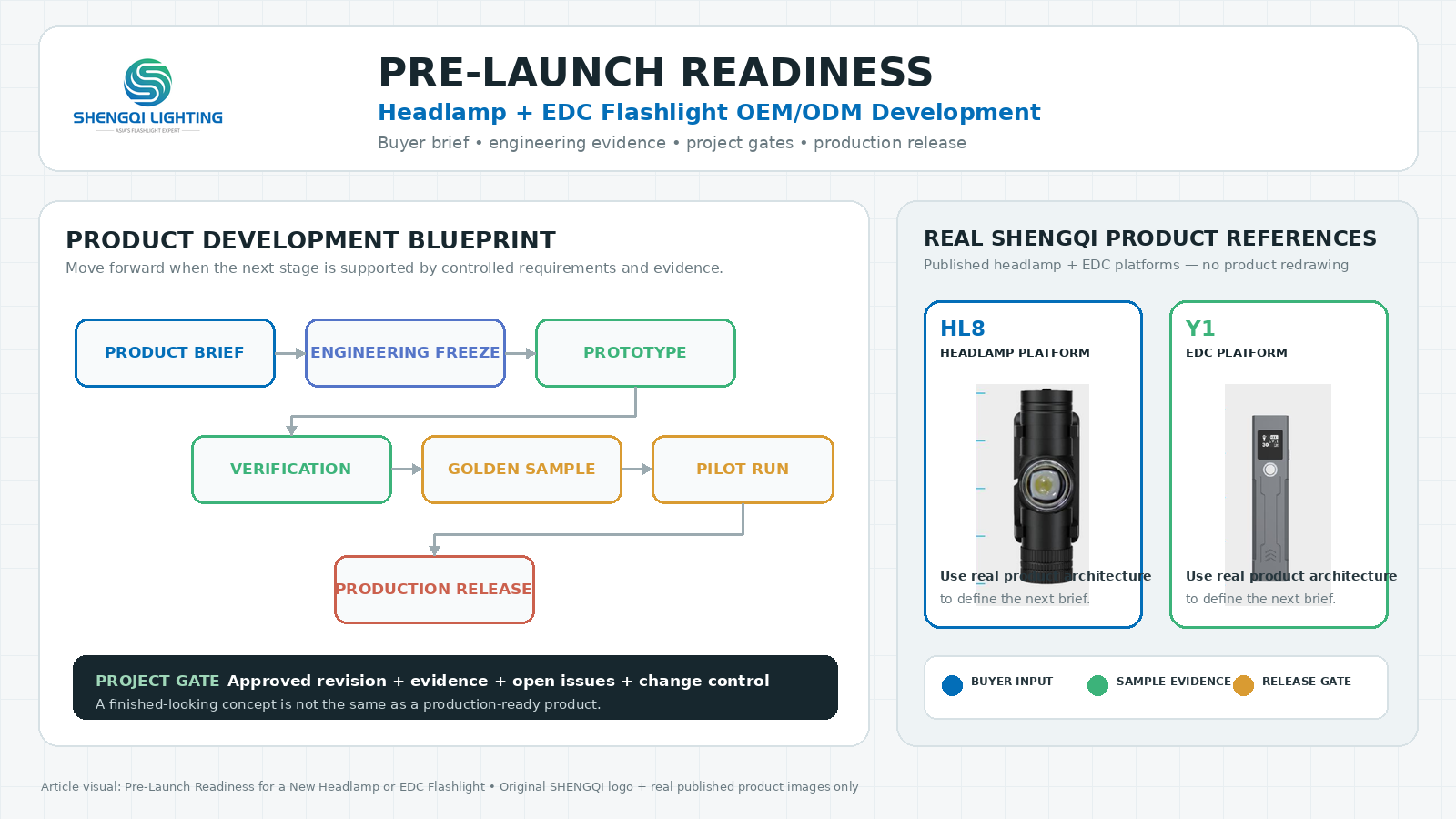

Why Pre-Launch Readiness Matters Before a Flashlight Project Moves Forward
The most dangerous early-stage problem is often not that the factory cannot manufacture the product. It is that buyer and supplier are working from different definitions of the same product.
“Compact headlamp” does not define size, battery, weight distribution, beam, runtime or controls. “Premium EDC” does not define material, finish, UI, battery, beam quality, testing or packaging.
Adjectives are not engineering specifications. A project should not move forward because the concept “looks finished.” It should move forward only when the commercial brief, engineering requirements, prototype evidence and production criteria are sufficiently defined for the next development stage.
What the Buyer Should Put Into the Product Brief
A useful brief gives the engineering team enough context to challenge assumptions and build a realistic architecture. It should cover market, application, lighting, product, power, UI, brand and target-market review before detailed custom flashlight development begins.
Target countries, sales channel, price positioning and user group.
Where, when, how long, handheld or hands-free, indoor or outdoor.
Flood or spot priorities, working distance, low mode and auxiliary light if required.
Approximate dimensions, weight target, carry method and material direction.
Rechargeable or replaceable battery direction, charging requirement and runtime target.
Switch, mode logic, lockout, memory and indication if required.
Logo, CMF, packaging and accessories.
Target region and any regulatory or certification requirements that need confirmation for the final configuration.
Product Requirement Priority
Requirements without which the product does not satisfy the intended use or commercial brief.
High-priority requirements that can be traded against cost, size, schedule or other constraints.
Features to include only if the architecture and project priorities support them.
A product brief should show priorities, not just features. If every request is labeled “must have,” the engineering team has no rational basis for resolving conflicts.
Define the User Task Before Defining the Flashlight
A headlamp brief may need to consider hands-free movement, headband architecture, weight distribution, flood versus spot behavior or sensing if the application requires it. Existing headlamp product architectures can help a buyer understand available product directions without making those features mandatory.
An EDC brief may instead prioritize pocket carry, grip, clip design, accidental activation, compact power architecture or secondary lighting. Buyers can compare the existing EDC flashlight platforms when defining where a new SKU should sit.
Same LED does not mean same product requirement. Product architecture follows the user task.
Freeze the Product Requirements Before Freezing the Housing
If the exterior is fully frozen before the internal system matures, later discoveries can force expensive redesign: the battery may not fit, an optic may require more depth, the PCB may grow, the switch or charging connector may conflict with structure, or the thermal path may be insufficient.
Industrial design should mature together with engineering, not ahead of it.
A freeze does not mean “never change again.” It means the current stage has an approved revision, known open issues and a defined change process. At minimum, control the drawing revision, BOM revision, firmware revision when applicable and sample revision.
Avoid discussing a Version A housing with a Version B PCB and Version C firmware as though they are one approved product.
Industrial Design and CMF Have to Work With the Internal Architecture
Industrial design defines form, grip, carry, proportions, interfaces and optical placement. CMF defines color, material and finish. Neither can be separated from battery space, optics, PCB layout, heat flow, sealing and assembly.
Design feasibility therefore requires engineering review rather than an assumption that any exterior concept can be manufactured unchanged.
CMF is also more than selecting a color at the end. Material and finish choices can affect machining, coating, logo application, cosmetic tolerance, batch consistency and the packaging protection required for visible surfaces.
CMF should be specified before final sample approval.
Define the Beam Before Approving the LED
“We need 1,000 lumens” is not a complete optical requirement. The buyer should define flood versus spot behavior, working distance, field of view, hotspot, spill, useful low mode, glare expectations and beam transition according to the application.
A headlamp and an EDC flashlight can use similar LED technology while requiring very different optical behavior.
The LED is one component of the optical system, not the beam specification.
Beamshots are valuable for comparison, but they are not scientific proof by themselves. Depending on the project, prototype verification may combine integrating-sphere testing, illuminance or distance measurement, comparative sample review and real-use evaluation.
Convert the Feature List Into a Defined Electronic Architecture
Depending on the project, electronics may include multiple LED channels, mode sequence, switches, battery feedback, lockout, memory, charging, sensors or protection logic.
Every electronic feature adds UI, PCB, firmware, power and validation requirements. The buyer should repeatedly ask: Does the user need this feature, or does the feature merely sound attractive?
If firmware is used, its revision belongs in project control. The firmware version approved with the sample should be recorded so the golden sample does not use one logic while production quietly uses another.
Battery Architecture Should Be Frozen Before the Mechanical Design Is Final
Battery architecture affects dimensions, weight, runtime, current capability, charging, replacement and transport or compliance considerations. No single cell format or integrated battery is universally best.
If the product is rechargeable, define the workflow: direct charging or battery removal, connector location, charging indication, whether a cable is included, and whether charging must remain practical while the product is mounted, clipped or carried.
These decisions influence enclosure space, PCB layout, sealing, accessory configuration and packaging, so they should not be postponed until the exterior is already complete.
Not Every Prototype Should Be Expected to Look Like the Final Product
A project may use several prototype stages depending on complexity. An appearance prototype may validate size, shape, grip and CMF direction. An engineering prototype may focus on optics, electronics, battery and mechanical architecture. An integrated prototype evaluates the complete system, while a production-representative sample moves closer to final material, process, assembly, finish and BOM.
Do not reject an early engineering sample simply because its cosmetic finish is unfinished when that sample exists to answer a different technical question.
Each sample should carry a clear revision identity: Project + Revision + BOM + Firmware if applicable + Date. “The sample from last Tuesday” is not robust configuration control.
Define the Verification Plan Before the Sample Arrives
The buyer should not receive a prototype and only then ask, “What should we test?” Establish the verification matrix while the requirements are being defined.
| Requirement | Test / Inspection | Sample Stage | Acceptance Criteria | Owner | Evidence |
|---|---|---|---|---|---|
| Functional | Lighting, UI, charging, battery, switch or sensor if applicable | Defined by project | Project-specific | Assigned team | Test record |
| Mechanical | Assembly, fit, carry, buttons and moving parts | Defined by project | Project-specific | Assigned team | Inspection record |
| Environmental | Ingress, impact or temperature where required | Defined by project | Project-specific | Assigned team | Applicable test evidence |
| Cosmetic | Color, finish, logo, scratches and gaps | Defined by project | Project-specific | Assigned team | Approved visual reference |
Relevant flashlight testing and quality-control capabilities can support project verification, but the exact test scope and acceptance criteria must follow the approved project.
Run a DFM Review Before Tooling or Production Commitment
DFM is not only “Can the factory make it?” Ask whether the product can be assembled repeatedly, critical dimensions inspected, wires routed consistently, seals installed reliably, fasteners reached, PCB assemblies handled safely, cosmetic surfaces protected and the planned process scaled to volume.
A product that can be hand-built once is not automatically ready for repeatable production.
If DFM changes the housing, PCB, clip, switch, battery or optic, update the drawing, BOM and sample revision. Verbal change is not configuration control.
The transition should connect engineering decisions with real sample-to-production manufacturing conditions.
Packaging Should Be Developed Before the Product Is “Finished”
Packaging affects product protection, accessory organization, cable placement, documentation, barcode and labeling requirements, retail presentation, carton dimensions and shipping configuration.
Waiting until production begins can expose conflicts such as an added cable, revised accessory, changed product dimensions or insufficient surface protection.
Compliance review should begin with the target country or region, final product configuration, battery, charger and sales channel. Certification or testing requirements must be confirmed for that final configuration and market rather than assumed across the entire product range.
A Golden Sample Needs More Than a Signature
A useful golden sample should be tied to the approved drawing revision, BOM revision, firmware if applicable, LED, battery, material and finish, logo, packaging and any approved exceptions.
The golden sample is a physical reference tied to controlled documentation. It is not simply the sample that someone looked at and considered acceptable.
It is also not proof that mass production will automatically match. Production still requires process control, inspection, supplier control and production checks. A perfect sample demonstrates an approved reference, not the consistency of every future unit.
Pilot Production Tests the Process, Not Just the Product
Prototype work primarily asks, “Does the design work?” Pilot production adds a different question: Can the planned process reproduce it?
Review assembly sequence, bottlenecks, fixtures, operator access, material consistency, cosmetic handling, inspection, defect patterns and packaging. The appropriate pilot quantity depends on the project and process.
The run should produce an issue list, root cause where identified, corrective action, drawing/BOM/process updates where required and a clear approval status.
“We managed to assemble the pilot units” is not sufficient reason to release mass production.
What Should Be True Before Mass Production Is Released?
Approved specification, order or forecast assumptions clarified, packaging confirmed.
Drawing approved, BOM approved and firmware approved if applicable.
Golden sample approved and agreed verification completed.
DFM issues closed or accepted and pilot issues resolved or controlled.
Inspection plan, critical characteristics and acceptance criteria defined.
Post-approval changes require review before implementation.
Mass production is a controlled release decision, not merely the date when assembly starts.
Pre-Launch Readiness Matrix for Headlamp and EDC Projects
| Development Area | Buyer Input | OEM/ODM Output | Approval Evidence | Risk if Unclear |
|---|---|---|---|---|
| 1. Target Market | Country, channel | Market review inputs | Confirmed scope | Late compliance changes |
| 2. User / Application | User task | Use-case requirements | Approved brief | Wrong architecture |
| 3. Product Positioning | Price / channel role | Requirement priorities | Positioning approval | Feature mismatch |
| 4. Lighting Requirement | Beam / use distance | Optical architecture | Beam evidence | Wrong beam |
| 5. Industrial Design | Form / carry intent | Design revision | Approved drawing | Repeated redesign |
| 6. CMF | Color / material / finish | CMF specification | Approved reference | Batch mismatch |
| 7. Electronics / PCB | Required functions | Circuit / UI logic | Revision record | Feature conflicts |
| 8. Battery / Charging | Workflow / runtime | Power architecture | Approved configuration | Packaging redesign |
| 9. Mechanical Architecture | Size / interface constraints | Mechanical design | Drawing / sample | Assembly conflict |
| 10. Prototype | Approval questions | Revision-controlled sample | Sample record | Wrong sample approved |
| 11. Verification | Acceptance priorities | Verification plan | Test / inspection evidence | Subjective approval |
| 12. DFM | Volume / service needs | Production review | Closed issue log | Poor repeatability |
| 13. Packaging | Channel / accessories | Pack-out design | Approved packaging | Late pack changes |
| 14. Production Release | Commercial approval | Release package | Signed gate status | Uncontrolled launch |
Five Decisions Buyers Often Make Too Early
01. Freezing the Housing Before the Internal Architecture
Exterior dimensions can lock the team into a battery, PCB and optic space that later proves inadequate. Engineering then has to redesign around a cosmetic decision. Mature ID and engineering together before final housing freeze.
02. Choosing Peak Lumens Before Defining the Beam Task
A lumen target does not define flood, spot, glare or working distance. It can push the system toward unnecessary battery and thermal loads. Define the visual task first.
03. Approving Appearance Before Reviewing the UI
A visually clean product can still have poor switch access or confusing mode logic. UI changes can then force button, PCB or housing changes. Operate the sample before approving the surface.
04. Ordering Packaging Before the Accessory / Charging Configuration Is Frozen
Cables, spare parts, chargers or revised product dimensions can invalidate an early insert or carton. Packaging development should start early, but final dimensions should follow the approved pack-out.
05. Asking for Mass-Production Price Before the Product Definition Is Stable
An early quotation may depend on assumptions about material, battery, electronics, finish, packaging and process. When those assumptions change, the commercial model changes too. Early estimates are useful when their assumptions remain visible.
Five Decisions Buyers Often Make Too Late
01. Defining Cosmetic Acceptance
If acceptable color variation, scratches, gaps or logo appearance are discussed only after production samples arrive, supplier and buyer may apply different standards. Define cosmetic references before final approval.
02. Confirming Target-Market Requirements
Late market review can trigger changes to product configuration, battery, charger, labels or documentation. Establish the target region before the design becomes difficult to change.
03. Testing Real User Workflow
A product can pass bench checks while remaining awkward to wear, carry, charge or operate. Test the intended workflow while design changes are still practical.
04. Controlling Firmware / BOM Revision
Revision control introduced after several sample rounds creates uncertainty about what was actually approved. Start configuration control as soon as technical variants begin.
05. Defining Production Change Approval
If component or process changes are not governed until after production begins, substitutions can reach finished units before their impact is reviewed. Define post-approval change control before release.
Fifteen Questions Brand Buyers Should Answer Before Sending an RFQ
- Who is the product for?
- What task must it perform?
- Is it a headlamp, EDC light or another platform?
- What beam behavior is required?
- What output modes are actually useful?
- What battery and charging workflow is expected?
- What body size and weight range is acceptable?
- Which functions are mandatory, preferred or optional?
- What controls and UI behavior are required?
- Which target markets will the product enter?
- What branding and CMF are required?
- What packaging and accessories are required?
- What prototype evidence will be used for approval?
- What must be frozen before pilot production?
- What production quantity and commercial timeline should the supplier plan around?
A Better Flashlight RFQ Starts With These Six Inputs
These six inputs are not a complete engineering specification, but they make the first OEM/ODM discussion much more productive and help the supplier identify the major open questions before quoting or proposing an architecture.
Frequently Asked Questions About Flashlight OEM/ODM Pre-Launch Development
1. What information should a buyer prepare before starting a flashlight OEM/ODM project?
Prepare the target market, user, application, product positioning, beam requirement, battery and charging direction, size and weight expectations, required features, UI, branding, CMF, packaging, estimated quantity, timeline and approval priorities. The first brief can contain open questions, but it should clearly distinguish mandatory requirements from preferences.
2. When should a flashlight product specification be frozen?
Freeze requirements by development stage when the information needed for the next decision is sufficiently mature. A freeze should identify the approved drawing, BOM, sample and firmware revision where applicable, plus any open issues. It does not prohibit future change; it requires changes to be reviewed and documented.
3. Should industrial design be completed before optical and electronic engineering?
Not necessarily. Industrial design and engineering should normally iterate together because the battery, optic, PCB, controls, thermal path, sealing and assembly requirements influence the exterior. Freezing the housing too early can force avoidable compromises or redesign when the internal architecture matures.
4. What should buyers verify on a flashlight prototype?
Verification should cover function, optics, UI, battery and charging behavior, mechanical fit, carry or wearing workflow, cosmetics and any project-specific environmental requirements. The exact checks depend on the prototype stage. Acceptance criteria should be defined before approval rather than decided only after the sample arrives.
5. What is the difference between a prototype and a golden sample?
A prototype is used during development and verification to answer design or engineering questions. A golden sample is an approved physical reference tied to controlled documentation such as drawing, BOM, firmware where applicable, material, finish and packaging. The golden sample still does not replace production-process control.
6. Why is DFM important before flashlight mass production?
DFM checks whether the approved concept can be assembled, inspected and reproduced consistently using the intended process. It can reveal inaccessible fasteners, difficult wire routing, fragile cosmetic surfaces, sealing issues or inspection problems before those issues become production bottlenecks.
7. What should be confirmed during a pilot production run?
Review assembly sequence, fixtures, operator access, material consistency, cosmetic handling, inspection points, defect patterns, packaging and any process bottlenecks. Record issues, corrective actions and resulting drawing, BOM or process changes before deciding whether the process is controlled well enough for release.
8. What should a brand include when requesting an OEM/ODM flashlight quotation?
At minimum, provide the target market, application, product positioning, required features, estimated quantity and target timeline. Adding beam requirements, battery direction, dimensions, branding and packaging expectations makes the quotation more meaningful because fewer commercial assumptions need to be made.
Move Forward When the Evidence Supports the Next Gate
A flashlight project is ready to move forward when the next stage is supported by controlled requirements and evidence—not simply because the calendar says it is time to launch. Strong flashlight product development connects buyer priorities, engineering revisions, prototype evidence, DFM, the golden sample, pilot findings and production criteria into one controlled decision chain.
Coming Soon: Shengqi Lighting is preparing to introduce a new Rangefinder Flashlight. Full specifications and official product information will be released soon.
Planning a New Headlamp or EDC Project?
Send your Target Market, Application, Required Features, Estimated Quantity and Target Timeline so the first technical discussion can focus on the product architecture and unresolved development decisions.
Review SHENGQI LIGHTING's OEM/ODM design and development capabilities for industrial design, optical engineering, electronics, PCB layout, packaging, manufacturing, testing and quality control.
Contact SHENGQI LIGHTING for an OEM/ODM technical evaluation at sales@shengqilight.com.
Contact SHENGQI LIGHTING