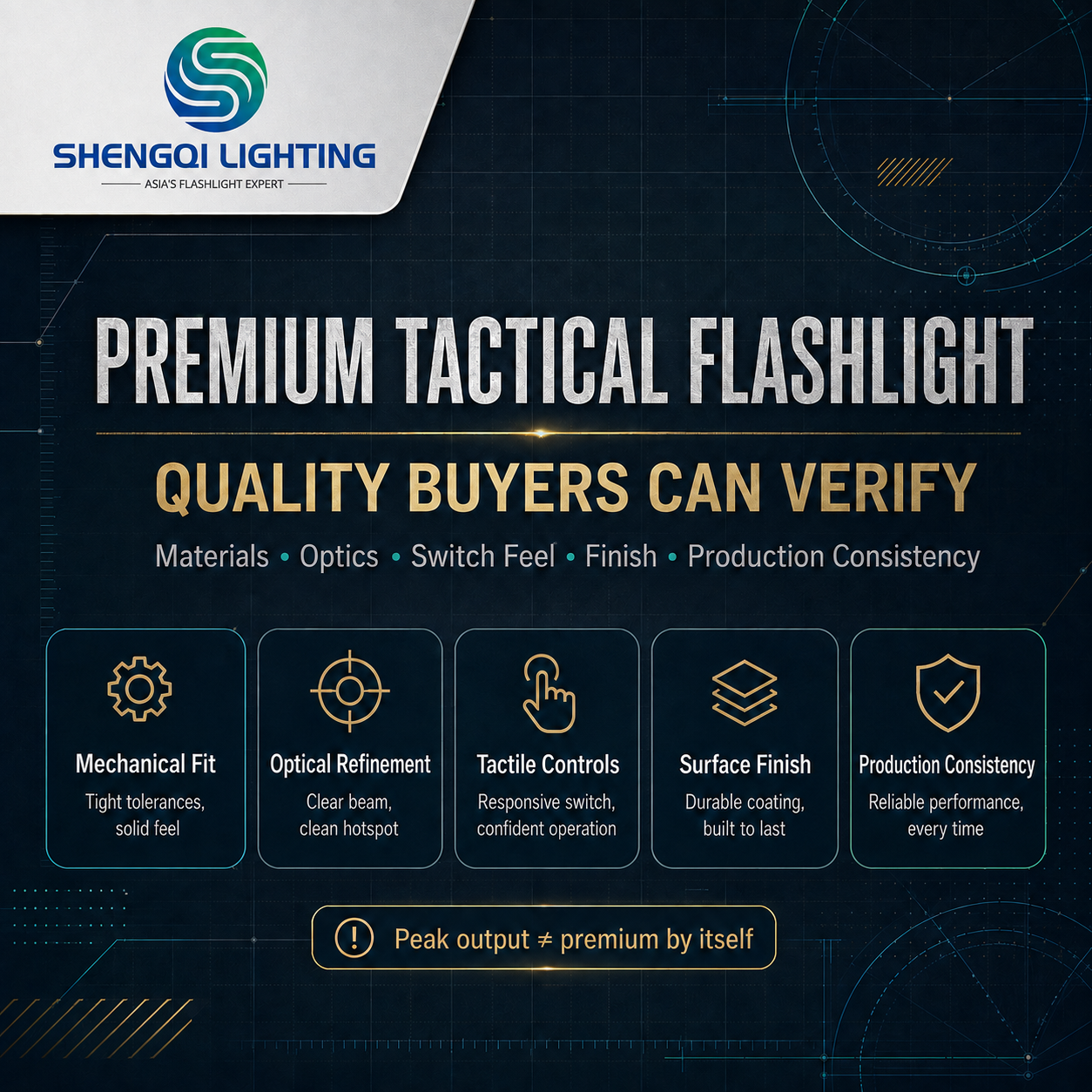

What Makes a Tactical Flashlight Premium?
A premium tactical flashlight combines consistent mechanical construction, refined optics, predictable electronics, deliberate controls, controlled surface finish and repeatable production quality. Materials matter, but only when their properties suit the design. Machining matters when it produces controlled interfaces, clean edges and repeatable fit. Optics matter when alignment, cleanliness and beam appearance remain consistent. The switch matters because it is the part users operate most often. Finish matters because color, texture and marking strongly affect perceived quality. Most importantly, production consistency determines whether these qualities exist beyond one engineering sample. Premium positioning should therefore be supported by inspectable evidence rather than price, weight, CNC language or a peak-lumen claim.
Does CNC Machining Make a Flashlight Premium?
No. CNC machining is a manufacturing method; premium quality depends on the resulting geometry, fit, finish, tolerance control, assembly and product-level verification. CNC can support precise features and repeatable interfaces, but a machined part can still contain burrs, poor mating surfaces, cosmetic inconsistency or misalignment. Buyers should evaluate critical dimensions, thread behavior, bezel and switch fit, edge treatment and assembly consistency instead of treating “CNC machined” as a quality grade. The process creates manufacturing capability; the finished part and the controlled production process provide the evidence.
Are Premium Flashlights Always Brighter?
No. Higher total output can be part of a premium flashlight specification, but premium positioning also depends on beam quality, controls, materials, finish, reliability and production consistency. A lower-output product can still occupy a premium position if its intended use prioritizes compactness, controlled illumination, simple operation or consistent fit and finish. Peak brightness answers a performance question; it does not answer whether the product feels well made, operates predictably or reproduces the approved quality level across production.
How Can B2B Buyers Verify Premium Flashlight Quality?
B2B buyers should convert “premium” into measurable or inspectable criteria covering materials, machining, finish, optics, controls, electronics, durability, cosmetic standards and production consistency. The approved sample should be connected to drawings, BOM revisions, defined component sources, cosmetic references and functional inspection criteria. Buyers can then compare prototypes side by side, review critical mechanical interfaces, inspect beam and switch consistency, evaluate charging and battery fit, and repeat the same checks on production-representative units. Premium quality becomes auditable when each important claim has a corresponding specification, approved reference or verification method.
Define What “Premium” Means for the Target Market Before Choosing Features
Outdoor and EDC buyers may care most about carry, finish, controls, battery workflow and durability. Professional tool channels may value reliability, simple UI, repeatability, inspection and serviceability. Premium retail may place more emphasis on CMF, tactile feel, visual identity and packaging.
That is why titanium, OLED displays, carbon fiber or a 5,000-lumen target should not be selected before the market position is defined.
Premium positioning must be translated into measurable product requirements.
Premium Feature Budget
Brands do not need every expensive feature. The budget may be better spent on a more refined optic, a better switch, tighter assembly control, stronger carry hardware, a more consistent finish, an approved battery or better protective packaging.
A premium product should spend complexity where the user can feel or verify the improvement. Premium product design is selective, not maximalist.
Premium Materials Matter Only When They Solve a Product Requirement
Aluminum alloys, stainless steel, titanium, polymers, glass and elastomers can all belong in a high-quality handheld light. Material name alone is not proof of quality.
An aluminum body still needs the right alloy, wall design, machining or forming process, thread design, surface treatment and thermal integration. Different alloys such as 6061 and 6063 may be selected around machining, extrusion, strength, finish, thermal and manufacturing requirements; they should not be presented as a universal premium ranking.
Titanium can provide corrosion resistance and a distinct material identity, but it can also change cost, machining complexity, heat transfer and weight. Changing the body material without improving the complete product experience may create a different SKU, but it does not automatically create a better product.
Heavy does not mean premium, and lightweight does not mean cheap. Weight comes from material, battery, optics, wall thickness, hardware and structure; weight distribution and use case matter more.
Mechanical Quality Is Felt at Every Interface
Users notice thread engagement, switch movement, tailcap fit, bezel fit, clip stability, charging-cover fit, button alignment, internal movement and sharp edges. These details often influence premium perception more than a material slogan.
If the product uses a threaded battery tube or tailcap, inspect engagement, smoothness, cross-thread risk, burrs, lubrication strategy where applicable, repeated opening and axial play.
Battery rattle, button rattle, clip movement or internal movement can also reduce perceived quality. Absolute silence is not a universal requirement; acceptable movement should follow the architecture.
Premium mechanical quality is often the absence of small inconsistencies.
CNC Machining Does Not Automatically Make a Flashlight Premium
CNC is a production method. Buyers should evaluate datum control, relevant concentricity, thread consistency, edge treatment, mating surfaces, optical alignment, switch openings and cosmetic consistency.
Tolerance stack matters because bezel fit, button alignment, lens compression, battery contact, reflector position and tailcap fit can all be influenced by several parts at once.
Premium fit comes from controlling critical tolerance stacks, not from making every dimension unnecessarily tight. Excessively tight tolerances can increase cost, reduce assembly yield and create fit problems without adding user value.
Manufacturing equipment creates capability; product-specific specifications, process control and verification determine the result. Buyers can review SHENGQI's flashlight manufacturing capabilities as infrastructure evidence, not as automatic proof of premium quality.
Surface Finish Is Where Engineering and Brand Perception Meet
Anodizing or another coating, texture, gloss level, matte level, marking method and color consistency should be specified around the intended channel. The coating specification should define appearance, adhesion, wear expectations and color consistency rather than relying on terms such as “scratchproof.”
Different body components can show visible black-to-black color variation between batches or suppliers. Premium brands should define acceptable cosmetic variation and how visible parts are matched.
Sharp edges and machining burrs can immediately undermine product feel. Inspect pocket-contact edges, switch openings, clip edges, bezels, threads and charging-port openings.
Branding also needs controlled location, size, alignment, contrast and wear expectations. Laser marking, printing and other methods should be selected around material, finish and channel requirements; no single branding method is automatically premium.
A Premium Beam Is More Than a High Lumen Rating
For premium perception, buyers should inspect hotspot centering, beam symmetry, transition, lens cleanliness, reflector cleanliness and optical alignment.
Visible rings, a dark center, uneven spill, an off-center hotspot, dust under the lens or debris on the optic can make a premium-positioned product appear poorly controlled even if measured lumens remain unchanged.
A user can see optical inconsistency even when the lumen number is unchanged.
Tint consistency can matter within a batch as well. An approved emitter and acceptable tint range should be defined where visible variation matters, without assuming every beam must be perfectly artifact-free.
Premium User Experience Is Often Decided by the Switch
The switch is one of the most repeated user interactions. Evaluate travel, tactile feedback, actuation consistency, position, sound, accidental activation, response and mode logic.
A premium switch should feel intentional and consistent, not merely expensive.
Complex UI is not automatically better. Double click, triple click, long press, hidden menus and many modes can reduce usability when users cannot predict what the flashlight will do next.
Premium control design reduces uncertainty. Mode memory can be useful for some products and undesirable for others; it should remain a product-specific choice.
Premium Electronics Should Be Defined by Stability and Control, Not Feature Count
Driver regulation, low-voltage behavior, battery protection, charging, indicator logic, UI response and component revision control all affect consistency.
A premium battery specification should focus on the approved configuration, fit, contacts, charging behavior, safety requirements, consistency and replacement strategy. A larger battery is not automatically more premium.
Direct charging also needs physical integration. Check connector alignment, insertion, cover fit, status indication, cable access and enclosure integration.
A modern connector can still be poorly integrated.
Premium Thermal Design Is About Predictable Behavior
Premium does not mean “never gets warm.” It means thermal behavior is understood, controlled and appropriate for the product's intended output.
Buyers should look for repeatable regulation behavior, reasonable grip comfort for the intended use and consistent operation between samples. Unexplained output instability can undermine perceived quality even if the flashlight still functions.
Surface-temperature behavior should be validated under project-defined conditions. Do not use claims such as “stays cool,” “never overheats” or “safe temperature” without corresponding acceptance criteria and evidence.
Premium Durability Has to Be Specified, Not Implied
A metal body, O-ring or thick housing does not by itself prove water resistance, impact resistance or long service life.
IP targets, impact targets, temperature exposure, cycling, corrosion exposure and switch-life requirements should be project-specific and verified on the applicable finished configuration.
If impact testing is required, do not stop at “Does it still turn on?” Recheck beam alignment, switch behavior, battery contact, bezel, lens, charging port, threads and cosmetic damage.
Durability claims become meaningful when the requirement and verification method are both defined.
Premium Quality Is Proven by the Second, Tenth and Hundredth Unit
A carefully prepared golden sample does not prove mass-production quality. Assembly sequence, fixtures, torque control where required, adhesive control, alignment, cosmetic inspection, battery fit, switch consistency, optic cleanliness and final functional verification all influence production results.
Silent component substitution is a major premium-product risk. Changing the LED, battery, driver IC, switch, optic, clip, coating or charging connector can alter feel, appearance, performance or durability.
Supplier and component change control is part of premium quality.
Premium Flashlight Quality Pyramid
Upper levels cannot compensate for failure below them. Attractive packaging cannot correct unreliable function, poor mechanical fit or inconsistent assembly.
Premium Tactical Flashlight Quality Matrix
| Quality Area | What the User Notices | Engineering Variable | Buyer Verification | Premium Failure Risk |
|---|---|---|---|---|
| Material Selection | Weight, feel, finish | Material specification | BOM / drawing check | Marketing-led material choice |
| Body Geometry | Grip and balance | Shape / wall design | Handling review | Poor weight distribution |
| Threads / Mating Surfaces | Smooth operation | Fit / surface condition | Repeated operation | Roughness or play |
| Machining Quality | Clean interfaces | Critical geometry | Dimensional / visual review | Burrs or mismatch |
| Surface Finish | Texture / appearance | Treatment specification | Cosmetic reference | Uneven finish |
| Color Consistency | Part-to-part match | Approved color range | Side-by-side review | Visible mismatch |
| Optical Alignment | Centered beam | LED / optic position | Beam-center review | Off-center hotspot |
| Beam Quality | Symmetry / artifacts | Optic and cleanliness | Visual beam review | Rings / debris |
| Switch Feel | Tactile confidence | Mechanism / assembly | Repeat operation | Inconsistent feedback |
| UI Behavior | Predictability | Firmware / logic | Task-flow review | Control uncertainty |
| Battery / Charging | Fit and charging ease | Cell / connector integration | Fit / charging review | Loose fit or poor access |
| Thermal Behavior | Predictable operation | Thermal design / regulation | Project-defined evaluation | Sample-to-sample variation |
| Assembly Consistency | Everything feels repeatable | Process / fixture / inspection | Representative sample comparison | Golden-sample drift |
| Packaging / Presentation | Protection and organization | Packaging architecture | Pack-out review | Presentation hides weak hardware |
Five Things That Look Premium on a Specification Sheet but Need Verification
01. “Aircraft-Grade Aluminum”
The phrase does not tell the buyer the actual alloy, structure or finish. Material selection should be tied to the drawing and product requirement. The user experiences the finished geometry, weight and surface—not a slogan. Verify the real specification.
02. “CNC Machined”
CNC explains how a part may be produced, not whether the final part is good. Burrs, poor interfaces, misalignment and cosmetic variation can still exist. Inspect critical geometry and mating surfaces. Process does not replace finished-product verification.
03. “High Lumens”
Output is one performance dimension. It does not prove refined controls, good beam appearance, mechanical fit or consistent assembly. A premium product may be bright, but brightness alone cannot establish overall quality. Evaluate the complete system.
04. “IP68”
An IP claim is meaningful only when the final product structure and corresponding evidence support it. The label does not automatically prove switch quality, finish, beam consistency or assembly refinement. Confirm applicability to the exact configuration. Do not transfer an IP rating from another model.
05. “Premium Packaging”
Packaging can improve protection and presentation, but the box cannot repair a poor switch, dirty optic or inconsistent assembly. Premium packaging should support a premium product rather than create the illusion of one. Hardware quality remains the foundation. Unboxing cannot make a mediocre flashlight premium.
Premium Feel Scorecard
Buyer-Defined Scoring — not an industry-standard rating system.
For supplier comparison, brands can also run a blind side-by-side review before revealing supplier name or price. Compare finish, switch, beam, fit, controls and packaging first to reduce marketing bias; this is an evaluation technique, not a certification method.
Twelve Questions Before Developing a Premium Tactical Flashlight
1. Who is the premium customer, and what will they notice first?
Define the channel and user. Premium requirements should start with observable value.
2. Which product attributes justify the premium position?
Select the few dimensions that create a clear step up. Do not upgrade everything by default.
3. Which materials are functionally necessary rather than selected only for marketing?
Connect material choice to weight, finish, structure, thermal behavior and manufacturing.
4. Which mechanical interfaces must feel more precise or consistent?
Identify threads, caps, clips, bezels, switches and other repeated user interactions.
5. What cosmetic standards apply to machining, finish and color?
Define acceptable visible variation and critical cosmetic areas before production.
6. What beam-quality characteristics should be controlled?
Define centering, symmetry, cleanliness and acceptable visible artifacts.
7. What switch and UI experience should distinguish the product?
Prioritize predictable operation and repeatable tactile behavior over feature count.
8. What battery and charging architecture fits the positioning?
Consider fit, charging, serviceability, approved specification and component consistency.
9. What thermal and durability behavior must be verified?
Set project-specific requirements instead of relying on material or enclosure assumptions.
10. Which components require strict revision or supplier-change control?
Identify LEDs, batteries, switches, optics, connectors and other performance-critical items.
11. How will the approved golden sample be translated into production inspection criteria?
Connect the reference to drawings, BOM, cosmetic standards and functional checks.
12. What packaging, branding and documentation complete the product without replacing real hardware quality?
Packaging should protect and organize the product while reinforcing, not inventing, its positioning.
Fourteen Checks Buyers Should Run on a Premium Flashlight Prototype
Compare visible surfaces with the approved cosmetic reference.
Check visible part-to-part consistency.
Inspect exposed edges and openings for unwanted sharpness.
Review engagement, smoothness and repeated operation.
Compare tactile behavior across repeated activations.
Confirm predictable access to intended functions.
Inspect visible optical surfaces and internal cleanliness.
Check alignment and visible artifacts.
Review fit, movement and electrical contact.
Review alignment, access and enclosure integration.
Evaluate project-defined operating behavior.
Recheck optics, controls and mechanical interfaces.
Confirm the pack-out protects visible finishes.
Compare later units with the approved specification and golden sample.
Acceptance criteria are project-specific. SHENGQI's flashlight testing and quality-control capabilities can support verification, but capability availability does not mean every model has completed every test under identical conditions.
Packaging and Branding Should Complete the Product, Not Rescue It
Premium packaging should protect the finish, organize accessories and cables, support documentation, accommodate replacement parts where applicable, and meet retail labeling or serialization requirements when the project needs them.
It does not have to mean a black box with foam. The packaging architecture should match the channel and value proposition.
Packaging should protect the finish and reinforce the product positioning without compensating for weak hardware.
Brand marking should also be specified for location, size, process, contrast, alignment and wear exposure. Unboxing has value, but it cannot turn inconsistent hardware into a premium product.
Premium Should Mean a Clear Step Up in the Product Line
If a standard SKU and premium SKU differ only in color, packaging and price, the premium position is weak.
A premium model should create measurable or verifiable improvement in selected dimensions such as controls, optics, finish, battery architecture, assembly, carry hardware, packaging or verification—not necessarily all of them.
The most expensive component is not always the best component for the product. More weight, complexity, heat or cost without user-perceivable value is not automatically an upgrade.
Portfolio decisions can be reviewed against existing SHENGQI portable lighting products and the broader flashlight product range so the premium SKU owns a clear product role.
Manufacturing Infrastructure Creates Capability; Product Control Creates Premium Quality
SHENGQI LIGHTING's confirmed manufacturing infrastructure includes an approximately 130,000 sq ft facility, 75 CNC machines, one fully automated SMT line, two welding lines, eleven dust-free assembly lines and approximately 2.2 million units of annual production capacity under an ISO9001 quality-management system.
Those resources can support development and production scale, but equipment count does not independently prove premium quality.
Premium products require stronger consistency because buyers are often more sensitive to small functional and cosmetic variations. Acceptance standards should identify critical functional and cosmetic defects; any defect classification or AQL approach should remain project- or customer-specific.
Product-specific specifications, approved samples, process control and production verification determine the result through sample-to-production manufacturing.
How an OEM/ODM Project Should Define a Premium Tactical Flashlight
A structured project should move through Target Customer → Premium Value Proposition → Material → Mechanical Architecture → CMF → Optics → Switch / UI → Electronics → Battery → Thermal Requirement → Durability → Cosmetic Standard → Golden Sample → Supplier / BOM Control → Prototype Verification → Production Inspection → Packaging.
Premium requirements must be converted from adjectives into drawings, specifications, approved samples and inspection criteria.
Industrial Design, Optical Engineering, Electronic Design, PCB Layout, Packaging Design, Manufacturing, Testing and Quality Control should support the same product position rather than operate as separate feature lists.
SHENGQI LIGHTING can support custom flashlight development from concept through engineering, prototype and manufacturing without assuming unverified material grades, tolerances, coating standards, durability results or premium-performance claims.
Frequently Asked Questions About Premium Tactical Flashlights
1. What makes a tactical flashlight premium?
A premium tactical flashlight combines intentionally selected materials, controlled mechanical fit, refined optics, predictable controls, stable electronics, consistent finish and repeatable production quality. Price, weight, aluminum construction or a peak-lumen figure cannot establish premium positioning by themselves. The strongest evidence is a specification and inspection system that reproduces the intended user experience across multiple production-representative units.
2. Are premium tactical flashlights always brighter?
No. Higher output may support one premium product position, but brightness is only one performance dimension. A product can justify premium positioning through better fit, controls, beam refinement, materials, finish, battery architecture, durability or assembly consistency. High-output engineering and premium product-quality evaluation should therefore remain separate decisions.
3. Does CNC machining automatically mean premium quality?
No. CNC machining is a manufacturing method. Premium quality depends on the geometry, critical tolerance control, edge treatment, threads, mating surfaces, cosmetic consistency, optical alignment and final assembly produced by that process. A buyer should inspect the finished component and production consistency rather than treating the manufacturing method as a quality grade.
4. Which materials are best for a premium flashlight?
There is no universal best material. Aluminum alloys, stainless steel, titanium, polymers, glass and elastomers can each be appropriate depending on weight, structural, thermal, finish, corrosion and manufacturing requirements. The correct material is the one that supports the target product architecture and user experience without adding cost or complexity that provides no meaningful value.
5. Why does switch feel matter in a premium flashlight?
The switch is one of the user's most frequent physical interactions with the product. Consistent movement, tactile feedback, placement, sound and predictable response can create confidence during daily use. A switch does not need a fixed force or travel value to feel premium; the important requirement is that its behavior is intentional, appropriate and consistent across units.
6. How important is beam quality for premium positioning?
Beam quality is highly visible to the user even when total output remains unchanged. Hotspot centering, beam symmetry, optical cleanliness, visible rings, dark areas and tint consistency can all affect perceived refinement. The goal is not a universally artifact-free beam; it is a beam that matches the intended optical design and remains consistent across the approved production range.
7. What should B2B buyers inspect before approving a premium flashlight?
Buyers should inspect material and finish references, critical mechanical interfaces, burrs, threads, color consistency, switch feel, UI logic, optic cleanliness, beam alignment, battery fit, charging integration and project-specific thermal or durability behavior. They should then compare production-representative samples with the approved golden sample and documented BOM, drawing and component revisions.
8. Can a premium tactical flashlight be customized for OEM/ODM projects?
Yes. A custom project can define the target customer, premium value proposition, materials, mechanics, CMF, optics, controls, electronics, battery, thermal behavior, durability, cosmetic standards, supplier controls and packaging as one product system. The key is to convert each premium claim into an approved specification, sample or inspection criterion before mass production begins.
Premium Quality Is a Repeatable Product System
A Premium Tactical Flashlight earns its position when materials, machining, mechanical interfaces, optics, controls, electronics, finish and production quality support the same product strategy. Price should follow the specification and value proposition, not define them. The most important proof is not one polished sample but the ability to reproduce the approved experience consistently in production.
Turn Premium Positioning Into Specifications Buyers Can Verify
Flashlight brands, tool companies, outdoor businesses and private-label teams can define materials, mechanics, optics, controls, CMF, supplier controls, prototype acceptance and production inspection as one B2B product-development system.
Contact SHENGQI LIGHTING for an OEM/ODM technical evaluation at sales@shengqilight.com.
Contact SHENGQI LIGHTING