
What Is a Rangefinder Flashlight?
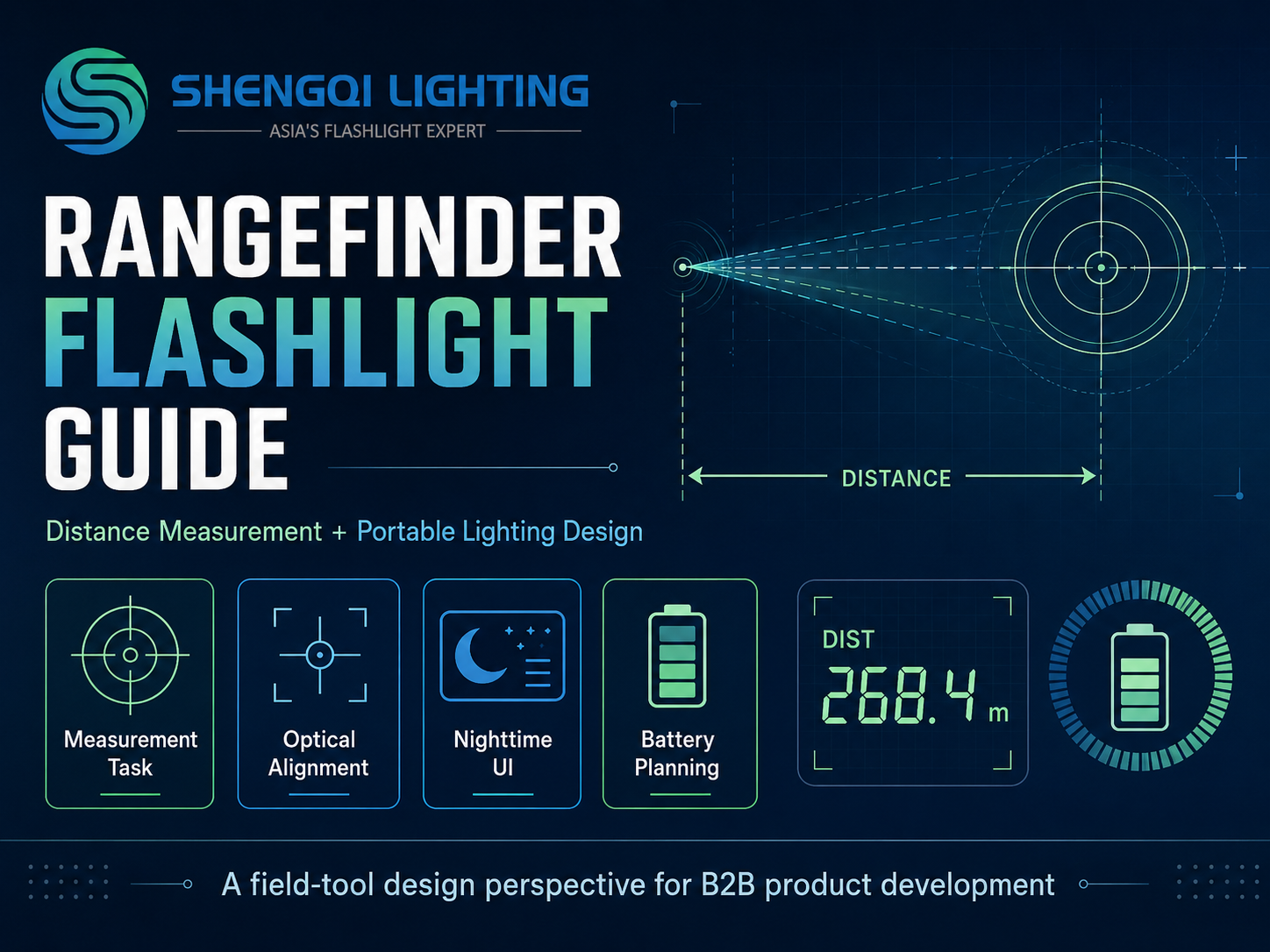
A Rangefinder Flashlight combines portable illumination with electronic distance measurement in one handheld architecture. The intended workflow is straightforward: identify or illuminate a target, measure its distance and read the result without repeatedly changing between two separate tools.
That does not mean the product should be treated as two independent feature blocks. The value comes from workflow integration. Outdoor observation, property inspection, facility checks, construction planning, utility inspection, agricultural field work and equipment setup can all create situations where lighting and distance information are needed together. The exact product brief should still come from the target application.
Start With the Field Task
Before choosing LEDs, optics or a measurement module, define what the user is trying to accomplish. A property inspector checking building dimensions has different needs from an outdoor team measuring equipment placement or a maintenance crew documenting distances around a facility.
The useful sequence is: Use Case → Target Distance → Measurement Module → Illumination Beam → Optical Alignment → Display → Controls → Battery → Mechanical Structure → Environmental Requirement → Verification.
Define the Measurement Task Before Choosing the Module
Buyers should first specify typical measurement distance, maximum useful distance, target size, target reflectivity, indoor or outdoor use, daylight or nighttime operation, measurement frequency and required repeatability.
Maximum advertised range alone does not define real usability. A small, low-reflectivity target outdoors may present a different measurement challenge from a large indoor surface. Measurement technology, accuracy target and verification method should therefore remain project-specific rather than being selected from one headline distance number.
The Flashlight Beam and Rangefinder Must Support the Same Target
The measurement axis and flashlight optical axis should be evaluated together. Beam center, aiming reference, hotspot size, spill, working distance and reflected glare all affect whether the user understands what the tool is actually measuring.
If the light visually emphasizes one object while the measurement subsystem reads another, the user may receive a technically valid number that does not match the intended target. Alignment becomes especially important when multiple objects sit close together or when the illuminated area is much wider than the measurement reference.
Optical alignment should be evaluated as a complete system.
Peak Lumens Do Not Define a Good Rangefinder Flashlight
Maximum output does not tell a buyer how clearly the target will appear at the intended working distance. It also does not define hotspot size, beam intensity, spill, glare, sustained output or thermal behavior.
The better approach is to work backward from real target distance and field conditions. The illumination requirement should support identification and aiming without assuming that the highest possible lumen figure automatically improves measurement workflow.
The Display Is Part of the Nighttime User Interface
A measurement result is only useful when the user can read it quickly. Display brightness, viewing angle, number size, battery indication and result layout should be reviewed together.
A display that looks excellent indoors may be too bright at night or difficult to read outdoors. Prototype evaluation should therefore include daylight, low-light and dark conditions. Automatic or adjustable display behavior can be considered as a design option if the product brief requires it.
Measurement and Lighting Controls Should Be Easy to Distinguish
A multifunction field tool may need separate actions for power, distance measurement, flashlight output, measurement mode and display control. The layout should make those actions understandable by touch as well as by sight.
Buyers should define first-click behavior, dedicated measurement and lighting buttons, button spacing, tactile differences, lockout, accidental activation and mode memory where required. These are product-design options, not universal industry standards.
One Battery System May Need to Support Both Lighting and Measurement
The battery may need to power the LED, driver, distance-measurement electronics, display, processor and controls. For that reason, battery capacity alone does not define operating time.
The product brief should specify measurement frequency, flashlight mode, expected operating period, standby behavior, display behavior, charging workflow and whether the battery should be integrated or replaceable. Cell format should follow the system requirement rather than being chosen from a generic preference.
High Light Output Can Affect More Than the LED
Higher output can increase driver load, battery load and internal temperature. The measurement electronics and display also occupy the same enclosure and may have their own operating limits.
This does not mean a particular measurement module will automatically drift when the flashlight becomes warm. It means thermal interaction should be evaluated during prototype testing rather than treating the lighting and measurement subsystems as thermally independent.
A Rangefinder Adds Mechanical and Optical Constraints
A measurement window, LED optics, display, PCB, battery, switches, charging interface, sealing structure, internal brackets and alignment features all compete for space. Industrial design therefore cannot be completed first and handed to engineering afterward.
The housing must protect both the illumination system and the measurement system while maintaining alignment.
The Product Should Be Easy to Aim and Measure With One Hand
Prototype testing should review hand position, access to measurement and lighting buttons, display visibility, wrist angle, balance and accidental button presses. One-hand operation should be validated on the final sample rather than assumed from a rendering.
Environmental Requirements Must Be Defined From the Application
Rain, dust, temperature, impact and general outdoor exposure should be specified according to the target channel and field task. A construction-oriented product may have different requirements from a property-inspection tool or agricultural field instrument.
The target IP rating, impact requirement and operating-temperature range should be specified and tested for the final product configuration. They should not be copied from an unrelated flashlight platform.
Rangefinder Flashlight Product Specification Matrix
| Design Area | Buyer Question | Engineering Variable | Sample Verification | Main Risk |
|---|---|---|---|---|
| Measurement Range | What distances are useful? | Module and target conditions | Project-specific field test | Headline range exceeds real need |
| Measurement Repeatability | Are repeated readings consistent? | Target and measurement subsystem | Repeated measurements | Unstable user confidence |
| Optical Alignment | Does light support the measured target? | Beam and measurement axes | Alignment review | User measures the wrong object |
| Flashlight Beam | What beam fits the working distance? | Hotspot, spill and intensity | Field beam review | Glare or poor target visibility |
| Display | Can results be read in changing light? | Brightness and information layout | Day and night test | Glare or unreadable results |
| User Interface | Can functions be distinguished quickly? | Buttons, spacing and logic | Dark-operation test | Wrong function activated |
| Battery | How are both subsystems powered? | Load, standby and charging | Combined-use test | Unexpected operating time |
| Thermal Design | How do systems interact when warm? | Internal heat path | Output-over-time evaluation | Thermal interaction overlooked |
| Housing | Can all components remain protected and aligned? | Brackets, windows and tolerances | Mechanical inspection | Alignment shifts after assembly |
| Environmental Requirement | What field exposure is expected? | Ingress, impact and temperature targets | Project-defined tests | Specification does not match use |
Ten Tests Buyers Should Run on a Rangefinder Flashlight Prototype
Repeat measurements against representative targets and conditions.
Check whether simultaneous operation changes the workflow or result behavior.
Verify that illumination and measurement references support the intended target.
Review hotspot, spill and glare at representative working distances.
Confirm that results remain readable outdoors.
Check readability without excessive glare.
Confirm that measurement and lighting controls are distinguishable by touch.
Evaluate representative lighting, measuring, display and standby use together.
Observe the complete system under representative operating conditions.
Compare alignment, controls and measurement behavior across representative builds.
Distances, sample quantities, environmental conditions and acceptance criteria should remain project-specific.
Ten Questions to Ask Before Developing a Rangefinder Flashlight
- What distances does the user actually need to measure?
- What types of targets will be measured?
- How should the flashlight beam relate to the measurement axis?
- What beam pattern is useful at those distances?
- How will users distinguish measurement and lighting controls?
- How should the display behave in daylight and darkness?
- What battery architecture supports both functions?
- What thermal and environmental requirements apply?
- How will alignment and measurement repeatability be verified?
- How will the approved prototype be matched to mass production?
How an OEM/ODM Project Should Approach a Rangefinder Flashlight
A custom rangefinder flashlight project would require the lighting platform and measurement subsystem to be defined and validated together. Development may involve Industrial Design, Optical Engineering, Electronic Design, PCB Layout, battery architecture, Mechanical Engineering, thermal design, prototype validation, manufacturing and Quality Control.
SHENGQI LIGHTING can support the portable-lighting side of that development through its product-development services, while production planning can be reviewed through its manufacturing capabilities and testing and quality capabilities. Existing portable-lighting platforms can provide general lighting-architecture references, but they should not be described as existing rangefinder products.
For flashlight OEM or flashlight ODM planning, the key is to freeze the measurement, illumination, electronics and mechanical requirements as one product architecture before mass-production release.
Frequently Asked Questions
1. What is a rangefinder flashlight?
A rangefinder flashlight is a portable field tool that combines illumination and electronic distance measurement in one housing. Its purpose is to let the user identify or illuminate a target, take a distance reading and view the result without switching between separate devices. The exact measurement technology, range, accuracy, battery, display and environmental specification depend on the final product brief and should not be assumed from the category name alone.
2. How does a rangefinder flashlight measure distance?
Distance measurement depends on the electronic ranging subsystem selected for the project. That subsystem generates and processes a ranging signal, while the product electronics calculate and display the resulting distance according to the chosen technology. The exact measurement principle, wavelength, classification, range and accuracy must come from the selected module and verified specification. A flashlight beam itself does not calculate distance; illumination and measurement are separate functions that need coordinated alignment.
3. Why does optical alignment matter in a rangefinder flashlight?
Optical alignment helps the user understand which illuminated object is being measured. If the flashlight beam emphasizes one target while the measurement axis references another, the result may be confusing even when the measurement electronics are functioning correctly. Prototype verification should therefore compare beam center, aiming reference and measurement behavior at representative working distances. Alignment should also remain controlled through mechanical design, assembly and production-representative sample evaluation.
4. Is a higher-lumen flashlight better for distance measurement?
Not necessarily. Maximum lumens do not define measurement range or accuracy, and they do not tell the buyer whether the beam is useful at the intended target distance. Hotspot size, intensity, spill, glare, sustained output and thermal behavior can matter more to the field workflow. The correct illumination target should be developed from real target visibility requirements rather than assuming that increasing peak output will improve the distance-measurement function.
5. What battery should a rangefinder flashlight use?
There is no universal battery choice. The battery must support the LED, driver, measurement electronics, display, processor and controls while fitting the required size, weight, charging and service strategy. Buyers should define measurement frequency, flashlight modes, standby use and expected operating time before selecting an integrated or replaceable battery architecture. Battery capacity in mAh should not be treated as a direct runtime specification without combined-system testing.
6. What should B2B buyers test on a rangefinder flashlight prototype?
B2B buyers should test measurement repeatability, measurement behavior while the flashlight is operating, optical alignment, beam pattern, daylight and nighttime display readability, button identification, combined battery use and thermal behavior. They should also compare production-representative samples rather than relying on one prototype. Exact target distances, sample quantities, environmental conditions and acceptance criteria should be agreed for the specific product and application instead of copied from an unrelated device.
7. Can a rangefinder flashlight be customized for OEM/ODM projects?
Yes, the architecture can be developed around a defined B2B product brief, but the lighting and measurement systems should be treated as one engineering project. Industrial design, optics, electronics, PCB layout, battery architecture, mechanics, thermal behavior, display, controls and verification all interact. SHENGQI LIGHTING can support custom flashlight development from the portable-lighting engineering side, while the selected measurement subsystem and final product requirements would need project-specific definition and validation.
Build Around the Workflow, Not the Feature Count
A useful Rangefinder Flashlight begins with the field task. Measurement distance, target type, illumination, alignment, display, controls, battery and enclosure should all support the same workflow. The strongest prototype is not the one with the longest feature list; it is the one where the user can identify the target, measure it, read the result and repeat the process predictably.
Define Measurement and Illumination as One Product Architecture
A rangefinder flashlight project should connect the target application, measurement subsystem, optical alignment, lighting, electronics, battery, structure and verification before the design is released for production.
Contact SHENGQI LIGHTING for an OEM/ODM technical evaluation at sales@shengqilight.com.
Discuss Your Product Brief