Stop Bleeding Capital: The Ultimate Vetting Guide to Sourcing a True china flashlight factory
Greetings. I operate as a Senior Global Supply Chain Auditor. In international procurement, depositing capital into an unverified offshore entity is a profound operational hazard. Procurement executives frequently scour B2B platforms, engaging with beautifully designed storefronts they believe to be an authentic china flashlight factory. Tragically, a vast majority of these listings are digital illusions orchestrated by intermediaries.
When an overseas brand blindly contracts a trading company, they immediately forfeit control over product integrity and delivery schedules. Because these middlemen possess no physical machinery, they must fracture your purchase order across multiple sub-tier workshops. This systemic lack of centralized oversight inevitably spawns catastrophic batch inconsistencies and disastrous delays during peak seasonal retail cycles. To preserve your brand equity, you must implement a ruthless vetting protocol. This whitepaper establishes the strict empirical benchmarks required to identify a legitimate source manufacturer, leveraging Shengqi Lighting’s formidable industrial foundation to demonstrate true manufacturing authority.
I. The "Made in China" Maze: Spotting a True Manufacturer
The primary vulnerability in cross-border sourcing is the communication black box. A trading company acts as a barrier rather than a bridge. If your engineering team requests a specific modification to a printed circuit board (PCB), the trader must relay this to a subcontractor, who may then consult another component supplier. Because critical technical data is diluted through multiple unqualified intermediaries, communication efficiency plummets, and fatal engineering errors are inevitably injected into the final product.
To systematically neutralize this risk, procurement directors must demand closed-loop vertical integration. A genuine source factory executes all critical processes internally. Supported by decades of comprehensive OEM/ODM expertise, a dominant facility integrates raw material procurement, structural machining, and electronic assembly under a single, highly regulated roof. This heavy-asset model ensures that communication is direct, production schedules are impenetrable, and the finalized hardware perfectly mirrors your original CAD blueprints.
II. Beyond Assembly: The Need for In-House Optical R&D
Contracting a basic assembly workshop forces global brands into a destructive homogenization trap. Because low-tier facilities can only produce generic "public molds," your inventory becomes visually and functionally identical to thousands of budget competitors. This lack of differentiation instantly destroys your pricing power. Furthermore, as market trends demand smaller housings with vastly higher lumen outputs, basic assemblers fail to comprehend thermodynamic constraints, resulting in products that suffer severe thermal throttling or catastrophic LED incineration.
To command a premium market valuation, your brand must collaborate with elite Flashlight OEM ODM Manufacturers. An authoritative facility functions as your dedicated offshore R&D laboratory. They must possess an independent optical engineering division capable of executing advanced ray-tracing simulations for bespoke parabolic reflectors. Concurrently, they must resolve intense heat bottlenecks by engineering direct thermal path (DTP) copper substrates utilizing thermo-electric separation. This profound engineering capacity empowers your brand to launch exclusive, private-mold instruments that physically outperform the competition.
III. The CNC Backbone: Guaranteeing Consistency in Mass Production
Subtractive Precision Architecture
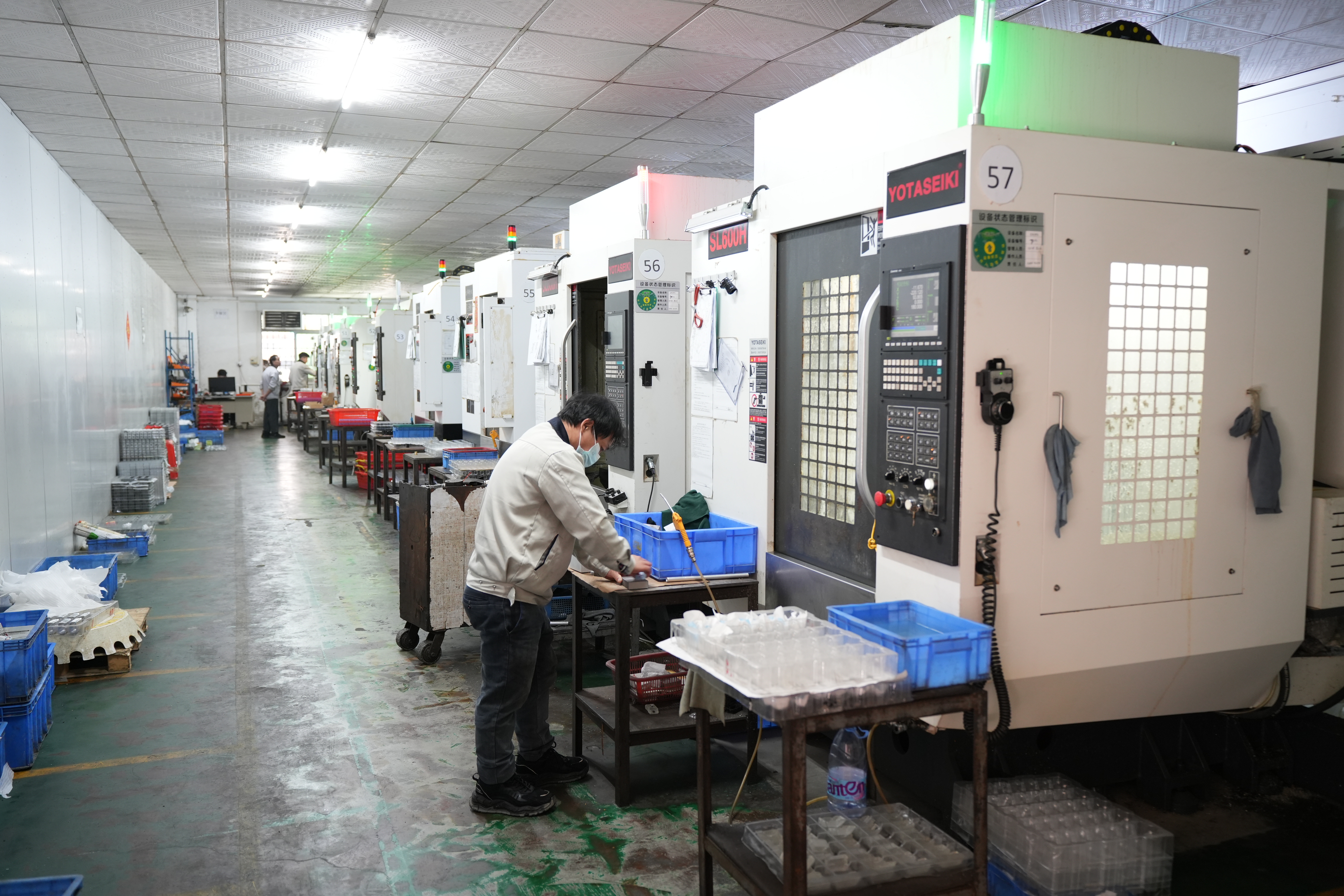
The most terrifying scenario for a cross-border distributor is the "Golden Sample" paradox: a perfectly machined prototype is approved, but the subsequent 100,000-unit bulk delivery features brittle bodies and cross-threaded caps. Because tactical and industrial instruments face extreme hydrostatic and kinetic stress, relying on cheap die-casting guarantees microscopic structural failures. To enforce absolute consistency, a factory must operate massive advanced multi-axis machining facilities. Carving each chassis directly from a solid aerospace aluminum billet ensures micron-level threading tolerances, which is the unyielding prerequisite for securing deep-water O-ring compression.
Optical Contamination Control
A flawlessly milled exterior is instantly compromised if the internal optical geometry is contaminated. Because ambient atmospheric dust settling on a reflector or LED die will induce severe chromatic aberration and dark focal artifacts, the environment must be strictly regulated. Mating the semiconductor to the optic must occur exclusively within optically pure dust-free assembly zones. Operating these pressurized, HEPA-filtered cleanrooms is a massive capital expenditure, serving as the ultimate litmus test separating a premier manufacturer from a low-end garage operation.
IV. Breaking the Trust Barrier: ANSI/NEMA FL1 Standards
The international procurement sector is heavily plagued by fraudulent performance metrics. Because overseas buyers cannot physically test prototypes prior to shipment without specialized metrology equipment, unethical vendors routinely exploit this distance. They print physically impossible lumen outputs and battery capacities on their packaging, transferring immense liability directly onto the retail brand.
You must eradicate this "fake specification" epidemic by demanding empirical validation. When evaluating a potential manufacturing partner, you must audit their internal laboratory infrastructure. A legitimate facility requires physical Integrating Spheres for calculating authentic luminous flux, pneumatic drop-test platforms for kinetic validation, and Salt Spray testing chambers to verify anodic oxidation integrity. By mandating that all telemetry complies strictly with the international ANSI/NEMA FL1 protocols, you strip away the marketing falsehoods and protect your brand’s reputation with undeniable physics.
V. Securing Factory-Direct Value and Peace of Mind
Inexperienced buyers frequently obsess over securing the absolute lowest initial unit quote. This strategy fundamentally miscalculates the Total Cost of Ownership (TCO). A marginally cheaper device procured from an unverified broker ultimately generates astronomical hidden liabilities. Because defective units trigger international return shipping costs, provoke negative e-commerce reviews, and cause the loss of premium retail shelf space, chasing the lowest initial quote inevitably destroys your net margin.
Strategic resilience is achieved through direct consolidation. By establishing an alliance with a Direct flashlight factory China, you seamlessly bypass intermediary markups to secure genuine factory-level pricing. More importantly, aligning with Reliable Flashlight Suppliers in China like Shengqi secures an exceptionally low defect yield rate. This provides absolute operational peace of mind, dramatically lowering your overall TCO, and empowering your enterprise to scale its distribution network securely.
Eradicate Supply Chain Vulnerabilities
Do not entrust the safety of your end-users and the integrity of your brand to unverified intermediaries. Resolving the crisis of supply chain opacity requires an uncompromising alliance with a verified, heavy-asset manufacturing partner.
[ Initiate Supply Chain Audit ]
SHENGQI LIGHTING operates as an elite, fully integrated source manufacturer. We formally invite global brand procurement directors to consult with our industrial trade division. Request empirical ANSI FL1 compliance data, explore custom OEM/ODM solutions, and schedule your comprehensive video factory audit today.