The Ultimate Tactical Flashlight Assembly Guide: Cleanroom Manufacturing and IP68 Sealing
[ Operational Analysis: The Ultimate Test of Manufacturing ]
Hello. I am the Senior Cleanroom Manufacturing and Assembly Director at SHENGQI LIGHTING. In the illumination industry, raw components mean very little. You might procure the most advanced 6061-T6 aerospace aluminum chassis and source the highest-bin LUMINUS LED available. However, if the final assembly is executed poorly in a contaminated environment, that premium hardware instantly degrades into industrial garbage.
When global tactical brands and defense contractors evaluate an OEM Tactical Flashlight Manufacturer, they do not just look at the CNC machines. They relentlessly audit the final assembly protocols. A microscopic speck of dust on a reflector will ruin a beam profile. A fractional misalignment of a seal will invite catastrophic water ingress under hydrostatic pressure.
This ultimate guide deconstructs our exact production workflow. From the initial thermal foundation to the final negative-pressure diagnostic, we will dissect the strict physics governing the Tactical Flashlight Assembly Process and IP68 Sealing.
I. Pre-Assembly & Thermal Foundations
The assembly process initiates long before the optical head is sealed. It begins with establishing the primary thermal and electrical pathways required for high-lumen, high-amperage operation.
Thermodynamic Preparation
First, automated SMT machines solder the bare LED die onto a Metal Core PCB (Aluminum or Copper DTP substrate). To mount this module into the aluminum flashlight chassis, engineers must eradicate microscopic air gaps. Automated dispensers apply a precisely calculated volume of high-thermal-conductivity silicone grease (or advanced thermal pads) directly to the back of the MCPCB. This guarantees a zero-resistance thermal bridge, allowing heat to instantly evacuate from the semiconductor into the flashlight's cooling fins.
Electrical Wire Routing
A 2000-lumen output demands massive electrical current. Standard PVC-coated wires might melt under these extreme thermal loads. During pre-assembly, technicians solder thick-gauge, high-temperature silicone-insulated wires to the driver board's output terminals. This specialized insulation easily survives internal temperatures exceeding 150°C, ensuring absolute electrical safety during prolonged tactical engagements.
II. The Optical Heart: Cleanroom Alignment
The optical module is the most vulnerable section of the instrument. As a certified Professional LED Flashlight Factory, our protocols dictate that optical integration must occur exclusively within positive-pressure, HEPA-filtered cleanrooms.
- [ MACHINE VISION ALIGNMENT ] Human hands cannot guarantee geometric perfection. Once the LED substrate is placed, we utilize automated machine vision systems. High-resolution cameras map the exact center of the LED die. Robotic arms then lower the parabolic reflector or TIR lens so that its focal axis perfectly intersects the semiconductor's center. A deviation of just 0.1mm might create a devastating "black hole" or asymmetrical artifact in the final beam profile.
- [ OPTICAL PROTECTION ] Following alignment, technicians place the front protective glass. We utilize tempered mineral glass treated with an Anti-Reflective (AR) coating to maximize light transmittance. Immediately above the glass, a high-elasticity fluororubber O-ring is seated into the CNC-machined groove to establish the primary hydrostatic barrier.
- [ CONSTANT TORQUE COMPRESSION ] Sealing the bezel is an exact science. If tightened unevenly, the glass might fracture under thermal expansion; if too loose, the O-ring will leak under pressure. We employ specialized pneumatic jigs that apply a strict constant torque. This guarantees uniform downward pressure across the entire 360-degree circumference of the O-ring, ensuring absolute structural stability and waterproof consistency.
III. Electrical Integration & IP68 Sealing
With the optical head secured, the internal electronics must be permanently bound to the chassis. As a premier Heavy duty tactical flashlight supplier, our final assembly methods focus heavily on vibration resistance and atmospheric isolation.
The Laser Welding Transition
Historically, technicians used soldering irons to connect the driver board wires to the LED substrate. This process subjects the delicate semiconductor to prolonged, damaging thermal shock. Our advanced assembly lines have transitioned to Laser Welding. A focused laser pulse melts the wire to the contact pad in mere milliseconds. This minimizes the Heat Affected Zone (HAZ) and creates an unbreakable metallurgical bond that easily survives violent weapon recoil and kinetic drops.
Hydrophobic Thread Lubrication
Before the tail cap is attached, the CNC-machined trapezoidal threads are coated with a specialized, heavy dielectric waterproof grease. This hydrophobic layer not only facilitates smooth, frictionless mechanical rotation but acts as a dynamic fluid barrier, physically repelling water molecules from migrating past the secondary rear O-rings.
Negative Pressure Leak Testing
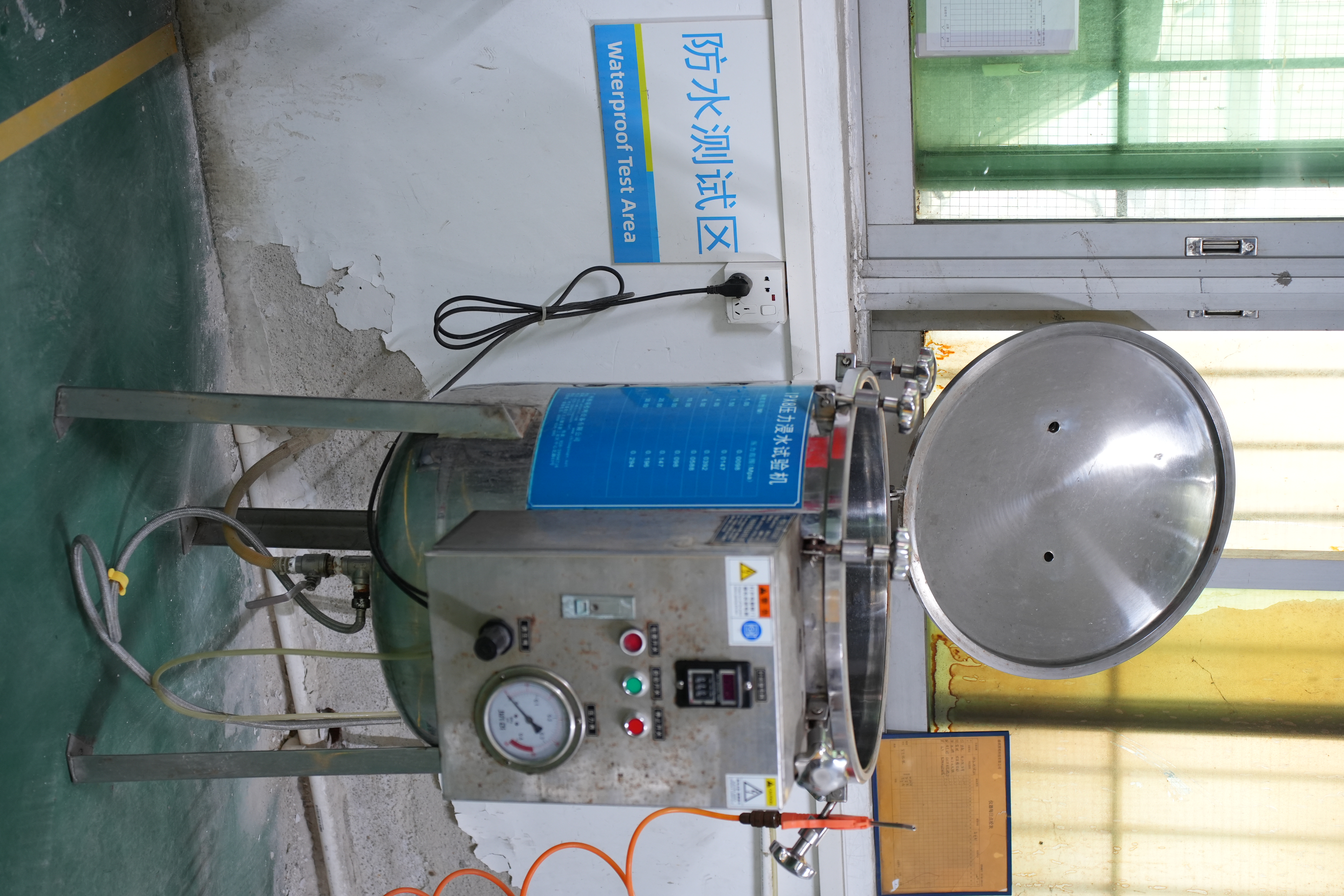
Waterproof claims must be empirically proven before the product is boxed. We do not arbitrarily drop finished flashlights into water tanks, as a failure would destroy the internal electronics. Instead, we utilize state-of-the-art Negative Pressure Leak Testing.
The fully assembled housing (without the battery) is placed inside an airtight diagnostic chamber. The machine rapidly extracts the ambient air, creating a severe vacuum. If any microscopic defect exists within the O-ring seals or the AR glass seating, the trapped air inside the flashlight body will expand and escape into the chamber. High-precision barometric sensors detect this microscopic pressure anomaly in milliseconds. This dry-testing methodology guarantees a true IP68 submersible rating (2 meters underwater) with absolute certainty.
IV. The Final Trial: Testing & Burn-in
A sealed chassis is only half the equation. As the definitive China Tactical Flashlight Factory, our final quality control protocols ensure that theoretical optical and thermal engineering successfully translates into physical reality.
Metrology: The Integrating Sphere
Samples from the assembly line are activated inside a highly calibrated Integrating Sphere. Coated in ultra-matte Barium Sulfate ($BaSO_4$), this instrument captures all scattered photons to objectively measure the total Luminous Flux (Lumens). Coupled spectrometers verify the Correlated Color Temperature (CCT) and measure peak beam intensity, ensuring the optical output matches the specific ANSI FL1 parameters demanded by the client.
The Burn-In Test
Electronic components adhere to a "bathtub curve" of failure, meaning manufacturing defects present themselves almost immediately upon high-stress use. To weed out these early failures, flashlights undergo an extensive Burn-in Test. Units are mounted to specialized racks and run continuously at maximum Turbo output. This subjects the internal MOSFETs, LED substrates, and thermal paste to maximum thermal saturation, guaranteeing that the thermal pathways operate flawlessly and the device will not fail during field deployment.
V. Expert FAQ: Assembly and Quality Control
Q1: Why do cheap, off-brand flashlights frequently display dark spots or a "donut hole" in the center of the beam?
This is a direct result of poor manual assembly. If a factory relies on human hands rather than Machine Vision Alignment to place the reflector over the LED, the semiconductor will not rest at the exact geometric focal point of the parabola. This fractional misalignment severely distorts the light rays, creating massive dark voids and asymmetrical artifacting in the beam profile.
Q2: Why is the application of "constant torque" so critical for IP68 waterproofing?
Hydrostatic sealing requires uniform elastomeric compression. If a worker manually tightens a flashlight bezel, the pressure applied to the fluororubber O-ring will be uneven. When subjected to the pressure of 2 meters of water, capillary action will force fluid through the least compressed section of the O-ring. Automated constant torque jigs guarantee 360-degree uniform compression, eliminating this vulnerability.
Q3: How does SHENGQI ensure assembly consistency when processing a massive order of 50,000 tactical flashlights?
Consistency at scale requires aggressive automation and strict ISO9001 quality management protocols. We eliminate human variables by deploying automated thermal paste dispensers, laser welding stations, and pneumatic negative-pressure leak testing machines across our 11 dust-free assembly lines. Every single unit undergoes automated metrology, ensuring unit #50,000 performs identically to unit #1.
Validate Your Supply Chain Assembly
Do not gamble your brand reputation on generic assemblers operating in contaminated environments. Precision illumination demands an uncompromising approach to structural integration, laser welding, and hydrostatic verification.
[ Facility Audit & Sourcing Initiation ]
SHENGQI LIGHTING formally invites global procurement directors, defense contractors, and tactical gear distributors to evaluate our 130,000 sq. ft. manufacturing infrastructure. Contact our trade division to request a comprehensive facility audit, secure evaluation samples, and discuss your bespoke OEM assembly requirements.