The Ultimate Tactical Flashlight Light Source Guide: LED, LEP, COB, and UV Explained by SHENGQI LIGHTING
[ Executive Metrology: The Soul of Tactical Illumination ]
Hello, this is your Senior Optoelectronic Engineer from SHENGQI LIGHTING. Flawless 6061-T6 aluminum CNC machining and advanced lithium-ion battery management systems are engineering prerequisites, but they ultimately serve one singular purpose: to deliver photons. The physical light engine dictates the absolute operational parameter of the instrument.
When B2B procurement directors and brand architects initiate a custom flashlight project, the core foundational decision rests upon selecting the correct photonic architecture. Different tactical and industrial environments demand diametrically opposed physics of light generation. A highly collimated search beam could prove disastrous in a close-quarters mechanical bay, just as a diffused floodlight might fail entirely during maritime border patrol. This objective guide dissects the exact physical properties governing modern light engines, ensuring your brand selects the optimal optoelectronic core.
I. The Main Battle: Tactical Flashlight Light Source: LED vs LEP
The primary dichotomy in high-performance illumination exists between traditional solid-state semiconductors and microwave-excited plasma. Understanding the Tactical Flashlight Light Source: LED vs LEP debate is critical for specifying military, law enforcement, and SAR (Search and Rescue) equipment.
Solid-State Dominance: The Light Emitting Diode (LED)
The LED is a solid-state semiconductor. It operates via electroluminescence; when a forward voltage is applied, electrons recombine with electron holes within the p-n junction, releasing energy as photons. The LED is the undisputed backbone of modern illumination due to its monumental operational lifespan (routinely exceeding 50,000 continuous hours), extreme resistance to kinetic shock, and its ability to render colors accurately with a high Color Rendering Index (CRI).
LEDs provide the perfect tactical equilibrium between wide-area flood and directional throw. For example, in our flagship T20 model, we deploy the legendary LUMINUS SST40 LED to generate an overwhelming 2000-lumen output. This architecture ensures the operator achieves instant perimeter saturation alongside a potent central hotspot. As a recognized High Lumen Tactical Flashlight Manufacturer, we rely on advanced LED configurations to provide law enforcement personnel with unparalleled localized spatial dominance.
The Throw Paradigm: Light Emitting Plasma (LEP)
When operational parameters demand illumination distances exceeding 1,500 meters, LEDs face insurmountable geometric limitations. To achieve absolute atmospheric penetration, engineers deploy the LEP. Light Emitting Plasma technology entirely discards the solid-state semiconductor. Instead, a solid-state amplifier generates high-intensity microwave energy, which is injected directly into a sealed, electrodeless quartz bulb filled with noble gases and metal halides.
The microwaves excite the gas into a highly luminous plasma discharge. The optical physics here are profound. LEP creates a continuous, full-spectrum emission that boasts an ultra-high CRI of 94-96Ra with absolutely zero flicker.
Because the plasma source is infinitesimally small, a specialized convex lens array may collimate the light into a mathematically flawless "Pencil Beam." With virtually zero peripheral spill, this beam slices effortlessly through thick smoke, dense coastal fog, and heavy rain without generating the blinding backscatter that plagues standard LEDs. It is the ultimate solution for long-range targeting, maritime navigation, and advanced search and rescue.
II. Technical Parameter Matrix: LED vs. LEP
The empirical table below defines the stark optical disparities between solid-state and plasma-driven architectures.
III. Special Operations: COB Homogeneity & UV Diagnostics
Certain industrial mechanics and forensic protocols demand highly specialized spectral emissions that standard directional LEDs cannot supply.
COB (Chip on Board) Architecture
Directional lighting creates harsh shadows inside cramped mechanical bays. COB technology resolves this by mounting dozens of microscopic, bare LED chips directly onto a highly thermally conductive substrate, coated in a continuous layer of uniform phosphor.
This transforms the diode into a massive, contiguous light-emitting panel. COB outputs a 180-degree, perfectly homogeneous wall of light. By entirely eliminating the "multiple shadow" artifacting of standard multi-die arrays, COB establishes itself as the ultimate optical solution for industrial workstations and camping lanterns (such as our articulated P2 and P3 models).
Ultraviolet (UV) Diagnostic Wavelengths
When inspecting crime scenes or executing Non-Destructive Testing (NDT), standard visible light is useless. We deploy specialized UV diodes operating specifically within the 365nm to 400nm spectrum (such as in our L13 and Y4 models).
Operating on the physics of fluorescence, these invisible high-energy photons trigger a profound Stokes shift in reactive phosphors. When directed at latent biological fluids (blood/semen), counterfeit currency threads, or industrial HVAC leak-detection dyes, the phosphors absorb the UV energy and re-emit brilliant, visible fluorescence. The strict 365nm wavelength is mandatory to prevent visible purple light bleeding from overpowering faint diagnostic reactions.
IV. The Manufacturer's Edge: Micron-Level Precision Alignment
Sourcing a premium LED or LEP engine is only the first step. If the engine is improperly seated within the flashlight housing, the resulting optical profile will be catastrophically distorted.
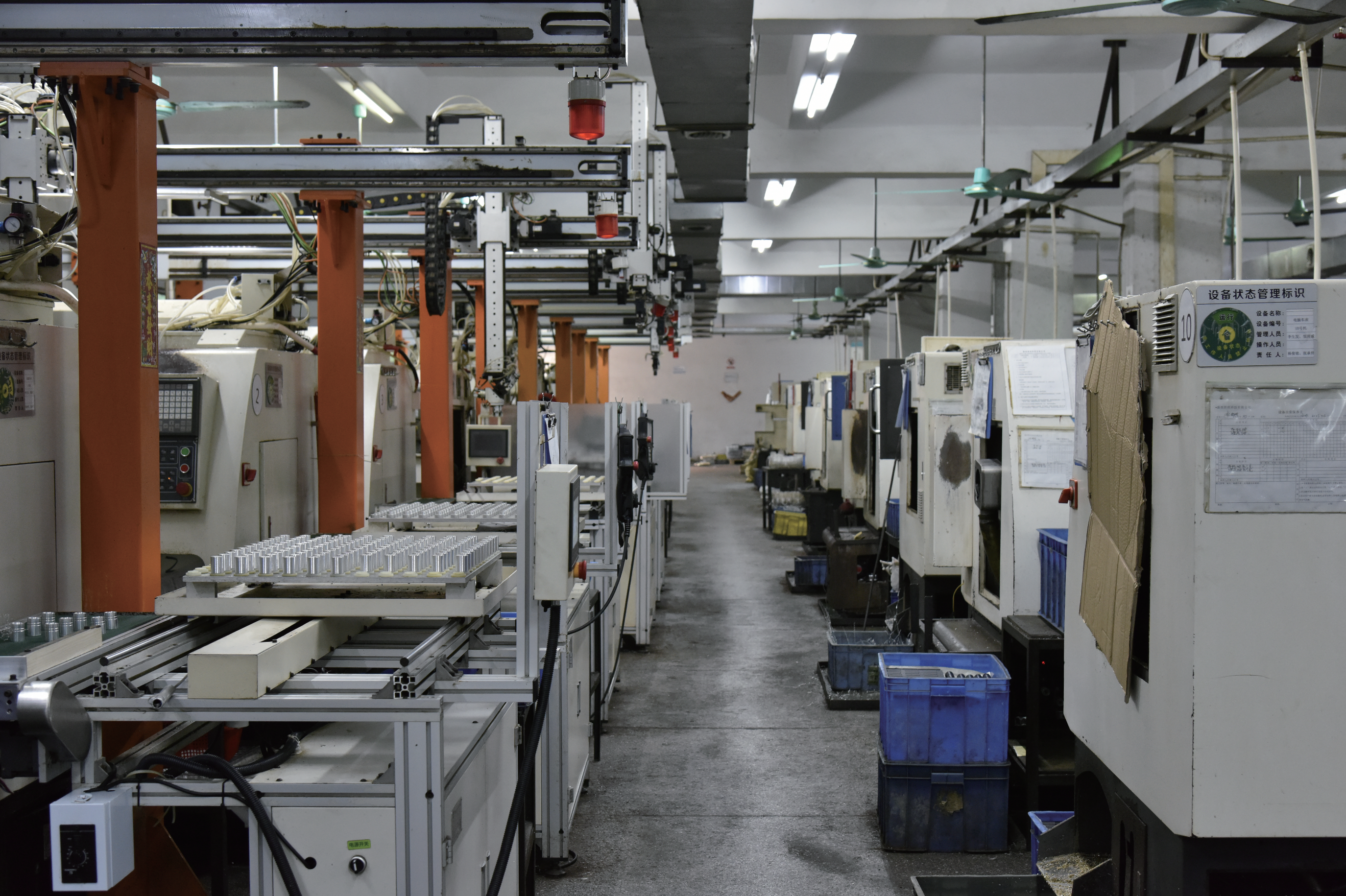
To collimate light efficiently, the semiconductor junction must sit at the exact geometric focal point of the SMO parabolic reflector or the central node of a TIR (Total Internal Reflection) lens. A lateral deviation of a mere 0.1 millimeters will instantly generate an asymmetrical beam featuring dark spots or a distorted, off-center "donut hole" hotspot. As a premier OEM Tactical Flashlight Manufacturer and a highly verified China Tactical Flashlight Factory, SHENGQI LIGHTING refuses to rely on manual insertion. We utilize high-resolution machine vision systems and 5-axis CNC turning centers to guarantee the ±0.01mm coaxial tolerances required to perfectly align the optical engine with the reflector architecture.
V. B2B Sourcing Decision Tree
Procurement officers may utilize this objective logic tree to formulate precise RFQ specifications based on their target market dynamics:
- [ Mission: Extreme Atmospheric Penetration ] Specify LEP Technology. Mandatory for border security, target designation, and long-range maritime communication.
- [ Mission: Kinetic Area Suppression ] Specify High-Lumen LEDs (e.g., LUMINUS SST40). Required for SWAT operations, CQC room clearing, and standard military duty lights.
- [ Mission: Industrial Hands-Free Maintenance ] Specify COB Modules. The undisputed choice for mechanic bays, HVAC repair, and wide-area camping lanterns.
Executing these diverse photometric parameters requires a highly capable Custom Tactical Flashlight Supplier. SHENGQI LIGHTING possesses the independent laboratory infrastructure to engineer bespoke light engines tailored to your exact operational requirements.
VI. Expert FAQ: Optoelectronic Engine Selection
Q1: Is an LEP (Light Emitting Plasma) flashlight safe for the human eye?
While LEP outputs a continuous, full-spectrum light, the severe collimation of its "pencil beam" generates extreme peak intensity (candela). Similar to high-wattage Class IIIb lasers, operators must strictly avoid pointing an LEP beam directly into a person's eyes at close range, as it might induce severe retinal damage. It is an instrument strictly reserved for long-distance targeting.
Q2: Why are COB modules rarely utilized as the primary optic in tactical flashlights?
A parabolic reflector requires a microscopic "point source" to geometrically focus light rays. A COB module is an inherently massive, wide-area surface emitter. If placed inside a reflector, the light will cross-scatter violently, resulting in a completely unfocused, short-range flood. COB geometry explicitly prohibits the intense beam distances demanded by tactical scenarios.
Q3: Why do high-lumen LEDs require such strictly regulated driver circuits?
LEDs are non-linear semiconductors governed by an exponential Voltage-Current (V-I) curve. A fractional increase in voltage triggers a massive spike in amperage, resulting in catastrophic thermal runaway. High-power LEDs demand sophisticated Constant Current (CC) drivers with active thermal regulation (ATR) to safely manage this volatile power draw without melting the substrate.
Secure Your Optoelectronic Architecture
Integrating highly volatile semiconductors into aerospace aluminum chassis requires uncompromising engineering discipline. Procurement officers must ensure that their chosen manufacturer possesses the independent laboratory infrastructure required to calculate parabolic geometry, execute exact CNC turning, and validate thermal safety.
[ Initiation of R&D Consultation ]
SHENGQI LIGHTING operates as a globally certified OEM/ODM manufacturing authority. We invite B2B brand agents and tactical distributors to consult directly with our optical engineering division to establish precision-aligned, custom light engines tailored specifically to your operational deployments.