Unmasking the Middlemen: The Insider's Vetting Guide to Sourcing a True flashlight factory in china
Greetings. I operate as a Senior Global Supply Chain Auditor. In the international procurement sector, placing a high-volume purchase order without verifying the underlying manufacturing infrastructure introduces catastrophic liability. Overseas brand directors frequently initiate contracts with entities they believe to be source manufacturers. In reality, a vast percentage of these enterprises operate merely as intermediaries—trading companies possessing zero internal quality control infrastructure and zero engineering authority.
When a brand relies on a fragmented supply chain, operational disaster becomes inevitable. Because trading companies outsource production to the lowest bidder, communication bottlenecks compound into massive delivery delays, while a lack of direct metallurgical oversight causes severe batch inconsistencies. To protect your brand equity, you must pierce this digital illusion. This document serves as the ultimate empirical vetting guide. We will dismantle the "black box" of overseas procurement, illustrating the uncompromising infrastructural thresholds that distinguish Shengqi Lighting as the apex standard for industrial illumination manufacturing.
I. The "Middleman" Illusion: Trading Companies vs. True Manufacturers
The primary vulnerability in global sourcing is misidentification. A brilliantly designed website might present a vendor as a genuine flashlight factory in china, yet behind the digital facade lies a small office reliant on a web of unstable sub-contractors. When a trading company receives your bulk order, they fracture the production process. Because they must outsource the aluminum machining to one facility and the circuit board soldering to another, they surrender all control over the production timeline. Consequently, communication costs skyrocket, custom private mold requests become impossible to execute, and bulk order lead times spiral out of control.
To insulate your supply chain, you must partner with an entity that utilizes closed-loop, vertical integration. A true source factory internalizes every stage of production—from the raw aluminum billet to the final shrink-wrapped carton. This centralization guarantees absolute accountability and impenetrable lead-time security. Shengqi Lighting exemplifies this standard, leveraging decades of deep-rooted manufacturing heritage to eliminate intermediary volatility and protect your peak-season inventory.
II. Beyond Assembly: The Importance of In-House R&D and Optical Engineering
Relying on basic assembly workshops traps brands in a perpetual cycle of homogenization. These facilities offer "public molds"—generic chassis designs available to anyone. Because these products share the exact same aesthetic and internal flaws as fifty other competitors, your brand is forced into a devastating price war, stripped of any unique technological differentiator. To command premium market valuation, your hardware must evolve beyond catalog selections.
An elite OEM tactical flashlight manufacturer functions as an extension of your own brand’s engineering department. When you initiate a custom project, the facility must deploy dedicated Industrial Design (ID) teams to calculate ergonomic kinetic grip patterns. Furthermore, they must possess deep expertise in Optical Engineering to simulate ray-tracing trajectories for parabolic reflectors. Crucially, they might mitigate extreme thermal bottlenecks by applying Thermo-Electric Separation on pure copper substrates, ensuring the semiconductor safely evacuates intense thermal loads. This full-stack R&D capability transforms a theoretical concept into an exclusive, high-margin asset, building a formidable market moat around your brand.
III. The Machining Muscle: Aerospace-Grade Tolerances and Cleanrooms
Subtractive Precision Infrastructure
Tactical operations and heavy industrial inspections inflict severe kinetic and hydrostatic stress upon equipment. Flimsy, die-cast components will inevitably fracture. To achieve true submersible defense and impact survivability, a factory must utilize massive advanced multi-axis machining facilities. By carving the chassis entirely from solid aerospace-grade aluminum, the metallurgical grain structure remains undisturbed. This guarantees micron-level thread tolerances, enabling perfect O-ring compression for unyielding submersible performance.
Atmospheric Contamination Control
An impeccably machined exterior is worthless if the internal optics are compromised during assembly. Ambient dust particles settling onto a highly polished reflector will induce severe chromatic aberration and structural dark spots within the beam profile. Elite manufacturing is characterized by the implementation of optically pure dust-free assembly zones. These pressurized, HEPA-filtered cleanrooms are an absolute prerequisite to ensure pristine photonic delivery, serving as the core dividing line between top-tier factories and low-end workshops.
IV. Zero Tolerance for "Fake Lumens": ANSI FL1 Standards and Torture Labs
The most pervasive fraud in global illumination procurement involves exaggerated performance metrics. Unverified vendors routinely publish theoretical "emitter lumens" while ignoring severe optical loss and battery capacity fabrication. Because these devices lack genuine thermodynamic management, they promise extreme output but deliver a dim, overheated beam within minutes. This generates a profound trust crisis among overseas buyers who demand absolute reliability.
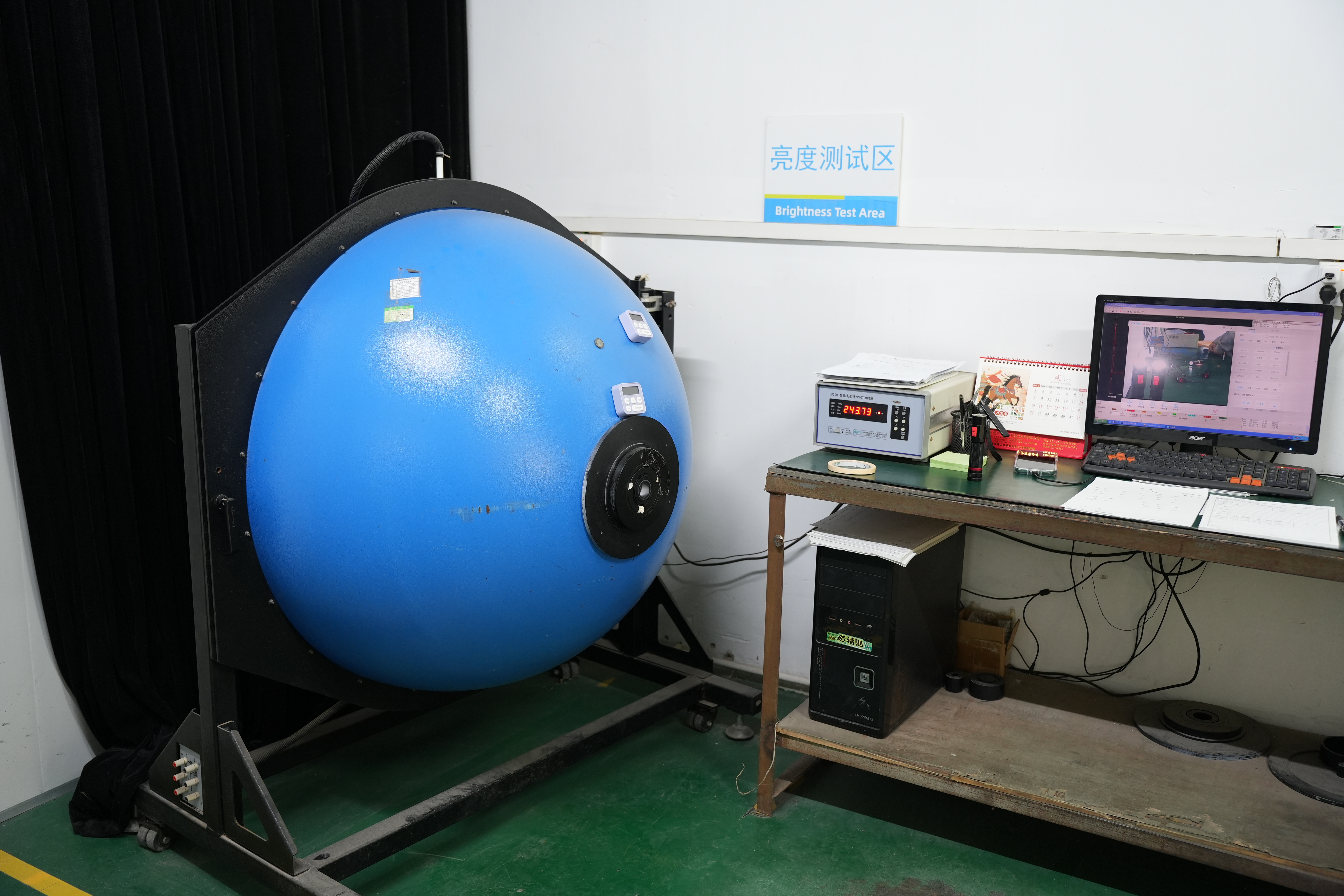
When auditing a China tactical flashlight factory, empirical laboratory infrastructure must be validated. A legitimate manufacturer annihilates "fake lumens" by relying strictly on the internationally recognized ANSI/NEMA FL1 Standard. During your audit, you must verify the existence of physical Integrating Spheres for true luminous flux measurement, automated vacuum negative-pressure leak testing machines for hydrostatic integrity, and pneumatic drop-test platforms. A truly reliable supplier speaks exclusively through verifiable, hard data harvested from these torture labs.
V. Securing Your Supply Chain with Reliable Partners
Inexperienced procurement managers often fixate on securing the lowest initial Bill of Materials (BOM) cost. This tactical error fundamentally ignores the Total Cost of Ownership (TCO). A marginally cheaper flashlight procured from an unstable trading company ultimately incurs catastrophic hidden expenses: staggering cross-border shipping costs for replacements, the administrative burden of processing high-volume consumer complaints, and the permanent erosion of brand loyalty.
By executing strict due diligence and partnering directly with reliable flashlight suppliers in China, a brand establishes an impenetrable supply chain. Aligning your enterprise with a source manufacturer supported by decades of deep-rooted manufacturing heritage allows you to secure highly competitive factory-direct pricing. More importantly, investing in rigorous QA/QC protocols yields an exceptionally low defect rate. This resulting "maintenance-free" product lifecycle drastically reduces post-sale liabilities, fundamentally minimizing your TCO and maximizing your long-term commercial profitability.
Eradicate Substandard Supply Chains
Do not allow intermediaries lacking engineering infrastructure to compromise the safety of your industrial end-users. Resolving the crisis of supply chain opacity requires engaging a proven, heavy-asset manufacturing partner.
[ Initiate Supply Chain Evaluation ]
SHENGQI LIGHTING operates as an elite, fully integrated source manufacturer. We formally invite global brand procurement directors to consult with our industrial trade division. Request our empirical compliance data, schedule your comprehensive video factory audit, and secure your customized partnership proposal today.