Cleaning Verification Guide
Black Light Inspection: How to Check Cleaning Results
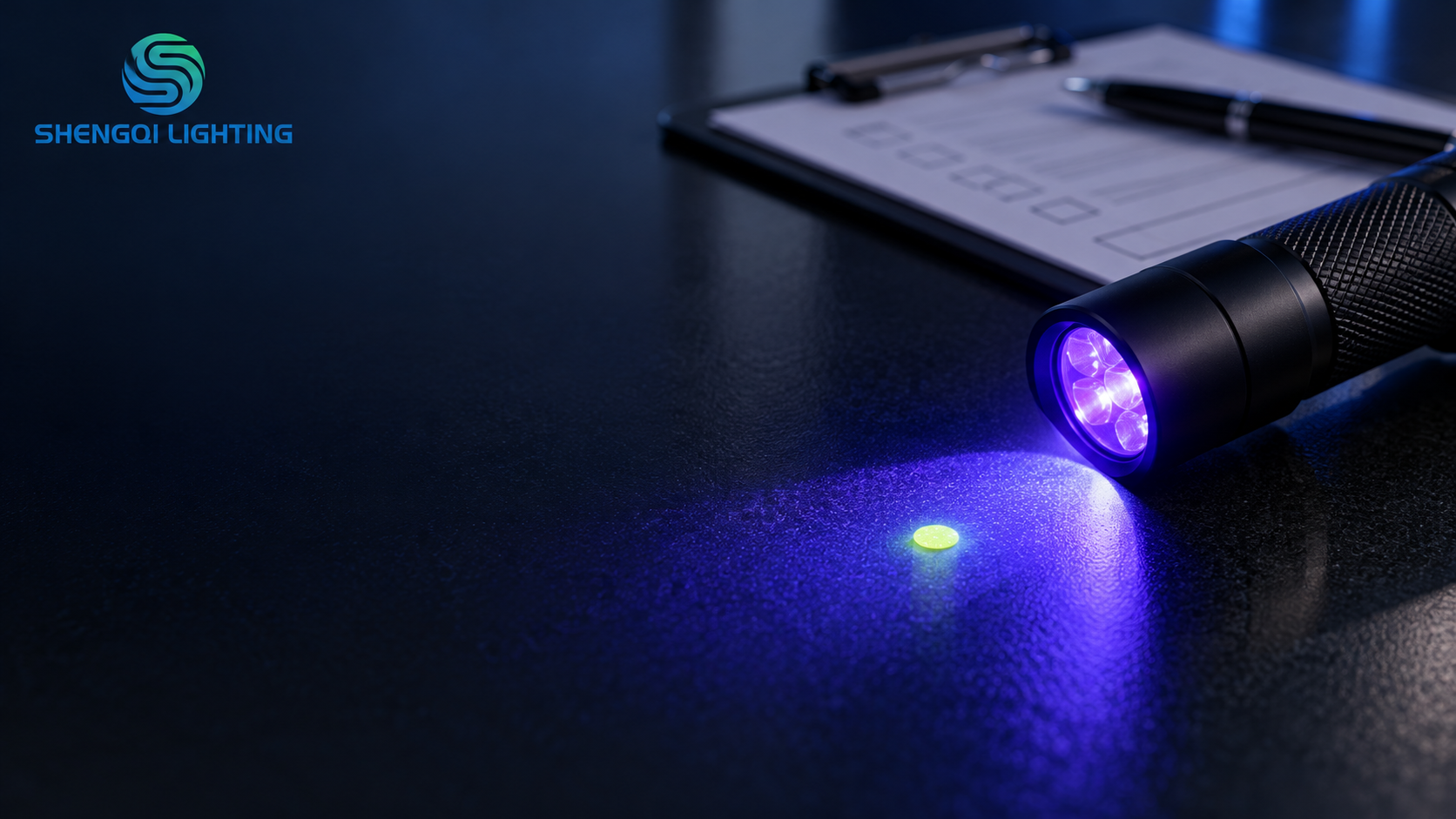
A black light inspection shows a fluorescent response under specific viewing conditions. It does not automatically identify what caused that response. An unknown glowing area and a pre-applied fluorescent marker need different interpretations. A single observation also cannot prove that a surface is free from contamination or that disinfection was effective.
The useful question after a black light inspection is not simply, “Did it glow?” It is, “What was the inspection designed to check, was the observation comparable to the reference, and what conclusion does the evidence actually support?” This distinction helps cleaning-equipment distributors, facilities teams and product managers explain a UV inspection tool accurately without promising more than it can demonstrate.
What black light inspection can support
It can support an observation that a defined fluorescent marker remains visible, has been removed, or that an unknown fluorescent response was seen under stated conditions.
What it does not prove
It does not directly identify bacteria, viruses, mold, body fluids or a specific substance. It also does not prove sanitization, disinfection or sterility.
Start by Defining What the Inspection Is Checking
There are two different inspection tasks that are often confused.
A. Scanning for an unknown fluorescent response
A user scans a surface and notices an area that fluoresces. This supports only that a visible fluorescent response was observed under those conditions. The source may be unknown and should not be assumed to be contamination, residue or a particular material without separate evidence.
B. Checking a known fluorescent marker placed before cleaning
A marker is deliberately placed at a documented location before cleaning. After cleaning, the observer checks whether that known marker remains. This can be used to assess whether the selected marked point appears to have been cleaned according to the defined process.
These two tasks cannot be exchanged. An unknown glow is not the same as a standardized marker result. Likewise, successful removal of a known marker does not establish a hygiene conclusion for an entire room, an entire work area or every unmarked surface.
A fluorescent-marker check is strongest when it answers the narrow question it was designed to answer: whether a known marker at a known location was removed under a defined cleaning process.
How to Interpret Black Light Inspection Results
A useful result statement should match the strength of the observation. The following table is a practical decision aid, not a bacteria test, disinfection standard or universal pass/fail rule.
| Observation | What It Supports | What It Does Not Prove | Next Check |
|---|---|---|---|
| Unknown fluorescence is visible | A fluorescent response was observed at that location under the stated conditions. | The identity, source or health significance of the material. | Compare with unmarked background and follow the site’s escalation or review process. |
| A known marker remains visible after cleaning | The marker appears to remain at the documented point. | That every cleaning step failed, or that the location contains a specific contaminant. | Confirm the location, review the process and apply the pre-defined recheck rule. |
| Known marker is no longer visible and the reference check is valid | The specified marker point appears to have been cleaned under the documented conditions. | Disinfection, sterility or cleanliness of the entire surrounding area. | Record the result as a marker-removal observation for that point and process. |
| Reference marker cannot be seen | The observation conditions may not support a reliable decision. | That the target point passed because no fluorescence was observed. | Record as unable to interpret; restore the reference and repeat under suitable conditions. |
| Background fluorescence or reflection prevents a clear reading | The surface or conditions introduce uncertainty. | A pass or failure conclusion. | Use a representative background comparison, revisit marker suitability or escalate for review. |
Build a Repeatable Observation and Recheck Process
A black light for cleaning inspections is most useful when the inspection process is defined before cleaning starts. The aim is not to create a universal protocol. It is to make a specific observation comparable before and after the selected cleaning step.
- Define the task. State whether the inspection is looking for unknown fluorescence or checking removal of a pre-applied marker. These tasks require different result language.
- Confirm surface and marker suitability. Follow the marker supplier’s directions and consider the material, texture and finish. A porous, rough or highly reflective surface may not provide a clear comparison.
- Document the initial condition. For marker checks, record the location and confirm that the marker is visible before cleaning. Without this reference, a later “no visible fluorescence” result can be difficult to interpret.
- Use both a reference and background comparison. A known visible reference helps show that the inspection setup is working. An unmarked representative background helps the observer distinguish marker response from surface fluorescence or reflection.
- Keep viewing conditions reasonably comparable. Ambient light, viewing angle, distance, flashlight condition and the exact inspection point can affect what is visible. A changed condition does not make the result invalid by itself, but it should be recorded when it affects comparison.
- Apply the decision rule already agreed for the task. Define in advance how to handle visible residual marker, partial removal and an observation that cannot be interpreted. An unclear result should not automatically become a pass.
Why the reference check matters
If a known reference marker cannot be seen, the absence of visible fluorescence at the target point does not support a reliable “pass” conclusion. The inspection may need to be repeated or reviewed under conditions that allow the reference to be observed.
What Can Make the Same Surface Look Different?
Differences in appearance do not always mean the surface changed. They can also reflect changes in observation conditions. Buyers and service teams should explain these limits before using a black light inspection result as an acceptance record.
- Surface background and texture: Rough, porous, patterned or glossy surfaces can create background fluorescence, retain marker differently or produce reflections that reduce clarity.
- Ambient light: A brighter environment can make a weak fluorescent response harder to see. Keep conditions consistent where possible and document meaningful differences.
- Distance and angle: Moving the light or changing the viewing angle can change glare, contrast and the apparent strength of a response. Do not create a universal inspection distance unless the applicable procedure specifies one.
- Light source condition: Confirm the intended inspection light is operating normally. Visible violet brightness alone is not a measurement of inspection capability.
- Location control: A result cannot be compared reliably if the observer cannot confirm the same marked point or the same representative area was viewed before and after cleaning.
A phone photo can be useful as a location record, but it should not be treated as a quantitative measurement or proof of a material’s identity.
A Short Record Template for Buyers and Service Teams
A brief record makes the inspection easier to explain later. This is a suggested documentation framework, not a SHENGQI LIGHTING internal SOP or a universal compliance form.
- Task and inspection purpose
- Surface, area and specific inspection location
- Marker or target being observed
- Light model and revision, where applicable
- Reference check and representative background comparison
- Viewing conditions, including relevant ambient-light or surface factors
- Before-cleaning observation and after-cleaning observation
- Interpretation: visible, not visible, partial residual or unable to interpret
- Follow-up action, recheck requirement or responsible reviewer
Where Fluorescent Marker Checks Fit in a Cleaning Program
Fluorescent markers are commonly used as a way to monitor cleaning practice at predetermined points. The CDC describes fluorescent markers as a tracing method used before cleaning, followed by a post-cleaning check for remaining tracer. It also states that this approach does not assess or correlate to bioburden.
That guidance was developed in a healthcare environmental-cleaning context. It should not be presented as a mandatory standard for every commercial, industrial or facilities application. However, its core lesson is broadly useful: inspection methods should be matched to the exact question being asked, and results should be communicated within their evidence boundary.
For source reference, see the CDC Environmental Cleaning Procedures and the California Department of Public Health fluorescent marker assessment tool.
Frequently Asked Questions
Does fluorescence prove a surface is dirty?
No. It proves only that a fluorescent response was observed under the stated conditions. The material and its significance require separate evidence.
Does no visible fluorescence mean the surface is clean?
No. It means no target response was observed during that inspection. Check whether the target, reference and viewing conditions were suitable before making a limited result statement.
What does a remaining fluorescent marker show?
It shows that the known marker appears to remain at the documented point. Follow the established review or recheck process rather than extending that result to unrelated surfaces.
Why can the same surface look different under another light?
Surface finish, background fluorescence, ambient light, viewing distance, angle and light-source condition can all affect visibility. Consistent observation conditions improve comparison.
Can a UV flashlight confirm disinfection?
No. A portable UVA inspection light is not the same as a UVC disinfection device, and marker removal does not prove that disinfection or pathogen reduction occurred.
Discussing a UV Inspection Application
For an application evaluation, provide the target material, surface type, marker information, expected viewing conditions and the record format your team needs. This gives an OEM/ODM discussion a clear technical starting point without assuming that a portable light alone can validate a cleaning or compliance conclusion.
SHENGQI LIGHTING, the brand of Dongguan Shengqi Lighting Technology Co., Ltd., can discuss portable-lighting configuration and sample evaluation needs for defined applications. Follow equipment instructions and applicable workplace procedures, and avoid directing UV light toward eyes or unnecessary skin exposure.
Explore portable pen-light categories · Explore work-light categories · OEM/ODM services · sales@shengqilight.com