Mineral Observation Guide
UV Flashlight for Rocks: Why Some Specimens Do Not Glow
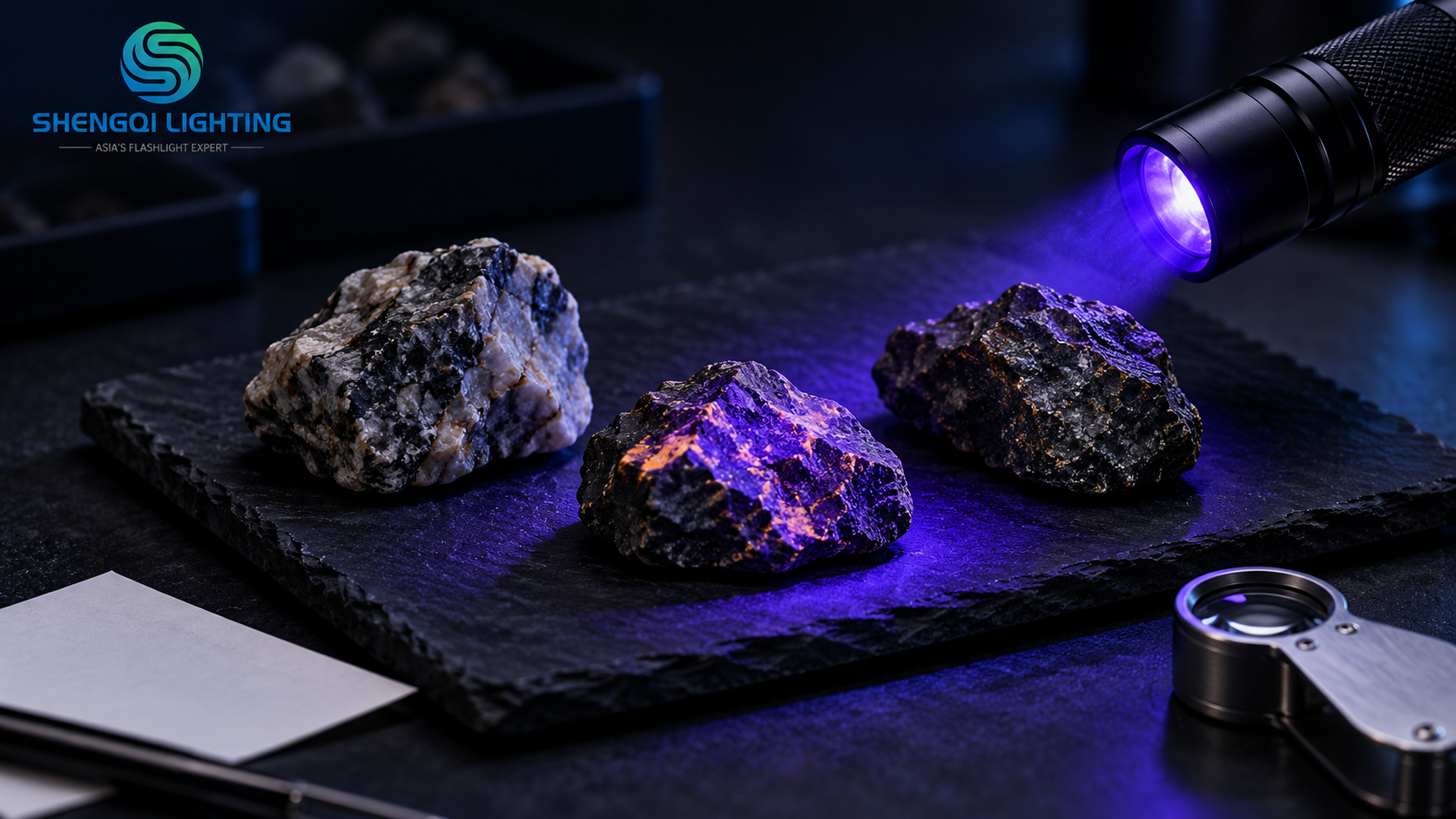
A UV flashlight for rocks can reveal fluorescence in some specimens, but a rock that does not glow is not automatically a bad sample, a fake sample, or evidence that the flashlight has failed. The result can depend on the minerals actually present, the UV excitation condition used by the original reference, the observation environment, and the way the light is used. A single non-glowing rock is not enough evidence to diagnose the sample or the light.
The right response is to narrow the cause step by step. Start with the target specimen and its source information. Then check the lighting condition behind any reference image. Next, compare representative samples under repeatable conditions. Only after those checks should a buyer decide whether the available portable UV platform fits the intended mineral-observation task.
Start With the Specimen, Not the Flashlight
A mineral name is not a guarantee that every specimen will show the same fluorescence. A hand sample may contain more than one mineral, weathered material, matrix rock, coatings, fractures, inclusions, or trace components. Two rocks sold under the same label can therefore behave differently under the same light.
Fluorescence is also conditional. The National Museum of the Philippines explains that a mineral’s response can depend on the presence of suitable activators or impurities and on the UV condition used for observation. The museum also notes that fluorescence alone is not routinely sufficient for mineral identification. Read the National Museum reference.
What a non-glowing result may mean
The specimen may not have a visible response under the current condition, may respond weakly, may need another excitation condition, or may be difficult to observe against the current background.
What a glowing result does not prove
Visible fluorescence does not by itself prove the mineral identity, source, authenticity, gemstone value, or commercial grade of the specimen.
Before evaluating a light, document what is known about the samples: their source, stated mineral content, white-light appearance, and any reliable observation record. This creates a much stronger starting point than testing one unknown stone and expecting it to behave like a dramatic image found online.
Check the Conditions Behind a Glowing Reference Photo
A glowing mineral photo is useful only when its conditions are understood. Before using one as a product expectation, check whether the original source identifies the specimen, the UV excitation condition, the observation environment, and whether the image shows the same piece of rock that the buyer intends to evaluate.
The University of Colorado Boulder demonstrates the same collection of minerals under longwave and shortwave UV. Some minerals that appear dark under one condition fluoresce under the other, while other colors and response strengths change. This is why a longwave observation and a shortwave display cannot be treated as interchangeable. See the University of Colorado example.
The USGS provides a useful reminder through its before-and-after image of scheelite. The original caption identifies the glowing image as a specimen viewed under shortwave ultraviolet light. That fact matters more than the apparent brightness of the photo. It cannot be used to claim that a 365nm or 395nm portable UVA flashlight will create the same result. View the USGS source.
If a reference photo does not state its lighting condition, exposure approach, or specimen details, treat it as visual inspiration rather than a flashlight performance benchmark.
A Documented Mineral Response Is Still Sample-Specific
A well-documented mineral can help a buyer understand why conditions matter, but it should not become a blanket promise for every rock. Smithsonian documentation for tugtupite, for example, describes fluorescence under both shortwave and longwave UV, with a stronger orange-to-orangey-red response under shortwave UV and a weaker salmon-pink response under longwave UV. See the Smithsonian specimen record.
The practical lesson is not that every collector should expect the same color from every specimen sold under the same name. The lesson is that excitation condition, specimen variation, and observation method all matter. A reference sample that glows only confirms a response for that material under those conditions. It does not prove that all target rocks will respond, or that any portable light is suitable for every mineral-observation application.
Before Replacing the Light, Check These Conditions
A non-glowing sample should lead to a structured check, not an immediate replacement decision. The following framework helps separate a sample question from an excitation, observation, or product-operation question. It is a practical decision aid, not a universal mineral-testing standard.
| Question | Why It Matters | Evidence to Check | Practical Decision |
|---|---|---|---|
| Does the target sample have a reliable response record? | A mineral name does not guarantee the response of every hand specimen. | Source notes, geological references, collection information, and representative samples. | Do not set an application expectation until the target material is better defined. |
| Did the reference image use another excitation condition? | The same mineral collection can react differently under longwave and shortwave UV. | Original captions, museum documentation, product notes, or stated UV conditions. | Match the required excitation condition before comparing results. |
| Could ambient conditions hide a weak response? | Visible background light can reduce perceived contrast and make a weak response hard to see. | Observation environment, comparison notes, and a suitable reference sample. | Repeat the observation in comparable conditions before changing products. |
| Is the actual work distance realistic for the task? | Close bench observation and scanning a wider group of rocks are different use cases. | Sample size, planned observation method, handling pattern, and realistic viewing distance. | Evaluate the light in the distance range that matches actual use. |
| Is the light operating according to its instructions? | An operating or setup issue may be mistaken for a mineral-response issue. | Product instructions, battery condition, controls, and comparison with a suitable reference sample. | Resolve the operating question before concluding that the light is unsuitable. |
| Can a suitable reference sample be observed under the same condition? | A known comparison sample is more informative than an unknown rock alone. | A documented sample appropriate for the intended excitation condition. | If no reference is available, record the result as uncertain rather than making a broad conclusion. |
Test Representative Samples Before Defining the Application
The right sample evaluation depends on the intended use. A collector examining one specimen at close range has a different need from a user scanning a tray of rocks or a rockhound looking for possible responses outdoors. Testing should mirror that real task instead of relying on one especially bright showcase sample.
Close collection observation
Focus on the target specimen, its expected excitation condition, close observation distance, and the available darkness or background contrast.
Tray or multi-sample scanning
Focus on the practical area to be observed, the intended scanning path, sample variation, and whether the objective is discovery or detailed inspection.
Outdoor rockhounding
Focus on carrying method, environmental light, actual task cycle, sample condition, and the difference between screening for possible response and confirming a mineral.
- Record the starting information. Note the sample source, stated mineral information, white-light appearance, and any known prior observation condition.
- Include a justified reference sample. Use a sample with reliable response information that is appropriate for the intended excitation condition whenever possible.
- Keep comparison conditions stable. Use a similar environment, practical distance, light state, and observation approach across the sample group.
- Record the result with limited language. Use visible response, no visible response under stated conditions, or uncertain observation. Do not turn a non-response into a mineral verdict.
- Review the group result. Multiple representative specimens provide a better basis for product positioning, packaging notes, and customer-service language than one unusually bright sample.
This is a suggested application-sample evaluation method, not a SHENGQI LIGHTING internal SOP, a mineral-identification procedure, or an industry-required test. Do not grind, acid-treat, heat, or otherwise destructively test unknown specimens for this purpose.
Turn the Application Into a Product Requirement
Once the sample question is clear, buyers can define the lighting requirement more accurately. The important questions are the required excitation condition, the intended observation distance, the sample area to be covered, visible background conditions, expected task duration, and carrying or handling method.
Visible lumens, LED quantity, electrical input power, UV radiation output, irradiance on the sample, and the apparent brightness of fluorescence are not the same measurement. Without application-specific measurement data, they should not be used as interchangeable claims or as a shortcut to predict mineral response.
Portable UV platform boundary
SHENGQI LIGHTING offers portable UV product platforms, including the L13 configuration listed with 395nm UV, 12 UV LEDs and a dual 18650/AAA power platform, plus the 2AAA-UV category listed with 365nm product-category wording and 2×AAA power. These listed configurations do not prove suitability for every mineral sample, do not establish exact spectral peak or tolerance, and do not replace sample evaluation.
For relevant platform information, review the L13 UV flashlight page, the 2AAA-UV pen-light page, or the broader portable pen-light category.
If the target sample requires an excitation condition outside an available portable platform, the correct answer is to keep that boundary clear rather than force a product recommendation.
Frequently Asked Questions
Why does my rock not glow under a UV flashlight?
The sample may not respond under the present condition, may require another excitation condition, may respond too weakly for the environment, or may not contain a responsive mineral. Check the reference conditions and a suitable comparison sample before blaming the flashlight.
Can every fluorescent mineral respond to the same UV light?
No. Mineral response can change under different excitation conditions. Check whether the original source identifies longwave, shortwave, or another condition before comparing results.
Will a more powerful UV flashlight always help?
No. More output cannot guarantee a response when the target specimen requires another excitation condition. It also cannot correct an unsuitable reference sample or a poor observation environment.
Can fluorescence identify a rock or prove a gemstone is genuine?
No. Fluorescence can be an observation that supports further research, but it does not independently establish mineral identity, gemstone authenticity, origin, or value.
What should a buyer test before ordering a UV flashlight for rockhounding?
Test multiple representative target samples, confirm the condition used by reliable reference material, document the actual observation environment and working distance, and record each result as visible, not visible under stated conditions, or uncertain.
Discuss a Defined UV Observation Requirement
For a portable UV-lighting discussion, provide the target samples, reliable reference materials and their stated excitation conditions, expected working distance, observation environment, and desired carrying method. This makes it possible to discuss a defined configuration and an application-sample evaluation rather than making a broad promise about all rocks.
Dongguan Shengqi Lighting Technology Co., Ltd. can discuss OEM/ODM portable-lighting requirements. SHENGQI LIGHTING does not provide mineral identification, gemstone authenticity verification, specimen valuation, or unverified fluorescence-performance guarantees.
Explore OEM/ODM services · Contact SHENGQI LIGHTING · sales@shengqilight.com
Follow product instructions, avoid looking directly into UV light sources, and avoid unnecessary skin exposure. Do not treat UVA as inherently safe or rely on unverified exposure-time guidance.