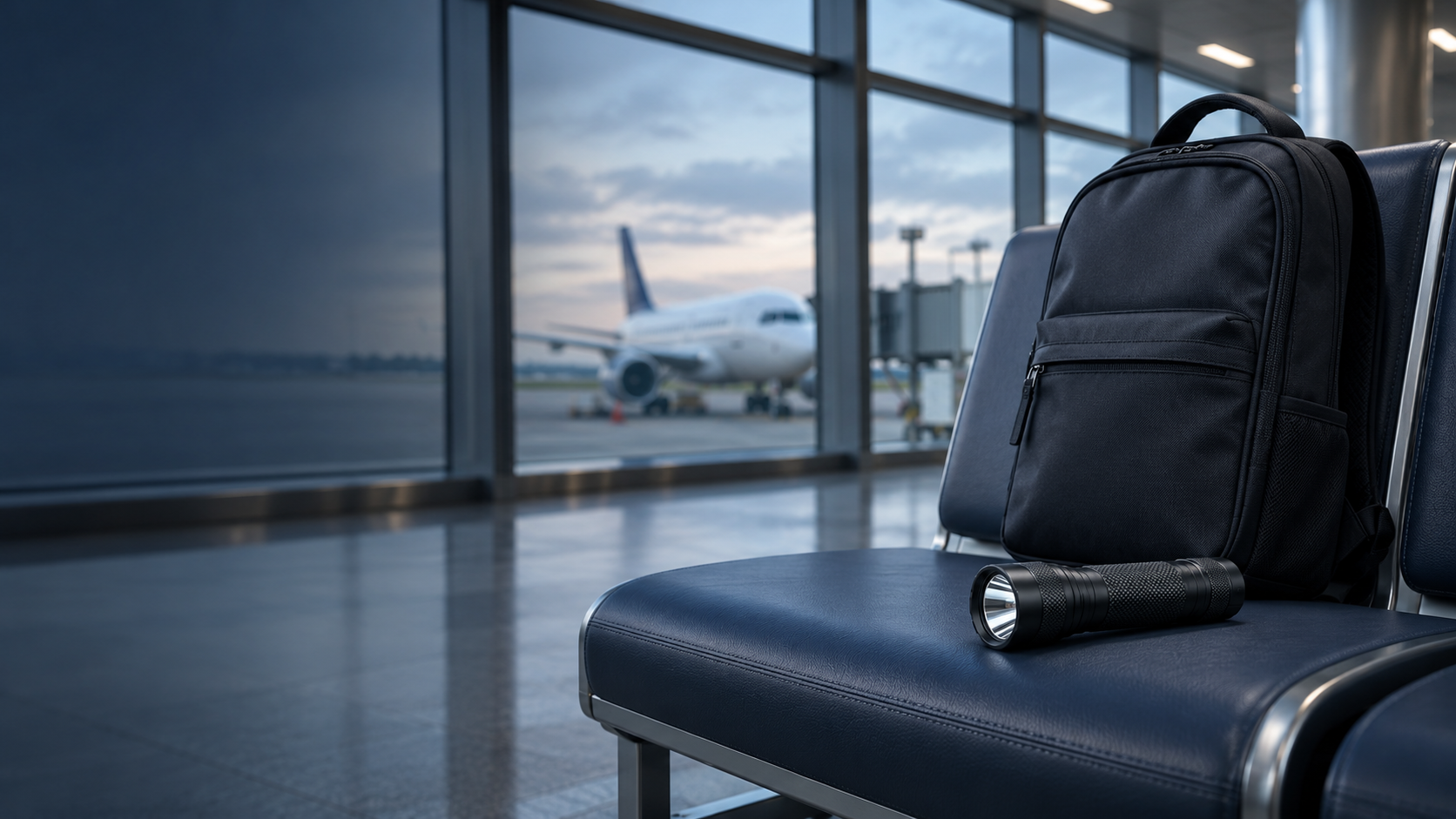
An ordinary flashlight can usually travel as a personal electronic device, but two separate questions matter: whether the light itself is accepted at security and how its batteries must be packed. For U.S. travelers, installed batteries and spare lithium batteries have different baggage conditions. Spare lithium batteries must remain in the cabin; when a lithium-battery device is permitted in checked baggage, it must be completely switched off and protected against accidental activation and damage. Your airline or international itinerary may impose stricter requirements.
U.S. battery guidance checked: November 25, 2026. Confirm current requirements before travel.
Check the Light and the Battery Separately
First, check whether your particular flashlight is acceptable for the baggage you intend to use. Its dimensions, shape or additional functions may warrant a specific question. The TSA flashlight guidance page is an official place to start for U.S. security screening. An acceptable battery rating does not itself establish that the whole item will pass screening.
Next, identify the battery chemistry, its energy rating or lithium content, and whether it is installed in the flashlight or carried separately. Then check the relevant carry-on and checked-baggage conditions. A product name such as “tactical,” or a description such as “ordinary flashlight,” is not a substitute for checking the actual item and its features.
Identify the Battery Before Choosing a Bag
AA, AAA and 18650 describe formats, not a complete set of travel rules. Alkaline, nickel-metal hydride (NiMH), lithium-ion and lithium-metal batteries are different chemistries. “Rechargeable” also does not identify every applicable condition. Read the markings and product instructions; if necessary, ask the manufacturer for the exact battery information.
A battery removed from a flashlight is no longer an installed battery for packing purposes: treat it as a spare. For a lithium-metal battery, a limit expressed as grams of lithium refers to lithium content, not the total weight of the cell. If you need help identifying a battery, see this guide to flashlight battery types and compatibility. Use only batteries approved for your flashlight.
Carry-On vs. Checked Baggage
The following summarizes U.S. battery guidance for personal travel. It does not approve a particular flashlight for security screening. Check the FAA’s passenger battery guidance and your operating airline’s current requirements for your configuration.
| Battery or configuration | Carry-on | Checked baggage | Conditions to confirm |
|---|---|---|---|
| Ordinary alkaline batteries | Generally permitted at the battery level. | Generally permitted at the battery level. | Protect spares from short circuits and damage; check the device and airline requirements. |
| Ordinary NiMH rechargeable batteries | Generally permitted at the battery level. | Generally permitted at the battery level. | Protect spare terminals and check the applicable device and airline conditions. |
| Lithium battery installed in a permitted device | The FAA recommends keeping the device in the cabin. | Only if the device and battery are permitted in checked baggage. | Observe applicable battery limits and airline requirements. If checked, switch the device completely off and protect it from activation and damage. |
| Spare lithium-ion battery, 100 Wh or less | Carry in the cabin, subject to applicable conditions. | Not permitted. | Protect each spare against short circuits and damage; check airline restrictions. |
| Spare lithium-metal battery, up to 2 g lithium content | Carry in the cabin, subject to applicable conditions. | Not permitted. | Confirm lithium content, not battery weight; protect against short circuits and damage. |
| Lithium-ion battery over 100 Wh and up to 160 Wh | Airline approval is required; larger spares are limited to two per person. | Spares are prohibited; check the conditions for an installed battery. | Obtain operator approval and confirm the specific device and battery configuration. |
For the ordinary personal devices discussed here, lithium-ion batteries above 160 Wh are outside the passenger baggage allowance described above. The two-spare limit applies to the larger approved battery category, not automatically to every smaller spare. Airlines may impose tighter limits or additional conditions. See the FAA’s lithium battery guidance and its guidance on devices containing batteries.
Read Watt-Hours Correctly
Use the watt-hour (Wh) rating printed on the battery or complete battery pack when available. If you need to calculate it from the stated nominal voltage and capacity, use:
Wh = nominal voltage × capacity in Ah
Wh = nominal voltage × capacity in mAh ÷ 1,000
For a hypothetical calculation, 3.6 V × 3,000 mAh ÷ 1,000 = 10.8 Wh. This illustrates the units; it is not a SHENGQI LIGHTING product specification or approval to fly. Do not substitute a 5 V USB charging input for the battery’s nominal voltage. For a multi-cell pack, confirm the rating for the complete pack rather than treating one cell’s rating as the entire system.
Do not open a sealed pack or remove its covering to find information. If the rating is unclear, request documentation from the manufacturer. A Wh calculation addresses only one condition; it does not guarantee acceptance at security or by an airline.
Prevent Accidental Activation and Short Circuits
Switch the flashlight off according to its instructions and use an accidental-activation prevention method the model actually supports. If the light is to be checked and the configuration is permitted, confirm that it is completely off and protected against activation and damage. An electronic lock alone should not automatically be assumed to satisfy every requirement for complete shutdown.
If the manufacturer allows the user to remove the battery, follow those instructions; once removed, pack it as a spare. Do not force open a flashlight with an integrated battery. Protect spare terminals using a suitable battery case, original packaging or another effective means of isolation. Keep loose cells from contacting keys, coins or one another.
A damaged, swollen, recalled or otherwise abnormal lithium battery should not enter the ordinary packing process. Contact the manufacturer and airline for guidance; tape or a different bag does not make a damaged battery acceptable.
If Your Carry-On Is Gate-Checked
A bag that starts as a carry-on can become checked baggage at the gate. Before handing it over, remove permitted spare lithium batteries and power banks, protect their terminals and keep them with you in the cabin. Recheck whether any flashlight with an installed battery may remain in the bag and whether its shutdown and protection requirements are met. The FAA explains this distinction in its guidance for spare lithium batteries.
Keep spare batteries somewhere accessible before boarding so you can remove them without unpacking the entire bag. Gate-checking does not mean every installed battery must be removed; the device’s permitted configuration and the airline’s instructions matter.
Check Special Features and Your Actual Airline
Some equipment requires a separate assessment. Certain diving lights or other heat-producing devices may fall under a specific provision requiring operator approval and other conditions. Consult the relevant provision in 49 CFR 175.10 and the airline rather than assigning a legal category based on a lumen number.
Devices primarily intended to supply power to other equipment can be treated as spare batteries under the applicable rules. A USB output alone does not establish how every multifunction product will be classified: describe the product’s actual purpose and ask the airline. Similarly, a metal body, a “tactical” label or one length measurement cannot guarantee a security decision.
For international travel, check the requirements at departure and transit points as well as those of the airline operating each flight. Airline policies can be more restrictive; Delta’s battery and fuel-powered item guidance is one example of an airline-specific reference, not a rule for every carrier.
When asking an airline or screening authority, provide the flashlight model, dimensions and shape, special functions, battery chemistry, nominal voltage and Wh or lithium content, whether each battery is installed or spare, the quantity and the intended baggage. An airline response helps clarify its policy but does not replace the security officer’s decision.
Personal Baggage Is Not a Commercial Shipping Shortcut
The passenger provisions discussed here concern personal use; they should not be treated as automatic authorization to carry goods or batteries intended for sale or distribution. A brand representative taking products to an event, demonstration or delivery should explain the actual purpose, quantity and battery configuration to the airline and confirm the applicable requirements. A single sample is not necessarily prohibited merely because it is a sample, but neither does its size alone settle how it should be transported. Do not describe commercial goods as personal items to avoid the applicable rules.
A Short Pre-Flight Checklist
- Check the flashlight itself with the relevant security authority and operating airline.
- Identify battery chemistry, rating and whether each battery is installed or spare.
- Place permitted batteries in the appropriate baggage and protect spare terminals.
- Confirm the device is properly off, protected from accidental activation and undamaged.
- Keep spare lithium batteries accessible in case your carry-on is checked at the gate.
- Check special features and every relevant departure, transit and airline requirement.
Planning a Flashlight for Travel Use
For lighting brands, clear battery markings, model information, shutdown instructions and protective packaging can make travel-related questions easier to answer. These details do not replace airline or security decisions, but they help users identify the configuration they need to check. You can explore SHENGQI LIGHTING’s flashlight range and product development services.
For a project discussion, share the target market, intended use, battery architecture and the carrying information you want to communicate. Contact sales@shengqilight.com to discuss the product and documentation requirements.