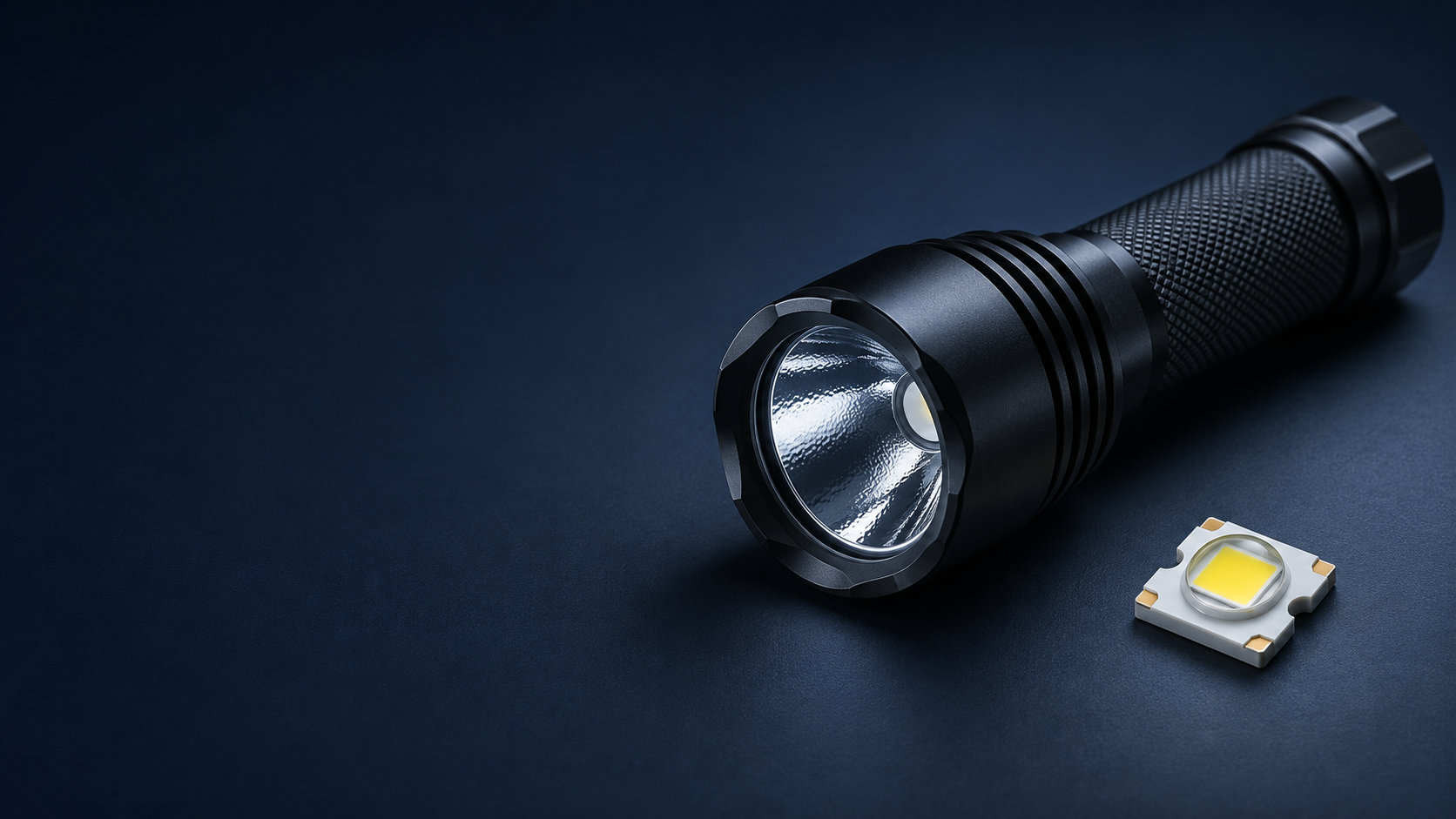
Lumen maintenance describes how much of a light source’s initial luminous flux remains after accumulated operating time, under stated measurement conditions. It helps explain long-term changes in LED output, but it is not the time a flashlight runs on one charge and cannot independently establish the reliable life of the complete product. To assess a long-life claim, separate LED aging from short-term brightness changes, battery behavior and the reliability of the assembled flashlight.
What Do L70 and L90 Mean?
L90 refers to a light output level equal to 90% of the initial output; L70 refers to 70%. When either appears in a lifetime claim, the associated time, tested object, operating conditions and assessment method are needed to interpret it. Luminus’s explanation of LED lifetime illustrates these levels as percentages of original light output.
For a simple normalized example, set one light source’s initial output to 100%. Output at 90% of that starting value represents the L90 level; output at 70% represents the L70 level. This example assigns no hours to either level and is not a measurement of a Shengqi product or a particular LED.
Lumen maintenance (%) = light output at the stated operating time ÷ initial light output × 100
L70 does not mean 70,000 hours, 70% battery charge or that 70% of lamps are still operating. Reaching the L70 level does not mean an LED suddenly switches off. L90 represents a higher retained proportion than L70, but hours reported under different conditions or for different objects cannot be compared on the labels alone.
The object of the claim also matters. An LED package’s light output is not automatically the same measurement as the lumens leaving a complete flashlight. Do not apply a component maintenance percentage directly to a flashlight’s advertised turbo output and present the result as a measured finished-product value.
Four Different Claims That Should Not Be Combined
A flashlight specification may contain several time-based statements. Each describes a different object or test question.
| Claim | What it describes | What it does not establish |
|---|---|---|
| LED lumen maintenance | The light source’s retained output over accumulated operation under stated conditions. | The service life of every part of the complete flashlight. |
| Flashlight runtime | Operation during a defined run with a specified mode, battery and test conditions. | The LED’s long-term lumen maintenance over accumulated use. |
| Battery cycle life | Battery performance retention through charging and discharging cycles under specified conditions. | LED lifetime or a direct equivalent to runtime on one charge. |
| Complete-product lifetime or reliability | The assembled product’s performance against defined conditions and failure criteria. | A result that can be established using one LED component’s projected hours alone. |
A commercial warranty is another separate matter: its terms describe a supplier’s obligations, not the same thing as a measured or projected lumen maintenance result.
Why a Flashlight Can Dim During a Single Use
A drop in brightness during one session does not, by itself, show that the LED has undergone permanent aging. Depending on the product, output can change because of a controlled step-down, the battery’s supply condition or another part of the operating system. A long-term maintenance assessment requires comparable measurements of the defined object over accumulated operating time.
For a meaningful comparison, keep track of the mode, battery state, measurement conditions and product configuration. A change that improves after cooling or charging should not automatically be treated as permanent LED degradation; equally, a change that remains does not by itself identify the failed part. For the separate question of output during a single run, see how to evaluate flashlight runtime claims.
LM-80 Measures; TM-21 Projects
LM-80 and TM-21 answer related but different questions. The IES description of LM-80 covers measurement of light-output and color-maintenance characteristics for solid-state light sources such as LED packages, arrays and modules under specified conditions.
TM-21 uses qualifying measurement data to project longer-term light-output maintenance. A report should make the actual measurement period distinguishable from any projected period and retain the applicable method, version and conditions. A projection is useful for evaluating a light source within its stated scope; it is not a record that the complete flashlight was operated for the projected number of hours.
Having a report is only a starting point. The LED used in the flashlight and its intended operating conditions need a traceable relationship to the report. Current, temperature and component construction can affect long-term behavior, so a figure without its conditions leaves an important part of the claim unanswered.
Six Questions to Ask About an LED Maintenance Report
A useful purchasing review connects the reported LED data to the configuration being proposed for the flashlight. Ask for the following information before turning a component figure into a product claim.
- Which exact LED part is used, and where is its report coverage documented? A report title that differs from the purchased part number is not automatically invalid: ask the LED manufacturer for a coverage explanation or similarity document. Conversely, a shared series name or similar appearance does not establish coverage. Luminus’s guide to reading LM-80 reports gives an example of how a manufacturer can connect a report to covered part numbers.
- How does the reported drive current relate to the intended flashlight mode? Identify the conditions relevant to the mode being discussed. A result obtained under a lighter load should not simply be promoted as the lifetime of a higher-load mode.
- What temperature was specified, and where was it measured? An LED manufacturer’s defined temperature point, LED junction temperature, ambient temperature and flashlight housing temperature are not interchangeable values. Ask how the report’s condition relates to the proposed product instead of estimating LED lifetime by touching the housing.
- How many samples were measured, and for how long? Separate the period supported by observations from the period represented by a projection. Sample information and the applicable method help the reader understand the basis and limits of the reported result.
- What retained-output target is required, and does color matter? State whether the project is considering an L90, L70 or another defined level. Lumen maintenance alone does not establish that color remains unchanged; a color-sensitive application may need separate requirements.
- Which product configuration and version does the review cover? If the LED, driver or thermal construction changes, review whether the existing evidence still applies. The effect of a change should be assessed in context rather than assuming that every revision has the same consequence.
If the part coverage or the relationship to actual operating conditions cannot be established, continue the discussion with the LED manufacturer or supplier. Missing information should not automatically be recorded as either a pass or a failure.
An LED Projection Is One Input to a Flashlight Project
A complete flashlight also contains a driver, power source, optical components and electrical and mechanical connections. Those parts have their own operating conditions and possible failure modes. An LED projected to retain a stated proportion of its light output does not establish that every other component will function for the same period. The IES position on LED product lifetime prediction explains why component maintenance projections should not be treated as a complete luminaire lifetime claim.
For a flashlight project, define the long-term light-output target alongside separate expectations for the complete product. The useful evidence depends on the intended modes, operating pattern and environment, as well as what the finished light is expected to do over its service life.
Discuss the Conditions Behind the Claim
When developing a flashlight platform, brand teams can start by describing the main modes and usage pattern, the desired long-term output target and whether that target applies to the LED or the assembled light. Expected environments and size constraints help frame the LED, driver and thermal design discussion. It is also useful to identify which component documents are needed, what operating conditions remain to be checked and which complete-product reliability requirements need separate evaluation.
You can explore Shengqi flashlight platforms and learn about flashlight design and development. To review the requirements for a proposed product, discuss your flashlight project with Shengqi Lighting.