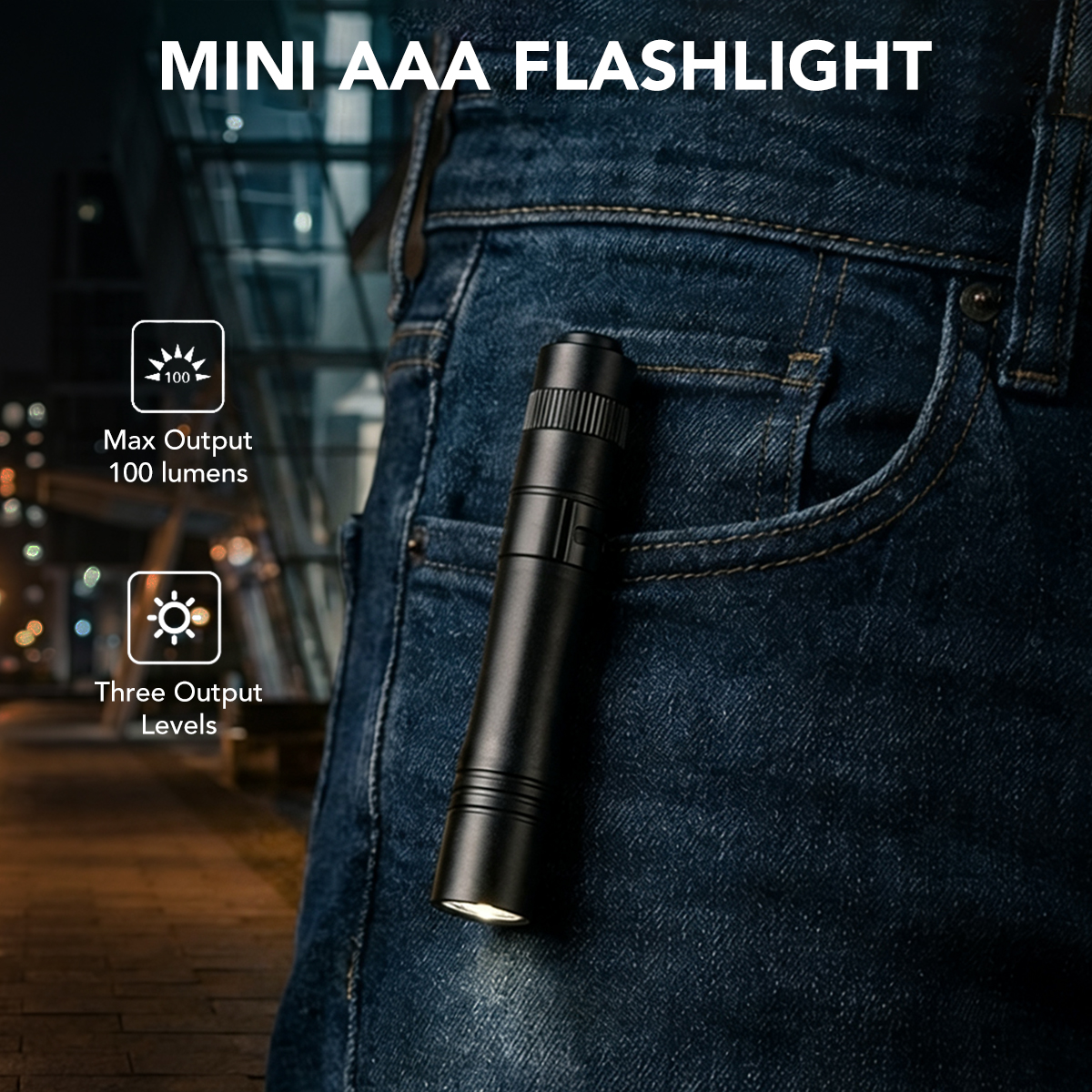

What should buyers look for in an AAA mini inspection flashlight?
Buyers should evaluate an AAA mini inspection flashlight by its physical size, output-mode spacing, useful beam distance, approved battery format, clip design, water-resistance boundary and model-specific evidence. A compact product should offer high, medium and low modes for different tasks, use a clearly stated one-AAA alkaline battery platform and remain practical for pocket or tool-kit carry. Buyers should request runtime by mode, review the IPX5 boundary and confirm exact model documentation. Universal compatibility with every AAA-format battery must not be assumed.
What Does a Single-AAA Design Change?
A single-AAA architecture can influence body diameter, length, weight, pocket fit, battery storage, grip size, packaging and retail positioning. A smaller body may improve organizer fit, but buyers should also assess switch access, repeated handling and glove use rather than assuming that smaller always means easier operation.
A single-AAA and a single-AA inspection light represent different size, grip, battery and product-positioning choices. The correct platform depends on the intended task and market. A separate single-AA aluminum pen-light guide explains the larger architecture.
Why 100LM, 17LM and 2LM Serve Different Tasks
High — 100LM
The listed maximum output can support brief directional checks, locating equipment and viewing nearby machinery. It does not prove a specific runtime or constant-output duration.
Medium — 17LM
This level may be more practical for labels, tool kits, vehicle compartments, shelves and repeated maintenance tasks, depending on ambient light and surface reflectivity.
Low — 2LM
Low output can support close labels, bags, organizers and reduced-glare orientation. It generally demands less electrical power than maximum output, but runtime still requires testing.
What Does a 55-Meter Maximum Beam Distance Mean?
The listed 55-meter maximum beam distance is a directional reference, not a guaranteed comfortable inspection distance. Useful visibility depends on target size, ambient light, contrast, weather, battery condition and user expectations.
Most inspection work may occur at much shorter distances. Buyers should request the applicable test method when beam-distance evidence is commercially important.
1AAA Case Study: A Compact Single-Cell Inspection Platform
The 1AAA mini inspection flashlight combines 100LM High, 17LM Medium and 2LM Low with a listed 55-meter maximum beam distance. The three modes support different task distances instead of making maximum brightness the only design target.
Its 6463 aluminum-alloy body has an anodized black finish and measures 15mm in diameter and 83.35mm in length. At 32.5g including the battery, the design prioritizes compact pocket, organizer and tool-kit carry.
The product uses one 1.5V AAA alkaline battery and includes a practical clip. The specification also lists IPX5 and 1-meter impact resistance. Runtime remains unverified, and the product is not intended to replace larger area lights or high-output work lights.
What Buyers Should Verify About the AAA Battery Platform
The confirmed specification lists one AAA alkaline battery at 1.5V. No direct charging interface is required for the flashlight body, but replacement still depends on target-market availability, correct storage, condition inspection and disposal planning.
Packaging should identify the approved battery format and polarity clearly. Stored alkaline batteries should be inspected for damage or leakage. Only battery formats listed in the approved product specification should be used.
How Compact Is the 1AAA Platform?
A 15mm body diameter supports a slim architecture, while the 83.35mm length supports compact storage. The 32.5g weight, including the battery, supports lightweight pocket or organizer positioning.
The practical clip can support pocket, tool-kit or workwear access. Buyers should still review retention and accessibility. A clip provides a carrying option; it does not automatically convert the light into a certified headlamp.
What 6463 Aluminum Alloy Contributes
6463 aluminum alloy can support a slim, rigid and accurately machined housing. Aluminum can also transfer heat away from internal components, while the anodized black finish can support surface protection.
Final durability still depends on wall thickness, machining, assembly and finish quality. The material should not be described as unbreakable, scratch-proof or military-grade.
How Should Buyers Read IPX5 and 1-Meter Impact Resistance?
IPX5 indicates protection against water jets under applicable test conditions. The X does not state a solid-particle protection rating, and IPX5 is not an immersion rating. Seal, switch and assembly condition can affect field performance.
The product specification lists 1-meter impact resistance. This should not be expanded into indestructibility because results can depend on surface, angle, sample condition and repeated impacts. Battery, clip and lens condition should be inspected after a drop.
When Is a Single-AAA Light Appropriate?
A compact inspection light can support equipment-label checks, tool-kit lighting, mechanical maintenance, automotive compartments, warehouse shelves, household repair, workwear carry and travel organizers.
Lighting does not determine whether equipment, electrical systems or work areas are safe to access. Electrical-cabinet observation should occur only after proper isolation and under applicable procedures.
When Is a Single-AAA Light Too Small for the Task?
A mini light may not be suitable as the only product for extended area illumination, large-room lighting, frequent maximum-output operation, high-output outdoor navigation or work requiring verified long runtime.
It may also be unsuitable when users need a larger grip, rechargeable workflow, certified hazardous-location equipment or hands-free head-mounted lighting. Its value comes from accessibility and task fit, not from replacing every larger light.
Single-AAA Mini Light vs Other Compact Lighting Platforms
| Product Architecture | Typical Size Direction | Power Workflow | Main Strength | Main Limitation | Buyer Verification Focus |
|---|---|---|---|---|---|
| Single-AAA Mini Light | Very compact | Replaceable alkaline battery | Pocket and close-task access | Limited stored-energy platform | Modes, grip and approved battery |
| Single-AA Light | Generally larger | Replaceable battery | Different grip and energy planning | Larger physical format | Final model specifications |
| Multi-AAA Pen Light | Longer pen-shaped body | Multiple replaceable cells | Elongated inspection format | Different length and balance | Cell matching, modes and dimensions |
| Rechargeable Mini Light | Compact by model | Charging-source workflow | Repeated-use convenience | Charging access and battery aging | Interface, runtime and serviceability |
This comparison describes general product architectures. It does not establish that one platform is universally better or predict the performance of a specific untested model.
B2B AAA Mini Flashlight Verification Checklist
B2B buyers should not approve an AAA mini inspection flashlight based only on maximum lumens, a generic waterproof label or the assumption that every AAA-format battery is compatible.
B2B Compliance and Model-Scope Evidence
The 1AAA model is listed within the model scope of the applicable CE-EMC verification and test report under EN IEC 55015:2019+A11:2020 and EN IEC 61547:2023. The result applies to the tested sample and configuration and does not assess the entire production process.
The model is also listed within the scope of the relevant REACH SVHC 253-item report, which records a PASS result for the stated scope. Other applicable requirements may still need to be addressed, and exact configuration matching remains necessary.
How SHENGQI LIGHTING Supports Compact Inspection-Light Development
For compact inspection-light projects, compact flashlight product development can coordinate body dimensions, mode spacing, battery definition, optical output, clip structure, enclosure protection and packaging language.
Relevant capabilities include Industrial Design, Optical Engineering Design, Electronic Design, Battery Testing, Discharge Time Testing and Luminous Performance Testing. Buyers can review SHENGQI’s flashlight performance and durability testing approach.
SHENGQI LIGHTING has manufacturing roots dating back to 1981, while the current company was formally established in 2008. Its aluminum-light production capabilities include 75 CNC machines, and the company operates under an ISO9001 quality management system.
Frequently Asked Questions
1. What is an AAA mini inspection flashlight?
It is a compact light powered by one AAA battery and designed for pocket or tool-kit carry. The format can support close-range inspection and short directional tasks where accessibility, low weight and small body dimensions are important.
2. Is 100 lumens enough for inspection work?
100 lumens can support selected short inspection and directional tasks, but suitability depends on distance, ambient light, contrast and task requirements. Buyers should also evaluate medium and low modes around reflective components and close working surfaces.
3. Why does a mini flashlight need medium and low modes?
Medium and low modes can improve task matching, close-range visibility and glare control while generally reducing energy demand. Their actual runtime and output stability still require mode-specific testing rather than assumptions based on lumen values alone.
4. Can the 1AAA use rechargeable AAA or 10440 batteries?
The confirmed specification lists one 1.5V AAA alkaline battery. Other battery chemistries or voltages must not be assumed compatible without approved product documentation for the exact model and configuration.
5. Is IPX5 suitable for immersion?
No. IPX5 describes water-jet resistance under applicable test conditions and is not an immersion rating. Product condition, seals, switches and assembly remain relevant to field performance, and model-specific evidence should be reviewed where required.
6. What should B2B buyers verify before sourcing a compact AAA flashlight?
Verify final dimensions, mode spacing, runtime by mode, approved battery chemistry, clip structure, IP evidence, impact evidence, product and packaging consistency, and the exact compliance scope covering the finished model and configuration.
Develop a Mini Flashlight Around Real Inspection Tasks
Tool brands, maintenance-product companies, workwear brands, hardware distributors and sourcing teams can discuss compact dimensions, output modes, AAA battery planning, aluminum construction, clips, durability testing and packaging instructions.
Contact SHENGQI LIGHTING for an OEM/ODM technical evaluation at sales@shengqilight.com.