
Why ASEAN Day 2026 Is a Useful Product-Strategy Checkpoint
ASEAN was established on August 8, 1967, and August 8, 2026 marks its 59th anniversary. Timor-Leste was admitted as ASEAN’s 11th Member State on October 26, 2025, so the regional framework now covers eleven Member States. ASEAN Day is used here as a product-planning checkpoint, not as evidence of flashlight demand.
The Asian Development Bank’s July 2026 outlook forecasts 4.6% growth for developing Southeast Asia in 2026, while emphasizing substantial differences among economies. Manufacturing, investment and external conditions also vary. A regional number provides context, but it does not justify one regional product specification.
How should brands select portable lighting products for Southeast Asia?
Brands should select portable lighting for Southeast Asia by segmenting each target market by application, environment, channel, battery workflow, product-service requirements and local compliance needs rather than using one ASEAN-wide specification. Tropical conditions can increase the importance of water, humidity and material verification, while maritime applications may require depth or corrosion evidence. Industrial maintenance may prioritize magnetic positioning and usable low modes, while outdoor channels may value compact handheld or hands-free lighting. Ingress protection, battery systems and after-sales requirements should therefore follow the actual distributor brief. Every country still requires country-specific verification for compliance, packaging, documentation and market access.
Do Not Build an “ASEAN Flashlight” SKU
One tropical flashlight, one IP rating, one battery platform, one packaging language or one retail assortment cannot be assumed to fit every market. Country should be the starting filter, not the final product specification.
Country → Channel → Application → Environment → Product Architecture → Compliance / Packaging → After-Sales.
The IEA notes that electricity demand in Southeast Asia is growing about twice as fast as overall energy use, while industrial electrification is already comparable with the European Union. These trends reinforce the diversity of maintenance environments; they do not establish flashlight demand. Regional energy trends should therefore inform segmentation rather than product-volume forecasts.
Four Portable-Lighting Use Cases to Separate First
01. Tropical Outdoor and General Handheld Use
Outdoor, hardware and travel channels may review water exposure, impact, useful low modes, battery workflow and carry size.
The T20 high-protection handheld flashlight provides 2000LM, 706LM, 130LM and 5LM modes, IP68, 2-meter impact resistance and an 18650 3100mAh platform. It is an architecture example, not a recommendation for every outdoor market. IP68 also does not make it a diving light.
02. Coastal, Marine and Diving Channels
Diving and marine distributors require stronger separation between splash exposure, corrosion review and verified underwater operation.
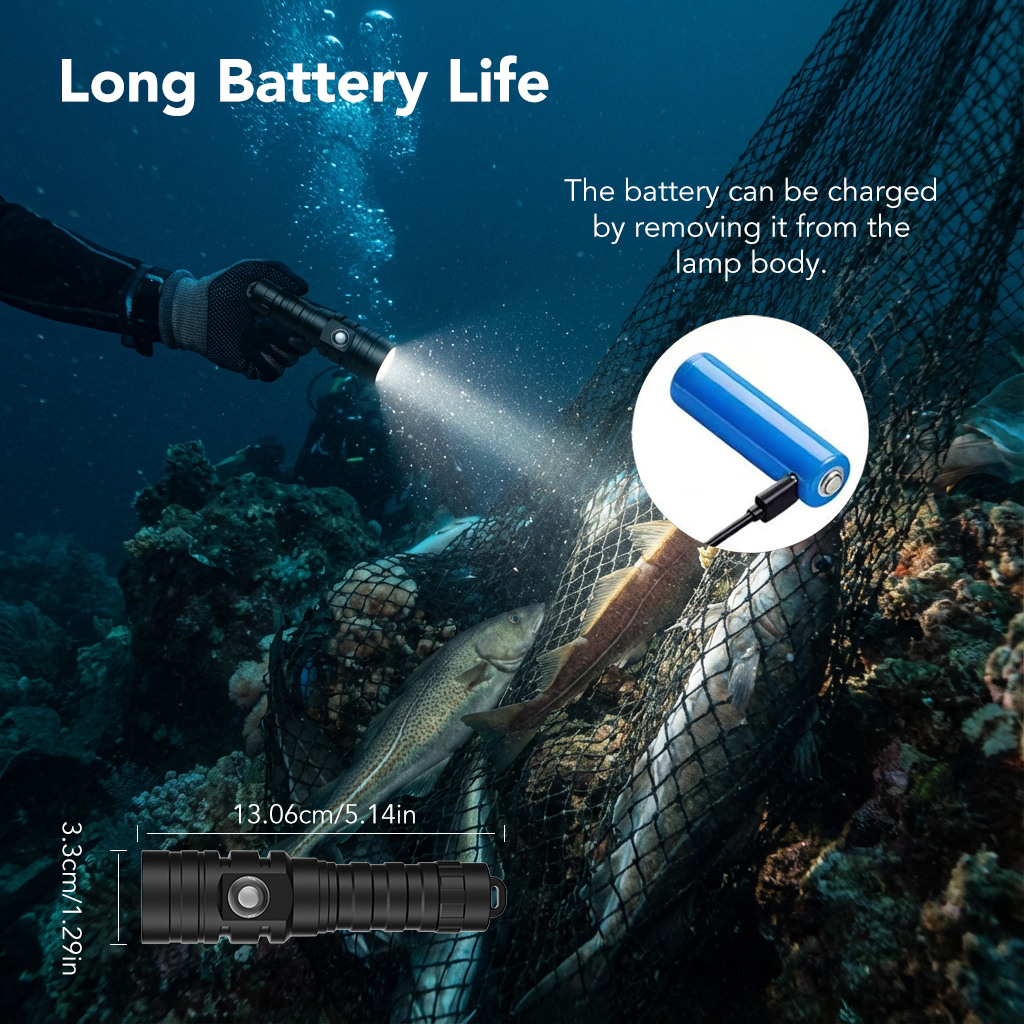
The D1500 20-meter diving flashlight provides 1500LM, 350LM and 30LM, a listed 20-meter depth rating and a 3100mAh 18650 platform. That depth rating is more relevant to a diving channel than generic “waterproof” language, but runtime and saltwater durability still require model-specific verification.
03. Industrial and Maintenance Channels
MRO and automotive channels may prioritize fixed beam positioning, useful low output and close-range glare control.
The P1 rotating magnetic maintenance light combines a rotating head, magnetic tail and 1400LM, 150LM and 4LM modes. The 4LM mode supports close reflective tasks, while magnetic holding force and runtime require separate verification.
04. Hands-Free Outdoor and Service Channels
Installation and service channels may value head-mounted operation, detachable structure and temporary magnetic positioning.
The HL10 detachable headlamp platform provides 1250LM, 500LM and 350LM with a 16340 650mAh battery. The verified specification set used here does not establish an IP rating, so environmental suitability must be reviewed separately.
Portable Lighting Product Roles for Southeast Asia Channels
| Market / Channel Need | Product Architecture | Key Product Requirement | Main Verification Risk | SHENGQI Case |
|---|---|---|---|---|
| Outdoor / Hardware | High-protection handheld | Low modes, ingress, impact, battery | Actual IP and runtime evidence | T20 |
| Marine / Diving | Depth-rated underwater light | Depth, sealing, controls | Pressure and corrosion evidence | D1500 |
| Industrial / MRO | Rotating magnetic tooling light | Beam positioning and low mode | Magnet, runtime and durability | P1 |
| Service / Hands-Free | Detachable headlamp | Wearing structure and battery | Environmental rating | HL10 |
No product architecture is universally appropriate for all ASEAN countries, channels or environments.
What “Tropical-Market Ready” Should Actually Mean
“Tropical” is too broad to be a complete flashlight specification. The ASEAN regional climate outlook shows differing rainfall patterns between northern and southern ASEAN even within the same season.
A professional review should separate water exposure, humidity, corrosion, temperature and material aging. Humidity may affect contacts, switches and battery compartments; coastal products may require corrosion evidence; temperature and charging limits require model-specific data. “Tropical-market ready” should be a verification checklist, not a marketing badge.
Marine, Coastal and Diving Lighting Are Not the Same Category
A coastal outdoor light may face humidity, splash and salt exposure. A boat-service light may additionally need stable positioning and wet controls. A diving light requires verified depth, pressure-related sealing, underwater switching and battery-enclosure integrity.
An IP68 handheld flashlight is not automatically equivalent to a depth-rated diving flashlight. T20 and D1500 solve different product briefs. Diving distributors should request model-specific underwater evidence, while corrosion performance also requires separate material or test verification.
Industrial Channels Need Task Architecture, Not Maximum Lumens
P1 supports fixed-position maintenance through a rotating head, magnetic base, 150LM routine mode and 4LM close-range mode. HL10 supports a different workflow: head-mounted hands-free use, detachable handheld operation and temporary magnetic positioning.
A maintenance distributor may need both architectures depending on end-user workflow, but neither should be selected from maximum output alone.
Battery Strategy Should Follow the Channel
T20 and D1500 use 3100mAh 18650 platforms, P1 uses an 1800mAh 18650 platform, and HL10 uses a 3.7V 650mAh 16340 battery. The same nominal cell format does not establish interchangeability.
Brands should verify physical dimensions, protection format, electrical requirements, discharge capability, polarity, charger compatibility and product instructions. Battery capacity alone does not establish runtime. Regional planning should also consider replacement-cell sourcing, lithium transport, service support and distributor storage.
Build a Channel Portfolio, Not a Universal Hero SKU
A four-layer portfolio could use T20 for general high-protection handheld lighting, HL10 for hands-free service, P1 for industrial tooling and D1500 for specialist diving channels. This is a planning example, not a recommendation that every distributor carry all four.
Why Distributor-Specific SKUs May Work Better
Mode configuration, battery inclusion, packaging, language, accessories, finish and branding can be evaluated by project. Regional customization should reduce unnecessary SKU complexity rather than create uncontrolled variants.
Eight Questions to Answer Before Entering an ASEAN Market
What Data Should a Brand Collect Before Choosing the Final ASEAN SKU Mix?
SEO market assumptions are not a substitute for distributor interviews, sales data, sample testing and local compliance review.
ASEAN Does Not Mean One Compliance File
Regional integration does not make product-safety, battery, labeling, language, importer, environmental, customs or charger requirements identical across all eleven Member States. Market-access evidence must be mapped country by country.
HL10 is listed within relevant CE-EMC and REACH SVHC model scopes, and P1 is listed within relevant tooling-light CE-EMC and REACH SVHC model scopes. Those records may support parts of a technical file but do not establish ASEAN-wide approval. T20 and D1500 receive no additional certification claims in this article.
How SHENGQI LIGHTING Supports Regional Product Portfolio Development
For Southeast Asia projects, OEM/ODM value comes from adapting a verified product platform to a defined country, distributor channel and end-use case instead of treating the entire region as a single flashlight market.
Relevant capabilities include Industrial Design, Optical Engineering Design, Electronic Design, Packaging Design, Battery Testing, Waterproof Testing and Luminous Performance Testing. Buyers can review SHENGQI’s portable-light testing capabilities and regional OEM/ODM product development.
SHENGQI LIGHTING has manufacturing roots dating back to 1981, while the current company was formally established in 2008. These capabilities can support product development and verification, but they do not guarantee distributor performance or country-specific market access.
Frequently Asked Questions
1. Is Southeast Asia one portable-lighting market?
No. Market structure, climate, industry mix, channels, regulations and buyer expectations differ substantially between countries and applications. A specialist diving distributor and an industrial MRO supplier may need completely different product architectures even within the same country. Country stereotypes are not a substitute for distributor data and local verification.
2. What portable lighting products are relevant for tropical markets?
There is no single “tropical flashlight.” Buyers should separately verify water exposure, humidity, corrosion risk, temperature, battery system and intended application. A humid urban hardware channel, coastal dealer, diving distributor and indoor maintenance supplier can require very different ingress protection, materials, modes and service arrangements.
3. Is an IP68 flashlight suitable for diving applications?
No. An IP68 handheld flashlight should not automatically be treated as a diving light. Diving applications require depth- and pressure-related evidence appropriate to the final product, plus suitable sealing and controls. A high-IP handheld and a depth-rated diving light answer different product briefs even when both are designed for wet environments.
4. Why are magnetic and rotating lights useful for industrial distributors?
They can support beam positioning and hands-free work around machinery, while low modes may improve close-range work on reflective surfaces. Magnetic mounting still depends on a suitable ferromagnetic surface and verified holding performance. Rotating mechanisms, magnets, impact resistance and runtime should be validated for the intended maintenance workflow.
5. Should all ASEAN markets use the same battery platform?
No. Battery selection should consider product architecture, channel service, charging workflow, replacement-cell supply, lithium transport and the approved product specification. Even products using the same nominal 18650 format are not automatically interchangeable because electrical requirements, protection, dimensions and charging compatibility can differ.
6. What should marine-equipment distributors verify in a diving flashlight?
Verify tested depth, seals, underwater controls, corrosion considerations, battery configuration, runtime evidence and maintenance requirements. Model-specific underwater testing matters more than a generic waterproof claim. Saltwater durability, battery performance and long-term sealing should not be assumed from depth rating alone without supporting product evidence.
7. What should B2B brands verify before launching portable lights in an ASEAN country?
Verify the target country, distributor type, application, environmental exposure, battery workflow, compliance requirements, packaging, after-sales expectations, sample-test results and final SKU strategy. Regional market context can guide planning, but the launch decision should be based on local distributor data, approved specifications and country-specific market-access review.
Build the Product Portfolio Around the Country and Channel
Southeast Asia distributors, outdoor brands, marine companies, industrial-tool businesses and sourcing teams can discuss handheld, diving, headlamp and tooling-light platforms, battery planning, output modes, enclosure design, packaging localization and product verification.
Contact SHENGQI LIGHTING for an OEM/ODM technical evaluation at sales@shengqilight.com.
Final product configuration, compliance, battery documentation, packaging and market-access requirements should be verified for each target country and distributor channel.