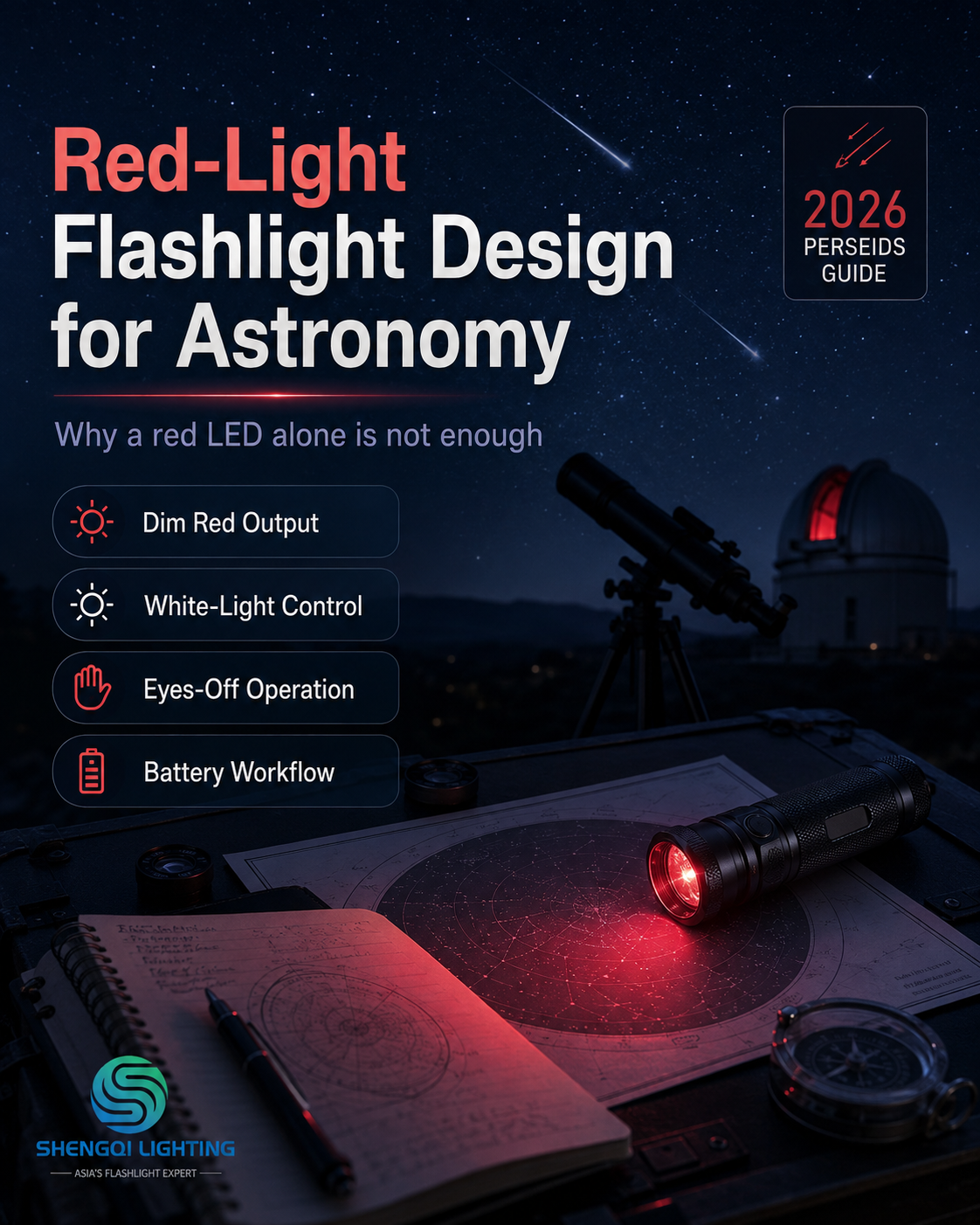

Why the 2026 Perseids Are a Useful Product-Design Checkpoint
As of August 2026, the Perseid meteor shower is active through July and August, with the 2026 maximum centered around August 13. The International Meteor Organization 2026 calendar places the main maximum in the August 12–13 period, while NASA's August 2026 skywatching guidance also identifies the evening of August 12 into the early morning of August 13 as the peak observing period.
The Perseids originate from debris associated with Comet 109P/Swift-Tuttle. Local weather, light pollution and site conditions still determine actual viewing quality. The meteor shower is used here as a timely product-design context, not as an observing forecast for every location.
What should private-label buyers specify in a red-light flashlight for astronomy?
Private-label buyers should specify red-light output, mode spacing, startup behavior, accidental white-light prevention, switch logic, beam width, battery workflow, carry structure and packaging instructions—not simply request a flashlight with a red LED. The product brief should define a dim red output appropriate for close tasks, white-light lockout or separation where required, the first startup mode, one-hand operation and tactile identification. Buyers should also define battery format, anti-roll structure, logo and packaging requirements, then verify the final behavior through sample testing. Even red light can interfere with dark adaptation if it is unnecessarily bright.
Why Dim Red Light Matters
Human eyes adapt gradually to low-light conditions. Bright light can interfere with that adaptation, which is why dim red illumination is commonly used around astronomy events and observing sites.
The National Park Service discussion of dark adaptation and red flashlights also notes that bright red light can still interfere with low-light vision. The product-design implication is simple: red light should be dim enough for the task. Color alone is not the complete specification.
Why a Red LED Alone Does Not Make an Astronomy Flashlight
A general multi-function light may include red illumination but still start on white, cycle through bright modes, make controls difficult to identify by touch or produce more red output than a close-range task requires.
A red LED is a component. An astronomy flashlight is a complete user-interface, optical, mechanical and battery specification.
Astronomy users operate the product in darkness, often while handling other equipment. Multi-function lights and dedicated astronomy lights therefore solve different briefs rather than competing through LED color alone.
Eight Specifications That Define an Astronomy Red-Light Flashlight
P100-R Case Study: A Multi-Function Red-Light Platform
The P100-R red-light multifunction platform uses a Cree XPE red-light LED alongside its OSRAM P9 white-light system. It has a built-in 1200mAh lithium battery, magnetic tail, flat rectangular 6063 aluminum body, IPX4 specification and 1-meter impact rating.
The flat structure provides a useful example of a body that can reduce rolling tendency compared with a round cylindrical format. However, astronomy-specific details such as red-light output, red mode count, red-first startup, white-light lockout, red runtime and switch logic remain unverified.
P100-R should therefore be treated as a multi-function platform reference, not automatically as a professional astronomy flashlight.
Multi-Function Red Light or Dedicated Astronomy Flashlight?
| Design Factor | Multi-Function Platform | Dedicated Astronomy Platform | Buyer Decision |
|---|---|---|---|
| White-light function | Available | Optional or absent | Channel requirement |
| Red startup | Must be verified | Can be designed red-first | Define first click |
| Red brightness | May not be astronomy optimized | Project-defined | Validate in darkness |
| Switch complexity | Potentially higher | Can be simplified | Match workflow |
| Battery | Existing architecture | Project-defined | Review field use |
| Branding and packaging | Broader positioning | Astronomy-specific | Define channel |
Neither architecture is automatically better. The correct choice depends on the buyer's channel and end-user workflow.
How to Define a Dedicated Private-Label Astronomy Flashlight
Should an Astronomy Flashlight Use Replaceable Batteries?
Replaceable batteries can support rapid field replacement and backup planning, while integrated rechargeable platforms can simplify compact packaging. Neither is automatically better. Battery-door sealing, cell compatibility, charging access, travel and service expectations should determine the final brief.
Anti-Roll, Carry and Eyes-Off Operation Matter Around Astronomy Equipment
Round lights can roll on sloped tables, cases or uneven outdoor surfaces. Flat sides, rectangular bodies, anti-roll rings or suitable clip geometry can reduce that tendency. P100-R provides one flat-body example, without implying that it cannot roll on every surface.
A clip should also be treated as a functional requirement rather than a decoration. Dedicated products can evaluate retention and orientation on jacket pockets, equipment bags or accessory pouches.
For eyes-off operation, sample users can be asked to identify and activate the red-light control in darkness without looking directly at the flashlight. This is a practical usability test suggestion, not an industry certification.
Astronomy Packaging Should Explain the Lighting Logic
Turn an Astronomy Inquiry Into a Product Specification
A recent astronomy-related B2B inquiry sought a red-light flashlight for an observatory/private-label application. That is a useful demand signal, but “red light + private label” is still not a complete product brief.
Development teams should clarify: red-only or red + white; task distance; red brightness levels; startup mode; white-light lockout; battery preference; runtime target; clip and anti-roll needs; IP target; logo method; packaging channel; observatory, club or retail use; target market; compliance needs; and order or revision structure.
Different channels can lead to different answers. Observatory organizations may prioritize standardized red startup and simple controls, while outdoor retailers may prefer broader red-and-white functionality.
What Should Buyers Test on an Astronomy Flashlight Sample?
Acceptance criteria should be agreed by the buyer and development team for the specific project.
Astronomy Private-Label Product Decision Matrix
| Buyer Requirement | P100-R Multi-Function Platform | Dedicated Red-Light Platform | Verification Needed |
|---|---|---|---|
| Dedicated red source | Cree XPE red LED confirmed | Project-defined | Optical measurement |
| Red output levels | Not Yet Verified | Project-defined | Mode test |
| Startup / white lockout | Not Yet Verified | Can be designed | Switch-logic test |
| Battery architecture | Built-in 1200mAh lithium | Project-defined | Battery review |
| Anti-roll structure | Flat rectangular body | Project-defined | Practical sample test |
| Environmental protection | IPX4 | Project-defined | Final configuration evidence |
What Evidence Should Support an Astronomy-Specific Claim?
Red-output claims should connect to optical measurement and the exact red mode. Runtime claims require the battery specification, mode-specific discharge testing and a defined endpoint. IP claims require evidence for the final configuration.
Anti-roll behavior can be checked on the sample structure. One-hand operation requires usability testing, while accidental white-light prevention requires switch-logic and repeated functional verification. Batch consistency requires an approved sample, controlled BOM revision and production inspection.
CE, REACH or an ISO9001 management system answer different questions and should not be used as substitutes for these functional tests.
How SHENGQI LIGHTING Can Develop a Private-Label Astronomy Light
For an astronomy-focused private-label project, product development should connect red-light output, beam design, switch logic, battery architecture, tactile operation, mechanical carry, branding, packaging and sample verification into one product brief.
Relevant SHENGQI capabilities include Industrial Design, Optical Engineering, Electronic Design, Packaging Design, Manufacturing, Luminous Performance Testing, Battery Testing and Discharge-Time Testing. Buyers can review private-label flashlight development and optical and battery verification capabilities.
SHENGQI LIGHTING has manufacturing roots dating back to 1981, while the current company was formally established in 2008. Development capability supports project definition and validation; astronomy performance still depends on the final approved specification and test evidence.
Frequently Asked Questions
1. Why do astronomers use red-light flashlights?
Dim red light is commonly used because it generally disturbs dark adaptation less than bright white light. That makes it useful for close tasks such as reading a chart, organizing eyepieces or checking equipment. The design should still control brightness, because light color alone does not determine how much an observer is disturbed.
2. Can red light still affect dark adaptation?
Yes. Red light that is unnecessarily bright can still interfere with dark-adapted vision. Buyers should therefore evaluate intensity, working distance and beam character rather than assuming that any red LED is suitable. A low red mode should be validated in representative dark conditions around the tasks the final user actually performs.
3. What brightness should an astronomy red flashlight use?
There is no single universal lumen value. Output should be matched to close-range tasks and validated in representative dark conditions. Map reading, notebook use, equipment labels and tripod adjustments may have different requirements. Private-label buyers should define the lowest useful red output first, then decide whether additional red levels are needed.
4. Why should an astronomy flashlight avoid accidental white-light activation?
Unexpected white light can disturb the user's dark adaptation and nearby observers. Buyers should therefore review startup behavior, mode order and how white light is reached. Depending on the architecture, an independent red control, red-only mode, lockout or deliberate white-light activation step may reduce accidental switching.
5. Is a multi-function red-light flashlight suitable for astronomy?
Potentially, but the presence of a red LED alone is insufficient. Buyers must verify red output, switch logic, startup behavior, beam characteristics and battery workflow. Multi-function products can provide broader channel flexibility, while a dedicated red-light product may allow simpler controls and more deliberate white-light separation.
6. Are replaceable batteries better for an astronomy flashlight?
Not automatically. Replaceable batteries can simplify field backup and rapid replacement, while integrated rechargeable batteries can support compact product architecture. Buyers should compare observation duration, charging access, travel, sealing, replacement supply and after-sales requirements before selecting a battery system.
7. What should private-label buyers verify before ordering an astronomy red-light flashlight?
Verify red output, wavelength if required, beam characteristics, mode sequence, accidental white-light prevention, one-hand operation, battery architecture, anti-roll behavior, clip requirements, logo placement and packaging. The final sample should also be tested for usability and production consistency before the product specification is frozen for mass production.
Define the Red-Light Experience Before Freezing the Product
Astronomy equipment brands, observatories, telescope accessory companies, science-education suppliers and private-label buyers can discuss red-output definition, beam design, independent red-light control, switch logic, battery architecture, anti-roll structure, branding, packaging and sample testing.
Contact SHENGQI LIGHTING for an OEM/ODM technical evaluation at sales@shengqilight.com.