
What Makes a Good Compact EDC Flashlight?
A good compact EDC flashlight balances pocket size, weight, grip, switch access, beam usefulness, battery capacity, thermal behavior and carry hardware rather than simply minimizing overall dimensions. A product that disappears in a pocket but is difficult to grip, activates accidentally or runs an unsuitable beam has missed the point of everyday carry. The design should reflect the target pocket, typical task and expected carry duration. Battery size and heat limits need to support the chosen output, while the clip and controls should remain accessible without adding unnecessary bulk. The result is a carry tool whose dimensions support its job instead of becoming the job.
How Small Should a Compact EDC Flashlight Be?
There is no universal size limit for a compact EDC flashlight because usable dimensions depend on the battery, carry method, grip, controls and intended lighting task. A short tubular light can still feel bulky if its diameter and clip offset create a pronounced pocket profile. A thin rectangular design may distribute thickness better but occupy more width. Compactness is contextual: the correct envelope is the smallest one that still supports the required battery, beam, control layout, thermal path and comfortable handling.
Are Smaller EDC Flashlights Always Better?
No. Making an EDC flashlight smaller can improve carry convenience, but excessive miniaturization can reduce grip, battery space, thermal capacity and control usability. Smaller switches may become harder to locate, crowded components can complicate assembly and reduced housing volume can make thermal management more demanding. Size reduction becomes useful only while the product still performs its intended everyday task predictably.
What Is a Compact EDC Flashlight?
A compact EDC flashlight is a portable light designed around repeatable everyday carry, where dimensions, weight, controls, battery, beam and carry hardware are intentionally balanced to reduce carry burden without removing the functions needed for the intended task.
That makes “compact” a system-level product target rather than a single measurement. Length alone does not define it. Neither does weight, diameter or battery size.
Brands evaluating different structures can use the EDC flashlight product range to compare flat, tubular, rectangular, clip-on and multi-source packaging directions without treating any one architecture as the universal answer.
There Is No Single Size That Makes a Flashlight “Compact”
No universal 50mm, 70mm or 100mm cutoff turns a flashlight into a compact EDC product. The meaningful dimensions depend on the use case, battery, pocket type, carry method, required beam and feature set.
A 95mm body can feel compact in one category and oversized in another. A flat body can reduce thickness while increasing width. A tubular body can maintain a narrow cross-section while extending farther down the pocket.
Compactness is contextual. The buyer should define the acceptable carry envelope before deciding whether a particular architecture is genuinely compact for the target user.
Start With Where the Flashlight Will Actually Be Carried
Front pants pocket: thickness, length, neighboring keys or a phone, clip orientation and accidental activation become important quickly.
Workwear or tool pocket: retention, repeated extraction, dirt exposure and control access may matter more than achieving the absolute smallest body.
Jacket pocket: movement and weight distribution can be more noticeable than a few millimeters of length.
Bag or organizer: shape, visibility, lockout and efficient use of compartment space may matter more than on-body comfort.
A flashlight that is compact on a specification sheet may still carry poorly in the target pocket.
Making a Flashlight Smaller Can Make It Harder to Use
Miniaturization creates packaging pressure. The switch can become too small, usable grip length can disappear, the clip can visually and physically dominate the body, battery capacity can shrink and charging components can crowd the remaining internal space.
Smaller housings can also provide less material and internal space for thermal paths. If the design then keeps adding side lights, indicators and multiple controls, the compact package becomes harder to operate rather than easier to carry.
At some point, size reduction starts removing usability instead of improving carry.
Weight Has to Be Evaluated Together With Size
A visually small product can still feel heavy if the architecture includes a high-capacity cell, thick aluminum sections, a steel clip, magnet or dense internal components. An extremely light design may create different compromises in battery capacity, structure or feature set.
EDC weight should be treated as a budget shared by the battery, housing, optics, electronics and carry hardware. Product teams should decide where that mass produces actual user value.
The goal is not automatically the lowest number on a scale. It is a carry weight that matches the product role.
Compact Does Not Have to Mean Cylindrical
A tubular architecture can provide a natural circular grip, straightforward battery-axis layout and narrow cross-section. Flat and rectangular architectures can reduce rolling tendency, create predictable pocket orientation and distribute thickness differently.
Neither one automatically carries better.
Pocket Bulge Is Often More Useful Than Volume on Paper
The wearer experiences how the product projects against the body, not its calculated cubic volume. Diameter, thickness, width, edge radius and clip offset all influence that feeling. A flat light may reduce one dimension while increasing another, so real pocket testing matters more than labeling one geometry “slimmer.”
A Compact Light Still Needs Enough Body to Grip and Control
Switch size, switch position, tail versus side operation, two-button layouts and tactile identification all consume physical space. If glove use is important to the target channel, that requirement should be added to the brief rather than assumed.
Compact products often fail through control density: several functions are forced into a tiny area and mode access becomes harder than the size saving is worth.
Control efficiency matters more than the number of modes.
Pocket Activation Is Part of the Carry Design
An exposed side button, tail switch, surrounding keys, clip orientation and mode memory can all affect accidental activation. Lockout is one possible design option, not a universal requirement. Buyers should test the final switch geometry in the intended pocket rather than evaluating button feel only on a desk.
Compact EDC Beam Design Should Follow the Everyday Task
Everyday use may involve locating items, walking, checking nearby equipment, temporary outdoor navigation or inspecting dark spaces. Those tasks do not all need the same beam.
Define near-field versus distance needs, hotspot, spill and useful low, medium and high modes before peak output becomes the design target.
The lowest useful mode is a product requirement, not an afterthought. It can improve close-range usability, reduce glare and change how the battery is used during routine tasks.
A compact EDC flashlight should provide enough light for its intended role without allowing peak output to dictate the entire enclosure.
Battery Choice Is Usually the Biggest Constraint on Compact Size
The battery can directly affect body diameter, thickness, length, weight, available energy and charging layout. AAA, AA, 14500, 16340, 18350 and integrated lithium architectures can all support different compact-product directions.
Replaceable batteries may support field replacement and serviceability. Integrated systems can provide more freedom in enclosure geometry and user handling. Neither approach is automatically smaller.
Battery capacity also does not equal runtime or sustained output. Voltage, LED load, driver behavior, mode, thermal regulation and the runtime endpoint all matter.
For one example of how a cylindrical battery platform can influence a compact pocket design, see the L2 MAX compact pocket-light case. That model-specific article retains its own search intent.
Compact Bodies Have Less Room to Hide Thermal Problems
Smaller housings can reduce available thermal mass and surface area, while higher-output LEDs can place meaningful heat inside a confined package. That does not mean every small flashlight will overheat.
Actual behavior depends on LED efficiency, drive current, PCB design, thermal contact, body material, geometry, control logic and output duration.
Peak output and compact size create a design trade-off that must be verified over time. Thermal performance should be measured on the finished architecture rather than inferred from product size or a peak-lumen claim.
The Clip Is Part of the EDC Architecture, Not an Accessory Added at the End
A clip affects carry depth, orientation, pocket bulge, extraction, switch exposure, retention and total thickness. A two-way clip can support different carry orientations or other attachment options, but not every compact product needs one.
Magnets are similar. They may support hands-free positioning on suitable ferromagnetic surfaces, but they add weight and consume internal or external space.
If direct charging is part of the brief, the connector, charging PCB, status indicator and any sealing structure also require space. Compact design should reduce unused volume, not blindly reduce structural material.
Compact EDC Products Can Become Too Feature-Dense
Brands may want a main beam, side light, UV, red light, magnet, clip, display, charging and multiple buttons without allowing the enclosure to grow.
The result can be crowded electronics, reduced battery space, more optical windows, harder sealing, higher assembly complexity and a user interface with no clear priority.
A compact flashlight should earn every feature it carries. Feature density should be limited by the product role, not by how many functions can physically fit into the housing.
Three Ways a “Compact” EDC Design Can Fail
01. Small Enough to Carry, Too Small to Grip
Reducing length can remove the body area needed for stable handling. The clip, switch and fingers start competing for the same space. The product may look impressively short on a specification sheet yet feel awkward when drawn and operated. The solution is not automatically a longer body; it is to test the actual grip and control layout before freezing dimensions.
02. High Output on the Specification Sheet, Uncomfortable Thermal Behavior in Real Use
A small enclosure can support high initial output, but the product still needs a thermal strategy for the modes users will actually run. Internal component layout, heat paths and control logic influence what happens after activation. Peak output should therefore be evaluated together with output-over-time behavior. Compact performance is a system question rather than a single headline number.
03. Too Many Functions in Too Few Controls
Adding secondary lights, lockout, indicators and several modes can make a tiny interface difficult to understand. Users may need repeated clicks or long mode cycles to reach the function they actually want. More functionality then produces more friction. Compact design is optimization, not miniaturization at any cost.
Compact EDC Flashlight Design Matrix
| Design Variable | Why It Matters | Compact Design Risk | Buyer Question | Prototype Evidence |
|---|---|---|---|---|
| Overall Length | Pocket depth and grip | Too short to handle well | What length fits the target carry? | Pocket and grip test |
| Thickness / Diameter | Pocket bulge | Carry discomfort | How does it project against the body? | Carry comparison |
| Weight | Long-duration carry feel | Dense small product | Where is the mass being used? | Complete-product weight review |
| Body Geometry | Pocket orientation | One dimension optimized at another's expense | Flat, tubular or another form? | Representative pocket test |
| Grip | Control stability | Insufficient hand contact | Can it be drawn and used easily? | Grip test |
| Switch / Controls | Fast predictable access | Crowded UI | Can functions be found by touch? | Control and activation test |
| Beam | Task usefulness | Peak output dominates design | What distances matter? | Working-distance beam review |
| Battery | Energy and body envelope | Runtime or size compromised | What architecture fits the brief? | Battery workflow test |
| Thermal Architecture | Output over time | Limited heat path | What modes need verification? | Thermal / output-over-time test |
| Clip / Carry | Retention and orientation | Extra thickness or switch exposure | What carry depth is needed? | Insertion / extraction test |
| Secondary Features | Product differentiation | Feature density | Does each feature earn its space? | Task-based validation |
| Charging / Environmental Design | Packaging and enclosure integrity | Crowded connector / seal area | What interfaces are required? | Final-configuration verification |
Compact EDC Should Have a Clear Role in the Product Line
An ultra-compact SKU may prioritize minimum carry burden. A general compact EDC can balance pocket comfort, useful runtime and a primary beam. A multi-function compact SKU can justify additional light sources or mounting features, while a higher-output pocket model may accept a larger battery and body.
The mistake is creating four products with nearly identical dimensions, functions and keyword targets. Product differentiation should help the user, the sales channel and SEO architecture understand why each SKU exists. Broader architecture planning can connect back to the SHENGQI flashlight product platforms.
Ten Questions Before Developing a Compact EDC Flashlight
1. Where will the user actually carry the flashlight?
Define the real pocket, workwear slot, organizer or bag location. That choice changes the importance of thickness, length, clip design and accidental activation.
2. What maximum thickness or diameter is acceptable?
Do not specify length alone. The body dimension that projects against the wearer may matter more than overall volume.
3. How much grip length is needed for comfortable operation?
A shorter body may improve carry while reducing control stability. Test the actual hand position before locking the enclosure.
4. What beam task matters most?
Define near-field, walking or inspection use before choosing output. The primary beam should own a clear job.
5. What is the lowest useful output mode?
Close work can expose glare problems that maximum-output comparisons miss. Low mode belongs in the requirement phase.
6. Which battery architecture fits the size and runtime target?
Balance cell dimensions, energy, charging or replacement workflow and serviceability. There is no universal best compact battery.
7. How will heat be managed during higher-output operation?
The answer depends on the LED, driver, body and intended operating duration. Verify the real mode rather than assuming size predicts thermal behavior.
8. Does the product really need a clip, magnet, side light or other secondary feature?
Every addition consumes mass, space or UI attention. Keep the functions that support the product role.
9. How will accidental pocket activation be controlled?
Review switch exposure, clip orientation, button force and any lockout strategy in the intended carry environment.
10. What role will this SKU own within the broader EDC product line?
Its size, feature set and keyword positioning should be meaningfully different from adjacent products.
Twelve Tests Buyers Should Run on a Compact EDC Flashlight Prototype
A compact EDC flashlight should be tested in the carry environment, not only on a laboratory bench. Representative use can include sitting, walking, bending, removing nearby items, drawing the flashlight and returning it to the pocket.
Use the actual target pocket or carry location.
Compare the real carry profile with the approved brief.
Check drawing and returning the product during representative use.
Verify usable hand contact with the finished enclosure.
Confirm predictable control access without awkward repositioning.
Test the actual switch, clip and surrounding carry items.
Evaluate the beam where the product will really be used.
Review close-range visibility and glare.
Use representative operating modes and conditions.
Check insertion, extraction, retention and interference.
Evaluate the complete power-use process.
Compare carry, controls, beam and mechanical fit with the approved sample.
Acceptance criteria are project-specific. Available portable-light testing capabilities can support project verification, but capability availability does not mean every model has completed every test under identical conditions.
Compact Packaging Makes DFM More Important
Small packaging can make assembly more difficult because the battery, PCB, switch, clip, charging interface, optics and wiring occupy closely connected spaces. Critical dimensions should be identified from the final architecture rather than assuming every tolerance must simply become tighter.
A project-specific DFM review should ask whether the battery can be installed without damaging wiring, whether the PCB and switch can be assembled consistently, whether clip hardware interferes with fasteners, whether seals can be installed correctly and whether key dimensions can be inspected.
Production consistency also depends on controlling the approved BOM, battery dimensions, PCB, switches, springs, housing, optics and charging components.
That transition can be reviewed through SHENGQI's sample-to-production manufacturing capabilities.
Three SHENGQI Architectures Show Why “Compact” Can Take Different Forms
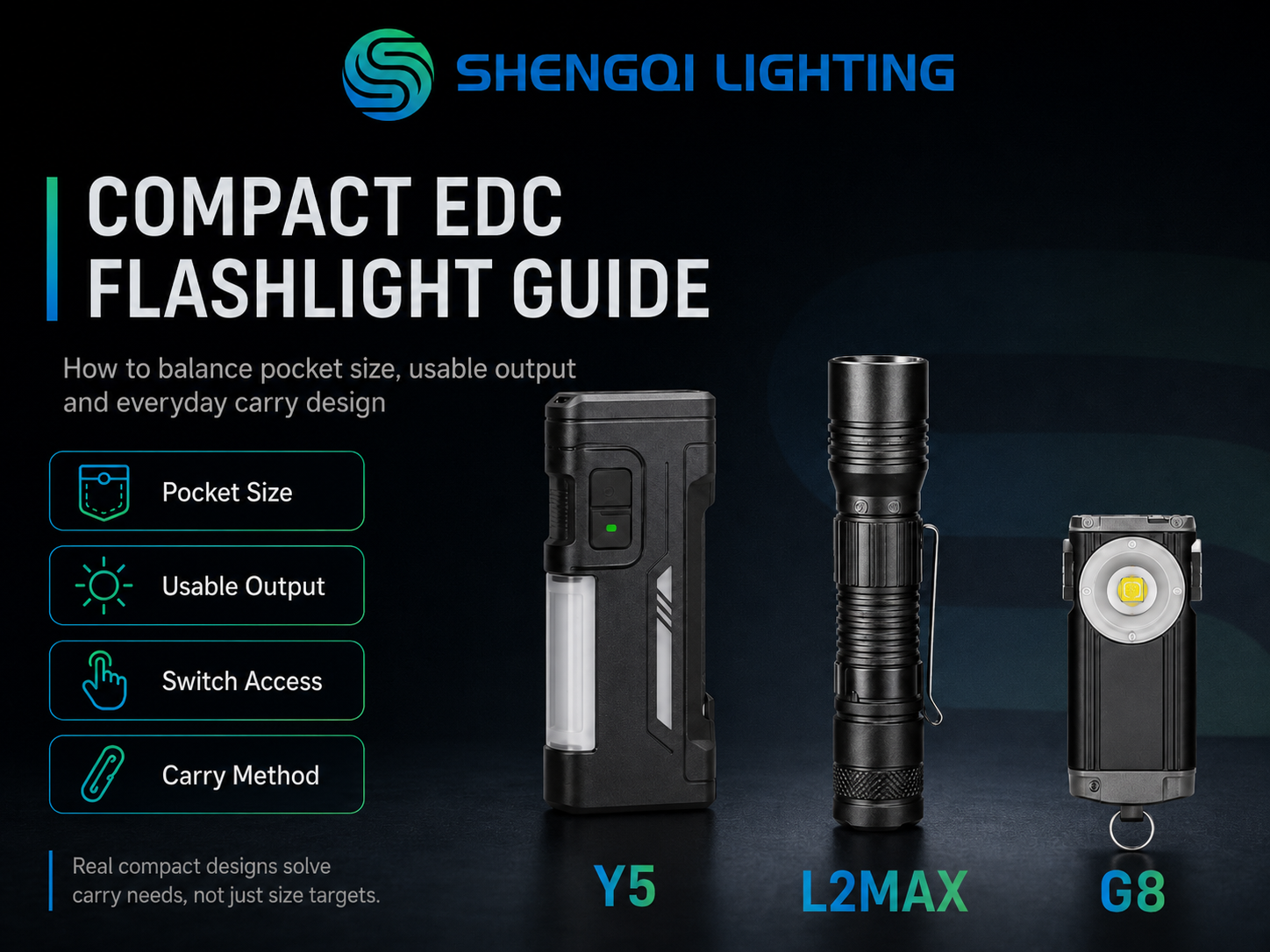
G8 provides an ultra-compact cylindrical reference at approximately φ30 × 64mm and 32g. Y4 shows a compact rectangular clip-on direction at 58 × 28 × 28.29mm and 52.4g, with several optical functions integrated into a different body shape. L2 MAX represents another cylindrical pocket architecture built around a 14500 battery platform.
These platforms illustrate different packaging directions rather than a universal compact-EDC formula. Product architecture should still begin with carry environment and task requirements.
How an OEM/ODM Project Should Define a Compact EDC Flashlight
A compact project should move in this order: carry environment, maximum body envelope, weight target, beam role, battery, UI, clip or carry hardware, secondary features, thermal target, DFM, prototype verification and packaging.
The body size should emerge from the product brief instead of being chosen before the internal architecture is understood.
Relevant development work may involve Industrial Design, Optical Engineering, Electronic Design, PCB Layout, battery architecture, manufacturing, testing, Quality Control and Packaging Design.
Brands planning a custom pocket platform can review SHENGQI's custom EDC flashlight development capabilities when defining the product brief.
Frequently Asked Questions About Compact EDC Flashlights
1. What is a compact EDC flashlight?
A compact EDC flashlight is designed for repeatable everyday carry while preserving the grip, controls, beam, battery and carry functions required by its intended task. Compactness should be evaluated as a complete product architecture rather than a single length or weight number. A successful design reduces unnecessary carry burden without shrinking the product past the point where operation or performance becomes inconvenient.
2. How small should a compact EDC flashlight be?
There is no universal dimensional limit. The usable size depends on battery architecture, pocket type, grip, controls, beam requirements and carry hardware. A thin rectangular flashlight may be wider than a tubular light, while a short cylindrical model may still create noticeable pocket bulge. The correct size is the smallest envelope that still satisfies the defined carry and lighting requirements.
3. Are flat EDC flashlights more compact than tubular flashlights?
There is no universal answer. Flat architectures may reduce thickness and rolling tendency but can increase width. Tubular architectures may maintain a narrow cross-section while increasing diameter or length depending on the battery and optics. Thickness, width, diameter, length and clip offset should be reviewed together. Real pocket carry is more useful than judging the form factor from one dimension.
4. What battery is best for a compact EDC flashlight?
There is no universal best battery. AAA, AA, 14500, 16340, 18350 and integrated lithium systems create different trade-offs in body size, energy, weight, serviceability and charging layout. The battery should be selected after the intended beam, runtime, overall dimensions and user workflow are defined. Battery capacity alone does not determine real runtime or sustained output.
5. Why can compact high-output flashlights get hot?
A compact housing may provide less thermal mass and surface area while the LED and driver still generate heat. That does not mean every small flashlight will become excessively hot. Actual thermal behavior depends on LED efficiency, drive current, PCB structure, thermal contact, housing material, geometry, control logic and output duration. Finished-product testing is required to understand the real operating behavior.
6. Does a compact EDC flashlight need a pocket clip?
Not necessarily. A clip can improve retention, carry orientation and access, but it also adds thickness and may change switch exposure or pocket feel. Some products may be better suited to key-ring, organizer, loose-pocket or other carry methods. The clip should follow the target carry brief rather than being treated as a mandatory EDC feature.
7. What should B2B buyers test on a compact EDC flashlight sample?
Test the product in the intended pocket or carry location, then evaluate pocket bulge, extraction, grip, switch access, accidental activation, beam behavior, low-mode usability and output-over-time performance. Clip or carry hardware, battery workflow and charging should be reviewed where applicable. Production-representative samples should also be compared with the approved development sample.
8. Can a compact EDC flashlight be customized for private-label or OEM/ODM projects?
Yes. A custom project can define the body envelope, battery, beam, controls, clip, secondary functions, thermal architecture, CMF and packaging around a target carry environment. The main design principle is to understand the internal architecture before freezing the exterior size. Prototype carry testing and project-specific DFM then help connect the approved product concept to production.
Compact Is an Optimization Target, Not a Race to the Smallest Body
A useful compact EDC flashlight reduces carry burden while preserving the grip, controls, beam, battery and thermal behavior required by its job. Pocket geometry, weight, clip design and feature density should be evaluated together. The final dimensions should be the result of the product architecture—not a number chosen before the engineering begins.
Define the Carry Environment Before Freezing the Product Size
EDC brands, outdoor companies, tool businesses and private-label buyers can discuss body geometry, battery architecture, controls, optics, carry hardware, thermal design, DFM, prototype verification and packaging as one compact product system.
Contact SHENGQI LIGHTING for an OEM/ODM technical evaluation at sales@shengqilight.com.
Contact SHENGQI LIGHTING