Dominate the Dark: Sourcing the T20 2000LM Tactical Flashlight for Law Enforcement
Within the rigorous parameters of law enforcement and private security operations, an illumination tool transcends basic utility; it functions as a critical element of the officer's defensive continuum. Standard commercial flashlights routinely fail under the extreme kinetic forces, rapid thermal cycling, and hydrostatic pressures inherent to active duty. When a patrol officer navigates a light-deprived industrial complex, optical failure could precipitate severe tactical disadvantages.
Addressing these exact operational vulnerabilities requires instruments engineered to strict military specifications. This technical white paper dissects the optoelectronic and metallurgical architecture of the T20, a highly specialized duty light. By evaluating its semiconductor efficiency, thermodynamic management, and mechanical sealing properties, procurement directors may objectively assess why this specific instrument qualifies as the premier Tactical Flashlight 2000LM solution for frontline deployment. Furthermore, understanding these underlying physics enables agencies to identify a qualified Self-defense Light Manufacturer capable of meeting strict supply chain tolerances.
01. Optoelectronic Architecture: The LUMINUS SST40
The luminous efficacy and spatial distribution of a tactical beam are dictated entirely by the semiconductor die and the surrounding parabolic geometry. The T20 utilizes a highly specific optical engine to achieve its necessary photometric output.
Semiconductor Physics: 2000 Lumens Peak Output
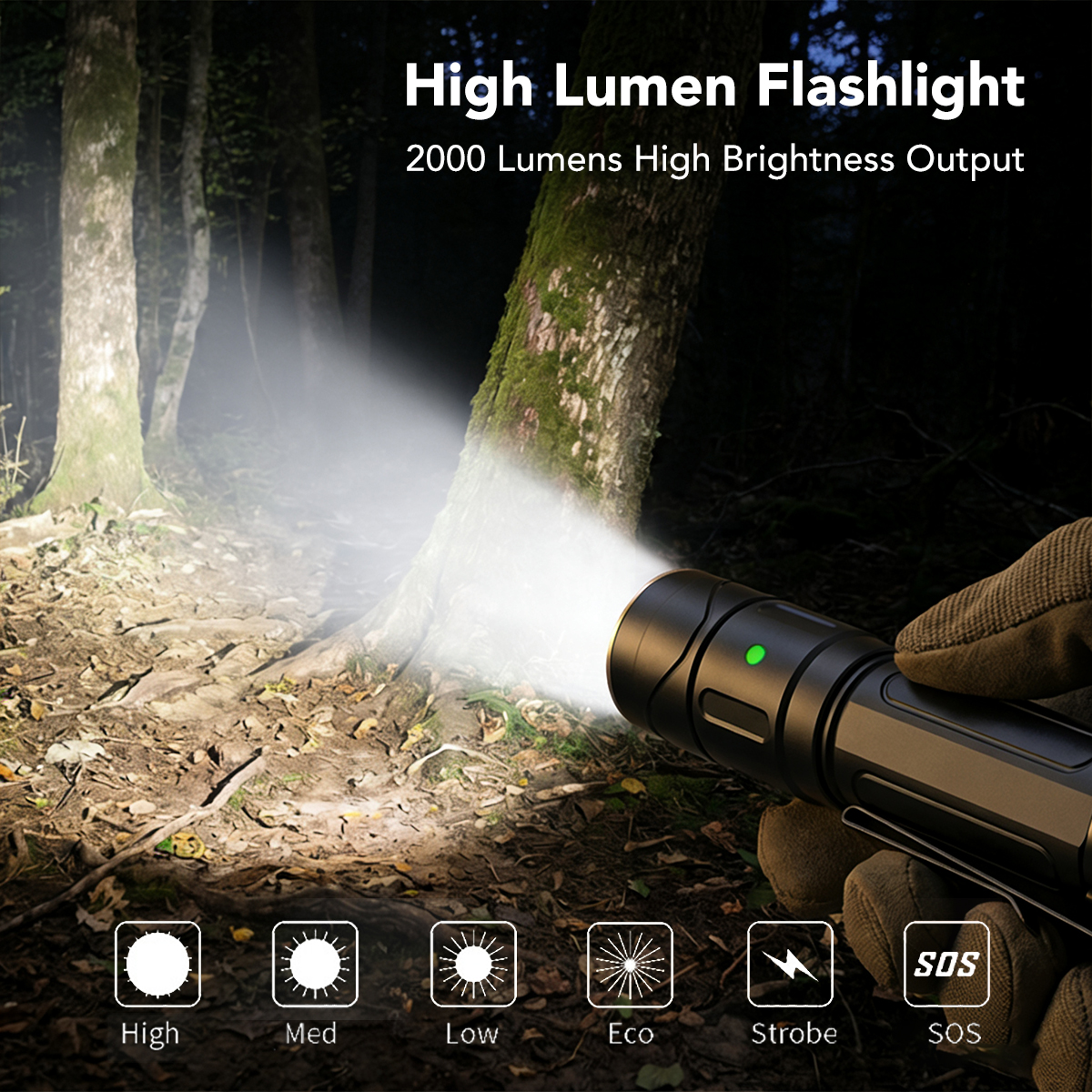
At the core of the device lies the LUMINUS SST40 LED. This specific emitter is highly regarded in the optoelectronics industry for its low thermal resistance and exceptional forward voltage ($V_f$) efficiency. When driven at maximum continuous current, the LUMINUS SST40 Flashlight architecture delivers a blinding 2000-lumen output in Turbo mode. This sheer volume of photonic energy is mathematically required to instantly saturate a dark environment, completely eliminating peripheral shadows where an adversary might conceal themselves.
Spectral Tuning: 5500K Correlated Color Temperature
Lumen output must be paired with the correct spectral wavelength. The T20 is precisely calibrated to a Correlated Color Temperature (CCT) of 5500K. In atmospheric physics, this specific neutral-cool white spectrum closely mimics direct daylight. Unlike higher Kelvin ratings (e.g., 6500K) which produce heavy blue-light backscatter in fog or smoke, the 5500K spectrum maximizes target contrast and depth perception, optimizing the human eye's rhodopsin response during low-light tactical operations.
Spatial Collimation: 240-Meter Throw
To utilize 2000 lumens effectively, the energy must be concentrated. The T20 employs a computer-modeled Smooth (SMO) parabolic reflector. By placing the LUMINUS SST40 die at the exact geometric focal point of the parabola, the system achieves extreme specular reflection. This highly collimated setup generates a concentrated hotspot capable of achieving a verified 240-meter beam distance. This allows an officer to illuminate a vehicle interior or a suspect from a safe, standoff distance, firmly establishing a tactical advantage.
02. Neurological Disruption: The Defensive Strobe
In a lethal force encounter, fine motor skills rapidly degrade due to stress-induced sympathetic nervous system arousal. A duty light must interface with the operator's gross motor skills to deploy defensive countermeasures instantly.
The Physics of the Bucha Effect
The T20 is engineered with an instant defensive strobe mechanism. When activated, the Microcontroller Unit (MCU) pulses the 2000-lumen output at a highly specific, variable frequency (typically oscillating between 10Hz and 20Hz).
This specific frequency range induces a phenomenon known as the Bucha effect (flicker vertigo). When directed at an adversary's visual cortex in a low-light environment, the high-intensity strobe overwhelms the photoreceptors. The brain struggles to process the rapidly changing spatial data, resulting in severe disorientation, loss of depth perception, and temporary spatial blindness. This allows the officer a critical window of opportunity to disrupt the target's OODA loop, escalate force, or effect an arrest safely. A dedicated dual-switch or immediate-access tail cap ensures this strobe can be triggered under extreme duress without accidentally cycling into a low-output reading mode.
03. Hydrostatic & Metallurgical Engineering
Protecting the internal driver board and lithium-ion cell requires a housing capable of withstanding immense kinetic shock and sustained hydrostatic pressure. The physical chassis of the T20 represents the pinnacle of subtractive manufacturing.
6063 Aerospace Aluminum & Impact Resistance
The flashlight body is exclusively CNC-machined from a solid extruded billet of 6063 aerospace aluminum. This specific alloy provides an optimal strength-to-weight ratio and exceptional thermal conductivity. The absence of internal micro-porosity (which plagues cheaper die-cast models) ensures the crystalline structure of the metal remains intact. Paired with internal dual-spring battery contacts that decouple mass during a shock event, the T20 is empirically certified to survive sudden 2-meter drop impacts onto solid concrete without sustaining optical or electrical failure.
IP68 Submersible Integrity
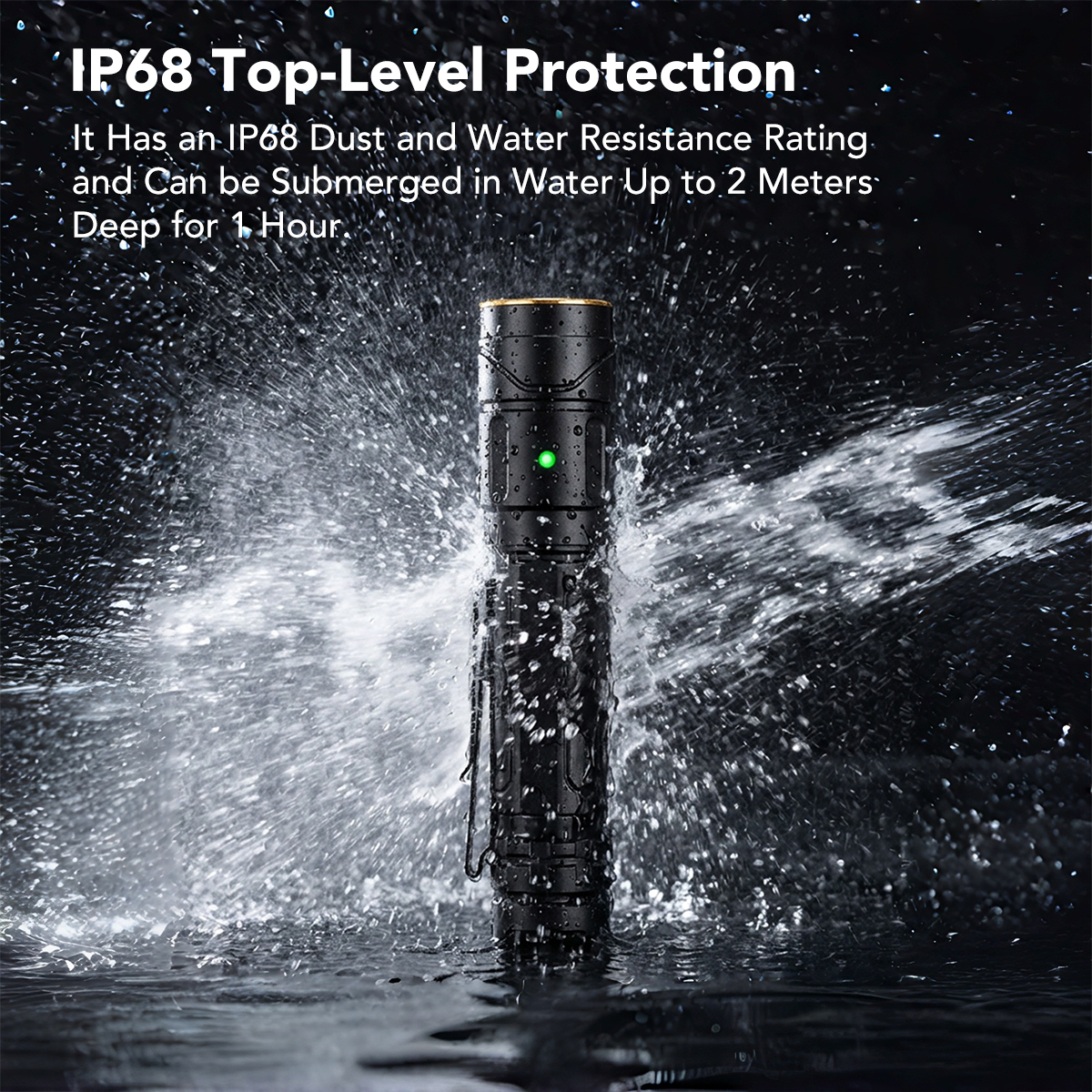
Water resistance is governed by the physics of hydrostatic pressure ($P = \rho g h$). The T20 achieves an uncompromising IP68 Rating. This indicates the device is completely dustproof and certified to remain fully submersible at a depth of 2 meters for 60 continuous minutes. This is achieved via precision trapezoidal thread cutting and high-durometer fluororubber O-rings. Partnering with a dedicated IP68 Waterproof Flashlight OEM ensures that every unit passes strict negative pressure leak testing before deployment, guaranteeing survival in torrential rainstorms or flooded subterranean environments.
04. Power Telemetry & 5-Mode Regulation
A 2000-lumen output demands significant amperage. Standard batteries would suffer severe voltage sag, resulting in immediate dimming. The T20 mitigates this through advanced electrochemical and electronic symbiosis.
18650 Li-ion Integration (3100mAh)
The device is powered by an included, high-capacity 18650 3100mAh Li-ion battery. The 18650 format was deliberately selected to maintain a 1-inch (25.4mm) body diameter, ensuring seamless compatibility with standard law enforcement duty belts and tactical weapon mounts. The 3100mAh capacity provides the immense discharge rate required for the Turbo burst, while maintaining enough energy density to sustain long-duration patrols.
5-Mode Intelligent Driver
The internal driver board utilizes a Constant Current (CC) switching topology to balance extreme brightness with energy efficiency. It regulates the output across 5 distinct modes (e.g., Turbo, High, Medium, Low, and Strobe). This allows the operator to scale the photonic output based on the specific operational requirement—utilizing Low mode for administrative tasks to preserve battery life for dozens of hours, while reserving the Turbo and Strobe modes for critical tactical engagements.
05. Technical Parameter Matrix: T20 vs. Legacy Duty Lights
Procurement officers must evaluate modernization upgrades based on empirical data. The following matrix illustrates the performance differential between the T20 architecture and legacy halogen/early-LED duty lights currently in circulation.
Procurement Protocol: Validate Manufacturer Authority
Law enforcement and tactical gear distributors cannot afford to source equipment from unverified trading companies. The T20 is engineered, machined, and rigorously tested directly within the ISO9001-certified facilities of SHENGQI LIGHTING. As a globally recognized Self-defense Light Manufacturer, we operate an advanced fleet of 5-axis CNC machines and cleanroom assembly lines to ensure every unit meets strict military and law enforcement specifications.
[ Initiation of B2B Sourcing ]
We formally invite procurement directors, security agencies, and wholesale distributors to evaluate the T20's structural integrity and photometric dominance. We provide comprehensive OEM/ODM private-label services, tailored circuit programming, and rigorous batch testing documentation.