
Why Storm Lighting Matters Right Now
As of July 21, 2026, the National Hurricane Center is issuing advisories for Tropical Storm Bertha over the northeastern Gulf region. Tropical storm watches and warnings remain in effect for portions of the northern Gulf Coast, with a Storm Surge Watch in some coastal areas.
The July 21 advisory also forecasts rainfall of 2 to 4 inches in parts of the affected Gulf Coast region, with isolated totals around 6 inches. The NHC notes that this rainfall may produce areas of flash flooding, particularly in urban areas.
Weather conditions and official warnings can change quickly, so readers should follow current guidance from local authorities and official weather agencies. For lighting planners, the broader lesson is that heavy rain, temporary power loss and limited charging access can occur together, making hands-free lighting, water-resistance boundaries and backup power relevant product-design considerations.
What type of lighting is useful during a tropical storm power outage?
Hands-free lighting such as a headlamp can be useful during a tropical storm power outage because it keeps both hands available for carrying supplies, inspecting equipment and moving through dark indoor areas. Water resistance should match the expected exposure, and an IP rating should never be treated as automatic permission for submersion. Medium and low modes can be more practical than maximum brightness for repeated tasks. Rechargeable products also need a charging contingency, and a separate handheld flashlight is useful for redundancy. Runtime should be verified by mode and battery configuration.
Why Hands-Free Lighting Matters During Storm Outages
A storm-related outage often creates ordinary tasks that become harder in darkness: opening storage containers, carrying supplies, inspecting a utility room, checking a vehicle, locating equipment or organizing an emergency area.
A headlamp keeps both hands available while directing light approximately where the user is looking. That can support maintenance work, supply handling and movement through dark indoor areas without requiring one hand to hold a flashlight continuously.
Hands-free lighting is also useful when users need to manipulate tools, check breakers or inspect equipment labels. The value comes from freeing both hands rather than simply increasing brightness.
A headlamp does not replace every handheld flashlight. A handheld model may offer different beam distance, beam shape or battery options depending on the product. The headlamp adds another lighting role to a broader emergency system.
Water Resistance Does Not Mean Floodproof
IP ratings help buyers understand a product’s tested water-exposure boundary, but the exact rating must match the exact model. Rain exposure, water jets and intentional immersion are different conditions.
| Rating | General Protection Direction | Storm-Lighting Interpretation | Buyer Reminder |
|---|---|---|---|
| IPX4 | General splash-protection level. | Can fit limited splash exposure when confirmed for the model. | Not an immersion rating. |
| IPX5 | Water-jet protection level. | Useful for evaluating rain-exposed and wet-weather preparedness tasks. | Does not mean submersible or floodproof. |
| IPX6 | Stronger water-jet protection level. | May suit stronger water-spray exposure when model-specific evidence supports it. | Still not automatically an immersion rating. |
| IP67 / IP68 | Immersion-related protection categories under defined test conditions. | Only discuss these ratings when the exact product has verified documentation. | Never transfer the rating from another model. |
Seals, charging interfaces, product condition and assembly consistency can affect real-world readiness. Water resistance does not mean a headlamp should be intentionally submerged or used in floodwater.
Floodwater itself can create electrical, chemical, structural and biological hazards. An IP rating is a product-protection specification, not a guarantee that floodwater exposure is safe for the user.
Why Emergency Headlamps Need More Than One Brightness Level
Maximum brightness is only one part of emergency usability. Different storm-outage tasks require different working distances, glare levels and energy demands.
300LM High
Can support short directional checks, equipment inspection and outdoor observation from an appropriate location. It should not define the entire emergency-lighting strategy.
140LM Medium
Can support general indoor tasks, repeated maintenance work and moving supplies where maximum output is unnecessary.
55LM Low
Can suit close-range work, equipment labels, indoor orientation and situations where full output would create unnecessary brightness.
Strobe and SOS
Can support attention signaling, visibility signaling and location indication where appropriate. Their use should be described without self-defense or tactical claims.
HL8 Case Study: Hands-Free Lighting for Wet-Weather Preparedness
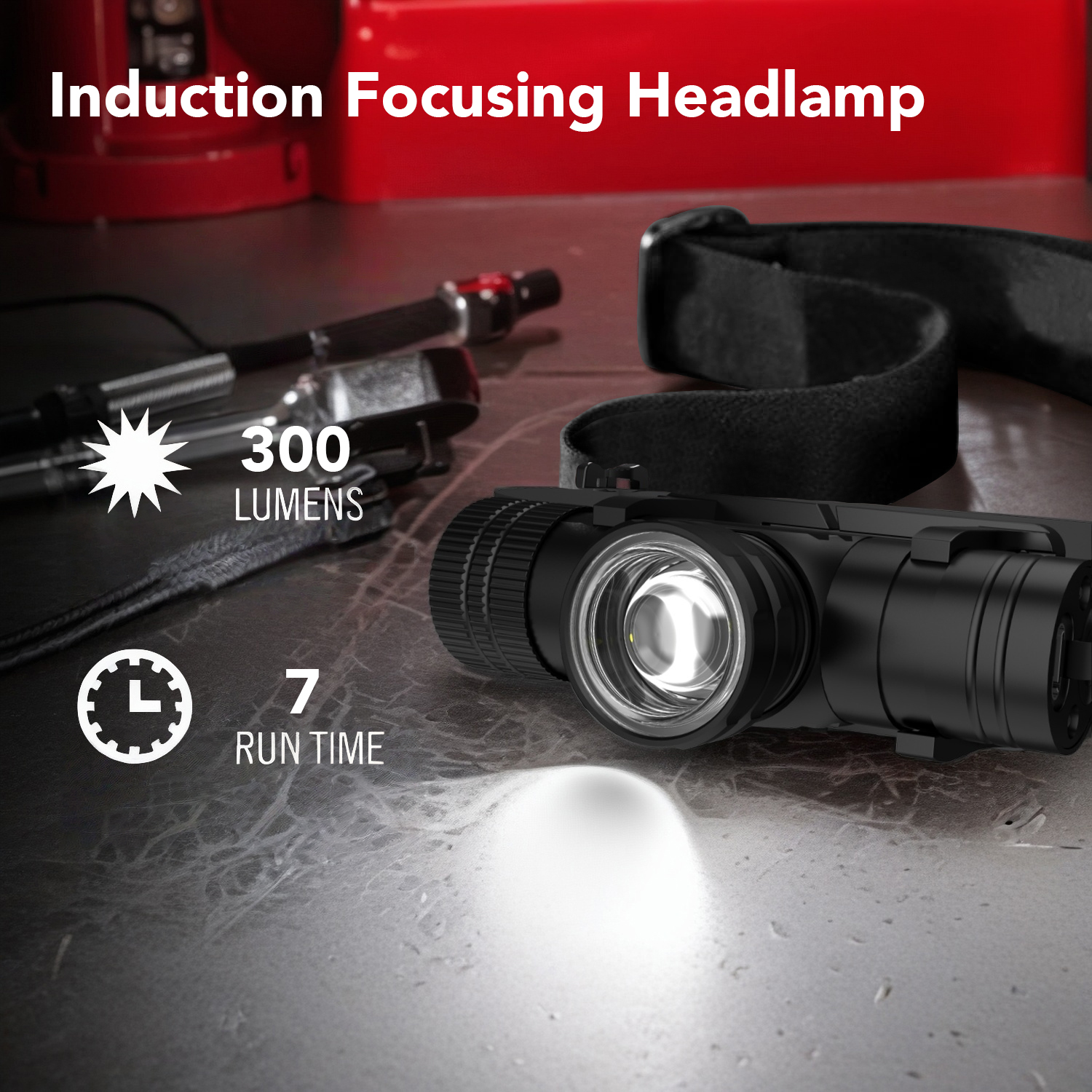
HL8 is an intelligent wave-sensing headlamp that illustrates how a hands-free lighting platform can combine multiple output levels, rechargeable power and rain-exposure protection for emergency-preparedness applications.
The 5W lighting platform provides 300LM High, 140LM Medium and 55LM Low, along with 300LM Strobe and 140LM SOS. Its maximum beam distance is 69 meters, giving the product a directional-lighting role for household outages, equipment inspection, vehicle checks and general preparedness tasks.
The wave-sensing function may reduce the need for repeated direct switch contact in suitable situations. This can support workflows where users are carrying supplies or working with both hands, but it should not be described as guaranteed wet-hand, glove or all-environment sensor operation without specific test evidence.
HL8 uses an 18650 lithium battery platform with a confirmed 1800mAh capacity. Because it is a rechargeable lithium platform, charging access and backup-power planning still matter during an extended outage. Battery capacity alone does not prove runtime.
The body uses 6063 aluminum alloy and carries an IPX5 water-resistance rating with 1-meter impact resistance. IPX5 indicates protection against water jets under applicable test conditions, not submersion.
HL8 is an example of a hands-free lighting platform, not a flood-rescue or submersible product. Buyers exploring other hands-free formats can review the headlamp product range.
Why a Headlamp Should Be Part of a Lighting System
A practical emergency kit may include several independent lighting roles rather than relying on one device.
Hands-Free Headlamp
Supports supply handling, maintenance and tasks that require both hands. It adds a different role from handheld directional lighting.
Primary Handheld Flashlight
Supports directional lighting and longer-range checks depending on the selected model. Buyers can compare handheld flashlight options.
Compact Personal Backup
Provides individual redundancy if the primary light is unavailable, depleted or being used by another person.
Spare or Backup Power
Rechargeable lighting requires a charging contingency, while replaceable-battery lights require compatible spare batteries and proper storage.
Periodic Inspection
Check battery condition, seals, operation and instructions before storm season rather than assuming stored lighting will remain ready indefinitely.
What Should B2B Buyers Verify Before Sourcing a Storm-Emergency Headlamp?
B2B buyers should not approve a storm-emergency headlamp based only on maximum lumens or a waterproof marketing label. Water exposure, battery planning, sensor behavior, mode design and model-specific evidence should be reviewed together.
What water exposure is the product actually designed to handle?
Define whether the product is intended for splash, water-jet or other verified exposure. Do not convert a rain-use claim into an immersion claim.
Is the IP rating supported by model-specific test evidence?
Request documentation for the exact model and configuration. An IP rating from a related product should not be transferred automatically.
Are low and medium modes practical for real outage tasks?
Evaluate indoor orientation, equipment inspection, repeated work and supply handling rather than selecting only by maximum output.
How is the rechargeable battery charged during an extended outage?
Confirm the final charging method and backup-power plan. Battery capacity alone does not solve loss of charging access.
Has runtime been tested for each output mode?
Request mode-specific runtime evidence instead of assuming that nominal battery capacity proves operating time.
Does the sensor function work reliably in the intended use environment?
Verify detection distance, response behavior and relevant environmental testing before making specific wet-hand, glove or rain-operation claims.
Do packaging and instructions clearly explain water-resistance boundaries?
Packaging should distinguish rain or water-jet protection from submersion and explain charging, battery and inspection requirements accurately.
How SHENGQI LIGHTING Supports Emergency Headlamp Development
For storm and outage lighting projects, headlamp product development can involve Optical Engineering Design, Electronic Design, output-mode planning and battery-system evaluation.
SHENGQI LIGHTING also maintains flashlight and headlamp testing capabilities including Waterproof Testing, Battery Testing and Luminous Performance Testing. These are company-level capabilities and should not be interpreted as proof that every available test has been completed for every model.
HL8 is listed within the model scope of relevant CE-EMC and REACH SVHC documentation provided for this product family. The associated EMC report records a PASS result for the tested configuration under the listed standards, including EN IEC 55015:2019+A11:2020 and EN IEC 61547:2023.
This compliance evidence is useful for B2B technical review, but it does not guarantee storm safety, waterproof performance or suitability for every destination market. Final compliance requirements should be checked against the exact configuration and intended market.
SHENGQI LIGHTING operates under an ISO9001 quality management system. For emergency headlamp projects, development value comes from coordinating optical performance, battery planning, sensor behavior, water-resistance requirements, instructions and repeatable production control.
Frequently Asked Questions
1. What type of lighting is useful during a tropical storm power outage?
A headlamp can support hands-free tasks, while a handheld flashlight provides a separate directional-lighting option. A practical system may also include a compact backup light and backup power. The exact products should be selected according to water exposure, battery availability, output modes and verified runtime data.
2. Is an IPX5 headlamp waterproof?
IPX5 indicates protection against water jets under applicable conditions, not submersion. It can support some rain-exposed and wet-weather tasks within the rating boundary, but it should not be described as floodproof, underwater-rated or suitable for intentional immersion.
3. Why is a headlamp useful during a power outage?
A headlamp keeps both hands available for carrying supplies, opening containers, checking equipment and completing maintenance tasks. It does not replace every handheld flashlight, but it adds a useful hands-free role to a broader emergency-lighting system.
4. Does a brighter headlamp always work better for emergency use?
No. Brightness is only one factor. Mode spacing, battery availability, runtime, water resistance and hands-free usability also matter. High output can help with short directional checks, while medium and low modes may be more suitable for repeated indoor or close-range tasks.
5. What should B2B buyers verify before sourcing a storm-emergency headlamp?
Buyers should verify model-specific IP evidence, runtime by output mode, charging requirements, battery planning, sensor performance, impact claims, packaging language and destination-market compliance. Storm-related marketing should stay within the limits of the actual test evidence.
Plan Storm Lighting Around Roles, Not One Specification
An emergency headlamp for tropical storms should be evaluated through hands-free usability, useful brightness levels, battery planning and model-specific water resistance. High lumens alone do not define preparedness.
HL8 demonstrates one hands-free approach through a 300LM High mode, useful medium and low levels, wave-sensing functionality, an 18650 rechargeable battery platform and IPX5 protection. Its role is hands-free lighting within a larger system, not flood-rescue or underwater use.
For B2B projects, the strongest product definition connects application needs, water-exposure boundaries, battery and charging requirements, mode spacing, compliance evidence, instructions and repeatable testing.
Develop Hands-Free Emergency Lighting Around Verified Storm-Use Requirements
Emergency preparedness brands, outdoor brands, headlamp brands, hardware retailers, automotive emergency-kit companies, distributors, importers, product managers and OEM/ODM sourcing teams can discuss emergency headlamp development, wave-sensing projects, water-resistance planning, battery selection, output-mode design, waterproof testing and compliance documentation.
Contact SHENGQI LIGHTING for an OEM/ODM technical evaluation at sales@shengqilight.com.