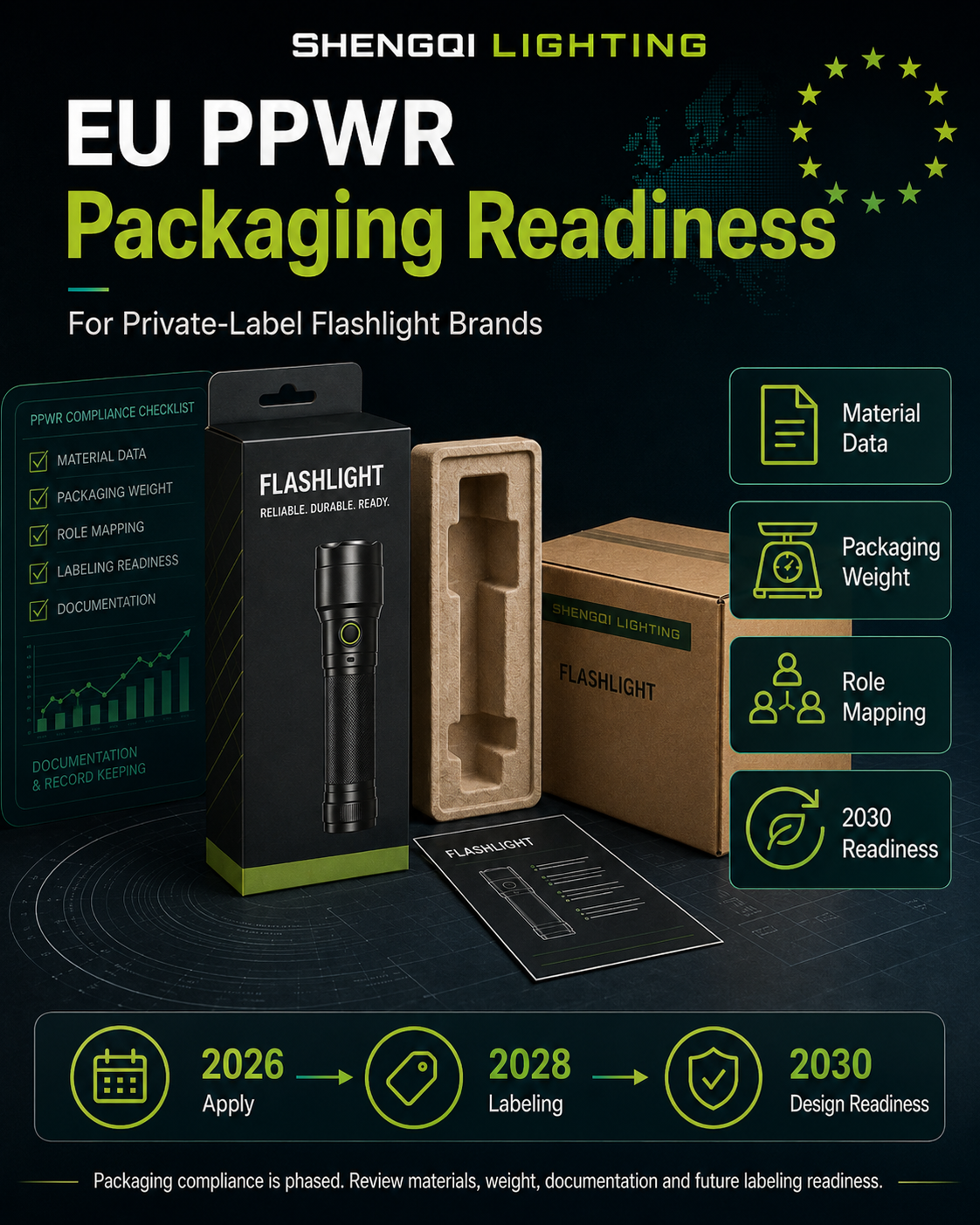

What Changes on August 12, 2026?
As of August 12, 2026, Regulation (EU) 2025/40, the EU Packaging and Packaging Waste Regulation commonly called the PPWR, generally begins to apply. It entered into force on February 11, 2025 and replaces the previous Packaging and Packaging Waste Directive under the Regulation's transitional framework.
The PPWR covers packaging and packaging waste across materials and origins within its scope. The European Commission's August 2026 PPWR implementation update confirms that requirements are phased rather than activated simultaneously.
The general application date does not mean that every PPWR requirement becomes mandatory on the same day. Brands should distinguish obligations applicable now from later harmonised labelling, detailed design-for-recycling, recycled-content, minimisation, reuse and other requirements.
PPWR Timeline for Private-Label Flashlight Packaging
2026 = build compliance architecture. 2028 = major labelling transition. 2030 = major design and circularity transition.
What should private-label flashlight brands review under the EU PPWR in 2026?
Private-label flashlight brands should review packaging materials, component weights, packaging dimensions, technical documentation, economic-operator roles, artwork revisions and future recyclability and labelling requirements now that the PPWR generally applies from August 12, 2026. A practical review should create a packaging BOM, record material composition and weight, determine the PPWR manufacturer role, separately map the producer and EPR role by Member State, and identify who owns the technical documentation. Brands should also prepare artwork files for the later 2028 labelling stage and collect material data needed for detailed 2030 recyclability and minimisation requirements. Exact obligations remain phased and packaging-category specific, so every target country and Article should be reviewed against the final supply chain.
Do all PPWR packaging requirements become mandatory on August 12, 2026?
No. August 12, 2026 is the PPWR's general application date, but many specific obligations apply later under phased timelines. Harmonised material-composition labelling follows from the 2028 stage, while detailed recyclability, minimisation and applicable empty-space requirements become more significant toward 2030 or later depending on secondary legislation. Packaging categories also differ. Buyers should therefore check the exact Article and applicable date instead of treating the PPWR as one single deadline.
Under the PPWR, “Manufacturer” and “Producer” Are Not the Same Role
Under the Commission's 2026 PPWR implementation guidance, the manufacturer and producer concepts serve different functions.
For sales and grouped packaging, a business that has packaging or a packaged product designed or manufactured under its own name or trademark may be the PPWR manufacturer, subject to the Regulation's detailed definition and exceptions. A private-label brand therefore should not simply assume that the physical packaging converter or Chinese supplier is automatically the legal manufacturer.
The producer concept is mainly tied to extended producer responsibility. It depends on who first makes packaging or packaged products available in a Member State, the sales structure, establishment, target market and whether products are supplied directly to end users.
Manufacturer and producer may be different entities. Responsibility should be mapped for the actual supply chain and target Member State rather than assigned from job titles alone.
Why Private-Label Packaging Changes the Responsibility Map
A private-label project may involve a brand owner, flashlight assembler, packaging converter, EU importer, distributor and regional warehouse. The buyer may own the artwork and define materials while a factory performs final filling and packing. Establish a Packaging Responsibility Matrix at project start rather than deciding responsibilities after production.
Build a Packaging BOM Before Discussing “Sustainable Packaging”
“Paper box” is not a complete packaging specification. A component-level Packaging BOM is a practical control tool for technical documentation and future recyclability assessment.
For each component, record material, supplier, weight, dimensions, coatings, adhesives or inks where relevant, recycled-content evidence when claimed, packaging function and revision. These fields are a practical project-control structure, not a claim that each item is a verbatim PPWR mandatory field.
Packaging Weight Should Become Controlled Product Data
Brands should distinguish product net weight, sales-packaging weight, grouped-packaging weight, transport-packaging weight and total packaged-unit weight. Accessories should be identified separately so packaging and product data are not mixed.
A Packaging Weight Record can include component name, material, actual sample weight, specification weight, supplier, measurement date and packaging revision.
Current verified packaging weights for the 2AAA, Y5 and HL10 examples are not available here. The correct procurement question is therefore: Has each packaging component been weighed and recorded for the approved packaging revision?
Paper Packaging Still Needs Engineering Review
A paper-based box can still include lamination, plastic windows, metallic foil, coatings, adhesives, foam, trays or mixed-material labels. Buyers should be able to answer: Can the brand identify every material that remains attached to the package when the consumer discards it?
Do Empty-Space Limits Apply to Every Flashlight Box Today?
No. The PPWR's key quantitative empty-space restrictions are phased requirements rather than a universal August 12, 2026 limit for every flashlight sales box.
The Commission guidance distinguishes sales packaging from grouped, transport and e-commerce packaging. The future 50% maximum empty-space ratio applies to grouped, transport and e-commerce packaging from January 1, 2030 or three years after the relevant implementing act enters into force, whichever is later. Sales packaging follows minimisation requirements without one universal 50% threshold.
Packaging minimisation does not mean removing the protection needed to deliver an undamaged flashlight. Product protection, accessories, instructions, handling and necessary regulatory information can require space.
Measure Packaging Efficiency Instead of Guessing
Record box dimensions, product and accessory dimensions, insert volume, protective-space purpose, transport-carton quantity and e-commerce outer packaging. Review oversized boxes, decorative cavities, redundant trays, unnecessary bags and duplicated layers, but document why each retained component exists.
Packaging Minimisation Must Preserve Product Protection
The correct objective is unnecessary packaging reduction, not protection reduction. Sample reviews can examine scratch risk, lens protection, switch activation, accessory movement, compression exposure and transport stability without inventing unverified pass values.
Recyclability Is a 2030 Design Requirement—But Data Collection Should Start Earlier
The PPWR includes a general recyclability requirement from the 2026 application stage, while the more detailed harmonised design-for-recycling criteria and assessment methodology are phased toward 2030 or later depending on the delegated acts.
Brands should not claim a final 2030 EU recyclability performance grade before the applicable methodologies are available. Instead, collect material composition, coatings, adhesives, inks, labels, detachable parts, multi-material combinations and supplier declarations.
Cardboard does not automatically pass every future PPWR requirement, and plastic does not automatically fail. Mono-material architecture can simplify certain assessments but does not guarantee conformity.
Audit Every Plastic Packaging Component Separately
- Is the component actually necessary?
- Can weight or size be reduced without increasing product-damage risk?
- Is an alternative technically practical?
- Is the material and any recycled-content claim documented?
- Are coatings, printing or other attached materials relevant to recycling?
- Can the component be separated?
Do Flashlight Packages Need the New Harmonised EU Sorting Label Today?
Not generally. The PPWR's harmonised material-composition sorting label is subject to a later phased application date.
Article 12 provides for the relevant harmonised material-composition label from August 12, 2028 or 24 months after the applicable implementing act enters into force, whichever is later. Brands should not invent future EU pictograms before the official specifications are established.
What should brands do now? Reserve artwork space, keep editable master files, record material composition, establish artwork revision control, identify target Member States and monitor Commission implementing acts.
Do Not Add a “PPWR QR Code” Without a Defined Purpose
The PPWR uses QR codes or standardised digital data carriers in certain contexts, but not every flashlight package requires a generic “PPWR QR code” from August 2026. If a project uses a digital carrier, define its information, language, owner, revision, long-term URL control and relationship to the exact packaging version.
Keep Product Instructions and Packaging Data Separate—but Coordinated
Operating, battery, charging and safety instructions should be controlled separately from packaging-material, economic-operator and future sorting information. The model, battery, accessories, importer and revision should remain consistent across both data sets.
Packaging Now Needs a Technical File, Not Just an Artwork PDF
Applicable PPWR manufacturer obligations include conformity assessment, supporting technical documentation and an EU declaration of conformity for packaging requirements. A practical Packaging Technical File can coordinate the evidence behind the final packaging configuration.
Useful controlled records can include packaging description and function, BOM, component drawings, material specifications, weights, dimensions, supplier declarations, artwork master, applicable test or assessment evidence, regulatory requirements, revision history and responsible economic-operator information.
This is a practical compliance-file structure aligned with the PPWR documentation logic; it should not be read as a claim that every internal field above reproduces Annex VII word for word.
PPWR Packaging Conformity Is Separate From the Flashlight's CE Declaration
A flashlight's CE-EMC documentation does not demonstrate PPWR packaging conformity. REACH information does not automatically establish packaging recyclability or minimisation. Likewise, an ISO9001 management system supports process control but does not replace packaging-specific evidence.
Three Flashlight Platforms Create Different Packaging Questions
2AAA Pen Light — Compact Replaceable-Battery Architecture
The 2AAA pen-light product architecture is 127.35mm long and uses two AAA alkaline batteries.
Packaging questions include whether batteries are included, insert size, clip protection, manual footprint, hanging structure, polybag necessity and whether a small pen light is being placed in an unnecessarily oversized retail box. Existing packaging dimensions, materials and weight require project-specific verification.
Y5 — Rechargeable Lithium-Battery EDC Architecture
The Y5 rechargeable EDC platform uses an 18650 lithium-battery architecture in a flat portable-light format.
Packaging review should separate the product, battery and documented accessories; reduce unnecessary small bags where technically practical; immobilise the product; control unintended switch activation; and keep packaging documentation aligned with the final SKU. PPWR retail-packaging obligations and IATA lithium-battery transport requirements remain separate regulatory frameworks.
HL10 — Headlamp and Wearing-Accessory Architecture
The HL10 detachable headlamp platform combines a detachable light with a head-mounted wearing structure and a 16340 battery platform.
The packaging brief may need separate positions for the lamp, holder, headband, battery, instructions and confirmed accessories. Current packaging material, dimensions and component weights should not be assumed without the approved packaging data.
PPWR Preparation by Portable-Lighting Product Architecture
| Product Architecture | Packaging Complexity | Main Data to Record | Minimisation Question | Future Recyclability Question | Main Documentation Risk |
|---|---|---|---|---|---|
| Pen Light | Low to medium | Insert, box, batteries, instructions | Is shelf packaging oversized? | Can inserts and attached materials be identified? | Missing component data |
| Rechargeable EDC | Medium | Product, battery, confirmed accessories | Are small accessory packages necessary? | How many packaging materials are combined? | Retail and transport rules mixed together |
| Headlamp | Medium to high | Lamp, headband, holder, battery, accessories | Can internal structure be simplified? | Can multi-material inserts be reduced? | Accessory revisions not reflected |
This comparison describes packaging-development questions, not verified current SHENGQI packaging configurations.
Private-Label Flashlight PPWR Responsibility Matrix
| Packaging Task | Brand Owner | Flashlight OEM/ODM Factory | Packaging Supplier | EU Importer / Distributor | Evidence to Retain |
|---|---|---|---|---|---|
| Packaging brief / artwork | Leads | Supports | Supports | EU review | Approved brief and artwork |
| Material specification / BOM / weights | Approves | Coordinates | Provides data | Reviews as needed | Specifications and weight records |
| Drawings / supplier declarations | Retains | Supports | Provides | Reviews | Controlled supplier files |
| Technical documentation / EU declaration | Depends on legal role | Supports data | Supports data | Depends on legal role | Conformity file |
| Future label update | Leads brand artwork | Supports production | Prints approved version | EU market review | Revision history |
| EPR role / registration | Requires project-specific allocation | Not automatically responsible | Not automatically responsible | May be relevant by market | Member-State EPR map |
| Revision control / production verification | Approves changes | Coordinates | Controls materials | Reviews market impact | Change and inspection records |
Private-Label Packaging Data Request Sheet
| Requested Data | Why It Matters | Supplier Source | Revision Control | Verification Status |
|---|---|---|---|---|
| Component list, composition, weight and dimensions | Core packaging data | Converter / factory | Packaging revision | Pending |
| Drawings and supplier specifications | Traceability | Packaging supplier | Drawing revision | Pending |
| Coating, laminate and adhesive information | Material assessment | Material supplier | Specification revision | Pending |
| Recycled-content evidence where applicable | Supports applicable claim or requirement | Material supplier | Batch / specification | Requires EU Review |
| Artwork and packaging manufacturer information | Identification and control | Brand / factory | Artwork revision | Pending |
| Packaging assessments where applicable | Supports technical file | Responsible party | Report revision | Requires EU Review |
| Sales / grouped / transport classification | Determines applicable rules | Project team | SKU revision | Requires EU Review |
| Technical-documentation owner | Responsibility clarity | Legal-role review | Supply-chain revision | Requires EU Review |
Ten PPWR Questions to Ask Before Approving Private-Label Flashlight Packaging
B2B buyers should not approve EU packaging only from a rendered artwork or a physical box sample.
PPWR Makes Packaging Artwork a Controlled Engineering Document
Artwork revision should record model, SKU, market, language, barcode, importer, applicable manufacturer information, material information, regulatory icons, battery information, manual version, revision number and approval date.
A packaging redesign that changes material or structure should trigger both artwork review and technical-file review.
A Packaging Supplier Change Can Be a Compliance Change
Changes to board grade, paper supplier, coating, laminate, plastic tray, foam, adhesive, ink, label, bag, dimensions or insert structure may require review. A visually identical substitution can change composition, weight or future recyclability evidence.
This does not mean every supplier change requires complete retesting. It means the project needs an engineering-change process that evaluates what evidence is affected.
Why 2030 Requirements Should Affect 2026 Development
Private-label packaging often remains in use for multiple annual production cycles. Printed inventory, distributor-specific SKUs and reused artwork can survive for years. Designing with future requirements in mind can reduce avoidable redesign later, while current compliance must still follow the requirements actually applicable at the relevant date.
How SHENGQI LIGHTING Supports Private-Label Packaging Development
Packaging must be developed together with the product rather than added after the flashlight is finished.
SHENGQI can support private-label projects by coordinating product dimensions, accessory configuration, packaging structure, internal protection, artwork, branding, battery information, packaging samples and manufacturing revisions through its private-label packaging development process.
Packaging decisions can also be coordinated with flashlight manufacturing and packaging coordination and product and packaging quality-control capabilities.
Final PPWR manufacturer, producer, technical-documentation, EPR registration and Member-State obligations depend on the actual legal role, final packaging and supply chain. Development support does not guarantee PPWR compliance or EU market access.
Frequently Asked Questions
1. What is the EU PPWR and when does it apply?
The PPWR is Regulation (EU) 2025/40 on packaging and packaging waste. It entered into force on February 11, 2025 and generally applies from August 12, 2026. It establishes EU-wide packaging requirements covering areas such as materials, sustainability, labelling, waste management and economic-operator responsibilities, with many detailed obligations following phased dates.
2. Do all PPWR packaging rules start on August 12, 2026?
No. August 12, 2026 is the general application date, but the Regulation contains phased requirements. Major harmonised packaging labelling follows from the 2028 stage, while detailed recyclability, minimisation, empty-space and other circularity requirements become more significant toward 2030 or later according to the applicable Article and secondary legislation.
3. Does every flashlight box need a new EU recycling label in 2026?
No. The harmonised material-composition sorting-label requirement has a later application timeline. For many Article 12 labels, the relevant date is August 12, 2028 or 24 months after the applicable implementing act enters into force, whichever is later. Brands should prepare editable artwork and material data instead of inventing unofficial future symbols.
4. Does the PPWR limit empty space in flashlight packaging?
Yes, but not through one universal 50% rule for every retail box today. The future 50% maximum relates to applicable grouped, transport and e-commerce packaging. Sales packaging follows minimisation requirements without that same predefined threshold. Packaging should still preserve necessary protection, instructions, accessories and handling functions.
5. Who is responsible for PPWR compliance in a private-label flashlight project?
There is no safe universal answer based only on job titles. The PPWR distinguishes manufacturer, producer, importer and distributor responsibilities. A branded private-label company may be the manufacturer under the Regulation's definition, while the EPR producer may be another entity depending on where packaging is first made available and the Member-State sales structure.
6. Is paper packaging automatically PPWR compliant?
No. A paper box may include plastic windows, lamination, coatings, metallic foil, inks, adhesives, foam inserts or mixed-material labels. Material composition and attached components still require review. “Paper packaging” is therefore a starting description rather than evidence of recyclability or PPWR conformity.
7. What packaging data should a flashlight brand request from its OEM supplier?
Request a packaging BOM, material specifications, component weights, dimensions, supplier documents, applicable coatings or laminates, controlled artwork revision and technical-document inputs. Buyers should also identify the packaging-responsibility owner and request test or assessment evidence where relevant. Each file should be connected to the exact final packaging and product revision.
Build Packaging Data and Revision Control Into the Product Project
EU flashlight brands, importers, packaging engineers, compliance managers and sourcing teams can discuss packaging structure, BOM preparation, accessory configuration, minimisation reviews, artwork, private-label branding, sample development and technical-data coordination.
Contact SHENGQI LIGHTING for an OEM/ODM technical evaluation at sales@shengqilight.com.
Final PPWR manufacturer, producer, EPR, technical-documentation and Member-State obligations should be reviewed against the final packaging configuration, supply chain and current EU rules.