Lumens, Candela, Lux and Beam Distance: What Flashlight Buyers Need to Know

What is the difference between lumens, candela, lux and beam distance?
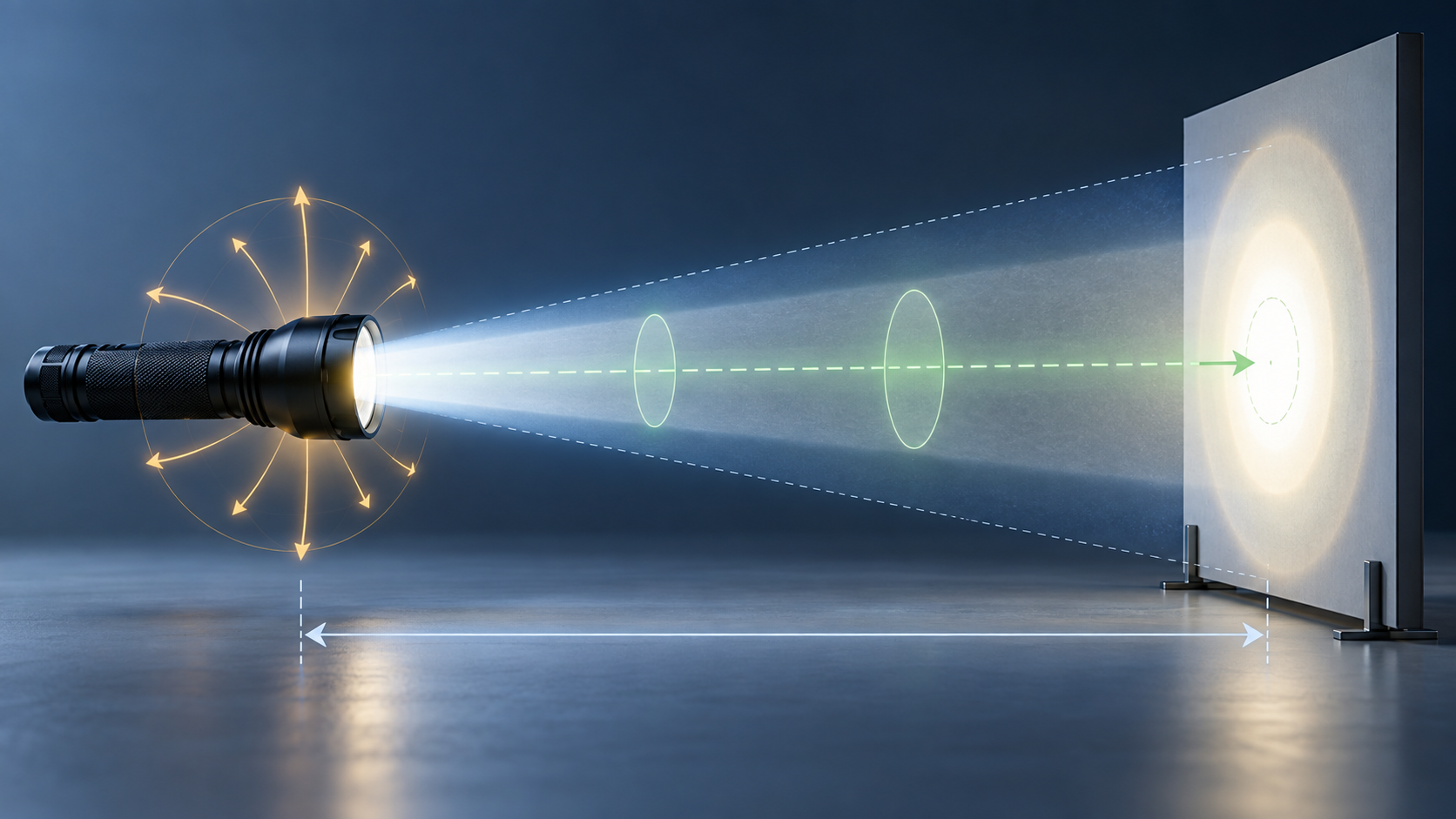
Lumens measure total luminous flux, candela measures luminous intensity in a particular direction, lux measures illuminance reaching a surface, and flashlight beam distance describes a distance derived from measured beam intensity under a defined criterion. These metrics describe different parts of the same optical system. A wide beam can distribute similar total output over a large area, while a concentrated beam can place more intensity in a narrower direction. Lux then depends on where the target is located and how the measurement is made. Beam distance applies a specified illuminance criterion to the measured beam; it is not a guarantee that every observer will recognise every target at that distance. For buyers, the useful comparison is metric plus condition plus application, not one isolated number.
Four Flashlight Metrics That Answer Four Different Questions
Buyers often see lumens, candela, lux and beam distance presented together, but they are not interchangeable. The CIE International Lighting Vocabulary distinguishes the underlying photometric concepts, while product standards may define how selected flashlight claims are measured and reported.
| Metric | Unit | What It Measures | Buyer Question |
|---|---|---|---|
| Lumens | lm | Total luminous flux | How much visible light is emitted in total? |
| Candela | cd | Luminous intensity in a direction | How concentrated is the beam in that direction? |
| Lux | lx | Illuminance arriving at a surface | How much light reaches this target or work surface? |
| Beam Distance | m or ft | Distance derived from an illuminance criterion | How far does the defined beam-distance criterion extend? |
Lumens describe the total visible light emitted by a source. Candela describes luminous intensity in a particular direction, so it helps explain concentration and throw potential. Lux describes illuminance at a surface, which depends on distance, direction, beam distribution and measurement position. A flashlight may have high total lumens but distribute them widely, while another may concentrate a smaller total output into a stronger central beam. These metrics should therefore be read together with beam profile and test conditions.
Lumens Measure Total Luminous Flux—Not Throw
A lumen is a unit of luminous flux. It describes the total quantity of visible light emitted by a source under the relevant photometric definition. It is valuable for comparing overall output, flood use, area illumination and multi-source performance.
However, lumen output alone does not describe beam concentration. Two lights with similar total output may have very different beam shapes: one may distribute light broadly for nearby area coverage, while another may direct more of its output into a smaller central region. The total flux can be similar even though the central intensity and practical reach differ significantly.
The mistake is not using lumens. The mistake is using lumens to answer a question that lumens do not measure. A buyer choosing an area light, close inspection light or broad work light may prioritise total output and beam coverage. A buyer evaluating distant targets must also request directional intensity and beam-distance evidence.
Candela Tells Buyers How Strongly the Beam Is Concentrated
Candela measures luminous intensity in a particular direction. In flashlight discussions, peak beam intensity is commonly used to describe the brightest directional part of the beam, usually near the central axis. It is reported in candela and helps buyers understand concentration and throw potential.
Candela is not a “better” or more advanced version of lumens. They measure different properties. A flashlight can increase lumens without proportionally increasing candela, and it can increase candela through optical concentration without a proportional increase in total lumens. High candela may support distant central illumination, but it does not automatically produce the best near-field coverage, visual comfort or mixed-use beam.
No. More lumens describe greater total luminous flux, not necessarily greater concentration in the direction of interest. A wide beam can spread additional output over a larger area, while a lower-output beam with suitable optical concentration may produce higher central intensity. Throw also depends on the emitting surface, optic design, aperture, alignment, beam profile and test method. Buyers should compare candela or beam intensity under documented conditions rather than assuming that a larger lumen number automatically means a longer useful beam.
Lux Tells Buyers How Much Light Reaches a Surface
Lux measures illuminance: the luminous flux arriving at a surface per unit area. In the accurate simplified relationship, one lux equals one lumen per square metre. Unlike lumens, lux is tied to a receiving surface and its position.
The same flashlight can produce different lux readings at different distances or locations. A reading at the hotspot centre is not the same as average beam illuminance. A single centre-lux measurement describes one point, not the entire beam. To understand the full optical result, buyers should also examine the beam profile, hotspot, transition region and spill.
When a customer says “Need a brighter flashlight,” they may mean more total lumens, higher centre intensity, higher lux at a target, a wider flood, a longer throw or a stronger visual impression. These are different requirements. A better RFQ asks: What exactly needs to be brighter—and at what distance?
Candela and Lux Are Connected by Distance—but They Are Not the Same Metric
Candela describes intensity leaving the source in a direction. Lux describes illuminance arriving at a surface. Under suitable far-field conditions for a point-like directional source, a simplified inverse-square relationship is often written as E = I / d², where E is illuminance in lux, I is intensity in candela and d is distance in metres.
This relationship provides useful intuition: as distance increases, illuminance in the same direction can fall substantially. It also explains why the target distance belongs in a meaningful flashlight specification. The practical question is not only “How many candela?” but also “How much light reaches the target at the distance that matters?”
The simplified relationship should not be applied mechanically to every near-field LED flashlight measurement. Beam geometry, source size, optic behaviour, alignment and measurement setup can affect the result, especially before a stable far-field pattern is established.
Flashlight Beam Distance Is a Test Metric, Not a Promise of Recognition Range
Beam distance is not another independent light-output unit. It is a distance derived from beam intensity or illuminance under a defined test criterion. In the commonly referenced ANSI/PLATO FL 1 framework, beam distance is associated with the distance at which the beam reaches 0.25 lux. The exact reporting context and applicable standard version should always be checked before comparing claims.
This does not mean that every person will clearly identify every object at that distance. Real visibility depends on target size, colour, reflectivity, observer vision, contrast, atmospheric conditions and background light. Rated beam distance and useful identification distance are different concepts.
Flashlight beam distance is determined by directional beam intensity or candela together with the illuminance criterion used to define the distance. Optical concentration, emitter characteristics, reflector or TIR geometry, alignment, battery and output condition can influence the measured result. The test method also matters: distance, timing, mode and equipment should be documented. A rated distance is therefore a criterion-based comparison value, not a universal promise of detection, recognition or identification for every target and environment.
A longer rated distance may suit searching or inspection at distance, but close work and wide-area illumination may require a different beam profile. Optical performance must be matched to the task.
Lumens vs Candela: Why Higher Output Does Not Automatically Mean Longer Throw
A large flood beam distributes total output across a wide angular area. A concentrated optical system directs more of the available flux into a narrower region. As a result, a higher-lumen flashlight can have lower central candela than a lower-lumen flashlight designed for stronger concentration.
| Optical Combination | Possible Product Role | Primary Optical Priority |
|---|---|---|
| Lower Lumens + Lower Candela | Close-range or compact-use lighting | Controlled output and portability |
| Higher Lumens + Lower Candela | Wide-area illumination | Flood coverage |
| Lower Lumens + Higher Candela | Concentrated directional lighting | Beam intensity |
| Higher Lumens + Higher Candela | High-output directional lighting | Both total output and concentration |
Throw and Flood Are Beam-Design Choices, Not Quality Grades
A throw-oriented beam generally uses stronger central concentration and a more defined hotspot. A flood-oriented beam spreads light over a larger nearby area. A balanced beam combines a central region with useful spill and transition.
Throw is not automatically professional, and flood is not automatically low quality. The correct choice depends on the task. Search, outdoor observation and inspection at distance may favour directional intensity. Maintenance, walking, area work and close inspection may benefit from wider coverage. Buyers can compare handheld flashlight platforms according to the working distance and beam role required.
| Beam Element | What It Contributes | What a Buyer Should Check |
|---|---|---|
| Hotspot | Central concentration and directional emphasis | Intensity, size and symmetry |
| Transition Area | Visual connection between centre and outer beam | Smoothness and artefacts |
| Spill | Peripheral awareness and near-field coverage | Width and useful uniformity |
White-wall beamshots can help compare hotspot shape, artefacts and colour distribution. They cannot by themselves prove outdoor visibility, contrast in fog, rain performance or real target recognition. Wall beamshots are visual evidence, not complete photometric measurement.
LED, Reflector, TIR and Lens Design Shape Candela Together
Beam concentration is not determined by the LED alone. Optical architecture converts source output into a beam profile. Relevant factors may include emitting-surface size, reflector diameter and depth, TIR design, lens geometry, emitter position, focus, alignment and optical efficiency.
A smaller apparent emitting surface may support a more concentrated beam in a suitable optical system, but a small LED does not automatically throw farther. Output, optic design, thermal behaviour, focus and system efficiency all influence the result. A larger effective optic aperture may help concentration, but it also creates packaging trade-offs involving head size, weight, carry comfort, manufacturing and alignment.
Reflectors and TIR optics can both shape a beam. Neither is universally superior. The right choice depends on design objectives, available space, beam distribution, manufacturability and verification results. Slight emitter misalignment, incorrect focal position or tilt can affect hotspot symmetry and centre intensity, making optical performance partly a mechanical tolerance problem.
For buyers considering different product roles, tactical flashlight platforms and compact EDC flashlight platforms may require very different compromises between optic size, portability, spill and directional intensity.
Rated Beam Distance Is Not the Same as Useful Identification Distance
It is useful to separate three levels of visual task:
The transition between these tasks depends on the target, observer and environment. A reflective sign may provide visible feedback at a distance where a dark matte object does not. A large object may be detected before a small object. A user with different visual adaptation may perceive the same beam differently.
There is no universal conversion from rated beam distance to real identification distance. Buyers should define the target and task instead of applying an unsupported percentage or distance ratio.
Fog, Rain, Dust and Target Reflectivity Change Real-World Visibility
Water droplets and airborne particles can scatter light. In a concentrated beam, some light may scatter back toward the observer, reducing contrast or creating visible glare. Fog density, rain intensity, particle size, beam angle and observer position all influence the result.
Fog or dust can scatter part of the beam back toward the user. This does not mean that lower candela is always better; it means that the environment changes the optical optimisation problem.
Target reflectivity is equally important. A white reflective sign and a dark matte object can produce very different visual feedback at the same distance. The target is part of the optical system from the user’s perspective.
Background light also changes perception. A city street, moonlit field and dark rural area create different contrast conditions, while the observer’s eye adaptation changes with the surroundings. A single beam cannot be assigned one universal real-world visibility distance.
How Flashlight Photometric Measurements Should Be Verified
Total luminous flux is commonly measured with an integrating sphere or another suitable photometric system. Candela or peak beam intensity requires defined geometry, measurement distance, alignment and a lux measurement that can be interpreted through the applicable method. A mapped beam profile adds information that one centre reading cannot provide.
An integrating sphere proves that a measurement device exists; it does not automatically prove accuracy, calibration, operator competence, traceability or batch consistency. Equipment is part of a measurement system, not the entire quality system.
For directional measurements, a stable fixture, repeatable alignment and defined sensor position are important. A handheld lux meter used casually at an undocumented position is weak evidence, especially for a concentrated beam where a small aiming error can change the centre reading.
Measurement distance must be documented. Near-field geometry may not represent stable far-field beam behaviour, so buyers should ask how the distance and method were selected rather than imposing an unverified universal distance.
Common Reasons Flashlight Photometric Measurements Disagree
Peak candela describes a measured high point under a defined condition. Sustained photometric data describes behaviour over time or under a specified operating state. These answer different questions. Time belongs in the test definition whenever output changes because of thermal or battery conditions.
If a supplier reports a value such as “120,000 cd” without identifying the sample, mode, battery, measurement distance, timing and method, the data has limited comparison value. The correct response is to ask for context, not immediately assume that the claim is false.
Reports should be traceable to the product or sample ID, revision, test date, test mode, battery or power condition, equipment, method and result. For production verification, a batch or lot reference may also be relevant. Multiple representative samples should be considered according to project risk; no universal sample quantity should be assumed.
Flashlight Photometric Verification Matrix for B2B Buyers
| Metric / Area | What the Buyer Should Ask | Test Evidence | Common Misinterpretation |
|---|---|---|---|
| Total Lumens | How is total output defined? | Photometric report and mode | Assuming lumens equal throw |
| Peak Candela | Where was peak intensity found? | Directional measurement record | Treating it as total output |
| Lux at Defined Distance | At what distance and position? | Distance and sensor location | Comparing readings without distance |
| Beam Distance | Which illuminance criterion applies? | Defined calculation or method | Calling it guaranteed visibility |
| Hotspot | How large and uniform is the centre? | Beam profile or image | Using one peak value only |
| Spill | How much near-field coverage is available? | Beam-profile review | Ignoring peripheral awareness |
| Beam Symmetry | Is the beam centred and balanced? | Mapped or visual comparison | Accepting alignment artefacts |
| Optical Alignment | How is emitter-to-optic alignment controlled? | Fixture or process evidence | Assuming every unit is identical |
| Measurement Distance | Was the distance documented? | Test setup record | Applying near-field data broadly |
| Battery State | What power condition was used? | Battery or supply record | Comparing unequal power states |
| Measurement Timing | When was the reading taken? | Timing and mode record | Confusing peak and sustained output |
| Ambient Conditions | What environmental conditions applied? | Condition record | Ignoring temperature or background |
| Test Equipment | What equipment was used? | Equipment identification | Treating any lux meter as equivalent |
| Calibration / Traceability | Can the result be traced? | Calibration and report records | Assuming equipment presence proves accuracy |
| Sample Quantity | How many representative units were checked? | Sample list and risk basis | Using one sample to represent a batch |
| Production Consistency | How will volume output be verified? | Inspection and lot records | Confusing prototype data with production data |
Flashlight Photometric Metrics at a Glance
| Metric | Unit | What It Describes | What It Does Not Tell You Alone | Buyer Use |
|---|---|---|---|---|
| Lumens | lm | Total luminous flux | Beam concentration or distance | Compare overall output and area coverage |
| Candela | cd | Directional luminous intensity | Full beam profile or visual recognition | Evaluate concentration and throw potential |
| Lux | lx | Illuminance at a surface | Total output or unqualified distance | Assess light arriving at a defined target |
| Beam Distance | m or ft | Criterion-based distance | Guaranteed identification range | Compare a defined beam-distance claim |
Four-Metric Buyer Decision Table
| If the Buyer Wants... | Metric to Prioritize | Metric That Is Not Enough Alone | What Else to Check |
|---|---|---|---|
| Wide Area Illumination | Lumens and beam profile | Peak candela | Flood coverage and uniformity |
| Long-Range Spot | Candela and beam distance | Lumens | Hotspot, alignment and target type |
| Close Inspection | Lux at the working surface | Rated beam distance | Colour, uniformity and spill |
| Search / Outdoor Use | Beam profile and directional intensity | Total lumens | Environment, contrast and sustained output |
| Mixed Beam | Balanced profile | Any single number | Hotspot, transition and spill |
Five Photometric Mistakes Flashlight Buyers Make
Similar total luminous flux can produce wide, balanced or concentrated beam patterns depending on optical design. Buyers should request both the number and the beam evidence.
How OEM/ODM Buyers Should Define Flashlight Optical Performance Before Sampling
A weak RFQ says: “Need 3000 lumen flashlight, very long distance.” This does not define the beam, candela, working distance, target, sustained behaviour or test method. A lumen target alone cannot define a long-range flashlight.
Define the application, target distance, target type, flood or throw priority, lumen direction, candela or intensity direction, beam pattern, sustained requirement, test method, estimated quantity and target market.
Specification Translation
| Customer Wording | Engineering Question |
|---|---|
| “Very bright” | Is the need total output or target illuminance? |
| “Long distance” | At what target distance and for what task? |
| “Strong beam” | Higher centre intensity, tighter hotspot or both? |
| “Wide light” | What near-field area must be illuminated? |
| “Can see 500m” | Detection, recognition or identification of what target under what conditions? |
Fourteen Tests or Reviews Buyers Should Use for Flashlight Optical Validation
For portable-lighting development, beam performance has to be reviewed across the emitter, optic, mechanical alignment, electronics and verification method. SHENGQI can support these development stages within its OEM/ODM process. Its approximately 130,000 sq ft manufacturing facility, CNC capability and production resources support manufacturing capability, but photometric performance still requires product-specific measurement and verification.
Buyers can review the portable lighting product range, discuss custom flashlight development requirements and evaluate flashlight manufacturing capabilities. Final approval should also consider portable-light testing and quality-control capabilities, sample revision, measurement conditions and production consistency.
Frequently Asked Questions About Lumens, Candela, Lux and Flashlight Beam Distance
Match the Metric to the Condition and Application
No single photometric number defines a flashlight. Lumens describe total output, candela describes directional intensity, lux describes the light arriving at a target, and rated beam distance applies a defined criterion to that intensity. The useful specification is the combination that matches the buyer’s actual working distance, beam requirement and verification method.
For meaningful comparison, always connect the metric with the sample, mode, battery, timing, measurement distance, equipment, environment and application. This is how buyers avoid approving an impressive number that does not describe the light’s real job.