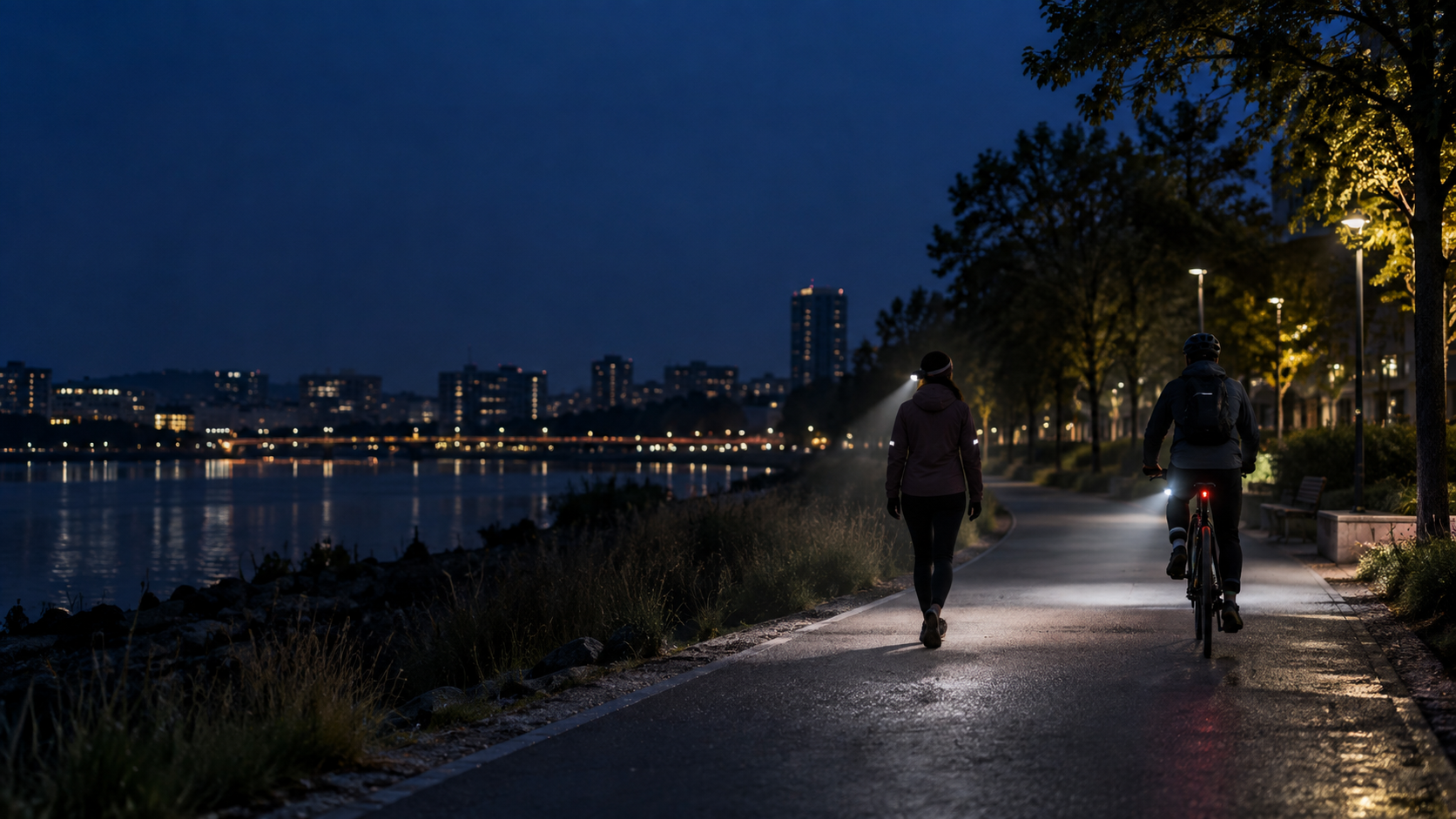

What makes portable lighting effective for walking and cycling at night?
Effective portable lighting for night walking or cycling should provide enough usable light for the user's path and movement speed while keeping the beam positioned so that unnecessary glare is not directed toward other road users. The evaluation should consider near-field detail, forward visibility, beam height, tilt, movement stability, and sustained output together. A light that looks impressive in a static demonstration may still be poorly matched to a moving user if the beam bounces, points too high, over-brightens the foreground, or becomes unstable as the wearer turns their head. The goal is not to maximize light in every direction. It is to place useful light where the task occurs, support the user's movement, and make the wearer appropriately noticeable without creating avoidable visual discomfort for others.
Why Night-Mobility Lighting Needs a Human-Factors View
EUROPEAN MOBILITY WEEK 2026 runs from September 16–22, 2026, under the theme “Mobility for Everyone,” with a focus on intergenerational fairness. That context is useful for lighting design because walking and cycling involve people with different movement speeds, visual preferences, carrying habits, routes and comfort requirements. It does not mean that one light can solve every mobility situation.
For portable-lighting development, the practical question is more specific: how should light support a person who is moving through a changing environment at night? The answer involves three separate jobs—seeing the path, being seen by others, and controlling glare. These jobs may use different optical, mechanical and electronic decisions. Treating them as one simple brightness problem can produce a product that is bright in a specification sheet but poorly matched to real movement.
Seeing the Path and Being Seen Are Two Different Lighting Jobs
Effective portable lighting for walking combines useful near-field illumination, enough forward visibility for the user's movement speed, stable beam placement and sustained output. It should help reveal the path edge, surface changes and obstacles without making the immediate foreground so dominant that the distance becomes harder to interpret. The correct balance depends on the route, ambient lighting, weather, mounting position and walking behaviour. A practical evaluation should therefore look at the complete wearing experience rather than only a wall beam pattern or a maximum-output claim.
A user may be able to see the road while remaining difficult for a driver, cyclist or pedestrian to notice. The reverse can also happen: a marker or reflective element may make the wearer conspicuous without providing enough light to reveal a curb, step, pothole, loose surface or path edge. These are different design objectives and should be stated separately in a product brief.
| Lighting Job | Primary Goal | Typical Design Question | Risk if Ignored |
|---|---|---|---|
| See the Path | Reveal useful road, path and surface information. | Where does the useful beam zone need to fall? | Late recognition of changes or obstacles. |
| Be Seen | Help other road users notice the wearer. | Which active or passive visibility elements are appropriate? | The wearer may blend into the background. |
| Glare Control | Limit unnecessary direct or reflected light toward others. | How do intensity, direction and observer position interact? | Visual discomfort or reduced contrast for others. |
Active light comes from the product itself. Passive visibility may come from reflective clothing, bicycle reflectors, reflective materials or existing street lighting. These elements have different roles. A portable light can be part of a visibility system, but it should not be described as a guarantee that the wearer will always be noticed.
More Lumens Do Not Automatically Create Better Night Mobility
No. Higher output may illuminate more of the road or extend some forward visibility, but useful performance also depends on beam direction, beam width, mounting position, movement, surface reflectivity and the user's visual task. A very intense hotspot can create unwanted glare, while excessive near-field light can dominate attention and make the distance appear comparatively darker. The better question is not “How bright is the lamp?” but “Where does the useful light go, under the conditions in which the product will be worn?”
Total output is only one part of the experience. Optics distribute light; mounting hardware determines where the optical system sits; movement changes the aim; and the surface changes how the light is seen. A product with a concentrated central beam may provide earlier forward information, while a broader beam may provide more surrounding awareness. Neither description alone identifies the right solution for every route.
If the beam falls in the wrong place, increasing output may simply add more light in the wrong place. First define where the user needs light. Then define how much light the task requires.
Walking Lighting Prioritizes Near-Field Detail and Predictable Foot Placement
Night walking often requires the user to interpret small changes close to the body: a curb, step, root, uneven surface, puddle, loose material or path edge. This makes near-field visibility important. At the same time, the beam should provide enough forward information for the user to plan the next part of the route.
The brightest point does not always belong immediately in front of the user's feet. If the foreground is much brighter than the distance, the scene may encourage attention to remain close to the body. This does not mean that near-field light is undesirable. It means that near-field illumination should support movement without becoming the only visually dominant part of the scene.
Movement speed also changes the lighting requirement. A person walking slowly may have more time to respond to a newly visible surface change than a person moving faster. Required preview distance depends on speed, terrain, ambient light and user response. It should be tested as an application variable rather than converted into one universal number.
Cycling Increases the Need for Earlier Forward Information
Cycling generally increases movement speed compared with walking, so the user may need earlier information about road direction, surface changes, obstacles, intersections and other road users. This places greater emphasis on forward visibility, stable mounting and predictable beam placement.
A headlamp beam also moves with the head. When a rider looks toward a person, vehicle, sign or side path, the beam may move in the same direction. That makes head movement part of the beam-placement problem. A head-mounted light used around other road users should therefore be assessed differently from a fixed light mounted to a bicycle.
A portable headlamp or handheld flashlight should not be presented as a substitute for any legally required bicycle front light, rear light, reflector or other road-safety equipment. Lighting requirements vary by country and jurisdiction. Users and buyers should follow the applicable local traffic and bicycle-equipment rules and treat portable lighting as supplementary unless the relevant law specifically states otherwise.
Beam Placement Determines Whether Light Helps the User or Distracts Others
Beam placement is influenced by mounting height, downward tilt, beam width, hotspot intensity, posture, movement and head movement. It is not only an optical-pattern question. The same product can create different experiences when worn on the head, attached to the body or held in the hand.
The useful beam zone is a product-planning concept describing the area where light is needed for the user's task. It is not an industry standard or a universal road-lighting boundary. The development goal is to keep more useful light in the task area and less unnecessary intensity in other users' eye direction.
A practical beam-aim review should place the light at its intended wearing position and observe where the hotspot, spill and upper edge of the beam fall relative to the path and to another observer at representative distances. This is a practical product evaluation, not a universal road-lighting standard.
For a head-mounted product, the evaluation should include looking forward, looking down, turning the head and briefly looking sideways. For handheld use, the test should consider how consistently the user can aim the light while keeping one hand available for the task.
Mounting Height Changes the Geometry of Glare
Head-mounted, chest-mounted and handheld lighting produce different relationships between the source, the path and another observer. A higher mounting position may improve the line of sight over some foreground obstructions, but if the beam is not aimed appropriately it may also place more direct light near another person's eye level.
A chest- or body-mounted light may move differently from a headlamp and can offer a different balance between stability and aim control. A handheld flashlight allows the user to actively aim the beam, but it occupies one hand and may be less consistent during movement.
There is no universal winner. Mounting height and downward aiming should be evaluated together with the beam profile, user posture, route and intended interaction with other road users.
Downward Tilt Is a Beam-Control Decision, Not Just a Comfort Adjustment
If the beam is aimed too high, forward glare may increase and the upper spill may enter another observer's visual direction. If it is aimed too low, the immediate foreground may become overly dominant and forward preview may be reduced. The appropriate tilt depends on mounting height, beam pattern, movement speed, terrain and the distance the user needs to inspect.
For product development, the goal is not to publish one “best” angle. The goal is to provide a usable adjustment range and verify how the beam behaves in the positions customers are likely to use. A beam-aim test should include static viewing and controlled movement. If cycling use is intended, testing should take place in a controlled and safe environment rather than on an open road for the purpose of creating glare.
Too Little Near-Field Light Is a Problem—and Too Much Can Be One Too
Near-field light helps reveal the surface close to the feet, wheels or immediate path. Too little may make it difficult to interpret surface changes. Too much may dominate visual attention, increase reflected glare from shiny or wet surfaces, and make the distant path feel comparatively darker.
Eyes adapt to the visible scene, so a very bright foreground can change how the rest of the scene is perceived. This is a reason to use careful language such as “may” and “can” rather than making clinical claims. The product question is practical: does the light support movement across the full useful field, or does it concentrate attention in a small area?
Glare Is a Visibility Problem, Not Just an Annoyance
A headlamp can reduce unnecessary glare by controlling beam direction, downward tilt, mounting height, intensity and movement. The product should be observed from the opposing user's position, not only from behind the light. Direct hotspot exposure, upward spill, reflective signs, wet pavement, shiny surfaces and head movement can all change the glare experience. The objective is not to promise zero glare in every condition. It is to place useful light toward the task area while limiting avoidable intensity in directions where another user may be looking.
Glare may come from a direct hotspot, upward spill, a reflective sign, wet pavement, a shiny surface, head movement or an incorrect mounting angle. Reducing total output may help in some situations, but glare control cannot be reduced to a simple lumen decision.
Together, these factors influence glare exposure. This is a conceptual framework, not a standard formula or a universal threshold.
Spot, Flood or Mixed Beam? Match the Beam to Movement, Not Marketing
A spot-oriented beam may help provide farther forward information, but an excessively concentrated beam may leave the near field less informative and may increase the importance of careful aim. A flood-oriented beam may provide broader near-field awareness, but the user may receive less detailed information farther ahead. A mixed or balanced beam may combine near and forward information, although its design and validation can be more complex.
The right choice depends on movement speed, route, ambient lighting, mounting method and the task. Product teams should avoid declaring one beam type universally superior. The useful comparison is whether the beam supports the intended movement without creating unnecessary visual distraction.
Some road-oriented lighting systems use controlled upper-beam distribution or cutoff concepts to reduce upward glare. A general-purpose portable headlamp should not automatically be described as having a road-oriented cutoff architecture or as satisfying a specific bicycle-light regulation.
A Good Beam Pattern Is Useless if It Does Not Stay Where It Is Aimed
Walking, running and cycling can create bounce, tilt drift, strap movement, product rotation and repeated aim changes. This makes beam stability a mechanical and ergonomic issue as well as an optical issue.
For headlamps, strap fit, product mass, centre of gravity, adjustment, sweat and movement all influence wearing stability. A lightweight lamp with poor mass distribution can still feel unstable. For body-mounted or handheld products, attachment security and the user's ability to maintain aim should be evaluated in the same way.
Observe beam aim while walking, looking down, turning the head and looking sideways. If cycling use is intended, assess movement in a controlled and safe test environment. Record whether the hotspot moves away from the useful beam zone, whether the product rotates, and whether the wearer must repeatedly correct the aim.
Rain and Wet Pavement Change What the User Sees
Rain can scatter light and reduce contrast. Wet pavement may create stronger specular reflections depending on the surface, light direction and observer position. A beam that feels comfortable on a dry path may produce more distracting reflections on a wet surface.
This is why “brighter is better” remains an incomplete assumption in wet conditions. Increasing output does not necessarily increase useful contrast in a linear way. Beam placement, intensity and surface condition need to be assessed together.
Environmental protection requirements should also be defined for the intended use and verified against the final product claim. Rain in an application article is not evidence that every product is waterproof, and no general IP rating should be assumed without confirmed product documentation.
Active Light and Passive Visibility Play Different Roles
Active visibility comes from a light source. Passive visibility may come from reflective or retroreflective elements that become more noticeable when illuminated by another source. Reflective clothing, bicycle reflectors and reflective material can therefore contribute to a visibility system without performing the same job as path illumination.
Colour, flashing behaviour and placement may be controlled by local rules in some markets. Product teams should not make universal claims such as “flashing is always safer” or assume that a specific colour is legally appropriate everywhere. The legal context must be defined for the target market.
Night Mobility Depends on Sustained Output, Not Only Maximum Mode
A maximum mode may look impressive in a short demonstration, but a long walk or ride depends on how useable the light remains over time. A stable low or medium mode may be more appropriate for a close path, longer duration, lower glare or battery conservation than repeatedly relying on the highest mode.
Buyers should ask how the product behaves as the battery state changes. Does it step down, provide a signal, retain a lower mode or shut down unexpectedly? The answer should be verified for the final product rather than inferred from an early sample or a general product category.
Before travel, consider expected duration, usable sustained mode, battery state, charging readiness, local lighting requirements and a secondary backup light where the risk assessment warrants it. Not every user needs two lights, but longer or less forgiving routes deserve a deliberate backup strategy.
Inclusive Lighting Evaluation
Different age groups and users may have different walking speeds, visual preferences, dexterity, comfort expectations and adjustment habits. Inclusive design begins with representative user needs rather than age-based assumptions.
A product review can gather feedback on switch accessibility, beam comfort, wearing stability, adjustment and perceived glare from several representative users. This approach is more useful than assuming one beam, one mounting position or one brightness level will suit everyone.
Portable Lighting Validation Matrix for Walking and Cycling Applications
Before approving a product, buyers should define the question being tested, the intended application and the risk of leaving the requirement unclear.
| Validation Area | Buyer Question | Test Approach | Risk if Unclear |
|---|---|---|---|
| Primary Use | What task comes first? | Write the use case before sampling. | Conflicting priorities. |
| Walking / Cycling Speed | How quickly does the user move? | Test at representative movement. | Insufficient preview. |
| Near-Field Illumination | Can close hazards be interpreted? | Review feet, wheels and path edge. | Late reaction to surfaces. |
| Forward Visibility | How much forward information is needed? | Assess path direction and obstacles. | Poor route planning. |
| Beam Height | Where does the beam sit relative to others? | Observe from an opposing position. | Avoidable glare. |
| Tilt Angle | Can the aim be adjusted? | Review more than one setting. | Wrong task area. |
| Hotspot | Is central intensity useful for the task? | Compare path and observer views. | Over-concentration. |
| Spill | Where does peripheral light go? | Inspect upper and side spill. | Distracting exposure. |
| Opposing-User Glare | Does direct light enter another view? | Use a controlled opposing-observer review. | Visual discomfort. |
| Head / Body Movement | Does aim change during movement? | Observe head turns and posture changes. | Unpredictable beam. |
| Wearing Stability | Does the product stay positioned? | Review bounce, drift and rotation. | Repeated readjustment. |
| Sustained Output | Is the useful mode maintained? | Evaluate the intended use period. | Performance drop. |
| Low-Battery Behavior | What happens as power falls? | Record step-down, signal or shutdown behaviour. | Unexpected loss of light. |
| Rain / Wet-Surface Use | How does the scene change when wet? | Review reflections where relevant. | More distraction. |
| Visibility to Others | Can others notice the wearer? | Review active and passive visibility together. | False confidence. |
| Production Consistency | Do production-representative units behave similarly? | Compare more than one representative sample. | Unreliable launch quality. |
Walking and Cycling Portable-Lighting Priorities
| Decision Area | Walking | Cycling | Why It Changes |
|---|---|---|---|
| Movement Speed | Usually lower and more adjustable. | Usually higher and less forgiving. | Forward information is needed earlier. |
| Forward Preview | Route awareness and surface changes. | Road direction, obstacles and intersections. | Task timing changes with speed. |
| Near Field | Foot placement and path edge. | Wheel path and surface transition. | The contact area changes. |
| Beam Stability | Comfortable aim during walking. | Stable aim during stronger movement. | Bounce has greater impact. |
| Head Movement | Side glances may redirect the beam. | Turning toward road users may redirect it. | Glare exposure can change quickly. |
| Mounting Height | Head, chest or hand use may be practical. | Head and bicycle mounting require separate review. | Geometry and legal context differ. |
| Glare Risk | Often depends on path interaction. | Can affect more road users at speed. | Observer position changes. |
| Carry / Wear | Convenience and comfort are central. | Stability and hands-free operation may matter more. | The user's control options differ. |
| Sustained Output | Useful for longer walks. | Useful for continuous route visibility. | Maximum mode may not be sustainable. |
| Battery Planning | Plan duration and charging readiness. | Plan route length and backup options. | Loss of light has different consequences. |
| Weather | Surface reflections may change. | Rain and spray may affect contrast. | The optical scene changes. |
| Legal Equipment Context | Local pedestrian rules may still apply. | Bicycle equipment requirements must be checked. | A portable light is not automatically a legal substitute. |
Five Mistakes Buyers Make When Evaluating Portable Lighting for Night Mobility
A high maximum mode does not describe beam placement, sustained output, glare or movement stability. Buyers should evaluate the complete use case.
A wearer may like the beam while an opposing observer experiences unnecessary direct light. Both viewpoints belong in the test.
A headlamp follows the user's head. Looking sideways may redirect the beam toward a person or vehicle.
A static beam image cannot reveal strap movement, bounce, tilt drift or the effect of posture during real use.
Portable lighting should be reviewed alongside the applicable local bicycle-equipment requirements, not used to bypass them.
See the Path, Be Seen and Control Glare: Design Trade-Offs
| Design Decision | See the Path | Be Seen | Glare Risk | Buyer Question |
|---|---|---|---|---|
| Higher Output | May reveal more area. | May increase conspicuity. | Can increase unwanted exposure. | Where does the added light go? |
| Wider Beam | May improve surrounding awareness. | May show more of the wearer. | Upper spill needs review. | Is the width useful or wasteful? |
| Higher Mounting Position | May improve line of sight. | May make the source more noticeable. | Eye-level exposure may increase. | How will aim be controlled? |
| More Downward Tilt | May improve near path detail. | May reduce forward source visibility. | Often limits upper spill. | Does it reduce forward preview? |
| Reflective Material | Does not illuminate the path. | May support passive visibility. | Depends on another light source. | What role does it supplement? |
| Flashing or Marker Function | Usually does not reveal the path. | May increase conspicuity if legally appropriate. | Pattern and placement need review. | Is it allowed in the target market? |
| Stable Head Mount | May keep light in the task area. | Keeps the source with the wearer. | Head turns can still redirect it. | How stable is it during movement? |
Static Beam vs Moving Beam
A static beam photo does not show what the beam does while the user moves. Head bob, head turns, body motion, strap movement and changing road slope can all alter the useful beam zone. A white-wall test can help inspect beam shape, but it cannot prove walking comfort, cycling glare performance, wet-road behaviour, moving stability or visibility to others.
Application testing should therefore follow photometric inspection. The wall test answers one question about beam shape. The movement test answers a different question about human use.
Place an observer in a representative opposing pedestrian or cyclist position. Review the light at the intended mounting height, beam angle and movement pattern. Record whether unnecessary direct glare occurs. This is a practical product evaluation, not a legal compliance test.
Fourteen Tests Buyers Should Run on Portable Lighting for Walking or Cycling Applications
These tests should be adapted to the target application. They should not be assigned universal lumen, lux, angle, distance, speed or duration values unless a specific project, regulation or standard requires them.
How OEM/ODM Buyers Should Define Portable Lighting for Walking and Cycling Before Sampling
A mobility-lighting brief should define where the light needs to go, not only how much light the product produces. Before requesting samples, buyers should specify the target market, target user, walking or cycling application, primary lighting job, see-or-be-seen priority, typical movement speed, working distance, near-field requirement, beam pattern, mounting position, tilt adjustment, glare-control requirement, wearing stability, sustained output, battery and backup direction, weather requirement, legal context, validation method, estimated quantity and target timeline.
“Need very bright headlamp for walking and cycling.”
This request does not define movement speed, beam placement, mounting position, glare, sustained output or the bicycle-equipment context.
Target user, application, movement speed, near-field need, forward-visibility need, mounting method, beam direction, glare requirement, sustained output, battery or backup direction, local regulatory market, estimated quantity and target timeline.
There is no free performance increase. A higher output may affect thermal behaviour or battery planning. A wider beam may change forward intensity. A longer forward beam may reduce near-field coverage. More downward tilt may reduce upward spill but limit preview. A lighter headlamp may be easier to wear but less stable if mass distribution is poor. A larger battery may improve duration but change comfort and balance. A higher mounting position may improve line of sight while increasing the need for aim control.
| Buyer Wants | Potential Trade-Off | Question to Resolve |
|---|---|---|
| Higher Output | More glare, heat or battery demand. | Where is the added light useful? |
| Wider Beam | Less concentrated forward information. | Does the route need width or reach? |
| Longer Forward Beam | Potentially less near-field detail. | What must remain visible nearby? |
| More Downward Tilt | Reduced forward preview. | Where is the useful beam zone? |
| Lighter Headlamp | Possible balance or stability changes. | How does it behave during movement? |
| Larger Battery | More mass or different ergonomics. | What sustained output is actually required? |
| Higher Mounting Position | Greater need for glare control. | How will the beam be aimed? |
| Longer Runtime | May require lower sustained output. | Which mode supports the real task? |
| More Stable Mounting | May affect adjustment or comfort. | Can the user wear and adjust it easily? |
For portable lighting intended for moving users, optical design needs to be reviewed together with mounting position, mechanical stability, sustained output and application testing. SHENGQI can support these development stages within its OEM/ODM lighting development process, from industrial design and optical engineering to electronic design, PCB layout, manufacturing, testing and quality control.
Buyers can compare relevant headlamp product platforms, handheld flashlight platforms and compact portable-light platforms according to the actual application. The broader portable lighting product range should be filtered by use case rather than by brightness alone.
Before approval, buyers should also review available portable-light testing capabilities and understand how production consistency will be checked. Manufacturing requirements can be discussed through the company’s manufacturing process.
Start with the intended mounting position, then review downward tilt, beam width, hotspot intensity, upper spill and the effect of head movement. Place an opposing observer at a representative position and assess the beam while the wearer looks forward and turns naturally. The evaluation should consider dry and wet surfaces where relevant. No general-purpose headlamp should be described as zero-glare in all conditions because glare depends on source intensity, direction, surfaces, distance, observer position and movement.
No. Requirements vary by jurisdiction, and a portable headlamp or handheld light should not be presented as a universal substitute for legally required bicycle lights, reflectors or other equipment. Buyers and users should follow the applicable local rules. If a product is intended to support cycling, the regulatory context should be defined for the target market before the product brief, sample review and final claims are approved.
Frequently Asked Questions About Portable Lighting for Walking and Cycling
1. What type of portable lighting works best for night walking?
There is no single best format for every user. The suitable design depends on walking speed, route, near-field needs, forward visibility, mounting preference, beam placement, wearing stability and local conditions. A headlamp, handheld light or body-mounted light should be evaluated against the actual task.
2. Does a brighter headlamp always improve night visibility?
No. More output may help in some conditions, but beam direction, beam width, near-field balance, surface reflection, mounting height, movement and sustained output also matter. Brightness in the wrong place may increase glare without improving the user's useful view.
3. What is the difference between seeing the path and being seen by other road users?
Seeing the path means receiving useful light on the road, surface and obstacles ahead. Being seen means helping other people notice the wearer. A marker, reflective element or active light may improve conspicuity without illuminating the path, while a path light may not make the wearer sufficiently noticeable.
4. How should a headlamp beam be aimed to reduce unnecessary glare?
The beam should be reviewed at the intended wearing position with attention to mounting height, downward tilt, hotspot, upper spill and head movement. The correct setting depends on the product, route, movement and observer position. There is no universal angle that fits every headlamp and application.
5. Is spot or flood lighting better for walking and cycling?
It depends on movement speed, terrain, forward-preview needs, near-field requirements and beam placement. Spot lighting may provide more concentrated forward information, while flood lighting may provide broader nearby awareness. A mixed beam may be appropriate for some applications, but no beam type is universally superior.
6. Why does wearing stability matter for a headlamp?
A beam pattern can lose its value if the product bounces, rotates or changes tilt during movement. Strap fit, mass distribution, centre of gravity, adjustment and user posture can all affect beam stability. Stability should be reviewed while the product is being worn, not only on a table.
7. Can a portable headlamp replace legally required bicycle lights and reflectors?
No. Portable lighting should not be presented as a universal substitute for legally required bicycle lights, reflectors or other road-safety equipment. Requirements vary by jurisdiction, so users and buyers should follow the applicable local laws and equipment requirements.
8. What should OEM/ODM buyers test before approving portable lighting for active-mobility use?
They should test near-field illumination, forward visibility, beam aim, mounting height, tilt, hotspot, spill, opposing-user glare, movement stability, sustained output, low-battery behaviour, weather conditions where relevant, visibility to others and production consistency. Testing should reflect the intended walking or cycling application.
Conclusion: Put the Right Light in the Right Place
Effective night-mobility lighting is not defined by the highest lumen number. It is defined by whether the user receives enough stable light in the useful path area, whether other road users can perceive the wearer appropriately, and whether beam placement avoids unnecessary glare as the user moves.
The strongest product-development decisions begin with the application: who is moving, how fast they are moving, what they need to see, where the light will be mounted, how the beam will be aimed, how stable it remains and what happens as the battery state changes. This approach helps buyers compare suppliers on useful performance rather than on isolated claims.
Shengqi Lighting is preparing new headlamp concepts for the 140th Canton Fair. Buyers can visit Booth 16.4F25 from October 15–19, 2026 for an early preview; final product information will be released after validation.
Developing Portable Lighting for Walking, Cycling or Other Moving Users?
For a more useful OEM/ODM evaluation, buyers should prepare the target market, target user, walking or cycling application, primary lighting job, movement speed, use environment, near-field requirement, forward-visibility requirement, beam preference, mounting method, glare-control requirement, wearing-stability requirement, sustained-output requirement, battery or backup direction, weather requirement, estimated quantity and target timeline.
Contact SHENGQI LIGHTING through the contact page or email sales@shengqilight.com for an OEM/ODM technical evaluation.