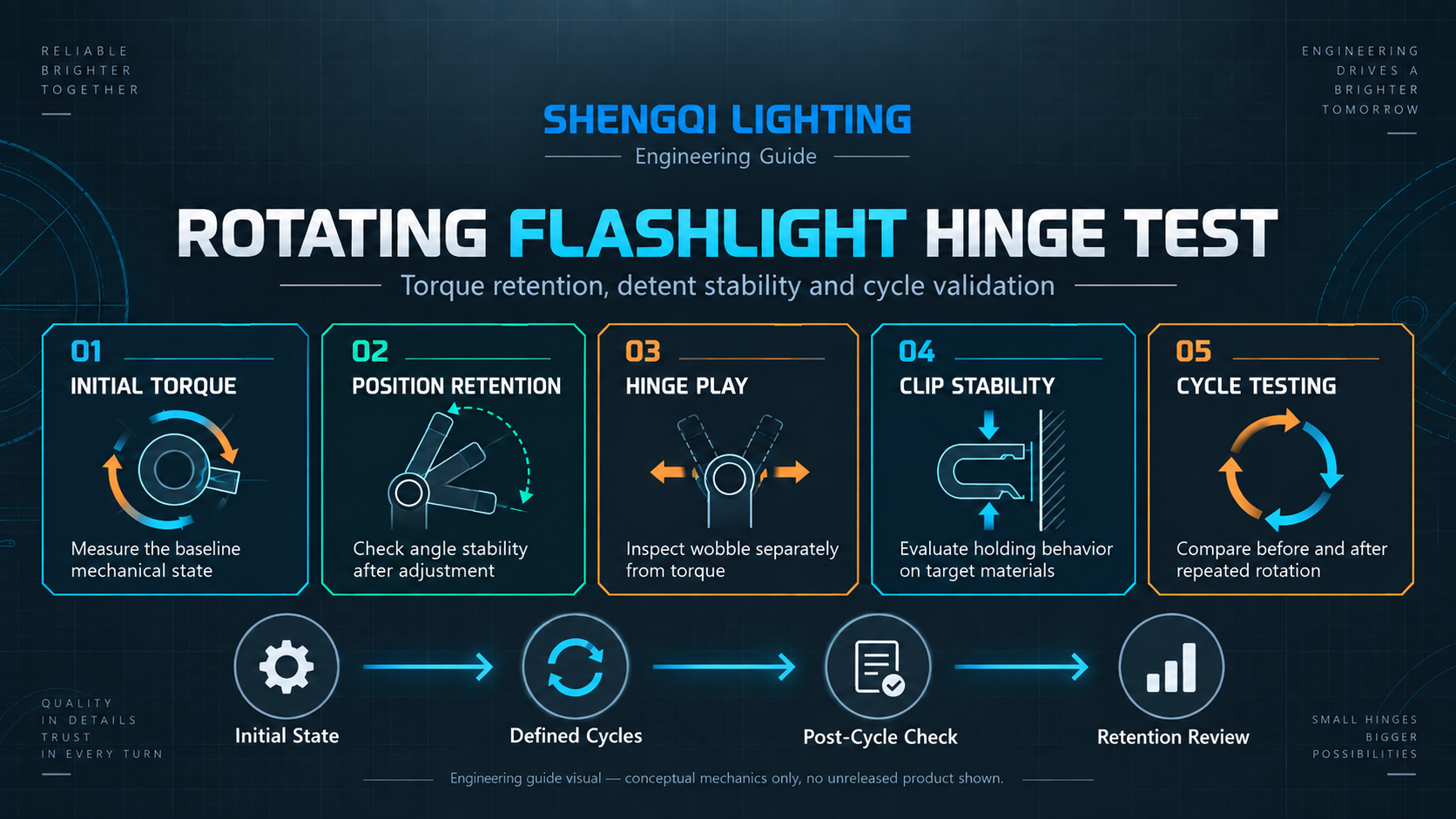

Why a Rotating Light Can Feel Tight at First and Loose Later
A new hinge has not yet experienced repeated contact, micro-movement, load reversals or long-term assembly settling. Its friction surfaces may still have their original finish, preload may still reflect the freshly assembled state, and lubricant—if the architecture uses it—may not yet have redistributed.
Wear-in or settling can describe a limited early change as contact surfaces begin to match each other. Not every design shows a clear wear-in stage. Progressive wear is different: torque, hinge play or detent definition may continue to degrade as cycling continues.
A supplier should not qualify hinge durability from hand feel alone. A new sample demonstrates initial function, not retained mechanical performance.
Hinge Torque Is More Than “Tight” or “Loose”
Torque is rotational resistance or moment around a pivot. A simplified relationship is T = F × r, where applied force and its perpendicular distance from the pivot influence the turning moment. This is a simplified mechanical relationship, not a complete hinge model.
Breakaway Torque — the torque required to overcome static resistance and begin rotation.
Running Torque — the torque needed to continue rotating after motion has started.
Position-Holding Torque — the resistance available to oppose unintended angle drift after adjustment.
Clip / Mount Reaction — the reaction at the clip or mounting interface while the user adjusts or loads the light.
Breakaway and running torque can differ. A product that is difficult to start but easy to move may feel very different from one with consistent rotational resistance. Position-holding behavior answers another question again: will the light remain where the user left it?
A usable hinge must both move deliberately and resist unintended angle drift.
Measure Hinge Torque Before and After Cycle Testing
↓
DEFINED ROTATION CYCLES
↓
VISUAL / MECHANICAL INSPECTION
↓
POST-CYCLE TORQUE
↓
ANGLE RETENTION
↓
FUNCTION CHECK
Torque retention describes how well the rotating joint maintains its positioning resistance after repeated use or another defined mechanical exposure. It can be compared with initial behavior, but there is no universal retention percentage that automatically applies to all clip lights. Acceptance limits must be defined by project requirements.
INITIAL STATE → USER ADJUSTMENT → REPEATED CYCLING → WEAR / SETTLING → TORQUE / PLAY CHANGE → POSITION RETENTION → PRODUCTION VERIFICATION
How a Friction Hinge Holds a Rotating Light in Position
A friction joint creates rotational resistance through contact pressure, friction surfaces, preload and geometry. Depending on the architecture, that resistance can involve washers, a spring element, a fastener, molded surfaces or another positioning structure.
Potential advantages include continuous positioning, smooth adjustment and no requirement for fixed angle increments. Challenges can include torque consistency, wear, preload drift, lubrication sensitivity and assembly variation.
Continuous friction positioning should therefore be treated as one architecture option—not as a more advanced solution by definition.
Detents Create Defined Positions—but Add Their Own Wear Interfaces
Indexed positioning can use teeth or serrations, spring-loaded detents, ball detents, molded indexing geometry or other mechanisms. These are generic examples only; they do not describe an unreleased SHENGQI structure.
Detents can create positive angle feedback and repeatable positions. They can also introduce separate questions around contact wear, noise, spring behavior, tooth or indexing-surface damage, contamination and user feel.
| Design Question | Continuous Friction Hinge | Detent / Indexed Hinge | What the Buyer Should Verify |
|---|---|---|---|
| Position Flexibility | Continuous adjustment possible | Defined positions | Does the task need arbitrary or repeatable positions? |
| Tactile Feedback | Primarily friction feel | Distinct positional feedback possible | Is the feedback clear and repeatable? |
| Noise | Can be relatively smooth/quiet | Clicks may be intentional | What sound level suits the product? |
| Wear Interface | Friction contact surfaces | Indexing/detent contacts | How do contacts change after cycling? |
| Adjustment Feel | Continuous resistance | Resistance changes around positions | Does one-hand use remain comfortable? |
| Angle Repeatability | User-defined | Discrete positions can repeat | Does repeatability matter to the task? |
| Assembly Sensitivity | Preload/contact can matter strongly | Alignment/spring/index geometry can matter | Which variables control consistency? |
| Cycle Behavior | Torque can change | Detent definition can change | What remains after cycling? |
Looseness Is Not Only About Torque—Play Matters Too
Rotational torque and radial or axial play describe different mechanical behavior. A hinge can still require noticeable torque to rotate while developing side-to-side wobble or axial movement. That movement can affect beam direction, perceived quality and alignment even if the joint still feels resistant.
Three-State Inspection
BEFORE CYCLING: record torque behavior, play, noise, position quality and visible condition.
AFTER CYCLING: compare the same variables and inspect contact or indexing wear.
AFTER DROP / IMPACT REVIEW: repeat torque, play, position, clip and functional checks where the project requires impact validation.
Mechanical reliability is about change over time.
Lubrication and Dust Can Change Hinge Feel in Opposite Directions
Where lubrication is part of the architecture, it may reduce friction and some forms of wear while also changing running torque and tactile feel. Repeated movement and temperature change can redistribute lubricant, so the first sample adjustment may not feel identical after extended cycling.
Dust or particles can increase abrasion, alter friction, interfere with detent contact or contaminate surfaces. This does not mean every particle will damage every hinge. The effect depends on joint geometry, sealing, materials and the exposure environment.
If dust exposure matters to the application, it should be evaluated as a defined project condition rather than assumed from appearance.
Temperature Can Change Materials, Lubrication and Fit
Temperature can change lubricant viscosity, polymer dimensions, metal fit, spring behavior and friction feel. The magnitude depends on the materials and mechanism. A product intended for markets with meaningful temperature variation may therefore justify a temperature-conditioned mechanical evaluation.
No universal hot or cold condition is appropriate for every rotating light. The environment should come from the target market, application, product specification or applicable project requirement.
A Good Hinge Design Can Still Fail if Assembly Variation Is Too Large
Depending on the architecture, final hinge behavior may be affected by shaft fit, washer stack, preload, spring position, molded geometry, pivot alignment, lubrication amount and fastener assembly if a fastener is used. Small variations can combine into a meaningful change in torque or play.
If final torque depends only on operator hand feel without defined process control, batch variation can widen. That does not make manual assembly unreliable by definition. Manual assembly can be reliable when process controls, fixtures or verification methods are clearly defined.
Fastener tightening and retention may require a defined method when applicable, but not every pivot design uses screws or an adjustable fastener.
Production consistency should also account for molded-part tolerance, pivot-component tolerance, washer thickness, spring components, clip forming, material batch and assembly sequence depending on architecture.
A Reliable Hinge Cannot Compensate for a Clip That Slips
If the hinge remains stable but the clip moves on a pocket edge, strap, webbing or workwear while the user adjusts the head, the final beam direction still changes. CLIP FORCE + HINGE TORQUE must therefore be evaluated together.
More clip force is not automatically better. Too little may allow slip; too much can make attachment difficult, interfere with one-hand use or damage delicate material. Clip validation should define the actual target material.
Thickness, texture and stiffness can change how the same clip behaves. Clip validation should use representative target materials. A single rigid test plate does not reproduce every pocket, strap or workwear interface.
This systems view is especially relevant to adjustable task-lighting product platforms, where mounting and beam direction operate together.
Center of Gravity Determines How Much Torque the Hinge Actually Has to Resist
The hinge does not respond only to total product weight. A simplified mechanical explanation is:
Moment ≈ Weight Force × Distance From Pivot
The farther the effective mass lies from the pivot, the greater the turning moment the hinge may need to resist. Two lights with the same total weight can therefore load the hinge differently if their batteries, light heads or main bodies distribute mass differently around the pivot.
A rotating light should be validated as a complete mechanical system. Existing portable lighting product range architectures can illustrate how different form factors distribute mass, but hinge demand still needs product-specific evaluation.
Test the Hinge at More Than One Angle
Different representative positions change the direction of gravity and the effective lever arm acting on the joint. Testing only in the folded or storage state can miss a position where the hinge is more heavily loaded.
Conceptual orientations may include upright, sideways, angled, clipped vertically or clipped horizontally, but actual test positions must be project-specific. The same principle applies to handheld flashlight platforms that include adjustable mechanical structures.
Walking, bending and equipment movement also add dynamic loads beyond static gravity. A static hold test does not capture every real carry condition.
Cycle Testing Should Measure Degradation, Not Just Count Movements
A useful cycle test does more than rotate the joint repeatedly and confirm it did not break. It tracks torque change, play, detent definition, noise, position retention, fastener condition where applicable and visible wear.
The cycle target should reflect the product requirement, expected use and buyer qualification plan. No universal cycle count applies to every rotating flashlight. Intermediate checkpoints can help reveal when mechanical behavior begins to change instead of comparing only Cycle 0 with the final cycle.
Impact review should also look beyond whether the light still turns on. For a rotating clip product, inspect hinge torque, hinge play, detent behavior if applicable, clip condition, fastener condition if applicable, angle retention and the housing around the pivot.
A hinge that still rotates after a drop may still have lost enough torque or alignment to fail its positioning function. Drop height and orientation should follow the project's actual requirement rather than a generic number.
Fourteen Tests Buyers Should Run on a Rotating Clip Light Prototype
01. Initial Hinge-Torque Review — Establish the starting mechanical state.
02. Breakaway vs Running-Torque Review — Distinguish starting resistance from motion resistance.
03. Multi-Angle Position-Retention Test — Check representative operating positions.
04. Hinge-Play Inspection — Inspect radial and axial movement separately from torque.
05. Detent Repeatability Test — if applicable — Review definition and consistency.
06. One-Hand Adjustment Test — Confirm deliberate adjustment without excessive effort.
07. Clip Attachment / Removal Test — Review user effort and mounting behavior.
08. Clip Holding Test on Representative Materials — Use realistic thickness, texture and stiffness.
09. Center-of-Gravity Position Test — Evaluate the effect of mass distribution.
10. Defined Rotation-Cycle Test — Use a project-specific cycle target.
11. Post-Cycle Torque / Play Review — Compare directly with the initial state.
12. Temperature-Conditioned Mechanical Review — if required — Use project-relevant environmental conditions.
13. Drop and Post-Drop Positioning Review — if required — Check mechanical retention, not only electrical function.
14. Production-Representative Sample Comparison — Confirm the manufactured product behaves like the approved design.
Rotating Clip Light Mechanical Validation Matrix for B2B Buyers
| Validation Area | Buyer Question | Test Approach | Evidence | Risk if Unclear |
|---|---|---|---|---|
| 1. Initial Hinge Torque | What is the starting resistance? | Defined measurement method | Initial record | Baseline unknown |
| 2. Breakaway Torque | How hard is motion to start? | Start-of-motion review | Measured behavior | Poor adjustment feel |
| 3. Running Torque | How does resistance feel in motion? | Rotation review | Torque/feel record | Inconsistent rotation |
| 4. Position Retention | Does the angle remain stable? | Representative position test | Retention observation | Angle drift |
| 5. Hinge Play | Is there radial/axial movement? | Mechanical inspection | Before/after record | Wobble overlooked |
| 6. Detent Definition | Are positions clear and repeatable? | Repeated position check | Feel/noise observation | Position feedback degrades |
| 7. Clip Holding Force | Does the mount slip? | Attachment/retention test | Slip observation | Beam direction unstable |
| 8. Representative Clip Material | What will users attach it to? | Material-specific review | Material list/results | Rigid-board bias |
| 9. Center of Gravity | Where is effective mass relative to pivot? | Load-path review | Architecture assessment | Torque demand underestimated |
| 10. Multi-Angle Loading | Does behavior change by position? | Representative positions | Position records | Weak orientation missed |
| 11. Cycle Testing | How does behavior change with use? | Defined project cycles | Checkpoint record | Wear timing unknown |
| 12. Post-Cycle Torque | What positioning capability remains? | Repeat initial method | Post-cycle record | Retention not quantified |
| 13. Drop Review | Did positioning change after impact? | Project-specific impact review | Post-drop inspection | Hidden alignment loss |
| 14. Temperature-Conditioned Behavior | Does feel change in target environment? | Project-defined conditioning | Conditioned comparison | Environmental effect unknown |
| 15. Sample-to-Sample Variation | Do samples feel mechanically alike? | Matched sample review | Comparison record | Assembly variation hidden |
| 16. Production Verification | Does production match approval? | Production-representative sampling | Quality record | Sample-to-batch drift |
Torque Retention Buyer Worksheet
| Condition | Torque / Position Observation | Play | Clip Stability | Visible Wear |
|---|---|---|---|---|
| New Sample | Record baseline | Inspect | Record | Inspect |
| After Initial Cycling | Compare with baseline | Compare | Compare | Inspect |
| After Extended Cycling | Compare retained behavior | Compare | Compare | Inspect |
| After Drop Review | Recheck positioning | Recheck | Recheck | Inspect |
| Production-Representative Sample | Compare with approval baseline | Compare | Compare | Inspect |
Rotating Light Mechanical Reliability Buyer Matrix
| Area | What to Ask | What to Measure / Observe | Why It Matters |
|---|---|---|---|
| 1. Hinge Architecture | How is position created? | Friction/indexing behavior | Defines wear mechanism |
| 2. Initial Torque | What is the new-sample state? | Initial resistance | Creates baseline |
| 3. Breakaway Torque | How hard is motion to start? | Start-of-motion behavior | Affects adjustability |
| 4. Running Torque | How does motion continue? | Resistance in motion | Affects feel/control |
| 5. Position Retention | Does angle remain? | Drift under defined load | Core positioning function |
| 6. Hinge Play | Is there wobble? | Radial/axial movement | Separate from torque |
| 7. Detent Behavior | Are positions repeatable? | Click/definition/noise | Shows indexing condition |
| 8. Clip Force | Will mounting slip? | Attachment/removal/retention | Completes load system |
| 9. Clip Material | What will it mount to? | Representative materials | Retention varies by surface |
| 10. Center of Gravity | Where is mass relative to pivot? | Load distribution | Changes hinge moment |
| 11. Angle Loading | Which positions create highest demand? | Multiple positions | Finds weak orientation |
| 12. Cycle Retention | What remains after use? | Torque/play/position change | Measures degradation |
| 13. Drop Review | Did impact alter alignment? | Post-drop positioning | Electrical function is not enough |
| 14. Environmental Influence | Do conditions change feel? | Conditioned comparison | Fit/friction can change |
| 15. Production Variation | Do units behave consistently? | Representative production comparison | Design must survive manufacturing variation |
Engineering Trade-Off Matrix
| Buyer Wants | Potential Trade-Off | Question to Resolve |
|---|---|---|
| Higher Hinge Torque | Harder one-hand adjustment / higher reaction at clip | How much retention is actually needed? |
| Smoother Rotation | Less tactile positional feedback | Continuous or indexed use? |
| More Detent Positions | More indexing interactions/complexity | How many useful positions does the task need? |
| Stronger Clip | More attachment effort/material pressure | Which material must it hold? |
| Lower Product Weight | Less structural/material margin | Where can mass be reduced safely? |
| Larger Battery | Changes mass distribution and hinge load | How does CoG move? |
| More Rotation Range | More positions/load cases to validate | Which positions are actually useful? |
| One-Hand Adjustment | Limits acceptable torque/clip reaction | What adjustment effort suits the user? |
There is no free mechanical upgrade. Improving one attribute can change another part of the load path or user interaction.
Five Mistakes Buyers Make When Evaluating Rotating Clip Lights
01. Judging the Hinge Only by How Tight a New Sample Feels
A new sample has not yet experienced meaningful settling, contact wear or repeated user adjustment. Tightness can create a strong first impression, but it does not tell the buyer how much positioning resistance remains later. Establish an initial baseline, run a defined mechanical exposure and then remeasure. The purchasing question is retained performance, not first-touch feel.
02. Increasing Hinge Torque Without Checking One-Hand Adjustability
More resistance can reduce some angle drift, but the user still needs to reposition the light deliberately. Excessive torque may force the user to use two hands, disturb the clip or apply high reaction loads to the mount. Evaluate adjustment and retention together. A product can be mechanically strong yet ergonomically wrong.
03. Testing the Hinge but Ignoring Clip Slippage
A stable pivot cannot control beam direction if the entire product slips on its mounting material. Clip retention must therefore be checked on representative pocket edges, straps, webbing or workwear. Material thickness, texture and stiffness can change results. Hinge and clip form one load system.
04. Running a Cycle Test Without Measuring Torque Retention or Play
“Completed the cycle test” is incomplete if the only pass condition is that the hinge did not break. Buyers should compare torque, play, detent definition, noise, position retention and visible wear before and after cycling. Intermediate checkpoints can reveal when behavior begins to change. Cycle count alone is not reliability evidence.
05. Approving One Excellent Sample Without Checking Assembly Variation
An engineering sample may receive exceptional attention during assembly. Production units introduce normal component and process variation. Depending on architecture, preload, pivot fit, molded geometry, spring components, lubrication or clip forming can change the result. Production-representative samples should therefore be compared with the approved mechanical baseline.
Buyer Verification Workflow
↓
IDENTIFY TARGET CLIP MATERIAL
↓
MEASURE INITIAL MECHANICAL STATE
↓
TEST MULTIPLE POSITIONS
↓
RUN DEFINED CYCLES
↓
RE-MEASURE TORQUE / PLAY
↓
RUN DROP / ENVIRONMENT REVIEW IF REQUIRED
↓
COMPARE PRODUCTION-REPRESENTATIVE SAMPLES
↓
FREEZE ACCEPTANCE CRITERIA
This is an engineering workflow example, not a mandatory industry standard. The buyer and manufacturer should define a sampling plan based on mechanical risk, production volume and quality requirements. Records can include torque or positioning observations, clip behavior and visible defects without imposing a universal AQL or sampling percentage.
For rotating structures, SHENGQI can connect product requirements with relevant portable-light testing and quality-control capabilities and manufacturing verification. Mechanical performance should still be tied to the exact product configuration and project acceptance criteria.
How OEM/ODM Buyers Should Define a Rotating or Flip-Style Light Before Sampling
A useful brief should define: 1. Target User, 2. Application, 3. Carry / Mounting Method, 4. Required Adjustment Behavior, 5. Continuous or Indexed Positioning Preference, 6. One-Hand Adjustment Requirement, 7. Target Clip Materials, 8. Product Orientation, 9. Center-of-Gravity Direction, 10. Initial Hinge Feel, 11. Post-Cycle Retention Requirement, 12. Allowable Play, 13. Noise / Tactile Requirement, 14. Drop Requirement if applicable, 15. Environmental Requirement, 16. Cycle Validation Requirement, 17. Estimated Quantity and 18. Target Market.
“Need rotating clip flashlight, hinge must be tight and durable.”
Application · Mounting Method · Adjustment Style · Target Clip Material · One-Hand Requirement · Position-Retention Requirement · Cycle Requirement · Play Requirement · Drop Requirement if applicable · Production Verification Requirement
Buyers should convert subjective feel into verifiable mechanical behavior. “Tight” can be separated into breakaway behavior, running torque, position retention and play. “Good click” can become detent definition, repeatability, noise and wear after cycling. “Strong clip” can become representative-material retention, attachment effort and slip behavior.
For rotating or flip-style portable-light projects, hinge behavior has to be developed together with the housing, clip, mass distribution and manufacturing tolerances. SHENGQI can support mechanical integration, prototyping and verification within its custom flashlight development process, including Industrial Design, Mechanical Integration, Electronic Design, PCB Layout, Manufacturing, Testing and Quality Control.
Manufacturing capability supports repeatability but does not prove hinge lifetime by itself. Controlled assembly, inspection and production verification should connect the approved engineering sample to flashlight manufacturing capabilities.
Buyers comparing existing architectures can also review compact EDC flashlight platforms before deciding whether a current platform or deeper mechanical development better fits the application.
Frequently Asked Questions About Rotating Flashlight Hinge Durability
1. Why do rotating flashlight hinges become loose over time?
Repeated rotation can change friction interfaces, preload, detent contacts and component fit. Wear, settling, lubrication redistribution, contamination and assembly variation can all alter torque or play. Reliability should therefore be checked by comparing the initial mechanical state with post-cycle behavior.
2. Does a tighter hinge automatically mean a more durable rotating light?
No. Excessive torque can reduce one-hand adjustability, disturb the clip during adjustment or increase mechanical loads. Durability is better judged from retained torque, controlled play, position retention and consistency after defined use rather than initial tightness alone.
3. What is hinge torque retention?
Hinge torque retention describes how well a rotating joint maintains its positioning resistance after repeated use or another specified mechanical exposure. Buyers should compare post-cycle behavior with the initial baseline and define acceptance limits around the intended product application.
4. What is the difference between a friction hinge and a detent hinge?
A friction hinge can provide continuous rotational resistance across a range of positions. A detent or indexed mechanism creates defined positions using mechanical indexing. Neither is universally better; buyers should evaluate position flexibility, feedback, wear, noise, one-hand adjustment and manufacturing consistency.
5. Why should a rotating clip light be tested at multiple angles?
Mass distribution and gravity create different turning moments as the product changes position. One folded or upright test can miss a more demanding orientation. Multiple representative positions help determine whether angle retention remains adequate throughout the intended operating range.
6. How does clip holding force affect rotating-light stability?
The hinge can hold its internal angle while the entire product still moves because the clip slips on fabric, webbing or another mounting surface. Clip retention and hinge torque should therefore be evaluated together using representative target materials.
7. What should buyers measure before and after cycle testing?
Record initial and post-cycle torque behavior, position retention, hinge play, detent definition where applicable, noise, clip stability, fastener condition where applicable and visible wear. Intermediate checkpoints can also reveal when mechanical behavior starts to change.
8. Can hinge torque, detent feel and clip force be customized in an OEM/ODM lighting project?
Potentially, but it depends on the architecture and engineering feasibility. Hinge behavior interacts with housing geometry, mass distribution, clip design, component tolerance and assembly method, so each requirement should be validated on representative prototypes before production approval.
Mechanical Reliability Is What Remains After Use
A rotating light should not be approved because one new sample feels tight. Mechanical reliability is demonstrated when the hinge still provides appropriate positioning after cycling, the clip still holds on representative materials, play remains controlled, and production-representative samples behave consistently. The useful question is not simply whether the pivot rotates today, but whether its relationship with the clip, load path and positioning mechanism remains acceptable after the mechanical exposure the product is expected to experience.
Shengqi Lighting will preview a new Flip-Design Outdoor Flashlight direction at the 140th Canton Fair. Visit Booth 16.4F25 from October 15–19, 2026. Product details remain subject to final engineering validation.
Developing a Rotating, Pivoting or Clip-Mounted Portable Light?
For the first technical discussion, prepare your Target Market, Application, Mounting / Carry Method, Target Clip Material, Adjustment Requirement, Continuous / Indexed Positioning Preference, One-Hand Requirement, Desired Position-Retention Behavior, Cycle Validation Requirement, Drop / Environmental Requirement if applicable, Size / Weight Direction, Estimated Quantity and Target Timeline.
Review SHENGQI LIGHTING's OEM/ODM portable lighting development capabilities.
Contact SHENGQI LIGHTING for an OEM/ODM technical evaluation at sales@shengqilight.com.
Contact SHENGQI LIGHTING