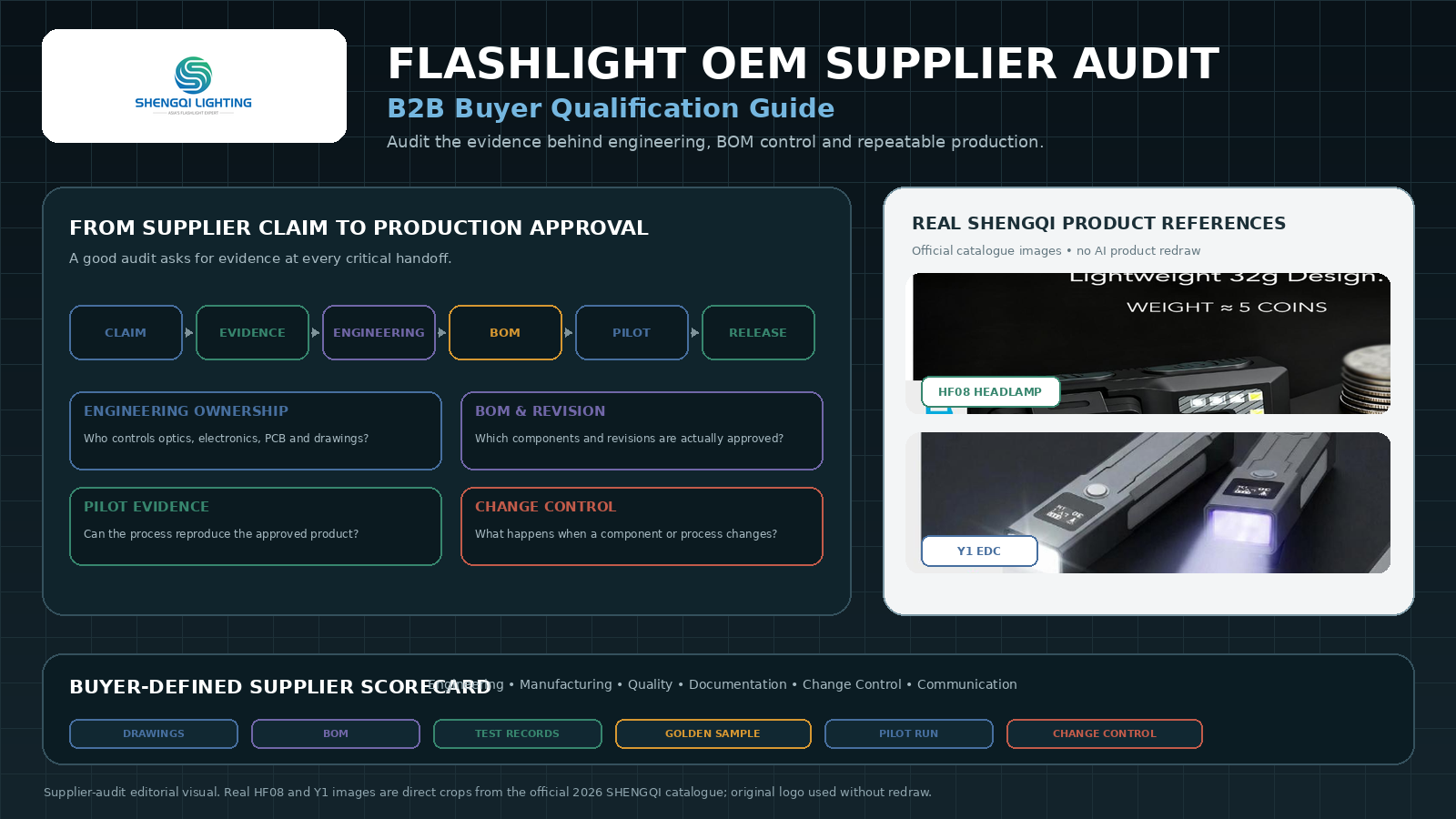

Why a Flashlight Supplier Audit Should Go Beyond the Factory Tour
IFA Global Markets provides a timely B2B sourcing context because its focus includes OEM, ODM, manufacturing, components, prototyping and scalable production. Buyers can use that same sourcing mindset when qualifying a headlamp or EDC supplier. IFA Global Markets is context here, not an endorsement or participation claim.
A factory tour can show machines, people, production lines and facility scale. It cannot by itself prove engineering quality, BOM control, firmware control, optical consistency, supplier management or mass-production repeatability. A factory tour shows what exists. An audit should determine how the system works.
Convert Every Supplier Claim Into an Evidence Question
The strongest audit habit is simple: CLAIM → EVIDENCE → PROJECT RELEVANCE → VERIFICATION. “We have optical engineering” should lead to: show how a beam requirement becomes an emitter, optic, prototype and production-verification decision. “We have strong quality control” should lead to: show the inspection plan, relevant test evidence and nonconformance process. “We support OEM/ODM” should lead to: which parts can your team actually design or modify?
| Supplier Claim | Evidence to Request | Buyer Question | Risk if Unverified |
|---|---|---|---|
| OEM Capability | Controlled customization example | What can be changed? | Scope misunderstood |
| ODM Capability | Development flow | What does engineering own? | Development gap |
| Industrial Design | Design process / controlled examples | Who creates the ID? | Styling without engineering |
| Optical Engineering | Specification + measurement example | How is the beam designed? | Equipment mistaken for design skill |
| Electronic Design | Circuit ownership / revision | Who defines the driver? | Unknown design ownership |
| PCB Development | PCB revision control | Who lays out the PCB? | Assembly mistaken for design |
| Firmware / UI | Version + behavior test | Which version is approved? | Silent behavior change |
| CNC Manufacturing | Drawing + inspection flow | Which dimensions are critical? | Machine count overvalued |
| SMT | PCB assembly controls | What is inspected? | Assembly defects |
| Assembly | Work instruction / process check | How is repeatability controlled? | Operator-dependent output |
| Testing | Method + result + sample ID | What requirement is tested? | Lab photo without evidence |
| Mass-Production QC | Inspection records / issue handling | How is production compared? | Sample-to-batch drift |
A Product Supplier and a Product-Development Supplier Are Not the Same Thing
An existing-platform supplier may be very effective for logo, color, packaging and minor configuration work. A development-capable OEM/ODM supplier may also support industrial design, optics, electronics, PCB, mechanical integration, prototype development, DFM and testing. The correct supplier depends on how much of the product the buyer needs to change.
Reviewing an existing headlamp product platform or EDC flashlight platform can be efficient when the required customization depth is limited.
Logo / Package / Color
Battery / Accessories / Existing Functions
PCB / Optics / Structure / UI
ID / Electronics / Optics / Mechanical Integration
Conceptual sourcing framework; not an industry-standard classification.
Who Owns Each Technical Decision?
Ask who selects the LED, defines the optic, designs the PCB, owns firmware, reviews mechanical interference, creates drawings and approves changes. Outsourcing a task is not automatically a problem. What matters is Responsibility + Control + Traceability.
How Buyers Can Audit Optical Engineering Capability
Do not stop at “Do you have an integrating sphere?” Audit the complete chain: Requirement → Emitter → Optic → Mechanical Position → Prototype → Measurement → Beam Review → Production Alignment. Ask how beam requirements are defined, emitters and reflector/TIR options are selected, focus is controlled and production changes are revalidated.
Measurement capability and design capability are related but different. Photometric equipment can measure a result. Engineering must interpret the result, change the design and control the new configuration.
Useful evidence can include a representative beam specification, photometric-report example, prototype comparison, beam photos as supplemental evidence, test method and sample revision. Evidence should be shared without exposing confidential customer information.
How Buyers Can Audit Electronics and PCB Capability
Audit circuit architecture, PCB layout, LED driver, charging, battery protection, indicators, sensing where applicable and firmware/control logic where applicable. “Can you make a PCB?” is too broad.
An SMT line demonstrates electronics manufacturing capability, but it does not automatically prove electronic-design capability. PCB design and PCB assembly are separate capabilities.
If the product uses an MCU, electronic UI or sensing, request firmware revision identification, approved behavior, test procedure and change process. “Software updated” is not enough; the buyer should know which version changed, why it changed and what requires re-verification.
Mechanical Capability Is More Than Owning CNC Machines
Audit CAD and drawing control, tolerance definition, component fit, battery packaging, switch placement, sealing architecture, thermal path, wire routing, assembly access and DFM. Machines manufacture geometry. Engineering decides what geometry should be manufactured and how consistently it must fit.
Not every dimension should receive an extremely tight tolerance. A mature supplier should explain which Critical-to-Quality dimensions matter most and why—for example, optic position, button fit, battery contact, thread interface or sealing surface where relevant to the design.
SHENGQI's confirmed manufacturing infrastructure includes 75 CNC machines. That supports manufacturing capacity; product-specific drawings, tolerances, inspection and process control determine the result. Buyers can review the broader flashlight manufacturing capabilities separately from engineering evidence.
A Supplier Audit Should Follow the Prototype Revision Trail
Sample A, B and C should not simply become “the new sample.” The audit should reveal Revision → Issue → Change → Result. A selected engineering sample can be useful during development, but later approval should include production-representative samples rather than permanently relying on the best hand-selected unit.
| Revision | Problem | Change | Evidence | Buyer Approval |
|---|---|---|---|---|
| A | Illustrative fit issue | Geometry revised | Inspection result | Open |
| B | Illustrative beam issue | Optic position revised | Beam comparison | Conditional |
| C | Issues closed | Controlled configuration | Verification record | Approved |
Illustrative prototype revision log only; not a SHENGQI customer project record.
BOM Control Is Where Many Supplier Risks Become Visible
A controlled BOM may cover the LED, battery, PCB, driver components, switch, optic, lens, gasket, spring, charging connector, material and finish depending on the product. Same model name does not guarantee the same product if the BOM is uncontrolled.
A component should not be substituted merely because it has the same size, lumen claim, mAh rating or appearance. LED, battery, switch, optic and electronic-component changes can affect performance, UI, thermal behavior, durability, certification scope or appearance.
An approved alternate component can be valid when it is predefined, evaluated and recorded. Controlled substitution and uncontrolled substitution are not the same thing.
Audit the Production Flow, Not Just the Equipment List
Follow the product through Material → Machining → Electronics → Assembly → Testing → Packaging. Not every process must be internal. Coating, specialist processes, components or packaging may be outsourced in mature supply chains. Audit approved suppliers, incoming inspection, specifications, change control and traceability rather than assuming outsourcing is automatically a defect.
SHENGQI's confirmed infrastructure includes an approximately 130,000 sq ft manufacturing facility, 75 CNC machines, one fully automated SMT line and eleven dust-free assembly lines. Manufacturing infrastructure demonstrates capacity and process scope; it does not replace product-specific engineering, inspection and verification.
Capacity Must Match the Actual Process
Annual capacity does not independently prove that a specific order can be delivered. Review line availability, process bottlenecks, critical outsourced processes, material dependency, assembly capacity and test capacity for the actual product.
“Good Quality” Is Not a Test Plan
A useful quality claim should become Requirement → Method → Equipment → Acceptance Criteria → Record → Action if Failed. Depending on the final product, verification may cover optics, battery, charging, discharge, temperature, impact, ingress, switching, dimensions and cosmetics. Verification scope must follow the final product requirement.
Buyers can request explanations or representative records for incoming inspection, in-process inspection, final inspection, testing, nonconformance handling, corrective action and change control, subject to commercial and confidentiality boundaries. Relevant flashlight testing and quality-control capabilities should be evaluated against the exact project.
The company operates under an ISO9001 quality management system. ISO9001 describes the management system; it does not independently prove the performance of a particular flashlight.
A Golden Sample Should Be Connected to Controlled Documentation
A golden sample should be linked to drawing revision, BOM revision, firmware where applicable, LED, battery, material, finish, logo, packaging and approved exceptions. The golden sample is not just the product the buyer liked most.
Pilot Production Shows Whether the Supplier Can Repeat the Product
Prototype: Can the design work? Pilot: Can the process reproduce it? Review assembly sequence, fixtures, operator access, yield issues, rework, cosmetic handling, testing, packaging, bottlenecks and consistency. The appropriate pilot quantity and acceptance criteria are project-specific.
A pilot run that reveals problems is not necessarily a failed pilot. If the supplier can identify, record, analyze, correct and verify the issue, the run provides useful process-learning evidence. The greater risk is an unrecorded problem that is informally “fixed” and followed immediately by mass production.
Supplier Qualification Is Incomplete Without Change Control
Production life may include an LED revision, battery supplier change, PCB-component shortage, coating supplier change, packaging revision or firmware update. Every change needs an impact decision, although not every change requires complete retesting.
Supplier Communication Is an Engineering Capability Too
A fast reply is not the same as good technical communication. Strong communication separates confirmed facts from assumptions, lists open issues, assigns ownership, identifies revisions, flags risks, records decisions and closes issues. A fast “yes” is less useful than a precise technical question.
“Yes, we can make it. Please send quantity.”
Clarifies application, market, beam, battery, UI, dimensions, branding, estimated quantity, timeline and verification requirements before confirming the architecture.
Price Comparison Requires Specification Alignment
If two quotations differ significantly, confirm they use the same BOM, battery, LED, material, finish, packaging, accessories, test scope, quantity and relevant commercial assumptions before calling one expensive and the other cheap.
Headlamp and EDC OEM/ODM Supplier Audit Matrix
| Audit Area | Evidence to Request | Buyer Question | Red Flag | Approval Basis |
|---|---|---|---|---|
| 1. Company Identity | Legal / factory information | Who contracts and manufactures? | Roles unclear | Identity verified |
| 2. Product Scope | Relevant product range | Does experience match the project? | Unrelated portfolio | Relevant capability |
| 3. OEM Capability | Customization flow | What can be changed? | Vague scope | Scope agreed |
| 4. ODM Capability | Development process | Who owns design? | No ownership | Responsibilities clear |
| 5. Industrial Design | Controlled design example | How is ID engineered? | Styling only | Design process clear |
| 6. Optical Engineering | Beam / test evidence | How is optics validated? | Equipment-only claim | Design + measurement |
| 7. Electronic Design | Circuit ownership | Who defines electronics? | Unknown owner | Revision controlled |
| 8. PCB / SMT | PCB + assembly control | Design or assembly? | Capabilities conflated | Both scopes clear |
| 9. Firmware / UI | Version + behavior test | Which version is approved? | Untracked update | Behavior frozen |
| 10. Mechanical Engineering | Drawings / CTQ dimensions | What dimensions matter? | No tolerance logic | CTQs defined |
| 11. Prototype Control | Revision log | What changed between samples? | No sample ID | Revision traceable |
| 12. BOM Control | BOM / alternate policy | How are substitutions approved? | Silent changes | BOM frozen |
| 13. Manufacturing | Process flow | Internal vs outsourced? | Control unclear | Process controlled |
| 14. Testing / Quality | Method / records | What is tested and when? | Generic claim | Criteria defined |
| 15. Golden Sample | Sample + linked revisions | What does approval cover? | Standalone sample | Documentation linked |
| 16. Pilot Production | Pilot / issue closure | Can process reproduce? | Problems informal | Issues closed |
| 17. Change Control | Change workflow | Who approves changes? | Silent release | Impact reviewed |
| 18. Packaging / Commercial Handover | Approved pack-out / quote basis | Is commercial scope aligned? | Quote mismatch | Release scope aligned |
OEM/ODM Supplier Qualification Scorecard
Buyer-Defined Scoring: Engineering · Manufacturing · Quality · Documentation · Change Control · Communication · Commercial Alignment. Buyers should set scoring and approval thresholds around their own project risk; this is not an industry-standard weighting system.
Seven Supplier Red Flags That Deserve a Follow-Up Question
01. Every Technical Question Gets an Immediate “Yes.” Speed can be useful, but complex questions should sometimes trigger technical clarification. Investigate whether the answer is based on engineering review or sales optimism.
02. Samples Have No Revision Identification. Without revision identity, it becomes difficult to know what changed or what was approved.
03. The Supplier Cannot Explain Who Owns the PCB or Firmware. Outsourcing may be acceptable, but responsibility and change control must be clear.
04. The BOM Changes Without Buyer Notification. Equivalent-looking components may affect performance or compliance scope.
05. Factory Capability Claims Have No Project-Level Evidence. Machines and laboratories should connect to the actual product requirement.
06. Golden Sample Approval Is Not Linked to Documentation. A physical reference alone cannot control future component or firmware changes.
07. Pilot Problems Are Fixed Informally Without a Closed Issue Record. Informal correction makes recurrence difficult to control. Red flag means investigate further, not automatic rejection.
Five Things That Should Not Decide the Supplier Alone
1. Lowest Unit Price. Price matters, but only after specification alignment. 2. Largest Factory. Scale can support capacity but does not prove project control. 3. Biggest Catalog. Selection is valuable but does not prove development depth. 4. Fastest “Yes.” Responsiveness matters, but accurate questions may be more valuable. 5. Best-Looking Sample. Appearance matters, but the sample must be reproducible.
Three Supplier Types
Type A — Catalog / Trading-Focused Supplier: useful for speed, existing products and selection. Type B — Manufacturing-Focused Supplier: useful when production execution is the main need. Type C — Development-Oriented OEM/ODM Supplier: useful when engineering, customization, prototypes and integration are required. Different sourcing projects may need different supplier types. A trading company is not automatically bad, and a factory is not automatically good. Supplier structure matters less than clarity of responsibility and control.
Buyers reviewing alternative product architectures can use the portable lighting product range as product-discovery context rather than as proof of development depth.
Supplier Qualification Levels
Conceptual Buyer Framework — not an industry certification.
If an on-site audit is not immediately possible, a structured video review can screen production areas, test equipment, engineering communication, sample revisions and selected documents. Remote review is a screening tool, not always a substitute for an on-site or independent third-party audit where the buyer's risk policy requires one.
Twenty Questions Buyers Should Ask a Headlamp or EDC OEM/ODM Supplier
1. Which parts of this product can your team design internally? Separate platform customization from new engineering work.
2. Who owns optical engineering? Identify who converts beam requirements into emitter, optic and validation decisions.
3. Who owns electronic design and PCB layout? Confirm whether design and assembly responsibilities are separate.
4. Who controls firmware if the product uses it? Require version identification and behavior ownership.
5. How are mechanical drawings created and revised? Review revision and approval control.
6. How do you identify prototype revisions? Each sample should connect to documented changes.
7. How is the approved BOM controlled? Identify core components and approved alternates.
8. What happens when an approved component becomes unavailable? Look for impact review rather than silent substitution.
9. Which production processes are internal and which are outsourced? Understand the complete process chain.
10. How are outsourced processes controlled? Review approved suppliers, specifications and incoming verification.
11. How are critical dimensions defined and inspected? Look for CTQ logic rather than uniformly tight tolerances.
12. How is beam or optical consistency verified? Connect prototype approval to production alignment.
13. What test evidence can be provided for this specific project? Ask for project-relevant records, not unrelated certificates.
14. How is the golden sample tied to drawings and BOM? Physical approval should connect to documentation.
15. What does the pilot run need to prove? Define process questions before the run starts.
16. How are production issues recorded and closed? Look for root cause, action and verification.
17. How are engineering changes communicated to the buyer? Confirm approval authority and impact review.
18. How do you ensure mass-production units match the approved sample? Review inspection, sampling and configuration control.
19. What information is needed before providing a reliable quotation? A mature answer should ask for specification alignment.
20. Who is responsible for technical communication throughout the project? The buyer should know who owns open issues and decisions.
What Should a Supplier Qualification Evidence Pack Contain?
Depending on project depth, an evidence pack may include Company / Factory Information, Capability Scope, Representative Development Flow, controlled drawing examples, Prototype Revision Record, BOM Control Example, Test / Inspection Example, Golden Sample Definition, Pilot / Issue-Closure Example and Change-Control Process. Examples should protect other customers' confidential information. Buyers do not need another customer's complete drawings to understand whether a control system exists.
How Buyers Should Qualify an OEM/ODM Supplier Before Mass Production
A practical qualification sequence may follow: 1. Define Project Requirement → 2. Review Supplier Capability → 3. Convert Claims to Evidence → 4. Technical Review → 5. Prototype → 6. Verification → 7. BOM / Revision Freeze → 8. Golden Sample → 9. Pilot Production → 10. Production Approval → 11. Change-Control Agreement. Individual projects may combine or adapt these stages.
When evaluating a development-oriented supplier, buyers may look for connected capabilities across industrial design, optics, electronics, PCB development, manufacturing and verification. SHENGQI supports these areas for portable-lighting OEM/ODM flashlight development.
Frequently Asked Questions About Flashlight OEM/ODM Supplier Audits
1. How should buyers evaluate a flashlight OEM/ODM supplier?
Evaluate claims through project-relevant evidence: engineering ownership, controlled drawings, prototype revisions, BOM control, test records, pilot-production results and change control. Factory size and sample appearance can support the review, but approval should depend on whether the supplier can reproduce the agreed product consistently.
2. What is the difference between OEM and ODM capability?
OEM work often starts from an existing platform and defined customization, while deeper ODM work can include industrial design, optics, electronics, PCB, mechanical integration and development verification. The better option depends on how much of the product the buyer needs to change.
3. Does a large factory automatically mean better flashlight quality?
No. A large facility can provide useful capacity and process scope, but quality depends on product definition, engineering, BOM control, process control, inspection, verification and corrective action. Machine count should be evaluated as part of the production system rather than as a standalone quality claim.
4. Why is BOM control important when sourcing flashlights?
BOM control protects component consistency between approved samples and production. LED, battery, optic, switch or PCB-component substitutions can alter performance, UI, thermal behavior or compliance scope. Changes should therefore follow documented review and approval rather than being introduced without buyer visibility.
5. What should a golden sample include?
A golden sample should be connected to the approved drawing revision, BOM, firmware where applicable, material, finish, key components, logo, packaging and any approved exceptions. It should function as a controlled production reference, not simply the sample the buyer preferred visually.
6. Why should buyers review pilot production before mass production?
A prototype shows that the design can work; a pilot helps show whether the intended process can reproduce it. Buyers can review assembly, fixtures, defects, rework, testing, packaging and issue closure before larger-scale production is released.
7. What supplier red flags deserve additional investigation?
Examples include untracked sample revisions, unclear PCB or firmware ownership, silent BOM changes, capability claims without project evidence, an undocumented golden sample or pilot problems closed informally. A red flag is a reason to investigate further, not an automatic reason to reject the supplier.
8. What should brands send when requesting an OEM/ODM flashlight quotation?
Provide product type, target market, application, customization depth, technical requirements, estimated quantity, packaging and accessory requirements, verification expectations and target timeline. A more controlled RFQ helps suppliers quote comparable specifications and reduces misleading price differences caused by different assumptions.
Evidence-Based Sourcing Reduces Uncertainty Before Scale
The strongest supplier is not necessarily the one that makes the most claims, owns the most machines or submits the lowest first quotation. For an OEM/ODM flashlight project, supplier confidence should grow as assumptions are replaced by controlled drawings, verified samples, stable BOMs, documented tests, pilot-production evidence and a clear change-control process. Supplier audit is not about finding reasons to reject factories. It is about reducing uncertainty before committing to scale.
Coming Soon: Shengqi Lighting is preparing to introduce a new Premium Tactical Flashlight. Full specifications and official product information will be released soon.
Evaluating an OEM/ODM Partner for Your Next Headlamp or EDC Project?
For the first technical review, prepare your Product Type, Target Market, Application, Required Customization Depth, Key Technical Requirements, Estimated Quantity, Verification Requirements and Target Timeline.
Review SHENGQI LIGHTING's custom flashlight development capabilities or continue to the project contact page.
Contact SHENGQI LIGHTING for an OEM/ODM technical evaluation at sales@shengqilight.com.
Contact SHENGQI LIGHTING